13/01/2012

Kenya general elections in March 2013 - unless coalition is dissolved

A Kenyan court just ruled general elections should be held in March 2013, unless the current coalition is dissolved...

MP for Gichugu Constituency and Presidential Candidate for Kenya 2012 Martha Karua reacted on Twitter this afternoon:

"I totally disagree with the courts ruling. Term of office must include the election period and that's the interpretation world over".

Accordint to the  the Chair of the Parliamentary Constitution Implementation Oversight Committee, Mandera Central MP Abdikadir Mohammed, as the current Parliament was elected on December 27, 2007 and the constitution states it must serve its full term, the next elections must be held in December 2012...

But it is also well known that the National Assembly did not meet after the last general election until 15 January 2008. Its life therefore expires on 15 January 2013, precluding a December 2012 election, according to Yash Pal Ghai, director with Katiba Institute, and scholar in constitutional law.

The section 9 of the Sixth Schedule says that the first general elections under the new constitution shall be held within “sixty days after the dissolution of the National Assembly at the end of its term”. This means that the next elections could be delayed as late as 15 March 2013, according to him, though there would be no need to postpone the elections until then (The Star, 6 November 2011).

12/01/2012

Kenya: Security Forces Abusing Civilians Near Somalia Border (HRW)

Kenya: Security Forces Abusing Civilians Near Somalia Border
‘There Are No Human Rights Here,’ Military Officer States


Human Rights Watch reports:

(Garissa, January 12, 2012) – The Kenyan security forces are beating and arbitrarily detaining citizens and Somali refugees in Kenya’s North Eastern province, which borders on Somalia, despite repeated pledges to stop such abuses, Human Rights Watch said today.

On January 11, 2012, in the latest of a series of incidents documented by Human Rights Watch since October 2011, security forces rounded up and beat residents of Garissa, the provincial capital, in an open field within the enclosure of the local military camp. A Human Rights Watch researcher witnessed the incident.

“When military officers can beat civilians in broad daylight without fearing repercussions, it’s clear that impunity has become the norm,” said Daniel Bekele, Africa director at Human Rights Watch. “Repeated promises by both the police and the military to stop these abuses and investigate have amounted to nothing.”

The Kenyan police and military have been responsible for a growing number of serious abuses against civilians since the Kenya Defence Forces entered southern Somalia in October, with the stated aim of eliminating al-Shabaab, an Islamist militia. The same month, suspected al-Shabaab sympathizers initiated a series of attacks against police, military, and civilian targets in Kenya.

In response, members of the security forces have been responsible for rape, beatings, looting, and arbitrary arrests of civilians. The crackdown has largely targeted Somali refugees and Kenyan ethnic Somalis, but residents of other ethnic backgrounds in North Eastern province have also been victimized.

The incident in Garissa on January 11 involved Kenyan citizens who told Human Rights Watch that they had been arbitrarily detained by the military. One of them, Ali Ibrahim Hilole, was at a shop across from the military camp buying items for a hospitalized relative when a military officer said to him: “Why are you standing here? So you’re al-Shabaab.” Soldiers forced him to accompany them to the camp, where they kicked him and told him to roll around on the ground.

Yusuf Khalif Mohamed, a long distance truck driver, stopped in Garissa for a soft drink on his way from Mombasa to Dadaab, where he was to make a food delivery for UNICEF. He parked his truck near the military camp, not knowing that parking was prohibited there. A military officer forced him to come to the camp, where soldiers threw a 20-liter container of water on him, forced him to roll on the ground, kicked him on the side, and hit him on the head with the butt of a gun. Mohamed told Human Rights Watch that one of them said, “I think you are al-Shabaab. You are bothering us in Somalia, and now you’ve come to bother us here.”

Both men, along with at least five to seven others who were similarly detained and mistreated – most of them truck drivers, and all of them Kenyan citizens – were released after 30 minutes. They were not interrogated or charged with any crime.

A Human Rights Watch researcher who attempted to visit the military camp to speak to the officer in charge witnessed soldiers forcing several men to lie down in the dirt and forcing another man to frog-jump across the field and to assume various gymnastic positions. Military personnel refused entry to Human Rights Watch, one of them stating, “There are no human rights here.”

The military spokesperson, Maj. Emmanuel Chirchir, said by phone from Nairobi that the people held at the military camp were being questioned because they had tried to build an illegal structure to sell things outside the camp. Chirchir said he did not have knowledge of any abuses, but assured Human Rights Watch that the military would investigate the allegations.

The events in Garissa follow a series of human rights violations by security forces against ethnic Somalis and others. On November 11, soldiers in Garissa rounded up ethnic Somalis arbitrarily on the basis of their appearance, beat them, and forced them to sit in dirty water while interrogating them.

On November 24, following two grenade attacks on civilian targets in Garissa and an improvised explosive device (IED) attack on a military convoy in Mandera, police and soldiers rounded up hundreds of suspects in both towns. Some were beaten so severely that they suffered broken limbs. In the days following the attacks, suspects were arrested at random. Human Rights Watch interviewed some who were taken to Garissa military camp and forced to do humiliating exercises, such as standing on their heads, and were beaten if they could not comply.

Explosions in the town of Wajir in early December were also followed by arbitrary arrests and beatings. A local activist in Wajir told Human Rights Watch that after an IED went off on December 12, injuring an intelligence officer and several others, police and soldiers rounded up and beat ethnic Somalis over the next three days.

“They criminalize all Somali people,” he said. “Whenever a crime is committed, detaining and torturing people doesn’t seem like a good security strategy. It is creating a barrier between the people and the security forces.”

The worst abuses took place at Dadaab, home to over 460,000 mostly Somali refugees. A police officer was killed by an IED at Dadaab on December 5, leading to arbitrary arrests of those in the vicinity. After further explosions targeting police vehicles on December 19 and 20, one of them killing a police officer, police reacted angrily, beating refugees, and, in several cases, raping women. The chair of the Supreme Council of Muslims of Kenya, which conducted investigations in the camps, said that Kenyan police raped at least seven women following the explosions. Other victims suffered broken limbs.

A Garissa-based organization, Citizen Rights Watch, found that on the same occasion police looted dozens of shops, stealing over 27 million Kenyan shillings (US$310,000) worth of property and money that refugee traders stored in their shops.

Garissa residents interviewed by Human Rights Watch complained that police have not conducted thorough investigations to identify the actual perpetrators of either the initial attacks or the subsequent abuses by the security forces.

“Kenya’s security forces are rightly concerned about attacks by suspected al-Shabaab members, and should be doing more, not less, to identify the attackers,” Bekele said. “But beating, raping, and humiliating innocent Kenyan citizens and Somali refugees accomplishes nothing. Those in the security forces who are responsible for these abuses should be investigated and prosecuted.”

10/01/2012

BACK IN NAIROBI


So here I am, back in East Africa!

It's sunny and warm and friendly and I'm gently preparing work for a few feature stories for radio and TV from my favourite coffee place...


I plan to meet some fashion designers, some human rights workers, some painters, some charity doctors and maybe to report in Tatu, the brand new city being built in the suburbs of Nairobi.

I'm also working on human rights in Kenya and on the place of charities and the UN in the development of the capital.

If you're interested in these topics, feel free to get in touch!

More soon...


06/01/2012

A lovely first week of January in London... My choices and addresses

1. Wandering in Central London:

And taking some time to go to the best travel bookstore :

Stanfords has every book a traveller needs, from travel guides to travel literature, not forgetting detailed road maps from anywhere in the world and lovely notebooks...

http://www.stanfords.co.uk/?gclid=CL-J8-nMua0CFWIntAod_B6R5Q


2. Enjoying an afternoon break after a work meeting : 

at the new Counter at The Delaunay on Aldwych. The brand new cafe illuminates the neighbourhood and brings some Vienna/Berlin 1920s atmosphere in town, also some delicious pastries from Central Europe traditions (From Chocolaty Sacher Torte to mille feuille and cheesecake Austrian style).

http://www.thedelaunay.com/counter


3. Fun circus-atmosphere in North London:

Going to see 'La Soiree' from La Clique on Friday evening. It's at 10pm in the Roundhouse in Chalk Farm, check more here:

http://roundhouse.org.uk/whats-on/productions/la-soiree

The joy of having a social life again!!!


4. Trying the brand new North African style lunch in town :

In Del'Aziz version Swiss Cottage...
Passing its lush window in Clapham, I couldn't help but stopping: Attractive presentation, appealing Berber-Arabic style, mouth-watering cakes and salads, lovely decoration, space and cosiness. In a word, perfection from the Atlas...
Not being a big fan of South London, I'm going to try the one in Swiss Cottage but there are already five other locations all around London.

http://www.delaziz.co.uk/locations.php#swisscottage

or

http://www.delaziz.co.uk/


5. Checking the hot exhibitions in town:

This weekend it will be the last chance to see the 'Building the Revolution: Soviet Art and Architecture 1915-1935' at the Royal Academy...

http://www.royalacademy.org.uk/exhibitions/building-the-revolution/

29 October 2011—22 January 2012 
In the Sackler Wing of Galleries

This exhibition examines Russian avant-garde architecture made during a brief but intense period of design and construction that took place from c.1922 to 1935. Fired by the Constructivist art that emerged in Russia from c.1915, architects transformed this radical artistic language into three dimensions, creating structures whose innovative style embodied the energy and optimism of the new Soviet Socialist state.

It's also the perfect timing to enjoy 'Grayson Perry, The Tomb of the Unknown Craftsman' at the British Museum...

http://www.britishmuseum.org/whats_on/exhibitions/grayson_perry.aspx

Where 'Grayson Perry curates an installation of his new works alongside objects made by unknown men and women throughout history from the British Museum’s collection'.

...And still early enough to be among the first to catch Gesamtkunstwerk: New Art From Germany,
until Sun Apr 29, at the Saatchi Gallery (Duke of York's HQ, King's Rd, London, SW3 4SQ)

http://www.saatchi-gallery.co.uk/artists/germany_art/

Since Gerhard Richter is stealing all the attraction this year with the rocking exhibition at the Tate Modern, prepared teamed up with Pompidou in Paris and the Neue Galerie in Berlin, German art is more than ever on the frontline...

--

I'll finish with a dinner in Stoke Newington and some sushis in Soho.
Then, it will be time for me to leave the continent... Africa's calling!

Enjoy!

04/01/2012

LITTLE EUROPEAN WINTER TOUR

The end of the year is a time to come home. The beginning is one to explore new territories. At least, that has been my pattern for a while.

This year, still being based in London, it was way easier that in 2010 to reach Paris for Christmas. No snow, no cold, no train cancelled nor closed airport...

Paris was simple adorable this Christmas, sunny for a couple of day, quiet as a lot of French people had left the capital for some holdiday, cultural as usual.


My main choice for arts this December has been the Evard Munch exhibition in Centre Pompidou:

http://www.centrepompidou.fr/Pompidou/Manifs.nsf/AllExpositions/B7B16198B955CF3BC1257824003508B8?OpenDocument&sessionM=2.2.1&L=1

A gigantic retrospective of the work f the Norvegian master, dedicated to his modern side, the artist of the 20th Century more thant th 19th, from his passion for photography and cinema to his experimentations about the vision, in the end of his live.

-

I named this Christmas a 'Yellow Christmas' because of the mild weather and the sunny day around the 25th and the 26th... And frankly, I'm always very releaved to avoid any 'white' holiday. The sun was shining over the Canal when I walked along it and it was also there in Berlin, when I arrived, a few days later, in the German capital.


Berlin seemed a bit changed since my last visit in 2007. More settled, more wealthy. Especially the well-know neighbourhoods of Prenzlauer Berg and Kreuzberg.


But what is definitely still there is this feeling of idleness, of a city where most people have so much time on their hands, enjoying all-day-breakfasts for cheap money, or never-endingly preparing their next exhibition, or play, or whatever.

Coming form London, it seems almost hard to believe and a bit disturbing. Coming from 2011, a year that was so busy and changing and dangerous and exhausting, it was more of a well-desserved relief!

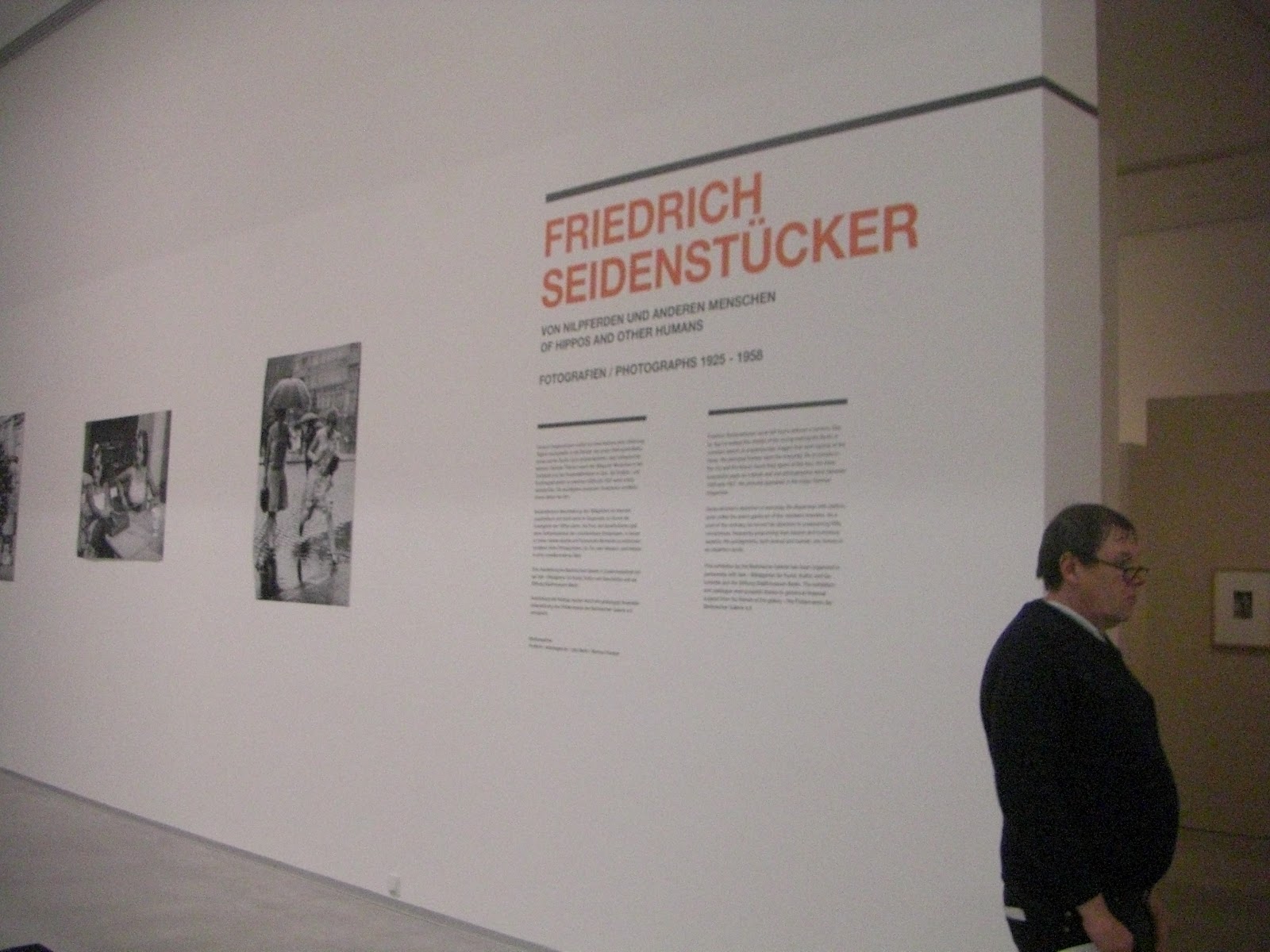
Art highlight: The Berlinische Galerie, in Mitte, where some paintings from the late 19th century sit next to oils from the 20th, and two photography exhibition a currently being displayed.


The location itself is really appealing, wide space, modern, pretty central...


The exhibitions show the phtographies of the German photographer Friedrich Seidenstücker and the Hungarian one Eva Besnyös (1910-2003)and both give a great insight into the 1920s and 30s...

It seemed to be the theme of this trip anyway... After our lovely New Year Eve's party in the 1920s. Felt like we were in the lastest Woody Allen movie, a sort of 'Midnight in Berlin' version, where I even met a man from the Twenties, a German man speaking a perfect English. Only in dreams...

Go to Berlin folks!


--

Berlinische Galerie
Landesmuseum für Moderne
Kunst, Fotografie und Architektur
Stiftung Öffentlichen Rechts

Alte Jakobstraße 124-128
10969 Berlin Germany
www.berlinischegalerie.de

21/12/2011

Algérie 2012

Algérie : les élections législatives auront lieu au printemps 2012 

Par RFI
 
Le calendrier électoral algérien se précise. Dimanche 18 décembre 2011, en Conseil des ministres, le président Bouteflika a annoncé que les élections législatives se tiendraient au cours du printemps prochain. Des élections qui seront donc organisées trois mois avant l’expiration du mandat de l’actuelle législature. Le président algérien a assuré qu'il fera appel aux observateurs internationaux pour surveiller le scrutin.

Les prochaines législatives se tiendront-elles au mois de mai ou bien, dés février, comme l'a récemment laissé entendre le Premier ministre algérien ? La date n'a pas encore été révélée.

Mais au cours de ce Conseil des ministres dominical, le président Bouteflika a indiqué que le corps électoral sera convoqué dés la fin de cette session parlementaire. Le président algérien a souhaité que le scrutin se tienne dans une pluralité sans précédent « avec la participation d'une classe politique renforcée ».

Le chef de l'Etat a promis par ailleurs la présence des observateurs internationaux. Des démarches vont être engagées sans délais auprès de la Ligue arabe, de l'UA (Union africaine) de l'OCI (Organisation de la coopération islamique), de l'Union européenne et des Nations unies, afin que ces organisations puissent dépêcher de façon significative leurs observateurs.

Plusieurs partis algériens comme le RCD (Rassemblement pour la culture et la démocratie) et le FFS (Front des forces socialistes) ont récemment conditionné leur participation à ce scrutin à la présence d'observateurs internationaux. Des partis politiques algériens qui ont tous entamé les préparatifs pour cette prochaine échéance. Les islamistes modérés du MSP (Mouvement de la société pour la paix) appellent les formations de la même mouvance à une alliance pour profiter de la dynamique islamiste constatée dans les pays voisins.

Le président Bouteflika a par ailleurs confirmé qu’il y aura bien une révision constitutionnelle via le Parlement, comme il l'avait promis en avril dernier, en réponse à une vague de protestation et d'émeutes dans le pays au début de l'année.

2011... 2012

2011 is almost over. What a year.

Time flies, but it's not surprising with such a busy world!

Last year at the same time, the uprising began in Tunisia. I remember, I was in Nairobi at the time and a few journalists and I were watching the events on the news networks, and could never have imagined how far it would go!

A month later, I was covering the elections in Uganda when the 'revolution' broke in Libya too.

Now the longlasting leaders of North Africa are gone, Ben Ali, Mubarak, Gadhafi.

2012 is near and it has to upclass this amazing surprising year.

I am on my way to travel again and to try to follow the news in some of the countries where I have travelled to in 2011 and before.

This will have to include Kenya (soon I hope and in August for the elections), Algeria, France and the USA. These four countries will hold major elections in 2012. Let's hope they all bring some more democracy where it's necessary...

See you in 2012.

13/12/2011

Notre journal Afrique - Mardi 13 decembre 2011


A la une de actualité africaine de ce mardi:
 http://www.voxafrica.com/info/video//?v=0_mhvhe10w

Tunisie : Moncef Marzouki élu à la présidence 

Son parti, Congrès pour la République (CPR) est arrivé troisième à l’élection de l'Assemblée constituante en octobre dernier. Le nouveau Président tunisien est un farouche opposant de l’ancien président Ben Ali.

Côte d'Ivoire : Le Parti de Gbagbo affirme être majoritaire 

Les Ivoiriens ont été peu nombreux à voter lors des législatives du 11 decembre. Le FPI - ex-parti au pouvoir - avait appelé ses partisans à s'abtenir pour protester contre le transfèrement de leur dirigeant. Laurent Gbagbo a ete transferé à la Haye, à la CPI, le 29 decembre dernier. Reportage de Mah Camara.

RDC : L’opposition a déposé un recours mais Kabila confirme sa réélection

Le Président congolais a reconnu que le scrutin n'avait pas été parfaitement exempt d'erreurs, mais nie toute accusation de fraudes. Selon lui, ces erreurs ne sont pas de nature à invalider les résultats du scrutin. Mais dans le pays, c’est loin d’être l’avis de tout le monde. L’opposition reste unie derrière Etienne Tshisekedi. Vital Kamerhe est allé lui-même déposer le dossier à la Cour suprême lundi.

--

Le lien pour la vidéo : http://www.voxafrica.com/info/video//?v=0_mhvhe10w

Voxnews - 20.30 - 12/12/2011

Le lien : http://www.voxafrica.com/vod/videos/?v=0_ppsalo87&p=1

A la une ce lundi soir :


1. Côte d'Ivoire : Premiers résultats et faible participation

La commission électorale régionale - la CEI - a proclamé les résultats des législatives pour la commune de Yamoussoukro et le rassemblement démocratique des républicain, le RDR, avec a sa tête le gouverneur du district Augustin Thiam a remporté ces élections avec un pourcentage de 42,10 %.


2. RDC : Victoire contestée de Joseph Kabila

Kabila reconnaît des erreurs, mais mineures. L'opposant Étienne Tshisekedi veut déposer plainte auprès de la Cour suprême.

3. Syrie : Elections municipales test

Les Syriens se sont rendus aux urnes ce lundi pour élire leurs représentants municipaux. Il s'agit du premier scrutin organisé depuis le début du mouvement de contestation sans précédent contre le régime du président Bachar al-Assad le 15 mars.

Le lien : http://www.voxafrica.com/vod/videos/?v=0_ppsalo87&p=1


12/12/2011

Voxnews - 12h30 - 12/12/2011

http://www.voxafrica.com/vod/videos/?v=0_riaddy2n&p=1


Elections législatives en Côte d'Ivoire : Faible participation dans la capitale

C'est la première fois depuis onze ans que les électeurs ivoiriens élisent leur Parlement. La campagne a été relativement calme. Environ 5,7 millions d'inscrits etaient appelés aux urnes pour ce vote à un tour. En lice à Yamoussoukro : le gouverneur Augustin Thiam, petit-fils de Félix Houphouet-Boigny, pour le RDR.
Elections législatives en Côte d'Ivoire : Enjeux à Abidjan

En lice à Abidjan, dans le quartier de Koumassi : l'actuel président de l'Assemblée nationale Mamadou Koulibaly, ancien du FPI qui dirige à présent le LIDER, ainsi que Ibrahim Cissé Bakongo, le Ministre de l'Enseignement supérieur RDR et le maire PDCI Raymond N'Dohi Yapi. Reportage.

RDC : La majorité satisfaite de la réélection de Joseph Kabila

En RDC, l'annonce de la réélection de Joseph Kabila, vendredi soir, a été suivie de violences, les autorités ont fait état de quatre personnes tuées par les forces de l'ordre. La majorité présidentielle se dit satisfaite de cette réélection de son candidat. Cherubin Okende, coordonnateur de la communication de la majorité, est au micro de notre correspondant à Kinshasa, Alex kathy Katayi.

Rwanda / Jamaïque : Succès d'un film sur le génocide 

Le réalisateur d'origine jamaicaine Alrick Brown revisite le thème du génocide au Rwanda dans son dernier film ‘ Kinyarwanda’. Il a déja été primé au Festival du Film de Sundance aux Etats-Unis.