24/01/2012

Nairobi - London

I'm back in the UK but my mind is definitely still in Kenya and East Africa.

I have spent two very inspirational weeks in Nairobi doing a few interviews and some filming while researching for more stories to cover for the French and UK press and this region really inspires me.

I hope to be back as soon as possible and want to thank all the people who helped so much!

See you soon Kenya.


23/01/2012

The ICC confirms the charges against 4 of the 6 Kenyan suspects

Kenya / ICC decision (The Hague, Netherlands):  


The International Criminal Court has started its live webstreaming of its decision about Kenyafrom 1.30pm (Kenyan time). 

The ICC has decided to confirm the charges against 4 of the 6 Kenyans accused in the postelectoral violence of 2007/08.


According o the Hague Judge Trendafilova, the Chamber by majority decided to confirm charges against these four of the six suspects.

The four are Wiliam Ruto, Uhuru Kenyatta, Joshua Sang and Francis Muthaura.

Henry Kosgey and Hussein Ali won't be prosecuted.

According to the Daily Nation, following live the ICC statement, The chamber found substantial ground to believe there was an attack against civilian residents in Nakuru and Naivasha, in particular those belonging to Lus, Luhya and Kalenjin tribes.

21/01/2012

Somalia Incursion Reaches Halfway Point? (Bloomberg)

Kenya’s Military Says Somalia Incursion Reaches Halfway Point


Kenya’s military said its battle to crush an al Qaeda-linked insurgency in southern Somalia has reached the halfway mark and said its forces struck several command centers and logistic facilities operated by the al- Shabaab group.

“The war is almost half lost; al-Shabaab is now facing serious challenges as far as command and control is concerned and logistical support,” Colonel Cyrus Oguna, an army spokesman, told reporters in Kenya’s capital, Nairobi, today. “It will not take a very long time before al-Shabaab is completely buried.”

In October, Kenyan troops entered Somalia saying they were pursuing al-Shabaab and securing the country’s borders and have since intensified attacks against the group’s bases. The incursion came after several foreign tourists and aid workers were murdered and abducted on Kenyan territory. Kenya blames al- Shabaab for the attacks, a charge the militants have denied.

Oguna said that in the past week, Kenyan forces have destroyed four of al-Shabaab’s organizational camps, some in the areas of Jilib and Bibi. Information about the fighting cannot be independently verified and the two sides’ version of events generally conflict.

Kenya may know by mid-February whether the United Nations will permit its soldiers to “re-hat” under the African Union Mission in Somalia, which is mandated by the UN, Lindsay Kiptiness, a Foreign Affairs Ministry spokesman, said today.

Al-Shabaab has been battling Somalia’s western-backed government for five years and controls most of the southern and central regions. Somalia has had no effective central government since the downfall of dictator Mohamed Siad Barre two decades ago.


20/01/2012

ICC: Decisions on the confirmation of charges in Kenya on 23 January

Media Advisory

Kenya situation: Decisions on the confirmation of charges to be issued on 23 January

Situation: The Republic of Kenya
Cases:    The Prosecutor v. William Samoei Ruto, Henry Kiprono Kosgey and Joshua Arap Sang
The Prosecutor v. Francis Kirimi Muthaura, Uhuru Muigai Kenyatta and Mohammed Hussein Ali

On Monday, 23 January 2012, Pre-Trial Chamber II of the International Criminal Court (ICC) will issue its decisions to confirm or decline to confirm the charges in the case of The Prosecutor v. William Samoei Ruto, Henry Kiprono Kosgey and Joshua Arap Sang and in the case of The Prosecutor v. Francis Kirimi Muthaura, Uhuru Muigai Kenyatta and Mohammed Hussein Ali. The confirmation of charges hearings in these two cases were held from 1 to 8 September 2011 and from 21 September to 5 October 2011, respectively.

The decisions will be notified in writing to the parties and participants in both cases. Thereafter, the Judges of Pre-Trial Chamber II will appear publicly in Courtroom I at 11:30 (The Hague time) for the sole purpose of informing the public about the outcome of their decisions. Neither the parties nor the participants will be present in the Courtroom during this public appearance.

19/01/2012

MSF has closed its largest medical centres in Mogadishu

Press release -
MSF CLOSES ITS LARGEST MEDICAL CENTRES IN MOGADISHU AFTER KILLINGS

 Other projects in Somalia continue, but MSF medical assistance in Somali capital reduced by half
 
19th January 2012 - Following the tragic killings of our colleagues Philippe Havet and Dr. Karel Keiluhu in Mogadishu, Somalia, on the 29th of December 2011, the medical humanitarian organization Medecins Sans Frontieres (MSF) sees itself forced to end all activities in the Hodan district of the capital, including the closure of two separate 120-bed medical facilities for the treatment of malnutrition, measles and the treatment of cholera.
 
The closure of activities in this district halves the assistance MSF is providing in Mogadishu . For now, MSF projects will continue to provide medical care in the other districts of the capital, as well as in 10 locations in the rest of Somalia .
 
However, the continuation of MSF work to assist Somalis in need of medical care is dependent upon the respect for personnel, patients and medical facilities. Where these conditions prevail, MSF remains committed to continue its activities in Somalia .
 
“It is hard to close health services in a location where the presence of our medical teams is genuinely life-saving everyday,” states Christopher Stokes, MSF General Director, “but the brutal assassination of our colleagues in Hodan makes it impossible for us to continue working in this district of Mogadishu.”
 
In Hodan, MSF has been assisting 200,000 Somalis who had fled to the capital in recent months. Since August 2011, treatment has been provided to 11,787 malnourished children, 1,232 patients for acute watery diarrhea and 861 measles patients. MSF teams have also vaccinated 67,228 children against measles.
 
MSF strongly reiterates its call to all parties, the leadership and the people of Somalia to facilitate the safe release of Montserrat Serra and Blanca Thiebaut, MSF aid workers who were abducted in Dadaab refugee camp in Kenya on 13 October 2011 while carrying out emergency assistance for the Somali population.
 
 
MSF has been working in Somalia continuously since 1991 and currently operates 13 projects in the country, including medical activities related to the ongoing emergency, vaccination campaigns, as well as nutritional interventions. MSF also assists Somali refugees in camps in Dadaab, Kenya, and Dolo Ado, Ethiopia .

13/01/2012

Kenya general elections in March 2013 - unless coalition is dissolved

A Kenyan court just ruled general elections should be held in March 2013, unless the current coalition is dissolved...

MP for Gichugu Constituency and Presidential Candidate for Kenya 2012 Martha Karua reacted on Twitter this afternoon:

"I totally disagree with the courts ruling. Term of office must include the election period and that's the interpretation world over".

Accordint to the  the Chair of the Parliamentary Constitution Implementation Oversight Committee, Mandera Central MP Abdikadir Mohammed, as the current Parliament was elected on December 27, 2007 and the constitution states it must serve its full term, the next elections must be held in December 2012...

But it is also well known that the National Assembly did not meet after the last general election until 15 January 2008. Its life therefore expires on 15 January 2013, precluding a December 2012 election, according to Yash Pal Ghai, director with Katiba Institute, and scholar in constitutional law.

The section 9 of the Sixth Schedule says that the first general elections under the new constitution shall be held within “sixty days after the dissolution of the National Assembly at the end of its term”. This means that the next elections could be delayed as late as 15 March 2013, according to him, though there would be no need to postpone the elections until then (The Star, 6 November 2011).

12/01/2012

Kenya: Security Forces Abusing Civilians Near Somalia Border (HRW)

Kenya: Security Forces Abusing Civilians Near Somalia Border
‘There Are No Human Rights Here,’ Military Officer States


Human Rights Watch reports:

(Garissa, January 12, 2012) – The Kenyan security forces are beating and arbitrarily detaining citizens and Somali refugees in Kenya’s North Eastern province, which borders on Somalia, despite repeated pledges to stop such abuses, Human Rights Watch said today.

On January 11, 2012, in the latest of a series of incidents documented by Human Rights Watch since October 2011, security forces rounded up and beat residents of Garissa, the provincial capital, in an open field within the enclosure of the local military camp. A Human Rights Watch researcher witnessed the incident.

“When military officers can beat civilians in broad daylight without fearing repercussions, it’s clear that impunity has become the norm,” said Daniel Bekele, Africa director at Human Rights Watch. “Repeated promises by both the police and the military to stop these abuses and investigate have amounted to nothing.”

The Kenyan police and military have been responsible for a growing number of serious abuses against civilians since the Kenya Defence Forces entered southern Somalia in October, with the stated aim of eliminating al-Shabaab, an Islamist militia. The same month, suspected al-Shabaab sympathizers initiated a series of attacks against police, military, and civilian targets in Kenya.

In response, members of the security forces have been responsible for rape, beatings, looting, and arbitrary arrests of civilians. The crackdown has largely targeted Somali refugees and Kenyan ethnic Somalis, but residents of other ethnic backgrounds in North Eastern province have also been victimized.

The incident in Garissa on January 11 involved Kenyan citizens who told Human Rights Watch that they had been arbitrarily detained by the military. One of them, Ali Ibrahim Hilole, was at a shop across from the military camp buying items for a hospitalized relative when a military officer said to him: “Why are you standing here? So you’re al-Shabaab.” Soldiers forced him to accompany them to the camp, where they kicked him and told him to roll around on the ground.

Yusuf Khalif Mohamed, a long distance truck driver, stopped in Garissa for a soft drink on his way from Mombasa to Dadaab, where he was to make a food delivery for UNICEF. He parked his truck near the military camp, not knowing that parking was prohibited there. A military officer forced him to come to the camp, where soldiers threw a 20-liter container of water on him, forced him to roll on the ground, kicked him on the side, and hit him on the head with the butt of a gun. Mohamed told Human Rights Watch that one of them said, “I think you are al-Shabaab. You are bothering us in Somalia, and now you’ve come to bother us here.”

Both men, along with at least five to seven others who were similarly detained and mistreated – most of them truck drivers, and all of them Kenyan citizens – were released after 30 minutes. They were not interrogated or charged with any crime.

A Human Rights Watch researcher who attempted to visit the military camp to speak to the officer in charge witnessed soldiers forcing several men to lie down in the dirt and forcing another man to frog-jump across the field and to assume various gymnastic positions. Military personnel refused entry to Human Rights Watch, one of them stating, “There are no human rights here.”

The military spokesperson, Maj. Emmanuel Chirchir, said by phone from Nairobi that the people held at the military camp were being questioned because they had tried to build an illegal structure to sell things outside the camp. Chirchir said he did not have knowledge of any abuses, but assured Human Rights Watch that the military would investigate the allegations.

The events in Garissa follow a series of human rights violations by security forces against ethnic Somalis and others. On November 11, soldiers in Garissa rounded up ethnic Somalis arbitrarily on the basis of their appearance, beat them, and forced them to sit in dirty water while interrogating them.

On November 24, following two grenade attacks on civilian targets in Garissa and an improvised explosive device (IED) attack on a military convoy in Mandera, police and soldiers rounded up hundreds of suspects in both towns. Some were beaten so severely that they suffered broken limbs. In the days following the attacks, suspects were arrested at random. Human Rights Watch interviewed some who were taken to Garissa military camp and forced to do humiliating exercises, such as standing on their heads, and were beaten if they could not comply.

Explosions in the town of Wajir in early December were also followed by arbitrary arrests and beatings. A local activist in Wajir told Human Rights Watch that after an IED went off on December 12, injuring an intelligence officer and several others, police and soldiers rounded up and beat ethnic Somalis over the next three days.

“They criminalize all Somali people,” he said. “Whenever a crime is committed, detaining and torturing people doesn’t seem like a good security strategy. It is creating a barrier between the people and the security forces.”

The worst abuses took place at Dadaab, home to over 460,000 mostly Somali refugees. A police officer was killed by an IED at Dadaab on December 5, leading to arbitrary arrests of those in the vicinity. After further explosions targeting police vehicles on December 19 and 20, one of them killing a police officer, police reacted angrily, beating refugees, and, in several cases, raping women. The chair of the Supreme Council of Muslims of Kenya, which conducted investigations in the camps, said that Kenyan police raped at least seven women following the explosions. Other victims suffered broken limbs.

A Garissa-based organization, Citizen Rights Watch, found that on the same occasion police looted dozens of shops, stealing over 27 million Kenyan shillings (US$310,000) worth of property and money that refugee traders stored in their shops.

Garissa residents interviewed by Human Rights Watch complained that police have not conducted thorough investigations to identify the actual perpetrators of either the initial attacks or the subsequent abuses by the security forces.

“Kenya’s security forces are rightly concerned about attacks by suspected al-Shabaab members, and should be doing more, not less, to identify the attackers,” Bekele said. “But beating, raping, and humiliating innocent Kenyan citizens and Somali refugees accomplishes nothing. Those in the security forces who are responsible for these abuses should be investigated and prosecuted.”

10/01/2012

BACK IN NAIROBI


So here I am, back in East Africa!

It's sunny and warm and friendly and I'm gently preparing work for a few feature stories for radio and TV from my favourite coffee place...


I plan to meet some fashion designers, some human rights workers, some painters, some charity doctors and maybe to report in Tatu, the brand new city being built in the suburbs of Nairobi.

I'm also working on human rights in Kenya and on the place of charities and the UN in the development of the capital.

If you're interested in these topics, feel free to get in touch!

More soon...


06/01/2012

A lovely first week of January in London... My choices and addresses

1. Wandering in Central London:

And taking some time to go to the best travel bookstore :

Stanfords has every book a traveller needs, from travel guides to travel literature, not forgetting detailed road maps from anywhere in the world and lovely notebooks...

http://www.stanfords.co.uk/?gclid=CL-J8-nMua0CFWIntAod_B6R5Q


2. Enjoying an afternoon break after a work meeting : 

at the new Counter at The Delaunay on Aldwych. The brand new cafe illuminates the neighbourhood and brings some Vienna/Berlin 1920s atmosphere in town, also some delicious pastries from Central Europe traditions (From Chocolaty Sacher Torte to mille feuille and cheesecake Austrian style).

http://www.thedelaunay.com/counter


3. Fun circus-atmosphere in North London:

Going to see 'La Soiree' from La Clique on Friday evening. It's at 10pm in the Roundhouse in Chalk Farm, check more here:

http://roundhouse.org.uk/whats-on/productions/la-soiree

The joy of having a social life again!!!


4. Trying the brand new North African style lunch in town :

In Del'Aziz version Swiss Cottage...
Passing its lush window in Clapham, I couldn't help but stopping: Attractive presentation, appealing Berber-Arabic style, mouth-watering cakes and salads, lovely decoration, space and cosiness. In a word, perfection from the Atlas...
Not being a big fan of South London, I'm going to try the one in Swiss Cottage but there are already five other locations all around London.

http://www.delaziz.co.uk/locations.php#swisscottage

or

http://www.delaziz.co.uk/


5. Checking the hot exhibitions in town:

This weekend it will be the last chance to see the 'Building the Revolution: Soviet Art and Architecture 1915-1935' at the Royal Academy...

http://www.royalacademy.org.uk/exhibitions/building-the-revolution/

29 October 2011—22 January 2012 
In the Sackler Wing of Galleries

This exhibition examines Russian avant-garde architecture made during a brief but intense period of design and construction that took place from c.1922 to 1935. Fired by the Constructivist art that emerged in Russia from c.1915, architects transformed this radical artistic language into three dimensions, creating structures whose innovative style embodied the energy and optimism of the new Soviet Socialist state.

It's also the perfect timing to enjoy 'Grayson Perry, The Tomb of the Unknown Craftsman' at the British Museum...

http://www.britishmuseum.org/whats_on/exhibitions/grayson_perry.aspx

Where 'Grayson Perry curates an installation of his new works alongside objects made by unknown men and women throughout history from the British Museum’s collection'.

...And still early enough to be among the first to catch Gesamtkunstwerk: New Art From Germany,
until Sun Apr 29, at the Saatchi Gallery (Duke of York's HQ, King's Rd, London, SW3 4SQ)

http://www.saatchi-gallery.co.uk/artists/germany_art/

Since Gerhard Richter is stealing all the attraction this year with the rocking exhibition at the Tate Modern, prepared teamed up with Pompidou in Paris and the Neue Galerie in Berlin, German art is more than ever on the frontline...

--

I'll finish with a dinner in Stoke Newington and some sushis in Soho.
Then, it will be time for me to leave the continent... Africa's calling!

Enjoy!

04/01/2012

LITTLE EUROPEAN WINTER TOUR

The end of the year is a time to come home. The beginning is one to explore new territories. At least, that has been my pattern for a while.

This year, still being based in London, it was way easier that in 2010 to reach Paris for Christmas. No snow, no cold, no train cancelled nor closed airport...

Paris was simple adorable this Christmas, sunny for a couple of day, quiet as a lot of French people had left the capital for some holdiday, cultural as usual.


My main choice for arts this December has been the Evard Munch exhibition in Centre Pompidou:

http://www.centrepompidou.fr/Pompidou/Manifs.nsf/AllExpositions/B7B16198B955CF3BC1257824003508B8?OpenDocument&sessionM=2.2.1&L=1

A gigantic retrospective of the work f the Norvegian master, dedicated to his modern side, the artist of the 20th Century more thant th 19th, from his passion for photography and cinema to his experimentations about the vision, in the end of his live.

-

I named this Christmas a 'Yellow Christmas' because of the mild weather and the sunny day around the 25th and the 26th... And frankly, I'm always very releaved to avoid any 'white' holiday. The sun was shining over the Canal when I walked along it and it was also there in Berlin, when I arrived, a few days later, in the German capital.


Berlin seemed a bit changed since my last visit in 2007. More settled, more wealthy. Especially the well-know neighbourhoods of Prenzlauer Berg and Kreuzberg.


But what is definitely still there is this feeling of idleness, of a city where most people have so much time on their hands, enjoying all-day-breakfasts for cheap money, or never-endingly preparing their next exhibition, or play, or whatever.

Coming form London, it seems almost hard to believe and a bit disturbing. Coming from 2011, a year that was so busy and changing and dangerous and exhausting, it was more of a well-desserved relief!

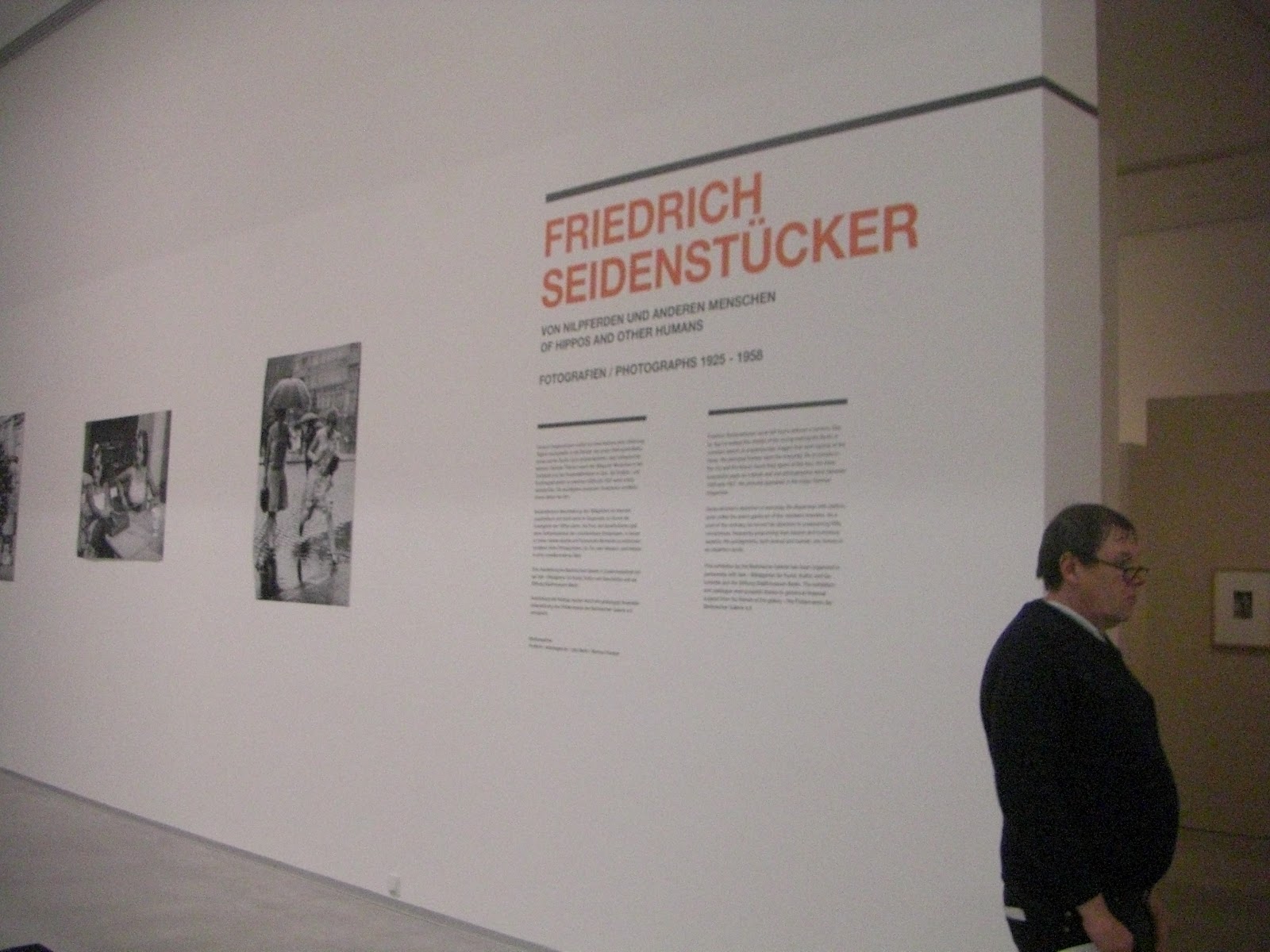
Art highlight: The Berlinische Galerie, in Mitte, where some paintings from the late 19th century sit next to oils from the 20th, and two photography exhibition a currently being displayed.


The location itself is really appealing, wide space, modern, pretty central...


The exhibitions show the phtographies of the German photographer Friedrich Seidenstücker and the Hungarian one Eva Besnyös (1910-2003)and both give a great insight into the 1920s and 30s...

It seemed to be the theme of this trip anyway... After our lovely New Year Eve's party in the 1920s. Felt like we were in the lastest Woody Allen movie, a sort of 'Midnight in Berlin' version, where I even met a man from the Twenties, a German man speaking a perfect English. Only in dreams...

Go to Berlin folks!


--

Berlinische Galerie
Landesmuseum für Moderne
Kunst, Fotografie und Architektur
Stiftung Öffentlichen Rechts

Alte Jakobstraße 124-128
10969 Berlin Germany
www.berlinischegalerie.de