26/11/2014

Ombres et lumières au Quai Branly


Comme un mercredi...


Et une peinture aborigène contemporaine :


L’ÉCLAT DES OMBRES

L’Art en noir et blanc des Îles Salomon


DU MARDI 18 NOVEMBRE 2014 AU DIMANCHE 1ER FÉVRIER 2015

COMMISSARIAT

  • Magali Mélandri, responsable de collections Océanie au musée du quai Branly

CONSEILLER SCIENTIFIQUE

  • Sandra Revolon, ethnologue, Université Aix-Marseille – CREDO

AUTOUR DE L'EXPOSITION

  • Visites, publications et événements (à venir)

Affiche de l'exposition "L'Éclat des ombres, l'art en noir et blanc des Îles Salomon"


Affiche de l'exposition "L'Éclat des ombres, l'art en noir et blanc des Îles Salomon" - Cliquer pour agrandir, ouverture dans une nouvelle fenêtre


À propos de l'exposition

Composé de douze îles principales (parmi neuf-cents îles et îlots au total), l'archipel des Salomon décline selon les groupes une multitude de tendances culturelles. On connaît de ces îles des œuvres emblématiques comme les figures de proue de canot de guerre, des reliquaires, des monnaies de plumes ou encore des armes.
En regardant les artefacts traditionnels des îles Salomon, l’œil du visiteur, même non initié, perçoit les effets visuels des coquillages polis, transformés en parures et monnaies, des contrastes entre la surface brillante de la nacre ou celle éclatante de la chaux de corail et la matité sombre du bois couvert de résine ou de charbon qui sont un trait stylistique commun à l’archipel des Salomon.
Ces jeux de contraste visuel renvoient à une multitude de référents culturels, et constituent le fil conducteur du parcours de l’exposition. Parcourant les provinces occidentales, orientales et les enclaves polynésiennes de l’archipel, l'exposition présente ainsi la façon dont les objets matérialisent, par leurs caractéristiques techniques et visuelles, les relations entre les humains, et entre les humains et les entités surnaturelles.

Partenaires médias


--


25/11/2014

Maghreb des films - suites


LETTRE D'INFORMATION N°108 DU 25 NOVEMBRE 2014……………………….……………………….……………………….……………………….……………….…………………………………


ETOILES AUX DENTS OU POULOU LE MAGNIFIQUEUn film de de Derri Berkani (France/1971/83’)

Jeudi 27 novembre à 20h00
Le Louxor, palais du cinéma, 170 Boulevard de Magenta, 75010 Paris

Avec Bernadette Lafont, Benaïssa, Malek Kateb, Charlotte Maury Sentier, Catherine Arditi, …

Un jeune écrivain public algérien mène à Paris une vie désinvolte avec ses amis Poulou, boxeur raté, et Ama, voleur maladroit. Ce n’est qu’après leur départ qu’il comprend son isolement et sa marginalisation. Les images aussi bien que les sons contribuent à renforcer le sentiment que Paris est une ville où il est à la fois chez lui et terriblement étranger.

Projection suivie d’un débat avec le réalisateur.

Pour en savoir plus, rendez-vous sur le Journal du Maghreb des Films 2014

La séance débutera par un court métrage, ALGERIENS EN FRANCE de José Maria Berzosa (France/1972/30’)

Une famille d’émigrés tous musiciens (non professionnels) joue dans le quartier de Barbès


--

Quand Idan Raichel rencontre Vieux Farka Touré


Ce soir au New Morning :


Idan Raichel (Piano)Vieux Farka Touré (Guitare,Voix)
Infos
La rencontre entre Idan Raichel et Vieux Farka Touré remonte à 2008 dans les couloirs d'un aéroport. En 2011, ils enregistrent The Tel Aviv Session. Après une tournée internationale de plus de 2 ans, ils ont eu envie de continuer. Le second album aurait dû s'enregistrer à Bamako, c'est finalement Paris qui les accueille. Ils s'isolent 3 jours au studio Malambo, privilégiant les musiques improvisées, les voix, des instruments variés et la présence d'invités.

Une nouvelle fois avec « The Paris Session », la magie opère, sincère et spontanée.

20H30 :
TOURÉ RAICHEL COLLECTIVE


Festival Jazz 'N' Klezmer
Klezmer
Le succès du Touré-Raichel Collective - un claviériste israélien et un guitariste malien - nous rappelle le pouvoir de la musique capable de gommer les différences géographiques, ethniques, politiques et religieuses.


24/11/2014

New era - old times: looking back at Robert Del Naja and Massive Attack's artwork


Remembering the 90s, i am digging into my Massive Attack's discotheque...

A few songs and references...


WHEN MUSIC MET STREET ART

Del Naja said: "Painting is difficult for me because I'm colour blind. Back in the day, I had to label my spray cans with what colour they were because I couldn't tell ... It's like the emperor's new clothes: [people] telling me it's great, and me pretending that's what I intended"...


Massive Attack's Robert '3D' Del Naja looks back on his work  with collaborators


GOLDIE AND GRAFFITI (1985) 3D becomes a spraycan hero to Banksy, and paint partner to future jungle star Goldie

GoldiePhotograph: Getty Images
"Graffiti was a perfect way out. I didn't finish my education, I was a bit of a layabout, but between 1983 and 1986 I was painting all over Bristol. Through that I got into more abstract work from New York, Jean Michel Basquiat and Keith Haring, then I started stenciling. That's the stuff Banksy always says made the most impact on him. I first met Goldie at the Bristol Arnolfini exhibition in 1985, which I think was the first in this country to put graffiti in a gallery and suddenly validate us. I spent a mad night painting with him on this massive municipal housing estate in Wolverhampton. We painted until dawn and then found out someone had painted "Niggers did this" on it as soon as we'd crashed out; it'd gone before we'd had a chance to look at it but Goldie found the guy. He almost beheaded him with a spade."
(...)

HELIGOLAND (2010) New Massive Attack album art banned on London Underground

Heligoland
"We can't use any of the Heligoland artwork I've painted for the posters on London Underground. They won't allow anything on the tube that looks like 'street art'. They want us to remove all drips and fuzz from it so it doesn't look like it's been spray-painted, which is fucking ridiculous. It's the most absurd censorship I've ever seen. We're hosting pop-up galleries [on] tour this year. We've got UnitedVisualArtists; Steve Bliss's No Protection artwork which was like an early prototype for his Grand Theft Auto stuff; and all the extras from Mezzanine and 100th Window."


--

WHERE BRITAIN MEETS AFRICA 

Massive Attack's Robert Del Naja's second release on his Battle Box label is a heavy, electronic collaboration with Congolese musician Jupiter Robert Del Naja & Jupiter Bokonjdi, the pair having met on an Afrika Express adventure in 2012.

Released on October 17 by The Vinyl Factory as a limited hand-numbered pressing of 300 with exclusive sleeve artwork by Paul Insect.


--

VISUALS, SOUNDS AND MORE


See more painting on this blog: http://propracthat.blogspot.fr/2013/01/robert-del-naja.html

Similar to Goldie, Del Naja often works with stencils, and his output varies greatly from Goldie's and other previously mentioned stencil artists such as Banksy. These in combination can be used to effectively demonstrate the flexibility offered by a single technique and medium, something which I am seeking to incorporate in my accessibility vision.


Del Naja's work also needs to be carefully considered, as a lot of it is politically motivated and the imagery used can be quite alienating, similar visually to that of Francis Bacon's paintings. Again, setting and context need to be considered before I use these examples.


--

Another article: https://artformusic.wordpress.com/2013/05/30/massive-attack-robert-3d-del-naja/


MASSIVE ATTACK’S ROBERT “3D” DEL NAJA | FIRE SALE


3D | Fire Sale | 24th May – 20th June | Lazarides Rathbone – Photo credit: Ian Cox 2013
Robert “3D” Del Naja started out as a graffiti artist (he was an influence on Banksy’s formative years) and was also member of “The Wild Bunch” a sound system collective formed in Bristol during the 1980s. The collective was”a confluence of hip-hop DJs, sound-system operators and graffiti artists partly inspired by, and not dissimilar to, the late 70s New York hip-hop scene that spawned Jean-Michel Basquait.” Del Naja is similar to the likes of Basquait and Haring in the way that they all started out painting the walls on the street, only to find themselves on the walls of galleries.

The iconic flame on Blue Lines album cover (1991), 3D has this tattooed on his arm.
It was from this collective that the hugely influential group Massive Attack emerged, the three founding members being Del Naja, Andrew “Mushroom” Vowles and Grant “Daddy G” Marshall. The group has been hugely influential and their 1991 album, Blue Lines has been “credited with revitalizing British dance music,” the seminal debut album creating a distinctive sound that became regularly imitated. They followed upBlue Lines with Protection (1994), Mezzanine(1998), 100th Window (2003) and Heligoland(2010) with a few compilation albums and soundtracks in between. Mezzanine, the groups most successful commercial album marked the departure of Andrew Vowles from the group shortly after the release due to creative differences. For 100th Window, Del Naja was the only member of the original trio to a feature with Vowles no longer in the group and Grant Marshall unwilling to take part in the making of the record. Marshall later rejoined Del Naja for the creation of Heligoland.
3D’s background in graffiti has since expanded into painting and digital art. He created the artwork for all of Massive Attack’s albums, often collaborating with Tom Hingston. Together they created album artwork and packaging for the studio albums Mezzanine, 100th Window and Heligoland and compilation album Collected often enlisting the help of photographer Nick Knight to generate imageryYou can see photographs of their work on Hingston’s portfolio under clients. Hingston describes the process of working with Del Naja as organic,
Del Naja seems fascinated with how the listener interacts with the music they create. This can be seen with the packaging for Massive Attacks Singles 90/98 boxset which featured heat sensitive packaging. The thermally sensitive ink turned white when heat was applied or was touched. Scroll down a page from this link to see a photo. Packaging like this is not surprising however as the original intentions for Massive Attack were to have a multimedia aspect in order to ‘create music around art.’ It is interesting how this group placed an emphasis on the multimedia aspect of music and also their performances, becoming well known for having impressive lighting during shows made with the help of United Visual Artists.
--

MORE ABOUT STREET ART IN BRISTOL

Link: http://www.culturalweekly.com/bristol-street-art/


An Introduction to Bristol Street Art and Graffiti

Bristol's See No Evil public street art project. Photo: Ben Merrington
Bristol’s See No Evil public street art project. Photo: Ben Merrington
Nestled beneath one of the world’s most famous bridges, designed and built by one of history’s most famous engineers, Brunel’s Clifton suspension bridge acts as an all seeing eye. Gazing over an area of the United Kingdom that has become a leader in creativity, largely with its foundations in non-traditional and non-academic platforms, Bristol continues to amaze, break new ground and be ahead of the game, time after time.
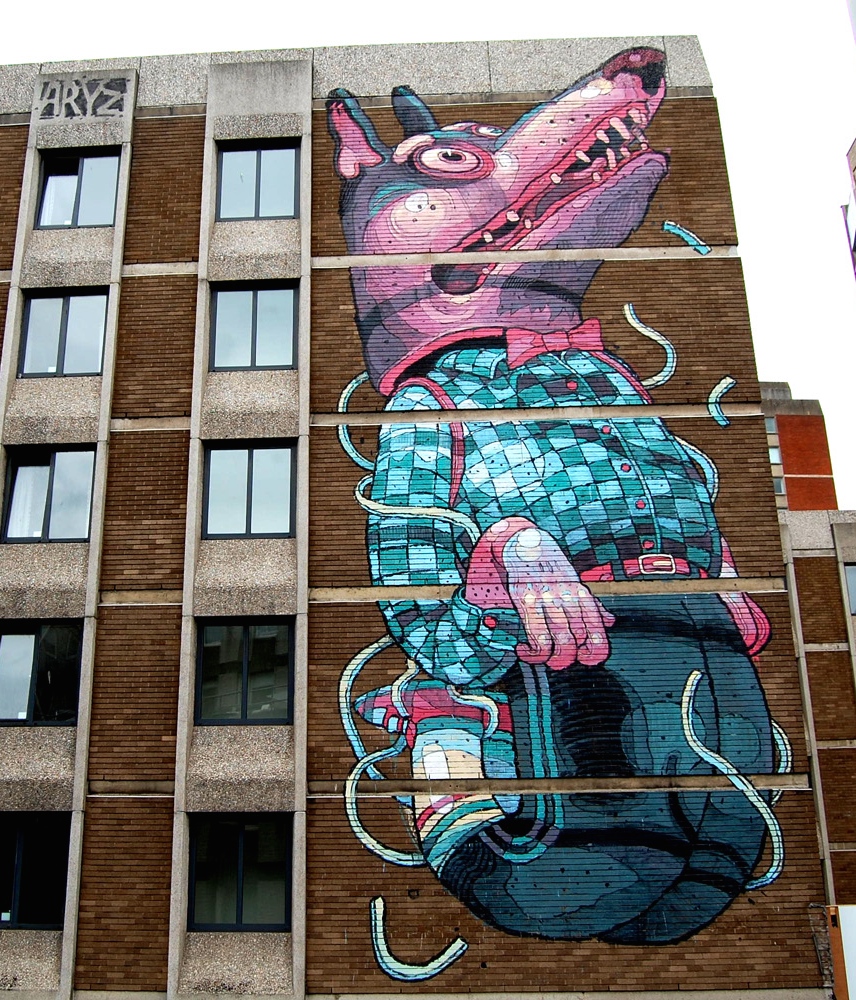
The work of Aryz on Bristols world-famous Nelson Street.
The work of Aryz on Bristol’s world-famous Nelson Street.
If you are not aware of Bristol, you should be. Actually, you probably are, but you just don’t know it yet. When cities boast of their achievements, the traditionalists amongst us turn to the pot of statistics that all local authorities have, such as crime, schooling and financial wealth. Bristol though has the alternative, balancing heritage with free-thinking progression. If Bristol was a person it would be Richard Branson, tattooed from head to toe. You know the type: those who work damn hard, take the right risks and don’t really care for convention.
So why this type of introduction to an article about Bristol’s world renowned street art and graffiti? Well for those of you that haven’t had the pleasure of spending time in our happy city, the photos you’ll see of 50 metre tall painted buildings and whole streets decorated from top to bottom just don’t do it justice. It’s like your first visit to New York City—those skyscrapers are truly wonderful, but similarly to Bristol, it’s the content in which they live that really give it that indescribable X factor.
Referencing New York is no mistake and although early forms of graffiti go back to ancient times, it was the resurgence in the late 70s and early 80s in the subways of New York that caught the attention and imagination of the creative and, some might say, destructive streak of a few lads in the smaller, lesser known city of Bristol.
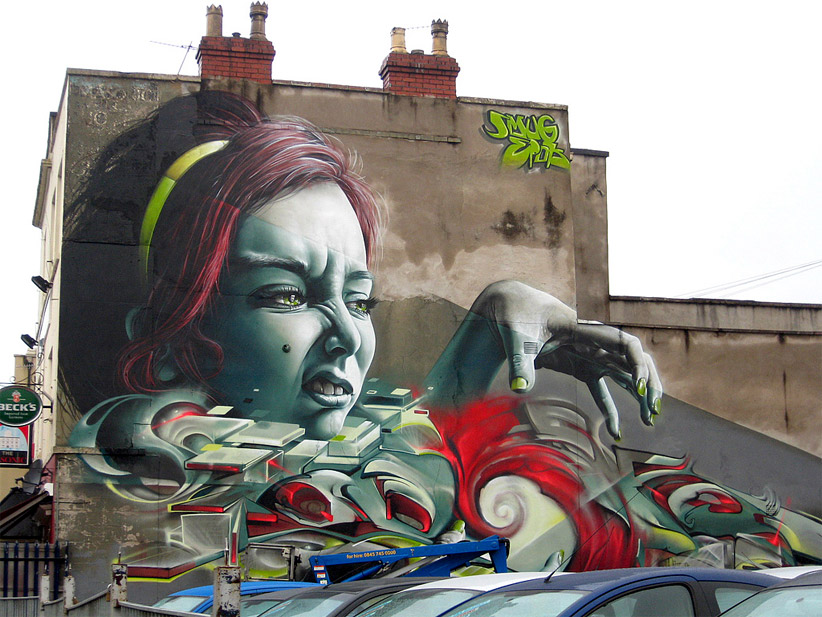
Epok and Smug collaboration at Upfest 2012
A catalyst of underground music, rebel attitude, and the introduction of aerosol paint fused together to bring the world the Wild Bunch. Active member ‘3D,’ alternatively known as Robert Del Naja and member of the UK band Massive Attack, is one of the most widely known names and influencers of this era. The wild style lettering continues to influence today’s graffiti artists, otherwise known as graffiti writers.
It was the second and third generation of Bristol graffiti artists inspired by the Wild Bunch that has really given Bristol its reputation as a publicly creative hub. Artists such as Inkie, Cheo, Paris, Nick Walker, Xenz, Jody, Kato, FLX One, Lokey, Turo, Dicy, Dale Vn Marshall, Feek and some guy called Banksy, to name but a few, went a long way to paving the way for the rest of us.
Since the Walls On Fire graffiti event in 1998, the city and its artist have led the way as street art has reached further into the accepted public realm, drawing in all manner of artist from illustrators such as Andy Council and Mr Jago, fine artists such as Andrew Colwill and Guy Denning, to contemporary artists like Lee Ellis.
For those within Bristol’s urban art scene, the explosion of community and council support can in a large part be attributed to one artist: Banksy.
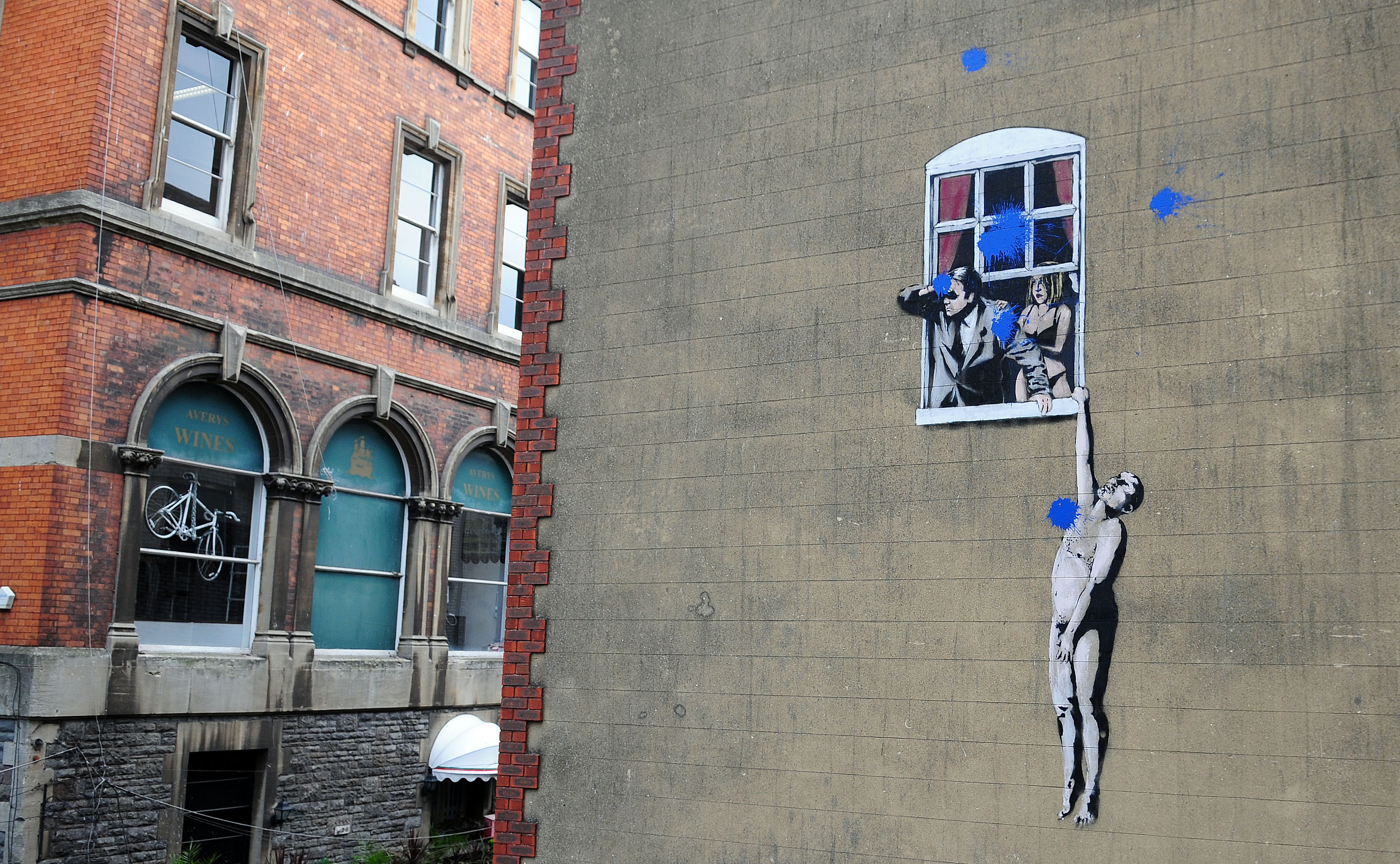
Ok, we had to show one Banksy! Naked Man is found on Bristol's Park Street.
Ok, we had to show one Banksy! Naked Man is found on Bristol’s Park Street.
From the city’s perspective, the Banksy Vs Bristol Museum exhibition in 2009, which saw over 300,000 visitors, reportedly brought £10 million into the Bristol economy. These allowed Bristol to strengthen its position as one of the world’s foremost cities for this form of public art.  In 2013, Bristol played host to Europe’s largest street art festival,Upfest – The Urban Paint Festival, accommodating 300 artists from across the globe and 30,000 visitors.  After a year off, the festival will return in August of 2015, once again drawing the attention of international observers on to our extraordinarily colorful and creative city, Bristol.
--

More soon.

--

Burkina Faso: la composition du gouvernement de transition dévoilée

BURKINA FASO ISAAC ZIDA MICHEL KAFANDO 

Burkina: un gouvernement de transition à dominante militaire

mediaLe Premier ministre et ministre de la Défense, le lieutenant-colonel Zida, le 21 novembre.REUTERS/Joe Penney
La liste des ministres de transition a été dévoilée ce dimanche soir avec près de deux heures de retard au Burkina Faso. Les échanges entre le président de la transition et son Premier ministre se sont poursuivis jusque tard dans la soirée, hier. Ce gouvernement de transition fait la part belle aux composantes de l’armée. Zida et Kafando, en plus de leurs fonctions actuelles, se sont réservé les principaux ministères.
Cette annonce a débuté avec une courte prise de parole d’Isaac Zida. Le Premier ministre s’est excusé pour le retard de près de deux heures sans donner plus de précisions. Les deux hommes forts de cette transition ont décidé d’être actifs dans leurs domaines respectifs. Le président Michel Kafando, diplomate de carrière, va occuper et gérer le ministère des Affaires étrangères. Le lieutenant-colonel Zida, Premier ministre, prend aussi en charge la Défense. Une décision prise à travers deux décrets.
C’est à lui qu’incombera la tâche d’entreprendre des reformes au niveau de l’armée, et surtout au niveau du régiment de sécurité présidentielle. Un régiment créé pour assurer la sécurité de l’ancien président Blaise Compaoré et dont les noms de certains membres avaient été cités dans l’assassinat du journaliste Norbert Zongo.
Trois autres militaires en plus d’Isaac Zida entrent dans ce gouvernement. Le colonel Auguste Denise Barry, l'un des plus proches collaborateurs du Premier ministre a été nommé ministre de l'Administration territoriale et de la Sécurité, l'équivalent du ministère de l'Intérieur. Un poste qu’il avait déjà occupé en 2011, avant la vague de mutineries qui avaient secoué tout le pays. Il a en charge la mise en place du système de sécurisation du pays face aux nombreux cas d’attaques à mains armée et au grand banditisme.
David Kabré, qui a négocié la charte de la transition pour l'armée, s'occupera des Sports. Le secteur stratégique des mines et de l’énergie est confié au colonel Boubacar Ba. Longtemps considéré comme un pays agricole, le Burkina Faso se positionne aujourd’hui comme un pays minier. Le pays va disposer, « dès 2015, de dix mines d'or exploitées par des sociétés minières. Du coup, la production passera de 32 à 40 tonnes », avait expliqué l’ancien ministre des Mines et de l’Energie. Des organisations de la société civile avaient lancé une campagne de plaidoyer pour demander « 1 % de l’argent de l’or pour sortir les communautés de la pauvreté ».
Le ministre de la Communication, le porte-parole de la transition, se nomme Frédéric Nikiema. Augustin Loada, directeur du centre pour la gouvernance démocratique, est une personnalité bien connue des Burkinabè. Il obtient le ministère du Travail. Enfin, la militante Joséphine Ouédraogo, qui était candidate à la présidence, occupera le poste de garde des Sceaux. De nombreux membres de ce gouvernement sont inconnus ou presque. Les Burkinabè découvriront sans doute dans les heures et dans la presse les ministres nommés pour gérer cette transition d’un an. La première séance du nouveau Conseil des ministres se tiendra ce lundi 24 novembre.
--
Après cette annonce, les réactions se multiplient. 
Pour Ablassé Ouedraogo, député de l'opposition et ancien ministre des affaires étrangères, cette composition est rassurante. La présence de technocrate de qualité est indéniable selon lui, et il le voit déjà se mettre rapidement au travail. Ablassé Ouedraogo se dit également conforté par la prise en charge de portefeuilles clés par les président de transition et chef du gouvernement : 
Pour Guy Hervé Kam, porte-parole du mouvement des balais citoyens, cette composition est globalement satisfaisante car elle réunit de bons technocrates et montre que les militaires sont positionnés aux bons ministères pour prendre en charge les questions de sécurité, mais il y a un grava point noir : la nomination d'Adama Sagnon, ex-procureur stigmatisé selon lui par son rôle dans l'affaire Norbert Zongo, décrédibilisé...
(joints par Mélissa Chemam)


Réprésailles des forces kenyanes contre les shebabs en Somalie


KENYA SHEBABS SOMALIE 

Kenya: les autorités affirment avoir tué 100 islamistes shebabs

mediaUn rebelle somalien shebab.REUTERS
Les forces de sécurité kényanes affirment avoir tué une centaine de miliciens shebabs en Somalie, après avoir pourchassé les islamistes dans le pays. Les représailles ont été lancées samedi 22 novembre, après l’assassinat de 28 personnes revendiqué par le groupe islamiste. Ils ont aussi détruit une de leurs bases, selon les autorités.
C'est le vice-président kényan William Ruto qui a lui-même annoncé que « deux opérations ont été menées avec succès de l'autre côté de la frontière contre les auteurs de ces exécutions meurtrières », une « action de représailles a fait plus de 100 tués », a-t-il précisé.
Cette opération a été lancée après l'attaque d'un autocar par des hommes armés samedi 22 novembre, qui ont exécuté 28 des passagers, dans la région de Mandera, dans le nord-est du Kenya. Les forces de sécurité kényanes ont donc lancé une opération de poursuite des assaillants qui tentent de se réfugier en Somalie, selon la police kényane.
William Ruto a également précisé qu'un camp des shebabs et quatre pickups équipés de mitraillettes ont été détruits. Selon lui, le message de cet assaut est de montrer que les forces kényanes poursuivront chaque shebab qui s'en prend à des civils kényans.
Le groupe somalien islamiste al-shebab a revendiqué l'attaque contre cet autocar qui se dirigeait vers la capitale, Nairobi. Les assaillants avaient ordonné aux passagers de réciter des versets du Coran pour faire sortir du car les musulmans et avaient ensuite abattu 28 personnes, 19 hommes et neuf femmes, qui n'étaient pas de confession musulmane.
Après une relative période d’accalmie au Kenya, cette attaque montre que le mouvement shebab veut affirmer qu’il est de retour.