04/10/2015

Opening in New York's Guggenheim Museum: Alberto Burri - 'The Trauma of Painting'


2015 has been for me an utterly fascinating journey through art discoveries, which started in Bristol, England, and does not seem to end.

Here is an insight into a wonderful artist's work, Alberto Burri, born a century ago, in 1915, in Italy.
His work is luckily soon to be celebrated in vibrant places.


--


Alberto Burri: The Trauma of Painting


This major retrospective exhibition—the first in the United States in more than 35 years and the most comprehensive ever mounted—showcases the pioneering work of Italian artist Alberto Burri (1915–1995). Exploring the beauty and complexity of Burri’s process-based works, the exhibition positions the artist as a central and singular protagonist of post–World War II art. Burri is best known for his series of Sacchi (sacks) made of stitched and patched remnants of torn burlap bags, often combined with fragments of discarded clothing. Far less familiar to American audiences are his other series, which this exhibition represents in depth: 
Catrami (tars), Muffe (molds), Gobbi (hunchbacks), Bianchi(whites), Legni (woods), Ferri (irons), Combustioni plastiche (plastic combustions), Cretti, and Cellotex works.

Burri’s work both demolished and reconfigured the Western pictorial tradition, while reconceptualizing modernist collage. Using unconventional materials, he moved beyond the painted surfaces and mark making of American Abstract Expressionism and European Art Informel. Burri’s unprecedented approaches to manipulating humble substances—and his abject picture-objects—also profoundly influenced Arte PoveraNeo-Dada, and Process art.

Alberto Burri: The Trauma of Painting is organized by Emily Braun, Guest Curator, and Distinguished Professor, Hunter College and the Graduate Center, City University of New York, with Megan Fontanella, Associate Curator, Collections and Provenance, and Ylinka Barotto, Curatorial Assistant, Solomon R. Guggenheim Museum. An accompanying study was led by Carol Stringari, Deputy Director and Chief Conservator, Solomon R. Guggenheim Foundation. The Guggenheim Museum is also grateful for the collaboration of the Fondazione Palazzo Albizzini Collezione Burri, Città di Castello, Italy.

--

Watch this video where the exhibition curator Emily Braun provides a brief introduction to Alberto Burri: The Trauma of Painting, on view at the Solomon R. Guggenheim October 9, 2015–January 6, 2016:

http://www.guggenheim.org/new-york/exhibitions/upcoming/alberto-burri-the-trauma-of-painting

--


Alberto Burri was born March 12, 1915, in Città di Castello, a small town in the Umbria region of Italy. In 1940 he received a degree in medicine from the Università degli Studi di Perugia. He served in the Ethiopian campaign and in World War II, first as a frontline soldier and then as a physician. Following his unit’s May 1943 capture in Tunisia, Burri was sent to a prisoner-of-war camp in Hereford, Texas. Disaffected by war and by his internment, he took up painting in an autodidactic, figurative style and never practiced medicine again.
In February 1946, Burri was repatriated to Italy and set up a studio in Rome. After his first solo exhibition, at the Galleria La Margherita in 1947, he visited Paris and was influenced byJoan Miró’s collages and Jean Dubuffet’s thickly painted works incorporating tar. Burri exhibited with the Rome Art Club, which familiarized him with Futurist arte polimaterica(“multimaterial” art). Experimenting with unorthodox pigments and resins, he produced hisCatrami (tars) and Muffe (molds), as well as protruding, sculptural canvases that he calledGobbi (hunchbacks). By 1950 he was making assemblages out of burlap bags and household linens—Sacchi (sacks) and Bianchi (whites)—that garnered him international acclaim. His first solo exhibitions in the United States took place in 1953 at the Allan Frumkin Gallery, Chicago, and the Stable Gallery, New York; that same year his work appeared in Younger European Painters: A Selection (1953–54) at the Solomon R. Guggenheim Museum. The Carnegie Museum of Art in Pittsburgh organized his midcareer retrospective in 1957.
Burri developed a new material realism that stood apart from postwar gestural abstraction and its emotive and existentialist content. He blurred the boundaries between painting and relief sculpture and redefined the concept and the making of the monochrome. In the mid-1950s he turned to mass-produced industrial materials in prefabricated colors and developed a new technique of painting with combustion to make torched wood veneer works (Legni[woods]); welded reliefs of cold-rolled steel (Ferri [irons]); and compositions of melted and charred plastic (Combustioni plastiche [plastic combustions]).
Burri married the American dancer-choreographer Minsa Craig in 1955, and from 1963 until 1991 they wintered in Los Angeles, where the artist began a dialogue with Minimalism. HisCretti, monochromatic (black or white) fields of induced craquelure, date from the 1970s. The monumental Grande cretto (1985–89) that he built over the ruins of Gibellina, a Sicilian town destroyed by a 1968 earthquake, is one of the largest Land art works ever realized. As part of the foundation he established in 1978, Burri designed his own museum in Città di Castello’s Palazzo Albizzini, and it opened in 1981. In 1990 works from his last series, the Cellotex, painted on flayed fiberboard, went on permanent display in a nearby complex of former tobacco-drying sheds known as the Ex Seccatoi del Tabacco. The artist died February 15, 1995, in Nice. Burri has been the subject of numerous retrospectives in Europe and the United States, including Alberto Burri: The Trauma of Painting at the Solomon R. Guggenheim Museum (2015–16).


--


Legno e bianco 1 (Wood and White 1)


While interned as a prisoner of war in Texas during World War II, Alberto Burri—then a doctor in the Italian army—took up painting and demonstrated an early predilection for cast-off, discarded materials. After his release, Burri fully dedicated himself to art making and embraced the inherent beauty of natural, ephemeral materials and unconventional mediums. From 1950 to 1960, Burri executed a series of textile constructions called sacchi(sacks), using paint and sewn or collaged pieces of burlap and fabric. Early commentators suggested that the patchwork surfaces of the sacchi signified living flesh violated during warfare. Burri subsequently became fascinated with burning materials and began to produce wood pieces, or legni, in 1955. As seen here, Burri scorched thin sheets of wood veneer until they had achieved the desired expressive impact and then glued the sheets to canvas. The surface textures of the fragile wood panels alternate between smooth and singed, matte and shiny.

ARTIST

Alberto Burrib. 1915, Città di Castello, Italy; d. 1995, Nice

TITLE

Legno e bianco 1 (Wood and White 1)

DATE

MEDIUM

Wood veneer, combustion, acrylic, and Vinavil on canvas

DIMENSIONS

87.7 x 159 cm

CREDIT LINE

Solomon R. Guggenheim Museum, New York

ACCESSION

57.1463

COPYRIGHT

Fondazione Palazzo Albizzini Collezione Burri, Città di Castello/2015 Artist Rights Society (ARS), New York/SIAE, Rome

ARTWORK TYPE

--


Bianco B (White B)


ARTIST

Alberto Burrib. 1915, Città di Castello, Italy; d. 1995, Nice

TITLE

Bianco B (White B)

DATE

MEDIUM

Plastic, acrylic, combustion, and Vinavil on Celotex

DIMENSIONS

159 x 159 cm

CREDIT LINE

Solomon R. Guggenheim Foundation Hannelore B. and Rudolph B. Schulhof Collection, bequest of Hannelore B. Schulhof, 2012

ACCESSION

2012.29

COPYRIGHT

Fondazione Palazzo Albizzini Collezione Burri, Città di Castello/2015 Artist Rights Society (ARS), New York/SIAE, Rome

ARTWORK TYPE


--


Cellotex LA 86


ARTIST

Alberto Burrib. 1915, Città di Castello, Italy; d. 1995, Nice

TITLE

Cellotex LA 86

DATE

MEDIUM

Acrylic on fiberboard

DIMENSIONS

50 x 76 1/8 inches (93 x 127 cm)

CREDIT LINE

Solomon R. Guggenheim Museum, New York Gift, Minsa Craig, 1986

ACCESSION

86.3445

COPYRIGHT

Fondazione Palazzo Albizzini Collezione Burri, Città di Castello/2015 Artist Rights Society (ARS), New York/SIAE, Rome

ARTWORK TYPE


--

Il Grande Cretto - Gibellina Vecchia


--

Alberto Burri - Trailer


--

More soon.


03/10/2015

'Lo Scrittore' - Giancarlo Neri (The Writer)


As I'm in the middle of a long writing process, a wonderful journey, source of many satisfactions, and snowballing discoveries, it is a pleasure to come across this piece of art from Italian artist Giancarlo Neri.


Lo Scrittore - Giancarlo Neri (The Writer)


"Giancarlo Neri is a sculptor born in Naples in 1955. At one time he played professional soccer for the New York Apollo of the American Soccer League. 

Perhaps his best-known work is The Writer, a 9-metre-high table and chair made from steel plated with wood, a piece about writer's block. It has been exhibited in Rome and on Hampstead Heath in London in 2005".


--

Here is more about the piece from a BBC article:


A table and chair the size of a house have been captivating visitors to north London's Hampstead Heath.


The 30ft (9m) sculpture, The Writer, will be on Parliament Hill for four months before returning to Italy.
The tribute to the loneliness of writing is meant to inspire visitors to the heath, which has associations with writers Keats and Coleridge.

Leslie Mare, from the Corporation of London which runs the heath, said: "People seem to love it or hate it".
Giancarlo Neri, who used to play soccer for New York Apollos in the seventies, chose the heath, one of London's most popular parks, after hearing of its artistic heritage.

The Naples-born artist used six tons of steel and 1,000lb of wood to create the giant sculpture.

He said he wants people to interact with it, using it as a picnic spot or using the legs as goal posts.
When it was on display in Rome two homeless people were said to have lived underneath it.
Ms Mare told BBC News: "People talk about it, look at it, some people have even graffiti'd on it but it's really engaged people.

"It's almost a reminder of the heath's hidden heroes, and hopefully will encourage new young budding artists and writers."

The sculpture will be officially unveiled at a party on the heath on Wednesday, during the first week of Art Fortnight London.


 It's almost a reminder of the heath's hidden heroes 
Leslie Mare
Corporation of London


Read on the BBC website: 

--

Here is an article in Italian too:

Quella volta che invase via Krupp, a Capri, con centinaia di lampadine accese. O quell’altra in cui piazzò un maxi cavallo galleggiante tra le acque del golfo di Napoli, di fronte Castel dell’Ovo. Oppure quando mise in mezzo al Parco di Villa Ada, a Roma, uno scrittoio e una seggiola alte quanto un palazzo. Giancarlo Neri, protagonista del terzo appuntamento napoletano dei Martedì Critici, è uno che ama confrontarsi con la natura degli spazi, sfruttandone caratteristiche, limiti, possibilità e condizioni. Una vocazione al confronto col reale che punta al coinvolgimento – spesso ironico – dello spettatore e che spinge verso la trasformazione radicale dei contesti.
Più che collocare un’opera in uno spazio, Neri la utilizza come generatore di alterazioni percettive, scegliendo principalmente la via dell’arte pubblica. In questa direzione vanno i suoi numerosi progetti in Italia e all’estero: da quello del Circo Massimo di Roma nel 2008, all’ultimo spettacolare intervento di Rio de Janeiro, nel gennaio 2012. Per chi non fosse a Napoli, martedì sera, c’è Artribune Television che documenta tutto. E nel frattempo guardatevi, sempre domani, il report dell’incontro con Betty Bee.
– Helga Marsala
28 febbraio 2012, ore 18Palazzo delle Arti Napoli, via dei Mille 60a cura di Alberto Dambruoso e Marco Tonelli

--

Giancarlo's website:


02/10/2015

More on Raoul Peck's 'The Young Karl Marx'


Very, very proud to bring y little contribution to this great project!!

http://blogs.indiewire.com/shadowandact/haitian-filmmaker-raoul-peck-is-currently-filming-the-young-karl-marx-20151001

--


Revered Haitian Filmmaker Raoul Peck Is Currently Filming 'The Young Karl Marx'


Photo of Tambay A. ObensonBy Tambay A. Obenson | Shadow and Actoctobre 1, 2015 at 2:13PM


Raoul Peck
Raoul Peck
Haitian filmmaker Raoul Peck is currently filming "Le jeune Karl Marx" ("The Young Karl Marx"), a period drama on the shaky friendship between Karl Marx and Friedrich Engels - the German intellectual titans and fathers of Marxism - charting their completion of the Communist Manifesto, and the creation of a revolutionary movement out of which were born the theoretical tools for emancipating oppressed masses in Europe and all around the world.
In what is described as quite an ambitious project, the film stars German actors, August Diehl as Marx, and Stefan Konarske as Engels.
Produced by Agat Films and Peck's own Velvet Film, as well as Rohfilm in Germany and Artemis Prods. in Belgium, Peck is directing the international co-production from a script he co-wrote with Pascal Bonitzer.
Vicky Krieps, Olivier Gourmet, Hannah Steele and Alexander Scheer round out the starring cast.
"Avoiding the habitual caricature of the old bearded revolutionary icon, this film is the coming of age of two young and daring intellectuals who will have an extraordinary impact on the world of the 20th century and beyond," said Peck, whose latest film, "Murder in Pacot" (highlighted a number of times on this blog) continues to travel the international film festival circuit.
Filming is currently taking place in Belgium. 
I should note that the filmmaker is also working on a documentary on James Baldwin. Although details on that aren't yet available in full. What we do know is that it's actually a project he's been working on for at least 7 years, and it is being made with the full cooperation of the Baldwin estate, which is always a plus. 
He also describes it as "a very creative documentary." In short, the film will toy with the idea that Baldwin actually wrote what was to be an ambitious book - "a masterpiece" as Peck puts it - on Medgar Evers, Malcolm X and Martin Luther King Jr., whose lives all ended in assassinations. Baldwin knew it would be a challenge, and didn't believe it would sell, but he felt that he needed to write it. Baldwin never did write the book (Peck learned about it via letters Baldwin sent to his agent); but Peck's "creative documentary" will imagine that he did. As the filmmaker states: "So the starting point of the film is to say - yes, he wrote it. He just didn’t bind it together, but if you go through his work, the film is there."
All Peck has to build on are 30 pages of Baldwin’s notes for the project, and the rights to all of Baldwin’s writings, of course, since it's a project being made with Baldwin's estate's blessings.
Why a film on Baldwin? Peck's response: "Because Baldwin is my life... I started reading Baldwin when I was 14 or 15, and I realized as an adult a lot of the things I was saying came from him."
Has a definitive film/documentary on the life of James Baldwin ever been produced? I don't believe so, which is unbelievable, and which makes Peck's project all the more significant!
A fearless filmmaker and activist who, I would argue, deserves even more recognition than he's received over the years, within the international filmmaking community, as one of Haiti's few filmmakers, and a primary exporter of Haitian films to the rest of the world, Peck's complex body of work has been covered plentiful here on S&A, since the blog was launched in 2009, much of it still sadly underseen - "Lumumba," "Moloch Tropical," "Fatal Assistance," most recently "Murder in Pacot" and more


--


'The Present Tense'


This dance, this dance
It's like a weapon, like a weapon
Of self defense, self defense
Against the present, against the present
The present tense

I won't get heavy, don't get heavy
keep it light, and keep it moving
I am doing, no harm
As my world, comes crashing down
I am dancing, freaking out
Deaf, dumb, and blind

In you I'm lost
In you I'm lost 

I won't turn around, while the penny drops
I won't stop now, I won't slack off
Or all this love will be in vain, o-ooh
Stop from falling down a mine
that's' nobody business but mine
Or all this love will be in vain
O-oooh

In you I'm lost 
In you I'm lost 

Radiohead - 'The Present Tense' 


30/09/2015

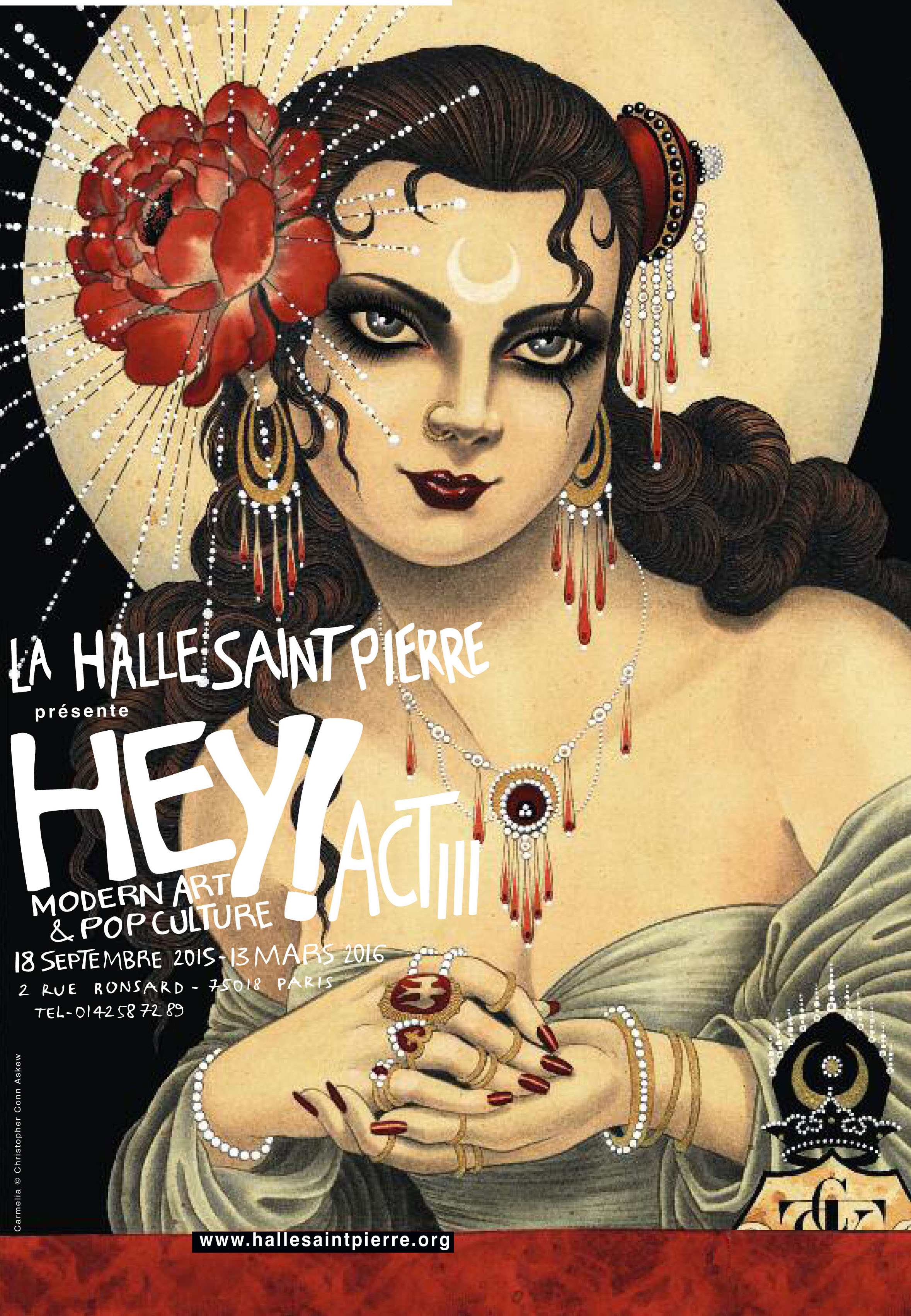
HEY! modern art & pop culture / Act III - Halle Saint-Pierre, Paris 18


Not easy to head to an art exhibition after seeing Banksy's Dismaland work and world...

Luckily for me, the nearest art centre to my place is a very special one: La Halle Saint Pierre has specialised in "outsider art" / "art brut" in French.


Exposition en cours
HEY! modern art & pop culture / Act III 
18/09/2015 — 13/03/2016
62 artistes internationaux
Mise en page 1
 Christopher Conn Askew, Carmelia, 2009.
--

Watch the teaser:


--

Plus d'infos, en français:


  • HEY! Act III - Exposition du 18 septembre 2015 au 13 mars 2016 - 62 artistes internationaux - La Halle St Pierre (Paris)
  • Long Description
    La revue HEY! modern art & pop culture fondée en 2010 par Anne & Julien est de retour à la Halle Saint Pierre, après deux premières éditions (2011 et 2013) accueillies avec enthousiasme par le public. Ce troisième volet, HEY! modern art & pop culture / Act III, poursuit l’exploration et la diffusion des différents expressions artistiques de la contre-culture : lowbrow art, art outsider, bande dessinée et plus largement les médias porteurs d’une culture de rue.

    La scène défendue depuis de nombreuses années par Anne & Julien est vivante, hétérogène, complexe : ses multiples courants ou territoires, allant de la forme la plus radicale - l’art brut - aux formes les plus savantes - le surréalisme pop - la font entrer de plein pied dans l’histoire de l’art contemporain.
    Ce sont ces caractéristiques qui aux yeux d’Anne & Julien donnent à cette scène sa valeur de modernité. L’engagement de ces deux activistes est d’en rendre compte à travers leur revue, leurs spectacles et les expositions. Ils ont ainsi permis la mise en lumière d’univers artistiques singuliers dont le dénominateur commun est la résistance par l’imaginaire : résistance aux normes, à la catégorisation, à l’institutionnel et aux impératifs de la mode. Ils sont les diffuseurs et les historiens d’une scène marginale, underground et alternative.

    Pour la Halle Saint Pierre, accompagner cette aventure est riche de sens. L’histoire des arts a toujours été marquée par de profonds changements de paradigmes. Dans le tournant géopolitique et culturel où se trouve le monde actuellement, les arts visuels eux aussi traversent une période de crise et de mutation.
    La trilogie HEY ! modern art & pop culture en est la manifestation.

    www.hallesaintpierre.org
--

La presse en parle :

Un art pétrifiant - Télérama 
Dans la vraie vie, Hervé Bohnert est boulanger pâtissier.
Hors norme, il pétrit aussi des oeuvres un rien macabres. Le voilà invité à l'expo «Hey!» à la Halle Saint Pierre.

--


L'art brut est un terme inventé par le peintre Jean Dubuffet pour désigner les productions de personnes exemptes de culture artistique. Il regroupa certaines de ces productions au sein d'une collection, la Collection de l'Art Brut à Lausanne.

/

The term 'outsider art' was coined by art critic Roger Cardinal in 1972 as an English synonym for art brut (French: [aʁ bʁyt], "raw art" or "rough art"), a label created by French artist Jean Dubuffet to describe art created outside the boundaries of official culture; Dubuffet focused particularly on art by those on the outside of the established art scene, such as psychiatric hospital patients and children.


--

Jeremy Corbyn quotes Nigerian writer Ben Okri and pays homage to Keir Hardie at Labour conference


Here is the quote:

"The most authentic thing about us is our capacity to create, to overcome, to endure, to transform, to love and to be greater than our suffering".
Ben Okri


Labour has seen a significant membership surge since its leadership election


And he ended his speech by calling for:  

"a kinder politics, a more caring society".


Listen here:


Jeremy Corbyn: "Let us build a kinder politics, a more caring society together." #lab15

--


Read more about his inspirations in this Guardian article:


Who are the inspirational figures quoted by Jeremy Corbyn in his speech?

References to Maya Angelou, Ben Okri and James Keir Hardie give us an idea of the Labour leader’s intended message

Link to the article: http://www.theguardian.com/politics/2015/sep/29/jeremy-corbyn-quote-maya-angelou-ben-okri-keir-hardie

From an American civil rights activist to a Nigerian novelist and the last bearded man to lead Labour, Jeremy Corbyn peppered his speech to the party conference on Tuesday with quotes from three key inspirational figures. Here’s what he quoted:
You may not control all the events that happen to you, but you can decide not to be reduced by them.
Corbyn took this quote from Maya Angelou’s third book of essays Letter to my Daughter. The remarks come in the opening comments of the book, which consists of 28 short essays and is dedicated to “the daughter [she] never had”. Angelou, who died in 2014 aged 86, became one of the most distinctive voices of black America, widely admired both as a civil rights activist, a friend of Malcolm X and Martin Luther King, and as an author of prose, poetry and polemics. She had been a teenage single mother, and worked as a dancer, cook, night club singer and actor before she wrote her first and most famous memoir. I Know Why The Caged Bird Sings was an unforgettable account of a childhood in racially segregated Arkansas. She was awarded more than 50 honorary degrees by universities across the world, wrote and and delivered a poem for the inauguration of Bill Clinton as president, and was awarded the presidential medal of freedom by Barack Obama.
--


The most authentic thing about us is our capacity to create, to overcome, to endure, to transform, to love.
This quote, from the Nigerian poet and novelist, Ben Okri, goes on in full to say “… and to be greater than our suffering”. Its origin is not easily identifiable but the proliferation of its use on inspiration quote sites such as brainyquote.com cements its popularity. Nigeria has inspired much of Okri’s work including his 1991 Booker-winning novel The Famished Road, and he is regarded as one of Africa’s leading writers. However, the writer born in 1959 was partly brought up and educated in England, coming first to London as an infant with his family, and returning to study literature at the University of Essex. He was awarded an OBE in 2001 and an honorary doctorate from Essex the following year. His work, which includes 10 novels and many collections of poetry, essays and short stories, is noted for the beauty and poetic intensity of his writing, and has been translated into 26 languages.

Pinterest
 Ben Okri, Nigerian novelist and poet. Photograph: Murdo Macleod for the Guardian

--

"My work has consisted of trying to stir up a divine discontent with wrong."


Here Corbyn turned to who he called “the last bearded man to lead Labour”, Keir Hardie, who held the party’s top position from 1906 to 1908. Various sources suggest Hardie delivered the soundbite around 1908, close to the time of his resignation. Corbyn chose to drop the words immediately preceding this quote: “I am an agitator.” Many have drawn comparisons between Corbyn and Hardie, who, as well as having a white beard, was similarily a vegetarian and a total abstainer from alcohol. Hardie wore a tweed suit instead of a black frock coat when elected an MP, and was born into a two-room cottage in North Lanarkshire in 1856. Formal schooling ended when he got his first job aged seven as a messenger boy, but he attended night school while working in a colliery and learned public speaking as an lay preacher. He became a miner’s leader, one of the founders and first elected leader of the Independent Labour party, a supporter of votes for women and on the outbreak of the first world war, an outspoken pacifist. In 2008, delegates at a Labour conference voted him Labour’s greatest hero, and Jeremy Corbyn was among the contributors to a new book on his relevance to 21st-century politics, What Would Keir Hardie Say?

--


This politician, Jeremy Corbyn is all I've been waiting for in politics and here he comes from the 2015 UK!! After the latest general elections in May, I could not expect such an inspirational outcome. But here it is indeed.


Bristol through Redland


Coming from Saint Pauls towards Gloucester Rd, I took a turn into Zedland Road and walk through Redland. Lovely walk on an Indian summer day!!

Love Bristol.


Local station


And Cotham Gardens


Up to Whiteladies Road