23/07/2023

My interview with Faïza Guène


We met in London in June 2022, but our conversation seems very relevant for now! 


My interview with Faïza Guène  


Back in 2004, a 19-year-old French novelist of Algerian heritage named Faiza Guène shook the French literary world with her debut novel, Kiffe kiffe demain (published in the UK as Just Like Tomorrow). The teenager from a disadvantaged suburb of Paris sold over 400,000 copies of the novel, which was translated into 26 languages.

16 years and five books later, in 2020, the author published her sixth novel. La Discrétion tells the story of an Algerian mother (Yamina, 70), her husband, and their four children in Aubervilliers, a northeastern suburb of Paris, and is inspired by Guène’s own family. The novel has been translated into many languages, including English, and has received praise in the UK and the US. It appeared in paperpack in June 2023 from Saqi Books in London.


Melissa Chemam: Your latest novel, Discretionwas published in English last year and received positive reviews. With your first novel Just Like Tomorrow, you enjoyed international success in 26 languages. Do you feel that you are better received abroad than in France?

Faïza Guène: I will say this, being fully aware that an author born in England and hailing from elsewhere, from the British colonies, say, would perhaps feel the same way I do concerning France, were he to be received in France — yes, abroad and especially in England, I always feel that I can express myself freely on the subjects I like, in my writing. It is one of the countries that has supported me the most, and where readers follow me particularly. Here, I am received with a slightly less limiting perspective.

MC: Isn’t this one of the crucial points in terms of how your books are received? These questions of “where does literature begin” and where does “the social phenomenon” that feeds it end?
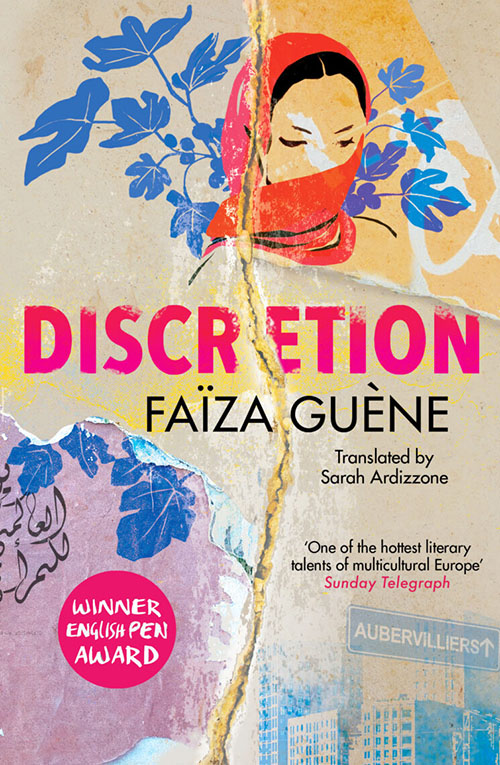
Discretion is out in paperback from Saqi Books.

Faiza Gùene: It’s true, and for a long time I had this feeling of having been left out of the “universal” in a certain way, in France, because I was stuck in all these social problems, from my first novel, Kiffe kiffe demain. I did not reject these problems, because they are obviously part of my journey and my work. But they have become limitations. Now, I feel much less limited. First of all, I’m getting older. I’m 37, so fortunately the reception of my books is different. And then, after six published novels, I think that in terms of legitimacy I have fought enough as it is. And my other projects in parallel have given me a more solid foundation, especially the screenplays.

MC: You started writing at a very young age, as a teenager, and to be 37 years old with six novels is prolific. Do you feel that you’re now at mature stage?

Yes, and moreover I took time between each novel. I think that with the experience of age, of writing these six novels, I can’t be treated like I used to be. I’ve often said, they treat me like they do musicians who make a summer hit and then disappear. As if my first novel was the equivalent of “La Macarena.” Now that’s over. I have experience. At the same time, I know it’s normal, because I wrote my first novel when I was 17. Since then, my vision of life has changed: I have written these books; I have become a mother. Everything I’ve experienced, within and beyond my career as an author, makes me write differently today. 15 years is a long time.

MC: One of your teachers encouraged you, but did you think you had a career in literature ahead of you?

Oh no, that’s for sure. I never imagined that I could make a living from writing when I started. I loved writing, I’ve always written, and I wrote fiction, with the confidence to make it fiction. It was a way to escape from reality, from childhood. It was something I enjoyed. And it wasn’t in the sense of survival or therapy; it was my hobby.

MC: Were there any authors who inspired you then, who were part of your youth?

Very young, not really, to be honest. I’ve been asked this question many times, and I could tell a great story, but honestly, as a child, no. I started reading in school, and then I read some more serious books as a teenager. One that stuck with me was J.D. Salinger’s The Catcher in the Rye. I often talk about Émile Zola. And later I discovered James Baldwin. As a child, I was more inspired by the life stories of the people around me.

MC: Following the immense success of your first novel, did you take on other roles, such as teaching, social work, or something else? Or did you become a full-time author?

Yes, in a way. But I didn’t stop my studies either, as some people think. I had already started working at the age of 16, to help my family, before I signed a publishing contract. And I was bored at school then. I became a full-time author first because it occupied all my time, concretely. And as a result, that’s all I did, especially when I started making a living from it, as soon as Kiffe kiffe demain came out. It didn’t last long, though, because I didn’t invest my money properly. For me at the time, it was an episode in my life. I didn’t think it was the beginning of a career.

MC: And have you changed your way of life? The Seine-Saint-Denis suburb of Paris, for example, is very important in your stories; have you continued to live there?

I still live in Seine-Saint-Denis, until today, even though life has changed. There are organic stores now next to my house; we’ve been visited by gentrification, but I haven’t changed my life, really. Even though I’ve sold a lot of books, I haven’t made millions. People often refer to my career as “trans-class,” but novelists are not footballers. Success is different in different circles. After a success with a novel, you have to keep up. In my family, we don’t have a heritage. I started out at minus 1000. So obviously, living on that success for five years is already enormous. I was able to pay rent and take care of my family, without anything excessive. I didn’t blow my money; I was just able to live. And that obviously allowed me to continue writing.

MC: And what is your family’s relationship to your books?

If you knew my family, you’d understand why I have to stay humble. Life went on as if nothing happened. In between official invitations and TV shows, I would go home and wash the dishes because it was my turn. There was no difference in my parents’ pride in me or my sibling. If anything, it was less than my brother. They had no disdain for literature, but no fascination either. They were just very happy to see me doing what I love. Of course, they feel a respect for everything that has to do with books and writing. For my mother, for example, who had to drop out of school, like the main character of Discretion, her great wound was not to have been able to continue her studies. So, she was encouraging. But success and fame were not the issue. What mattered to them was that I was doing something respectable. At the same time, my parents and family don’t really understand my profession, not totally. So that kept me down to earth.

You’ve worked a lot with your mother. She participated in your first short film, when you had to replace the original actress at the last minute. Was that a natural thing to happen?

Yes. I have a mother who transmitted to me, without being very conscious of it, feminist values in terms of the freedom, the confidence she gave me. And my father also transmitted that to me. They let me do what I wanted to do; they never stopped me from anything. They trusted me.

This is reflected in your latest novelwhere there are never any clichés about Muslim and/or veiled women. The women are presented as very different, sometimes even extreme; one refuses to marry even as her sister chooses a kind of arranged marriage. But they all make their choices. Is this what you wanted to show — a culture that lets women choose?

Exactly. The issue is not to choose for them. It’s not about veiling them or revealing them that helps them. The whole idea of this book and even everything I write, what I want to show, is that I gravitate toward complexity. We have the right to be complex, sometimes to suck, sometimes to be mediocre, like other French people. Sometimes they are! But we, the children of immigrants, don’t always have these basic rights. This relates to the question of representation. Why do we have this pressure to shoulder some kind of responsibility when we come from a working-class background? When you are a woman, or of Arab origin, here in France, I have the feeling that you are not allowed to be complex, different or even bad. We are obliged to be excellent because otherwise there is no place for us.

And what is your relationship with the culture of your parents? Do you go to Algeria often? Do you speak Arabic?

It is my mother tongue! I speak it every day. I am very close to my original culture. And I’m getting closer and closer to it as I get older, because I have children. I had my first daughter at the age of 25, so quite early in my life. And so there was very early on the necessity of what I want to transmit. The language is part of it. The culture of my parents, too. This is also explained by the fact that we went to Algeria a lot when I was little. And I was convinced that we would return to Algeria one day: my parents, me, my brother and my sister. I think that the history of my parents plays a role; my father was born in 1934, and my mother in 1949. So, I have issues from the generation before, because of the huge generation gap between my parents and me (I was born in 1985).

You talk a lot about your family in your books, and always with a lot of love and respect, even admiration, despite all these traumas. And, if we are honest, we have to say that there is almost a trade in trauma in the literary world, especially when we talk about decolonized countries, such as Nigeria or Algeria. Yet in your books, there is, above all this, love. Is this due to a desire to be authentic? Or does it just come to you?

It’s not even a thought with me. Again, the only thing I tell myself when I write is that I want my characters to be right, to be true. I write them with sincerity. Afterwards, with the analysis and the feedback from the readers that I’ve had, I’ve realised that. And it’s like that with every book. With Kiffe Kiffe demain, I’ve been told: “You finally give a positive vision of the suburbs.” But […] I faithfully recounted what I knew according to my own experience. And with this last book, it’s the same thing. I didn’t try to do something revolutionary by dealing with characters that were nice Arab men. It’s that, in fact, they exist! That’s what’s so terrible about it: You never see them in literature or on television. With the usual deficiency and misrepresentation, when you try to be a little fair, it’s perceived as something extraordinary.

It’s also my way of seeing this story. That’s what excites me. The possibility to change the perception of this environment a little bit, to be a little bit indulgent. I can speak for example of the character of Malika in my last novel, who marries at 17 because her parents help her and arrange this union. They do what they would have done in the village because they don’t know how to do it otherwise, because that’s how it was done there. And it makes sense to her. She agrees to get married like that, almost as a courtesy. She has nothing against it; she is even quite shy. Others could talk about forced marriage. In France, in the 1980s, there were many debates on the subject. Looking back, I find it incredibly racist and paternalistic, where French politicians proposed to save all these young Arab girls, without knowing what was best for them.

Were they seen in an exoticised way? And was the violence of the so-called French social reality in the suburbs blamed on the parents’ culture?

Of course. I explain this, in my fiction, through a burning desire of the parents to retain the little that they brought with them, that is to say, their culture, their traditions, their history, their way of doing things. Because it is so brutal when you uproot yourself. Because these immigrants and exiles have had a thousand mournings to make when leaving. The mourning of tradition, the mourning of religion, the mourning of language. It is so painful. Perhaps those who were very conservative were that way because they wanted to keep what constituted them, and to transmit it to their children. So, of course, some of them were sometimes clumsy. Others were violent, others brutal, certainly, but I like to think that I will dig a little bit in that area to understand. It makes us forgiving, and that’s why I like the character of Malika, because there’s a kind of gentleness in her in the idea of saying, “My parents, they did what they could.”

After coming up with characters that seemed never seen before for your debut, was it difficult to write the second and subsequent novels?

No, and moreover I want to say that there have been other such novels before mine, and several waves, several generations of authors who have written on the subject before me. I point this out every time I can. There are other authors of Maghrebi origin in France who have evolved in different times. Of my generation, especially as a girl, one can say that I was a little pioneer. But before, in the previous generation, there were authors such as Tassadit Imache, for example, author of the book Une fille sans histoire, published in 1989. It is another time, but it shows that there were people who emerged.

Unfortunately, the literary world tends to extinguish success as quickly as it engineers it, and we treat these authors as a social phenomenon. Also, because fame can be so short-lived, oftentimes the newer generation does not know anything about earlier writers. But I often think of those writers, of people such as Mehdi Charef; they did a lot for previous generations and they wrote for us too. The problem is that we don’t quote them; we don’t talk about them. But I am not the first, that’s not true. There was also Rachid Djaïdani a few years ago, with Boumkoeur. They are different universes, but we are in the same space, of this in-between of children of immigrants who tell their moments of life. [Cf Les Savauges and 404 by Sabri Louatah]

And these are authors that you discovered with difficulty?

I discovered them too late, yes, quite late, whereas I should have found them more easily because I was looking for that. I grew up in France, where they were largely ignored, so how could I hear about them then? I wish I had heard of them and claimed them as my own when I started writing and getting published.

In France, we often expect authors to be professors of literature, to claim an institutional affiliation of some sort, but you didn’t have such a thing, right?

Exactly. As a result, I have been denied a certain legitimacy. But there was only one book at home, the Quran. And that’s what led me to have a sacred relationship with books. Just the way my mother [physically] handled it made an impression on me. On the other hand, we had thousands of oral stories, and that allowed me to value our culture. In a dual culture, it should not be the case that one is valued and the other devalued.

Do you feel that the French tend to devalue North African cultures?

Yes. The feeling is related to the resentment of lost glory. When they see us, they think of their lost grandeur and empire. For our generation, there are still colonialist legends, even about the Senegalese or Algerian riflemen who loved the French empire so much that they wanted to defend it, but in fact those poor people just didn’t have a choice. And in 2022, with the 60th anniversary of Algerian independence, we witnessed a monopolisation of the word, by the French, the pieds noirs and their descendants. All the stories are put on the same level. We, Algerians, have finally conquered a little space to make our stories and our voices heard, but the dominant narrative still colonises these spaces. As if the grandchildren of the colonists are doing the same thing to us, in a symbolic way. To me, this is unbearable. It is indecent because you cannot compare the suffering of the colonised and the colonisers. Not to mention the cultural appropriation, the French who produce documentaries on Algerian music, without including any Algerian. For me, this perpetuates colonial appropriation.

Is this what led you to write about the story of Oussekine (a young Frenchman of Algerian origin killed in 1986 by the police in Paris) and other more difficult episodes in Franco-Algerian history, such as October 17, 1961?

My little documentary on October 17, 1961 was actually my first project, even before my first novel. I met a historian of this period, Jean-Luc Einaudi, for example, and I didn’t let myself be trapped by critics who tell us that we are too close to the subject. I didn’t let myself be dissuaded from speaking by “intellectuals,” politicians, or historians. It’s my good fortune to be a self-taught person. I speak only from my intimate point of view, as the daughter of a poor Algerian worker.

Many Algerians and French of Algerian descent have too often been left out of storytelling projects, books, podcasts, etc. Suddenly, it became cool to be Maghrebi or traumatised. With Oussekine, we wanted to tell the story from the family’s point of view and we worked with them, as close as possible to their experience. We succeeded in telling a unique story — not the whole story of police violence, just that of Malik Oussekine. We did not want to appropriate a discourse, but to give the family the chance to express themselves. In the first episode, we compared the police methods of the 1980s to those of the colonial era and October 17. French counter-insurgency methods were the same in the 1950s, during the Indochina War, the Algerian War, and quite similar to police methods in France itself in the 1980s and 1990s. This colonial sort of violence in the metropole made the Muslim community feel segregated, and even fostered terrorism.

In your novels, this is also expressed?

Yes, they express the impossibility of conveying our sufferings, of transmitting the truth about colonial violence, without being accused of victimhood. I am often told that I am the one who is obsessive. But I have the impression that I am hardly heard. Yet the great American or Western narratives, when they repeat the same themes, are described as profound.

Discretion is less light, less comedic; was it time for such a work?

I allowed myself to be more expansive, to write for my people, to go into a more autobiographical story, which my mother had told me. But I also discovered episodes, by asking her to talk about her childhood memories. For example, when she told me that a French soldier threatened her family by pointing his rifle at her baby brother. These are not trivial memories; they are traumas once again. The impact of the unspoken, of the repressed word, has long worried me, in my life, as in my literature. What is difficult is to make the link between how one is, how one lives, and the great family and political narratives. This novel is a small step on that path.


France : Réagir face au système raciste


TRIBUNE 19 JUILLET 2023

Face au système raciste, nous refusons d'obtempérer


Nahel Merzouk est mort le 27 juin dernier entre les mains de la police. 

Son meurtre a provoqué « une révolte face à laquelle s’est déchaînée une succession de violences politiques, médiatiques et symboliques, preuves du racisme systémique en France ». 

Un ensemble de militant·es antiracistes et allié·es, entrant en lutte et invitant toutes les personnes qui le souhaitent à les rejoindre, pour « construire un véritable mouvement social antiraciste en coordination avec les autres initiatives existantes ».


Il aura fallu plusieurs jours pour sortir de la sidération, de l’effroi puis de la rage dans laquelle nous a plongé·es l’exécution de Nahel. 

Au moment même où la révolte nous rappelle notre capacité à réagir, le meurtre de Mohamed B., tué par un tir de LBD à Marseille, celui de Carl Tarade en marge des affrontements en Guyane et le coma d’Aymen, qui fait suite à un tir n pleine tête du RAID, nous renvoient à nouveau au même effroi. 

Ces morts font éclater au grand jour que la vie d’un Arabe, d’un Noir, d’un jeune de quartier, peut lui être retirée à tout moment, par l’Etat ou des forces racistes qui le suppléent. 

Ça aurait pu être n’importe quel·le jeune de banlieue, Arabe, Noir·e, Rom, Juif·ve, Asiatique, métisse ou identifé·e comme tel. 

Ce furent Monzomba, Alhoussein, Zineb, Cédric, Ibo, Adama, Souheil, Ali, Babacar, Angelo, Shaoyao, Lamine et tant d’autres.

Plutôt que de le reconnaître, l’Etat s’est organisé pour faire taire toute contestation, quitte à bafouer les principes élémentaires de la justice. Alors que deux des principaux syndicats de police appellent à la sédition, nous affirmons ici notre soutien aux révolté·es et demandons immédiatement leur amnistie au vu du caractère politique, disproportionné et expéditif de la justice qui a été rendue ces dernières semaines.


À lire en intégralité ici : https://blogs.mediapart.fr/les-invites-de-mediapart/blog/190723/face-au-systeme-raciste-nous-refusons-dobtemperer?fbclid=IwAR25OaVFXp-VzO5BSk1yb05hAjxzqUKHlW-rf0mtjw93nCsW8_i50z_YOsM


À signer là : https://docs.google.com/forms/d/e/1FAIpQLSc5nRDC03B7wy5JH4BRSLBpcvJ7M7jKd9B4ZXGa6HLC3XcdWQ/viewform


15/07/2023

On Frederick Douglass


In collaboration with the Edinburgh Art Festival, Isaac Julien, and the Scottish National Galleries, Shifting Vision created a bespoke film which premiered on July 29 in the Scottish National Gallery of Modern Art.

Following in the footsteps of abolitionist and freedom fighter Frederick Douglass throughout the city of Edinburgh, the film brings to life Isaac Julien’s visionary ten-screen installation 'Lessons of the Hour' through the insights of the artist, Director of the Edinburgh Art Festival Sorcha Carey, and Celeste Marie-Bernier, Personal Chair in the United States and Atlantic Studies at the University of Edinburgh. www.shiftingvision.org


14/07/2023

Sudan's international partners try to stop the civil war


Egypt and Sudan's international partners try to stop the civil war: here are the positions of each ally, Egypt, Kenya, the USA, Saudi Arabia, Russia, the UAE

- My latest article for RFI English:
https://www.rfi.fr/en/africa/20230714-egypt-and-sudan-s-international-partners-try-to-stop-the-civil-war?ref=tw


SUDAN CRISIS

Egypt and Sudan's international partners try to stop the civil war

 Leaders from Sudan’s seven neighboring countries agreed on Thursday in Cairo to a new Egyptian-led initiative seeking to resolve the deepening conflict in the African country.


Egyptian President Abdel-Fattah el-Sissi speaks during the summit on the Sudan conflict, in Cairo, Egypt, Thursday, July 13, 2023.
Egyptian President Abdel-Fattah el-Sissi speaks during the summit on the Sudan conflict, 
in Cairo, Egypt, Thursday, July 13, 2023. © Egyptian Presidency Media Office via AP

Egyptian President Abdel Fattah al-Sisi received Ethiopian Prime Minister Abiy Ahmed, Chad’s President Idriss Déby, Eritrea’s President Isaias Afwerki, South Sudan’s President Salva Kiir, and a representative of Libya.

South Sudan’s President Kiir said their vision for resolving the Sudan crisis is based on a ceasefire and cessation of hostilities.

Regional impact

Fighting in Sudan started three months ago, on 15 April, when army chief Abdel Fattah al-Burhan fell out with his former deputy, Mohamed Hamdan Daglo, known as Hemedti.

Hemedti now commands the paramilitary Rapid Support Forces (RSF) who are fighting Burhan's forces (the SAF) around Khartoum, in Darfur and in South Kordofan.

More than 3,000 people have been killed in the violence, according to the Armed Conflict Location and Event Data Project, and more than three million have been displaced.


Refugees have fled to neighbouring Egypt, ChadCentral African Republic and South Sudan.

Thursday's meeting in Cairo follows multiple diplomatic efforts to end the violence in Sudan.

Since the beginning of the conflict, the United States and Saudi Arabia have tried impose unsuccessful ceasefires.

Middle Eastern scholar Talal Mohammad recently wrote in Foreign Policy: "Sudan is a bridge that links the Middle East and Africa, and its abundant natural resources mean the battle for Khartoum has taken on a regional dimension."

One of the main challenges faced by Sudan's partners is that they are all accused of taking sides. Here is where they stand

Egypt

Up until this point, Egypt has supported Saudi-hosted talks in Jeddah.

But the proximity and similarities between Sudan and Egypt seem to have forced Egypt's al-Sisi to act.

Approximately 256,000 Sudanese refugees have entered Egypt since mid-April, and Egyptians worry about a further influx of  people displaced by the war.

Egypt and Sudan also have economic ties. The war  is impacting Egypt's exports in Sudan.

Politcally, Egypt's leader is a military general, and a fierce opponent of Hemedti's rebellion.

It is believed that if the negotiations fail again, Egypt might have to support Burhan more openly and maybe even get involved in the conflict on his side.

Kenya

The east African regional bloc IGAD on Monday held renewed talks, calling on the warring parties to sign an unconditional ceasefire.

The talks were led by Kenyan President William Ruto.

However, the Sudanese army boycotted the gathering in Addis Ababa, after Khartoum's foreign ministry objected to Ruto's leadership, accusing Nairobi of siding with the RSF.

Ths reaction dampened hopes for an end to the three-month-old conflict.

USA and Saudi Arabia

Both the US and Saudi Arabia have reacted quickly to try and broker a ceasefire as both have an interest in stabilising the region and especially the Red Sea. 

The US also offered a major donation for humanitarian aid in June.

Saudi Arabia, for its part, is a long-time investor in Sudan.

Port Sudan remains a key access for trade between north-eastern Africa and the Arab world.

But Russia also has interests in the region and has helped Sudan extract gold from its largest mines.

The US, for itst part, is concerned about the growing involvement of Moscow in both Sudanese camps.

The US and Saudi Arabia remain the main providers of arms in Sudan.

Christopher Tounsel, the director of the African Studies Program at the University of Washington, told RFI English that Riyadh could secure the involvement of the whole of the Arab League, which could have a major role in stopping the conflict.

UAE

While Saudi Arabia supports Burhan, the United Arab Emirates (UAE) have backed Hemedti, because of his links with rebels in the Libyan and Yemeni conflicts, where the UAE are also involved.

The UAE are interested in controlling Sudan's economic resources. 

The UAE has also collaborated with Russia in supporting the RSF, through the paramilitary Wagner Group, active in Sudan since 2017.

Al-Sisi hopes to secure the support of both Qatar and the United Arab Emirates on his side and thus Burhan's, to help weaken the Hemedti's RSF.


"Bastille Day"...


Pourquoi et comment les autorités françaises ont-elles associé un défilé militaire à la date du 14 juillet, marquant la prise d'une prison et la rebellion contre une autorité abusive?


>> Fête populaire à l'origine en 1790, les réjouissances du 14 Juillet deviennent militaires pendant le Directoire.


Puis, sous Napoléon Ier, la fête perd considérablement de son importance, et il faut attendre la fin du XIXe siècle et la Troisième République pour que le 14 Juillet revienne à l'honneur.

En 1880, la prise de la Bastille et la fête de la Fédération deviennent fête nationale par une loi promulguée le 6 juillet. Politiquement, il s'agit alors de montrer le redressement militaire de la France après la défaite de 1870... Et d'entretenir dans l'opinion publique l'esprit de mobilisation pour recouvrer, grâce à l'armée, les provinces perdues (Alsace et une partie de la Lorraine).

>> On nous impose des défilés militaires depuis à l'exception de quelques années (1940-44 par exemple...).

>> Cette année le président Macron invite le Premier ministre indien, auquel Dassault vend des armes en large quantité : 26 rafales commandés à cette "belle occasion"... 


13/07/2023

France : Amnesty International publie son analyse sur la mort de Nahel et le rôle de la police


Amnesty International publie aujourd'hui son analyse des faits et de leur contexte : La mort de Nahel M. est un homicide illégal.


Le groupe appelle à une révision des règles d'utilisation des armes à feu et à la fin du racisme systémique dans l'application des lois par les forces de l'ordre.

https://twitter.com/amnestyfrance/status/1679398632422817793


Nahel M. est au moins la 15e personne tuée par la police lors de contrôles routiers depuis 2022. 

En 2017, un article ajouté au Code de la sécurité intérieure avait élargi les motifs d'utilisation des armes à feu.

Résultat : une liberté d’interprétation trop large laissée aux forces de l'ordre pour déterminer si le refus d'arrêter un véhicule est une menace suffisante pour justifier l’usage de la force meurtrière. 

Au lieu d’être restrictif, le cadre juridique est permissif.

L’homicide de Nahel illustre les failles de cet article du Code de la sécurité intérieure. 

Rappel : le fait qu’une personne tente de s’enfuir, sans mettre en danger la vie d'autrui, n’est pas une raison suffisante pour utiliser une arme à feu.

L’homicide de Nahel est aussi la conséquence directe de pratiques discriminatoires et racistes de la police. 

Selon Reuters, la majorité des personnes tuées par la police dans un véhicule étaient des hommes noirs et arabes. Nahel était lui-même français d’origine algérienne.

L’un des domaines dans lesquels le racisme systémique à l’égard des populations racisées en France a été le plus observé est celui du maintien de l’ordre. 

Les autorités persistent à nier ce constat, dénoncé même par les Nations Unies.

Et le déni des autorités nourrit le climat d’impunité dont jouit la police.

En refusant de reconnaître l'usage excessif de la force et le racisme dans les opérations de maintien de l’ordre, les autorités couvrent les injustices. 

Stop au déni, place aux réformes !

Donner notamment la priorité à l’obligation de rendre des comptes pourrait apaiser la colère exprimée par la population française depuis la mort de Nahel. 

Nous soutenons les marches pour demander justice pour Nahel et pour les victimes de violences policières.

Combien de Nahel n’ont pas été filmés ? Combien de policiers n’ont pas été jugés ? Combien de familles de victimes attendent que justice soit rendue ?


A lire en intégralité ici : 


MORT DE NAHEL 

IL FAUT RÉFORMER LES RÈGLES D'UTILISATION DES ARMES À FEU ET METTRE FIN AU RACISME SYSTÉMIQUE DANS LA POLICE


Publié le 13.07.2023 | Mis à jour le 13.07.2023


Nahel est mort. Il a été tué à bout portant par un policier. Il avait 17 ans. Nous publions une analyse du contexte dans lequel sa mort s’inscrit. Nous appelons à la justice, mais aussi à une révision des règles d’utilisation des armes à feu par la police et à la fin du racisme systémique dans l'application des lois.

Mardi 27 juin 2023, à 8h 15. Un policier tue par balle Nahel, un mineur de 17 ans, lors d’un contrôle routier à Nanterre, en banlieue parisienne. Dans la voiture se trouvent deux autres garçons âgés de 17 et 14 ans. Deux jours plus tard, le policier auteur du tir mortel est mis en examen pour « homicide volontaire par une personne dépositaire de l’autorité publique ». Maintenu en détention provisoire, il fait actuellement l’objet d’une enquête officielle de l’Inspection générale de la police (IGPN). 


A lire en intégralité ici : 

Le jour de la mort de Nahel, la député Caroline Abadie, vice-présidente de la Commission des lois de l’Assemblée nationale, a déclaré dans une interview : « C’est quand même la police qui détient le droit de faire usage de la force. […] On est dans un état de droit, il faut […] rappeler les fondamentaux, quand il y a un barrage de police, on s’arrête, point barre […] Il faut aussi rappeler ces principes basiques17. » Ce raisonnement, largement répandu, est erroné. 

Selon le droit international, le simple fait qu’une personne refuse d’obtempérer ou tente de s’enfuir, sans mettre en danger la vie de quiconque, n’est pas une raison suffisante pour utiliser une arme à feu. Un refus d’obtempérer à un ordre d’arrêter une voiture ne constitue pas en soi un motif légitime de recours à la force.  L’usage d’une arme à feu dans une telle situation ne peut être justifié que par des considérations autres que le simple fait qu’un véhicule a forcé un poste de contrôle : il doit y avoir une menace imminente de mort ou de blessure grave pour des tiers.


A lire en intégralité ici : 


👉 Ce que nous dénonçons.

Le cadre juridique français n'est pas conforme au droit international relatif aux droits humains ni aux normes internationales en la matière. 

👉 Ce que nous demandons.

Les responsables de l’application des lois ne doivent être autorisés à utiliser leurs armes à feu qu’en dernier recours, en situation de légitime défense ou pour défendre des tiers contre une menace imminente de mort ou de blessure grave. 


A lire en intégralité ici : 


Le poids du racisme systémique 

Si les autorités doivent revoir la politique générale de la police en matière d'utilisation des armes à feu, elles doivent aussi prendre des mesures significatives pour lutter contre le racisme systémique dans le maintien de l'ordre.  

En France, l’utilisation illégale des armes à feu dans le contexte de contrôles routiers semble en effet être associée à un préjugé raciste, puisque beaucoup des victimes d’homicides illégaux survenus dans ce contexte sont des personnes racisées. Selon l'agence de presse Reuters, la majorité des personnes tuées par la police dans un véhicule étaient racisées. Nahel était lui-même français d’origine algérienne.  

En 2021, avec une coalition d’organisations (la Maison communautaire pour un développement solidaire, Pazapas, le Réseau Égalité, Antidiscrimination, Justice interdisciplinaire, Human Rights Watch et Open Society Justice Initiative) nous avons engagé une action de groupe contre l’État français pour son inaction depuis des années. Nous avons saisi la plus haute juridiction administrative française, reprochant aux autorités de n’avoir pas pris les mesures nécessaires pour empêcher et sanctionner les contrôles d’identité au faciès menés par la police, malgré des preuves accablantes faisant état de discrimination systémique.  

Les pratiques de contrôle au faciès ne naissent pas de rien.  

Le profilage racial est à la fois une cause et une conséquence du racisme systémique. De telles pratiques n’existent pas dans un contexte vierge et leur prévalence en France peut être considérée comme un reflet de la persistance d’un racisme sociétal systémique.

TendayiAchiume,Ex-rapporteuse spéciale sur les formes contemporaines de racisme, de discrimination raciale, de xénophobie et de l’intolérance

👉 Ce que nous dénonçons.

L'incapacité de longue date à mettre fin au profilage racial.

👉 Ce que nous demandons.

La fin du dangereux déni des autorités concernant les effets du racisme systémique dans le maintien de l'ordre.


A lire en intégralité ici : 


12/07/2023

20th day of strike for the French weekly JDD


The editorial staff of the JDD has been on strike since 22 June. Their worries were caused by the appointment of far-right editor Geoffroy Lejeune. They're renewing their strike. And in an open letter, their journalists called on Emmanuel Macron to protect the independence of the press.


Journalists from the weekly newspaper voted onTuesday to renew their strike.

The movement has reached its 20th day.


This Sunday was the third with no JDD in France.

The editorial staff shared on open letter, published by the daily newspaper Ouest-France, to call on President Macron for support.

“Information is not a commodity like the others”, JDD's staff wrote in its letter, insisting on the “urgency” to guarantee “the editorial independence and impartial information”.

They ask President Macron to “seize this question as quickly as possible. First by taking a public position on this decisive question, then by changing the legal framework”.


Unacceptable far-right editor

Many observers see in the appointment of editor Geoffroy Lejeune, who's close to the far right, as a choice from billionaire owner Vincent Bolloré.

Yet, Arnaud Lagardère, the head of the group that owns the Journal du Dimanche (JDD), denies it.

The nomination of Lejeune came just after the Vivendi group of Mr. Bolloré received the the green light from Brussels to buy the Lagardère group.

The length of the strike movement is unprecedented; the previous strike of 2016 at Le JDD had affected only one Sunday of publication.

The JDD editorial staff said in a statement that "under Geoffroy Lejeune, Valeurs Actuelles spread hateful attacks and fake news. We refuse that the JDD follows this path."


Waiting for political support

Culture Minister Rima Abdul Malak received a delegation of JDD journalists last week, a few days after expressing her deep concern for “republican values” on Twitter.

Yet, Olivier Véran, spokesperson for the government, on June 27 at the National Assembly, declared that “it is not up to the State today to interfere in the choice of a drafting of the private domain.”

The NGO Reporters without Borders (RSF) expressed its worries, and published a report on Bolloré's constant attacks against free press in 2021.

"Bolloré is a specialist in taking an axe to media that he buys," Christophe Deloire, secretary general of RSF, wrote on Twitter.

"He is a businessman who bullies his media employees and could destabilise the sector."


"I was born here, and I'll die here, against my will"


Last April, I wrote this words, in French, and posted them on Facebook


Call for help: 

Paris has been depressing me so much since February... 

Despite the breath carried by the demonstrators, the negative atmosphere, the general suffering of the people, the metro crowded, where people become violent, the dire problem of housing, the lack of joy, anonymity and indifference between each other, people too busy, in too much of a hurry, the gaps in inequality greater than ever... 

My heart is aching. 

I used to be my city's biggest fan for a while, but I'm dying there now... 

What else to do but leave?


Since 2015 though, I have felt that France has sunk into its worst habits, and racism is haunting me.

Now with the death of Nahel, and the denial of our own government about the worst of our problems: racism, discrimination, post-colonial hatred, police brutality, harassement, segregation...

...I have no more hope we can change the situation.

But I also no longer the hope to escape it by leaving.

I've learned my lessons the hard way: If you leave letting your ghosts thrive in a feast, they will haunt you and eat your dreams up...

There is no escape.


11/07/2023

France : Nouvelle manifestation ce samedi 15 juillet place de la République en soutien au comité Adama


Nouvelle manifestation en soutien au comité Adama : ce samedi 15 juillet, place de la République à Paris


Assa Traoré lors de la conférence de presse improvisée à Paris, le 8 juillet 2023
© Jérémy Paoloni / Reporterre


La coordination nationale d'associations et syndicats contre les violences policières appelle à une mobilisation large ce samedi 15 juillet à 15h Place République.

La CGT, EELV ou encore LFI ont appelé à rejoindre la marche, ainsi que de nombreuses associations, des collectifs, des syndicats... 


Tous les signataires :

Syndicats : 

CGT, Fédération Syndicale Étudiante (FSE), FSU, Syndicat des avocats de Frances (SAF) Solidaires, UNEF, l’union étudiante

 Associations : 

Attac France, Collectif Enfants Lallia, Coudes à Coudes, DAL, Dernière Rénovation, Fondation copernic, Fédération nationale de la Libre Pensée, Fasti, Femmes Egalite, Fuiqp, Gisti (Groupe d'information et de soutien des immigrées), Memorial 98, Planning familial, Observatoire national de l’extrême-droite, Réseau d'Actions contre l'Antisémitisme et tous les Racismes-RAAR 

Collectifs : 

Collectif Justice pour Claude Jean-Pierre collectif, Comité justice et vérité pour Mahamadou, Collective des mères isolées, Collectif National pour les Droits des Femmes, Comité Ali Ziri, Comité Lumière pour Sabri, Coordination des comités pour La Défense des quartiers, Coordination Nationale Contre les Violences Policières, Le collectif la chapelle debout !, La Révolution est en marche, Le Peuple Uni 

Organisations politiques : 

ENSEMBLE ! – Mouvement pour une Alternative de Gauche, Écologiste et Solidaire, Europe Ecologie Les Verts (EELV), La France insoumise (LFI), Gauche démocratique et sociale , GDS) Gauche Ecosocialiste (GES) Nouveau parti anticapitaliste (NPA), Parti Communiste des Ouvriers de France (PCOF), POI, Révolution permanente, Révolution Écologique pour le Vivant (REV)