24/05/2016


23/05/2016

Why I love England
Monday morning, the sun is out, I have a couple of articles to finish, and the news it all about Ken Loach and Marvin Rees... Doesn't seem like a good time to leave England!!
I briefly met with Bristol new mayor on Saturday while at the teachers' union meeting, interviewing people on the Brexit campaign. I'll have to come again to take time to approach him.
I wanted to stay still for a while, but will it even be possible?
England, I might not be able to stay this time, but we'll find a way soon...
--
Important changes:
From Bristol:
"Idon’t want to be tagged as the black mayor. I’m a mayor for all of the city,” says Marvin Rees. “But my story of growing up here as a mixed-race kid does matter. There is something special about that.”
From Cannes:
“When there is despair, the people from the far right take advantage,” said Loach. “We must say that another world is possible and necessary.”
Read here:
http://www.theguardian.com/film/2016/may/22/ken-loach-cannes-2016-palme-dor-win-i-daniel-blake
Ken Loach stuns at Cannes 2016 with Palme d'Or win for I, Daniel Blake
The 79-year-old Briton has triumphed at the Cannes film festival for the second time with his welfare state drama, as Andrea Arnold’s American Honey takes third prize and dark horses pick up awards across the board
(...)
Read Marvin's interview with the Guardian's John Harris:
http://www.theguardian.com/cities/2016/may/23/bristol-mayor-marvin-rees-racism-inequality
Bristol mayor Marvin Rees: ‘My dad arrived to signs saying: No Irish, no blacks, no dogs’
His election as UK’s first black mayor was deeply symbolic. How does he plan to tackle Bristol’s growing problem with inequality – and its racist past?
"I don’t want to be tagged as the black mayor. I’m a mayor for all of the city,” says Marvin Rees. “But my story of growing up here as a mixed-race kid does matter. There is something special about that.”
Earlier this month, Rees defeated the incumbent mayor of his home city of Bristolwith a final vote-share of 63%. In London, Sadiq Khan’s win was being held up as a huge moment for Britain’s Muslim population, and welcome proof that divisive, borderline-hateful campaigning is often more likely to backfire than succeed – but 120 miles up the M4, an equally dazzling story was playing out. Rees, after all, had become not just the local elections’ other big Labour story, but also the UK’s first black mayor. Moreover, in a city with a history intertwined with slavery and the black community’s fight for rights and recognition, his arrival in power was deeply symbolic.
“Fifty years ago, my dad arrived here from Jamaica to signs saying: ‘No Irish, no blacks, no dogs’,” Rees tells me. “At around the same time, we had the Bristol bus boycott because they wouldn’t employ black and Asian people. And now they’ve elected a mixed-race guy to be mayor. That says something about the journey Bristol has been on.”
He checks himself, wondering aloud whether to carry on in this vein, and referring to what tends to happen to his quotes in quickfire news stories. There’s a pause. “I’ll be open, ’cos this is a longer piece, isn’t it?” he says, eventually. “I grew up in Bristol, and I would walk to school and have guys drive past me calling me a nigger. This was not unusual; this was normal. Normal. But it was strange, because, for me, there was a strange cocktail of race and class.” His mum and extended family, after all, were white, and at primary school he was the only black kid in his class.
“Some of the closest people to us were poor, white kids. They were our natural cohort. My primary carers were white, and from a really well-known, old Bristol family. My great grandad was one of Bristol’s first taxi drivers.” When there were riots in the St Pauls area of the city in 1980, “a black kid said to me: ‘Marv – whose side are you going to be on in a war between black and white?’ I couldn’t answer. I didn’t know how to.”
His complex background, Rees says, puts him in a good position to navigate tensions in the city that still linger. “I got to a point where I thought, ‘You know what? If the world can’t cope with my identity, it’s not me that’s the problem,’” he says. “I’m here and I’m present. It’s the categories that are a problem, and the way they box us in. That’s where I stand now. I talk to mixed-race kids, and I think there’s a really rich seam there to be mined, about identity, Britishness, belonging and not belonging, and how we make peace after historical injustices.”
How would he characterise what he has had to contend with? “Oh, where do I fit? And do I fit?” And how does he feel now? “When I was growing up, I probably thought it would have been really nice to have just slotted into a box. We all want that, don’t we? ‘It would be really nice to get rid of this complexity that I don’t have words for, and not be a problem for anyone.’ But now, no: I think there’s something really rich in it.”
Rees is a 44-year-old father of three who lives on the southern edge of central Bristol. He has a fascinating backstory. Before he went to Swansea University, he came close to signing up as an officer in the Royal Marines (“They kept on telling me: ‘You’ll be the first British-born black Royal Marine officer’”), before a minor eye defect ruled him out.
After graduation, he spent time in the US working for campaigning and community-organising groups – including Sojourners, a famous church-based organisation rooted in Washington DC and largely focused on inner-city poverty. This experience clearly shaped how he does his politics: rather than use the dried-up vocabulary of many UK politicians (“hard-working families” and all that), he tends to talk in incisive, inspirational terms that link specific issues to great causes, in the manner of someone running for office in the US.
Rees joined the Labour party in 2004, having spent time with the campaign group Operation Black Vote, one of whose founders presented him with a simple argument: “‘You’ve got a great analysis of why the world is rubbish. But what are you going to do about it?’ The challenge was: join a party, get yourself elected and take up a position of influence.”
When Bristol was the only English city to vote for a mayoral system in the referendums of 2012, he stood as the Labour candidate for mayor and lost – to George Ferguson, an independent, who spent four years as a vivid figurehead for the city and an unquestionably creative politician, but was criticised for doing too little about Bristol’s rising problems with housing and inequality. This year, by contrast, Rees’s win was portrayed as a loud shout from the city’s more neglected neighbourhoods, and a sign that Bristolians had belatedly accepted the mayoralty’s importance: turnout rocketed from 24% to 45%, and, whereas Ferguson’s win had been based on 31,000 first-preference votes, Rees got 56,000.
He is taking office just as Bristol faces testing circumstances. Two years ago, the Sunday Times hailed it as Britain’s best city to live in, praising its “great shopping, great scenery and great social scene”. Bristol remains a byword for admirable social diversity and vibrant community politics, based on a shared idea of defying convention and doing it yourself (as seen in everything from food recycling co-ops to self-built community centres). Last year, it was Europe’s official green capital. But as word of the city’s wonders has spread, it has also thrown its problems into sharp relief. As a 40-minute walk around its central neighbourhoods – from, say, opulent Clifton to down-at-heel Lawrence Hill – proves, it is a city characterised by glaring inequality, which seems in many ways to be getting worse.
“We have a story to tell,” says Rees. “And it’s a fantastic story; it’s a true story. But the integrity of us telling that story is undermined by the fact that 25% of our kids are in poverty, inequality is increasing and the city is increasingly unaffordable. That’s no way to run the place. I think it’s a challenge for all of us – for our moral integrity and our future economic strength. At the moment, we haven’t cracked it. I’m not saying it’s easy. But the first thing you have to do is recognise it and not pretend it’s not an issue.”
As in other rapidly changing cities, gentrification is a charged issue, with many long-term residents feeling pushed out. The basic story is simple: people (and companies) fleeing London contribute to double-digit house-price inflation, rents soar and the character of renowned areas of the city – particularly St Paul’s, the byword for Bristol’s black community where Rees spent some of his childhood – is said to be under real threat. Rees is all too aware of the issue: his own sister, he says, recently decided to move back to Bristol from London, but discovered it was prohibitively expensive.
“When I was in the US in the 90s, in Washington – that was when I first came into contact with this idea of gentrification,” he says. “Columbia Heights, the neighbourhood where I was living, was being gentrified. And then I came back to Bristol, and I had a sense that this stuff was bubbling away. In the last year, I’ve heard people here start to use the word a lot.
“It breaks down communities, it creates instability. There’s a tangible sense of resentment. And it’s not the fault of individual people. Some people have been very sensitive to being at the forefront of that gentrification. But it’s about a system. Because of the way housing markets work, everyone’s being pushed around. It’s poor people and middle-income people – and now even people who earn good money – who can’t afford to live in a place.”
Rees is about to appoint a dedicated “lead” on housing, who will try to get to grips with all this. As well as pledging to protect children’s centres, increase school places and concentrate on apprenticeships, his campaign promised a drive to build 2,000 new homes a year by 2020, including 800 that would be “affordable” – with, he assures me, a particular emphasis on rented social housing. If that seems modest, he says he has complex planning issues to deal with, as well as edicts from central government – such as a push to sell off publicly owned land.
But he talks about the challenges with an energetic sense of purpose – particularly when it comes to the paltry share of new housing developments given over to “affordable” homes. The city council has an official target of up to 40% – but, as was recently revealed by the super-vigilant city news outlet the Bristol Cable, many projects have delivered nothing at all.
“I went to meet one developer, and I asked them: ‘Who’s going to live here?’” Rees recalls. “And they came up with a beautiful description that sounded like something from an estate agent: ‘Forward-looking people, after something different.’ I said, ‘No – who’s going to live here?’ And a colleague of mine said: ‘Are there any affordable homes?’ They said, ‘No.’ They just kept on saying they’d come up with a community building for local people. But who’s going to live in a place where you can do salsa or pilates for £20 an hour? We need homes for people, not more community venues. That’s Lazarus economics, whereby rich people sit round a table and a few crumbs fall off.
“I said to them, ‘If you build a development with no affordable housing, it has an impact. It’s not a neutral act. It’s actually harmful. And if I become mayor, I’ll end up spending money on the social consequences of you doing a development that compounds our inequalities. Inequality costs money, right? So what you’re doing is asking me to support something I think will hurt Bristol.’ It is not an option to come here and expect to do development without making sure there are houses for real people.”
While Jeremy Corbyn was hardly in the foreground of Khan’s London campaign – and Khan followed his win by further distancing himself from the Labour leader – he seem to have a much more harmonious relationship with Rees. Corbyn visited Bristol a few times during the mayoral campaign and returned hours after Rees’s triumph, praising him as someone with “a fantastic personality [with] this ability to unite the whole city to face the problems you all have”. Rees voted for Andy Burnham in last year’s leadership election, but gives Corbyn his due. “Jeremy has been fantastically supportive to me, and I really appreciate that. I think he understood my story and what it could potentially represent.” He then pauses. “But my thing was, this was a Bristol election, and some of the people who mobilised around me were people who have known me since I was a kid. They weren’t thinking about that conversation that happens in the Westminster bubble.”
Signifiers for the troubling aspects of Bristol’s past are not hard to find: one thinks, for example, of Edward Colston, the 17th- and 18th-century slave trader and philanthropist whose statue stands in the city centre, and whose name adorns the Colston Hall, one of the city’s key arts venues. At a time when Oxford University students have demanded the removal of the now-infamous statue of Cecil Rhodes, I suggest, such features of the cityscape are more highly charged than ever.
Rees won’t be drawn on the Colston statue (“a landmine question,” he says), so I try another tack. Is further addressing the slave era’s legacy on his agenda? “It’s always on my agenda. But I think something has already been done.” He cracks a smile. “I got elected.”
Bristol For Refugees
Bristol Refugee Week
A Community project Bristol, United Kingdom
If you are from a refugee background and want to run a stall at Celebrating Sanctuary in Queen Square on Sunday 12th June please get in touch with Richie at richie@tribeofdoris.co.uk
(NO food stalls please!)
(NO food stalls please!)

Support Bristol Refugee Festival 2016 programme of arts, cultural & educational events and help us plan and expand our activities for 2017.
In its 11th year Bristol Refugee Week is part of a nationwide programme of arts, cultural and educational events that:
- celebrates the contribution of refugees in the UK
- promotes a better understanding of why people seek sanctuary
Due to many factors, this year events will stretch across a month - 24th May - 26th June, giving us the opportunity to turn it into "Bristol Refugee Festival"!
The main event 'Celebrating Sanctuary' in Queen Square is a free public event that has becoming an annual day out, with great music, food and activities for all the family. There are also many other events such as the Refugee Women of Bristol Dance and The City Community Cup Football Tournament; all becoming popular calendar events.
We will use the month to:
- encourage greater understanding between communities
- raise awareness of the issues and difficulties facing refugees and asylum seekers
- highlight the work of the many organisations working on their behalf in Bristol.
The festival relies on generous donations of money, time and gifts in kind.
Can you help? Every pledge you give will make a difference and together we can help refugees and asylum seekers feel more welcome, secure and understood in our City Of Sanctuary .
--
See also the programme for the month-long festival:

20/05/2016
Bristol in the Public Art Review... Issue #54
... with my first article for this American art review:

The spring/summer 2016 issue of Public Art Review features a profile of a socially-engaged artist, climate change art, and much more! Please allow 1-2 weeks for delivery.
http://shop.forecastpublicart.org/index.php?p=product&id=108
Issue 54 - Spring/Summer 2016

Bristol Carnival founder Carmen Beckford has passed away
It's is with sadness that I announce the passing of Miss Carmen Beckford M.B.E aged 87 http://www.iconicblackbristolians.uk/

--
Carnival founder Carmen Beckford dies
Louis Emanuel , May 20, 2016
One of the founding organisers of St Paul’s Carnival who went on to become a figurehead for race relations in Bristol has died, aged 87.
Carmen Beckford MBE, a retired nurse who arrived in the UK from Jamaica at the age of 17, passed away in her adopted home of Bristol on Wednesday after a long illness.
Her legacy is set to be immortalised in a giant mural as one of “seven saints of St Paul’s” due to be painted onto streets this summer.
Paying tribute on Wednesday, Peter Courtier, former director of Bristol Racial Equality Council, said Beckford "courageously fought against racial discrimination and inequality" in a city which "owes her so much".
Born in St Thomas, Jamaica, in 1928, Beckford left for the UK to train as a nurse at Ashford Hospital in Kent. She moved to Bristol in 1965 to work as a midwife in Downend and soon become active in the local community.

Carmen Beckford pictured right alongside artist Michelle Curtis with the illustration which will form the base of a mural in St Paul's. Pictured left on her 87th birthday
She was instrumental in setting up St Paul’s Carnival - known as St Paul’s Festival at the start - in 1967 with the help of St Paul’s and Environs Consultative Committee and the West Indian Development Association, aided by the vicar of St Agnes Church.
Beckford, a lover of music and dance, was put in charge of entertainment at the carnival which grew to host more than 100,000 people.
Her work with the community didn't go unnoticed and she was encouraged by the Jamaican High Commissioner to apply for the role of Bristol first community development officer at Bristol City Council, a role held between 1978-86 which included working to improve race relations in the city.
Throughout her life she also sat on the Commonwealth Coordinated Committee alongside bus boycott campaigner Paul Stephenson and established the West Indian Dance Team in Bristol.
The club went on to perform at Colston Hall and traveled as far as Germany. Beckford said of the team later: “When you have self-respect and pride no one can mess with you. I was involved in all of their lives, I would tell my girls when you are walking on the street keep your head high and no loud talking as you are members of The West Indian Dance Team.”
Her work in the community was officially recognized by the queen in 1982 when Beckford was awarded an MBE, becoming the first black recipient in the South West.

Carmen Beckford was instrumental in setting up St Paul's Carnival in 1967
Later, when asked about her contribution to Bristol as one of the city’s most important black leaders, she said: “I never paid much attention to what other people felt was right or wrong, or whether people felt that I should be doing this or that.
“I just followed what was in here (her heart), as that is the only voice that matters and trust that he (God) is guiding me to do the right thing.”
Asher Craig, councillor for St George West and close friend of Beckford’s told Bristol24/7: “She was a beautiful woman and had a heart of gold. She was extremely stylish and was an amazing networker who had all the skills and expertise of a socialite, which she capitalised on in her role as the entertainments officer on the board of St Paul’s Carnival.
“The legacy of Carmen Beckford's contribution towards helping to create a more equal and integrated city must never be forgotten and I will ensure that it lives on."
Peter Courtier, former director of Bristol Racial Equality Council added: “Black women pioneers had it hard in the Black rights struggles of the 60s, 70s and 80s. She courageuosly fought against racial discrimination and inequality. I and Bristol owe her so much. RIP Carmen.''
Carmen Etheline Marjorie Beckford, who lived in Filton, was born on December 21, 1928, and died on May 18, 2016 at Westbury Care Home. She was the eldest of seven children and leaves behind her brother Derek Beckford, sister Loris Mair and many nieces and nephews.
Read more: Funding for St Paul's Carnival withdrawn
Bristol for Massive
A certainly unusual morning in Bristol!!
Fans queue from 4.30am for Massive Attack tickets
Read more: http://www.bristolpost.co.uk/LIVE-Fans-queue-4-30am-Massive-Attack-tickets/story-29297322-detail/story.html#ixzz49BeTADNi
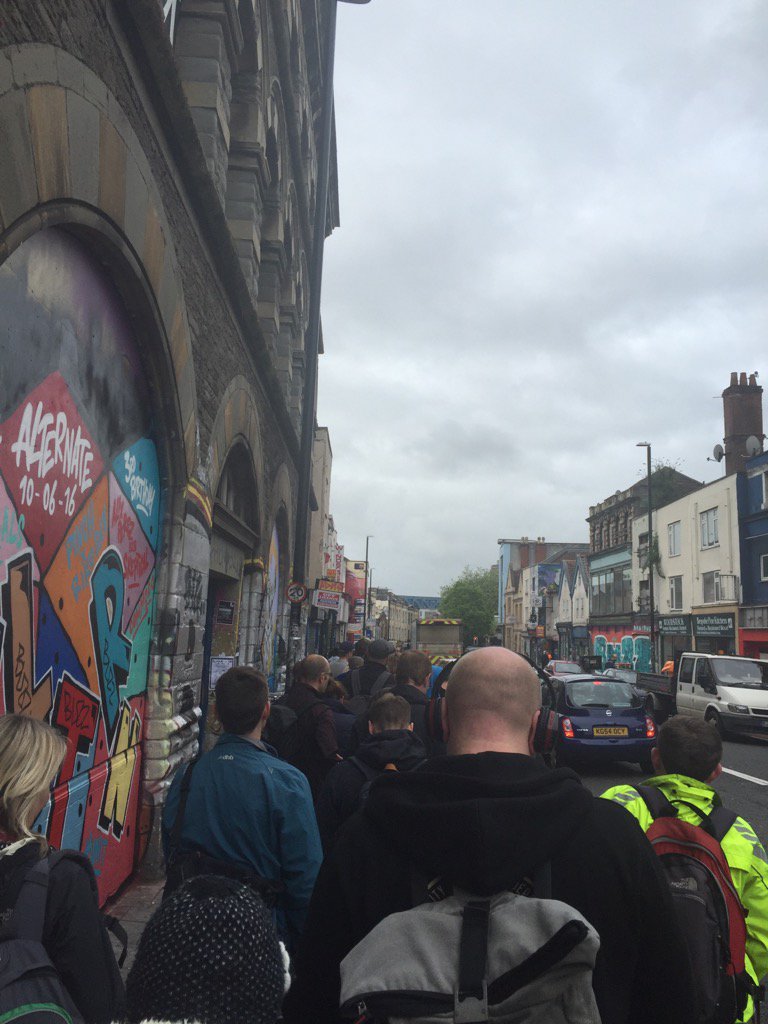
Unlike Glasto or Radiohead, and in stupidly long actual physical queue for gig tickets. #stokescroft #massiveattack

The ticket queue at Bristol Ticket Shop is still going strong too!

Ben is first in the queue at Idle Hands in Stokes Croft! He says "Massive Attack just represent Bristol don't they?"

https://twitter.com/bbcrb/status/733550481142775809
--
Massive Attack tickets generating massive queues after going on sale

Tickets for Massive Attack's home-coming concert in Bristol have gone on sale with hundreds of people queuing in the city to get their hands on them.
The concert in September will take place on the Downs - the first time an outdoor music event has been held there for 15 years.
Tickets have also gone on sale online but many fans decided to queue up outside the Stokes Croft shop Idle Hands from as early as 4am to be in line for tickets as they went on sale at 8am.
Around 20,000 people are expected to attend the show on September 3.
---
19/05/2016
"Jamaican Pulse" in Bristol this summer
Bristol's Royal West of England Academy (RWA) will host an exhibition of Jamaican art this summer. One more reason to pass by.
Jamaican Pulse: Art and Politics from Jamaica and the Diaspora

B.I.B. Kimani Beckford, oil on canvas, 2014
At a time when Jamaican art is receiving growing international acclaim, Jamaican Pulse showcases the extraordinary diversity of Jamaican art, presenting contemporary artwork alongside key works from Jamaican art history.
While exploring the roots of modern Jamaican art and suggesting new links between past and present, the exhibition also explores the artwork through a political lens and considers how global attitudes to body, gender, religion, class and sexuality have impacted this small island nation. By creating a conversation between the Jamaican Diaspora population across the UK and internationally, Jamaican Pulse looks back at early artistic and political awakening, whilst also creating a platform for contemporary artists.
Many of the contemporary artists in the exhibition also featured in the recent, critically- acclaimed Jamaica Biennale. Their work spans multiple disciplines including painting, sculpture, photography, textiles and moving image, and will be supported by twentieth century artwork from a number of public and private collections, including the Jamaican High Commission, London, and The National Gallery of Jamaica, Kingston.
Jamaican Pulse will be accompanied by an exciting learning and participation programme, with activities taking place on and off-site, including a satellite programme at The Bluecoat, Liverpool.
Jamaican Pulse is delivered in partnership with the Jamaican High Commission and is supported by Arts Council England and the Art Fund. It is co-curated by Kat Anderson and Graeme Mortimer Evelyn on behalf of the RWA

Ras Dizzy, The Bird is a Shefield Prospect it Cald the Gospel Bird, 1998, Tempera and oil on matboard,27.9 x 38.1 cm, Courtesy of Cavin-Morris Gallery, Photograph © Cavin-Morris Gallery
--
Details:
25 June – 11 September
Admission Prices
Adults: £6.95
(includes a 70p donation)
(includes a 70p donation)
Concessions: £4.95
(includes a 50p donation)
(includes a 50p donation)
Under 16s/SGS, UoB & UWE students: FREE
Art Fund card holders: £4.50 (includes a 50p donation)
PLEASE GIFT AID YOUR TICKET and help us to claim up to 25% more
(Please ask for details)
Become a Friend (yearly membership): from £15, enjoy unlimited repeat visits, private view invitations, and other benefits.
For more details on admissions go to: www.rwa.org.uk/visit-us/admission/
Opening times
Galleries and café
Tuesday – Saturday: 10am – 6pm
Sunday: 11am – 5pm
Closed Mondays
Last admission 30 minutes before closing.
Tuesday – Saturday: 10am – 6pm
Sunday: 11am – 5pm
Closed Mondays
Last admission 30 minutes before closing.
Subscribe to:
Posts (Atom)