16/08/2016

The thing about Britain...


 Ah England... Even after the Brexit referendum, even after the most wonderful weeks in the equally as wonderful Sicily, you manage to remain such a source of inspiration for me! Why...? How come?! You know, a friend even suggested that we may have been deeply linked in a past life...

 Anyway, England, as much as things are changing right now, as awkward as the political prospects remain, I'm still deeply connected to your culture.

 It's not only about England... It's the whole of the British Isles!

 I was reading some poems from the great William Butler Yeats and it's obvious that in terms of history and politics, Ireland is a special source of inspiration. Samuel Beckett is indeed one of my favourite writers. And Dubliners have always shown to me how incredibly welcoming they are...

It's about how London has managed to remain connected to the world, I guess, to preserve its openness and intelligence from bigoterie.

So here are a few events that I want to share, currently in or soon to take place in London.

I'll be back soon in West England too. Then I hope to visit Glasgow and Northern Ireland before the end of the year. Next summer, I have to be in Edinburgh for the literary festival. And I don't even mention my long-overdue visit to Liverpool where a dear friend is from.

And so on and so on.

Below for the events!

--

First, art:


BLACK CHRONICLES
PHOTOGRAPHIC PORTRAITS 1862-1948

18 MAY - 11 DECEMBER 2016

NATIONAL PORTRAIT GALLERY

LONDON, UK
Free display


The National Portrait Gallery in partnership with Autograph ABP presents a unique ‘snapshot’ of black lives and experiences in Britain.
An important display of photographs, which will reveal some of the stories of Black and Asian lives in Britain from the 1860s through to the 1940s, opens in May at the National Portrait Gallery.
Black Chronicles: Photographic Portraits 1862-1948 will bring together some of the earliest photographs of Black and Asian sitters in the National Portrait Gallery’s Collection.
These will be exhibited alongside recently discovered images from the Hulton Archive, a division of Getty Images. The display of over 40 photographs will highlight an important and complex black presence in Britain before 1948, a watershed moment when the Empire Windrush brought the first group of Caribbean migrants to Great Britain.
In addition, Black Chronicles: Photographic Portraits 1862-1948 will highlight new acquisitions including a series of portraits by Angus McBean, of Les Ballets Nègres, Britain’s first all-black ballet company and a selection of photographs of the pioneer of classical Indian dance in Britain, Pandit Ram Gopal, by George Hurrell.
Individuals with extraordinary stories, from performers to dignitaries, politicians and musicians, alongside unidentified sitters, will collectively reveal the diversity of representation within 19th and 20th century photography and British society, often absent from historical narratives of the period. 
They will include the celebrated portraits by Camille Silvy of Sarah Forbes Bonetta, one of the earliest photographic portraits of a black sitter in the Gallery’s Collection. Born in West Africa of Yoruba descent, Sarah was captured at the age of five during the Okeadon War. She was thought to be of royal lineage and was presented to Queen Victoria, as if a gift, from King Gezo of Dahomy. As Queen Victoria’s protégée, Sarah was raised among the British upper class and educated in both England and Sierra Leone. In 1862, she married the merchant and philanthropist James Pinson Labulo Davies.
Black Chronicles: Photographic Portraits 1862-1948 will also feature Samuel Coleridge-Taylor, a celebrated British composer of English and Sierra Leonean descent who was once called the ‘African Mahler’; Dadabhai Naoroji, the first British Indian MP for Finsbury in 1892; members of the African Choir, a troupe of entertainers from South Africa who performed for Queen Victoria in 1891; international boxing champion Peter Jackson a.k.a ‘The Black Prince’ from the island of St Croix; and Ndugu M’Hali (Kalulu), the ‘servant’ of British explorer Sir Henry Morton Stanley, who inspired Stanley’s 1873 book My Kalulu, Prince, King and Slave: A Story of Central Africa.
Black Chronicles: Photographic Portraits 1862-1948 will include original albumen cartes-de-visite and cabinet cards from the Gallery’s permanent Collection, presented alongside a series of large-scale modern prints from 19th century glass plates in the Hulton Archive’s London Stereoscopic Company collection, which were recently unearthed by Autograph ABP for the first time in 135 years and first shown in the critically acclaimed exhibition ‘Black Chronicles II’ at Rivington Place in 2014.
Dr Nicholas Cullinan, Director, National Portrait Gallery, London says: “We are delighted to have the opportunity to collaborate with Autograph ABP and present this important display - bringing together some of the earliest photographs from our Collection alongside new acquisitions and striking images from Hulton Archive’s London Stereoscopic Company collection.”
Renée Mussai, Curator and Head of Archive at Autograph ABP, says: “We are very pleased to share our ongoing research with new audiences at the National Portrait Gallery.  The aim of the Black Chronicles series is to open up critical inquiry into the archive to locate new knowledge and support our mission to continuously expand and enrich photography’s cultural histories. Not only does the sitters’ visual presence in Britain bear direct witness to the complexities of colonial history, they also offer a fascinating array of personal narratives that defy pre-conceived notions of cultural diversity prior to the Second World War.”
Liz Smith, Director of Participation and Learning, National Portrait Gallery, says:  “Beyond the significant display, the partnership with Autograph ABP will enable the National Portrait Gallery to provide a rich programme for schools, families and young people and a one-day conference. This will enable a fuller exploration of perspectives on identity and representation and for the images to reach a wider audience.”
-

UK FILM PREMIERE AND DISCUSSION
DREAMS IN TRANSIT

TUE 6 SEPT, 7 - 9PM

RIVINGTON PLACE

LONDON, UK
£3


Join us for the UK premiere of award-winning director Karen Martinez's Dreams in Transit, a poetic documentary reflecting on the theme of identity and contemporary migration.
First screened to much acclaim at the Trinidad & Tobago Film Festival in September 2015, the film is narrated by a Trinidadian based in London, who returns to the Caribbean to explore what 'home' and ‘belonging’ really mean for both migrants and non-migrants, particularly in the age of cheap air travel and Skype. The film uses a kaleidoscopic approach that mixes interviews, actuality, a meditative narration delivered by the actor Martina Laird and an evocative acoustic score by acclaimed London-based Trinidadian composer Dominique Le Gendre.
After the screening independent film and moving image curator Karen Alexander will be in discussion with director Karen Martinez.
-
Theatre / Musical

Groundhog Day

Join us this summer for the world premiere of Groundhog Day a new musical directed by Old Vic Artistic Director Matthew Warchus.
Groundhog Day is the story of Phil Connors (Andy Karl), a cynical Pittsburgh TV weatherman who is sent to cover the annual Groundhog Day event in the isolated small town of Punxsutawney, Pennsylvania, when he finds himself caught in a time loop, forced to repeat the same day again and again…and again. As each day plays out exactly the same as before Phil becomes increasingly despondent, but is there a lesson to be learnt through his experiences, will he ever unlock the secret and break the cycle?
Director Matthew Warchus, composer and lyricist Tim Minchin, choreographer Peter Darling and designer Rob Howell, four of the creators of the international sensation Matilda The Musical, have joined forces with writer Danny Rubin to collaborate on this new musical based on his 1993 hit film.
Andy Karl’s numerous Broadway credits include On the Twentieth Century, Rocky, The Mystery of Edwin Drood, Jersey Boys, Wicked, 9 to 5, Legally Blonde, The Wedding Singer and Saturday Night Fever.
Groundhog Day will play a strictly limited 10-week season from Friday 15 July – Saturday 17 September 2016.
[Andy Karl is appearing with the support of UK Equity, incorporating the Variety Artistes’ Federation, pursuant to an exchange program between American Equity and UK Equity].

At the Old Vic Theatre
Fri 15 Jul – Sat 17 Sep 2016
(Previews Fri 15 Jul – Mon 15 Aug)
Mon – Sat 7.30pm; Wed & Sat 2.30pm
-
See you soon England.

11/08/2016

Full line-up for Massive Attack's "The Downs Festival" announced


Via Crack Magazine :


ADDITIONAL SUPPORT ACTS ANNOUNCED FOR MASSIVE ATTACK BRISTOL SHOW

A DJ line-up has also been announced for the Clifton Downs festival
The full line-up for The Downs Festival with Massive Attack has now been announced.
Additional support acts Savages and Khruangbin will join Primal Scream, Skepta and local support on the main stage, while on the second stage, Smith and Mighty, DJ Krust, Pinch, Sam Binga, Bristol Hi-Fi, Stryda and Idle Hands will complete the DJ line-up.
The Downs Festival will take place on Saturday 3 September from 1-11pm on Clifton Downs. 
Tickets are now sold out.

09/08/2016

THE COLOR LINE: Quai Branly (4 octobre 2016 - 15 janvier 2017)


THE COLOR LINE
Les artistes africains-américains et la ségrégation

4 octobre 2016 - 15 janvier 2017


L'exposition The Color Line, présentée au musée du quai Branly à partir du 4 octobre retrace 150 ans d'histoire de l'art africain-américain, à travers les œuvres d'artistes emblématiques, David Hammons, Jacob Lawrence, Aaron Douglas, Elizabeth Catlett, Ellen Gallagher...


Titre d'un article du grand leader loir Frederick Douglass, l'expression The Color Line désigne la ségrégation des Noirs apparue aux États-Unis après la fin de la guerre de Sécession en 1865. La ratification du 13e amendement allait ouvrir une nouvelle période de l'histoire américaine, et l'esclavage laissait place à un siècle de ségrégation (qui connaîtra son terme en 1964, après de nombreuses luttes, avec la signature du Civil Rights Act par le Président Johnson).

Rassemblant  pour  l'une des  premières  fois  en  France les grands   noms   de   l'art    africain-américain,   encore   trop largement méconnus en dehors des frontières  américaines, l'exposition  du  musée  du  quai  Branly  -  Jacques  Chirac s'articule autour  d'un parcours chronologique. Il débute en 1865  par  la  fin  de  la  guerre  de  Sécession,  l'abolition  de l'esclavage et le début de la ségrégation et s'achève avec  les productions contemporaines dont celles traitant du Civil Rights Act, portant les marques indélébiles de cette période de l'histoire des africains-américains.

Le parcours intègre également quelques focus thématiques sur de grandes figures ou mouvements liés à la ségrégation : le quartier de Harlem, la figure emblématique de Rosa Parks, ou encore le cinéma noir des années 1920-1930.

A travers un ensemble exceptionnel de 600 œuvres et documents, l'exposition présente cette période de l'histoire américaine du point de vue de ceux qui étaient les victimes de cette « ligne de couleur »discriminatoire.


 Exposition Galerie Jardin 
Commissaire de l'exposition : Daniel Soutif
Reginald A. Gammon, Jr, Martin Luther King Jr © Adagp, Paris, 2016

Mickalene Thomas, Origin of the Universe I © Adagp, Paris, 2016


01/08/2016

That Window...


“The 100th Window is the one you don’t close. It’s the one you’ve got no real control over. It sounded celestial to me, almost Buddhist. It’s a window in your head where people can look in and you can see out without fear.”

- Robert Del Naja, in The Big Issue, February 2003


-


'Future Proof', live in Paris, February 2016: 


De Massive Attack à Banksy, l’histoire d’un groupe d’artistes, de leur ville, Bristol, et de leurs révolutions


On October the 6th, 2016, my book will be out in France.
Then I hope in 2017 in the UK...

Thanks a million to all the wonderful artists who agreed to be interviewed, in Bristol and beyond. See you soon in the West Country.

Pour les francophones, rendez-vous le 6 octobre dans toutes les bonnes librairies!

-


En dehors de la zone de confort

De Massive Attack à Banksy, l’histoire d’un groupe d’artistes, de leur ville, Bristol, et de leurs révolutions

Mélissa CHEMAM

Editions Anne Carrière


Copyright / crédit : Robert Del Naja


Qu’ont en commun le Pont suspendu d’Isambart Brunel, l’acteur Cary Grant, le groupe Massive Attack, le plasticien Damian Hirst et l’artiste de rue Banksy ? Ils sont tous originaires de Bristol, une ville moyenne de l’ouest de l’Angleterre. Une ville marquée par une histoire riche et complexe, mais encore jamais racontée !

Marquée par une fortune précoce liée à l’ouverture de l’Angleterre vers l’Amérique, elle devient aussi un des points névralgiques du commerce triangulaire. C’est justement cette histoire qui va nourrir, de manière inédite et radicale, la génération d’artistes éclose à Bristol à partir de la fin des années 1970. Post-punk et reggae se rencontrent autour de groupes comme Black Roots, le Pop Group puis The Wild Bunch.

Tout prend forme lorsque qu’un jeune graffeur anglo-italien du nom de Robert Del Naja signe du pseudonyme de 3D sa première œuvre de rue sur un mur de la ville en 1983. Avant de fonder le groupe Massive Attack en 1988 avec les DJs Grantley Marshall et Andrew Vowles, il rencontrera sur sa route les pionniers du post-punk de Londres et Bristol, les passionnées de reggae antillais du quartier de Saint Pauls, puis la chanteuse Neneh Cherry et le rappeur Tricky. Creuset inattendu mêlant hip-hop, reggae, soul et guitares rebelles, le premier album de Massive Attack, Blue Lines, sort en 1991 et provoque une révolution dans la culture populaire britannique. Massive Attack devient l’incarnation du succès d’un métissage à la britannique, et parviendra à toujours se renouveler, tenter de nouvelles révolutions et durer au-delà de nombreux mouvements musicaux des années 1990 et 2000, telles la Brit Pop, l’electronica et le drum and bass.

Dans le sillage de cette créativité débridée mêlant musique, art et implication sociale profonde, naissent aussi les groupes Portishead et Roni Size, les mouvements nommés trip-hop et dubstep, et le génial Banksy, inspiré dès son plus jeune âge par les graffitis de Robert Del Naja. Depuis, la profondeur artistique de ces artistes et leur engagement n’ont fait que se renforcer, tout comme leur lien avec leur ville. Ce lien va devenir le tremplin qui les porte jusqu’à l’autre bout du monde, de l’Amérique à Gaza. Il pousse aussi très tôt Robert Del Naja à se mobiliser – contre la guerre d’Irak, pour les droits des Palestiniens ou plus récemment pour l’accueil des réfugiés jetés sur les routes européennes. Rébellion, art, musique, engagement, Bristol synthétise ainsi une autre histoire du Royaume-Uni. Une histoire qui amène au sommet des charts et sur le devant de la scène de parfaits autodidactes et la part plurielle et afro-antillaise de la culture britannique.


L'auteur
Journaliste depuis 2004, passée par Paris, Prague, Miami, Londres, Nairobi et Bangui avant d’atterrir à Bristol, Mélissa Chemam est allée à la rencontre de tous les artistes de la ville anglaise, chez eux, et sur les routes qu’ils parcourent.

-

Lien vers le site de l'éditeur:
http://www.anne-carriere.fr/ouvrage_en-dehors-de-la-zone-de-confort-melissa-chemam-302.html


Sicile : Art's Oasis, l'île en art


 Back from Sicily, here the first of my articles about the art scene.
Enjoy and thanks to the wonderful people I met in this beautiful island!!


« ART'S OASIS », DÉBARQUEMENT D’ART EN SICILE


En Sicile, la petite ville de Petronino, dans l’ouest de l’île, a été littéralement transformée par l’art. C’est une nouvelle équipe municipale emmenée par le maire Gaspare Giacalone qui a réussi à redonner à ce village délaissé ses lettres de noblesses : bord de mer radieux, plantes méditerranéennes et services publics y sont désormais les atouts qui redonnent aux quelque 8500 habitants leur dignité. Pour fêter cela, l’équipe municipale a créé le projet Art's Oasis, qui invite des artistes à redécorer la ville tous les étés. Compte-rendu de la deuxième édition.


Les sculptures sont posées face à la mer, comme le mégaphone géant créé par Giuseppe Zumma, artiste et commissaire d’exposition originaire de la petite ville de Gibellina, formé à Rome. Les murs des maisons bénéficient quant à eux de murals, pour la plupart des œuvres peintes par des artistes et plasticiens, avec l’aide de quelques graffeurs et street artistes. Gaspare Giacalone et son équipe ont été élus en 2012, après que Gaspare, banquier spécialisé dans l’aide au développement basé à Londres mais originaire de Petrosino, a lancé une campagne pour empêcher un promoteur immobilier peu scrupuleux de défigurer la côte avec un projet imposant. Petrosino, où « seulement 15% des habitants payaient alors leurs impôts », selon Gaspare, avait besoin d’un renouveau politique. Depuis cette élection, la population de la ville est passée de 7000 à 8500 habitants, des jeunes partis chercher du travail ailleurs étant revenus pour aider au renouveau. A cela s’ajoute un influx de 4000 personnes l’été.
« Mes grandes priorités ont été de ramener la propreté, de rouvrir les écoles, de replanter les fleurs et de faire venir de l’art », insiste Gaspare, entouré de son adjointe, la souriante Federica, du jeune Gianvito, en charge de la communication pour la municipalité, et de Sergio qui a convaincu les artistes invités cette année de passer une partie de leur été à Petrosino. C’est ainsi qu’est née l’initiative Art's Oasis, qui fait venir musiciens et artistes du monde entier dans la petite ville sicilienne.

Tour du monde artistique

De Milan à Naples en passant par Bruxelles, Santiago de Cuba et Rio Les artistes invités cette année viennent de plusieurs continents : de Milan à Cuba, en passant par le Brésil. Le célèbre Dzia est également venu de Belgique mi-juillet. Paopao, graffeur et artiste du nord de l’Italie, est arrivé en famille, avec sa femme, qui l’aide depuis ses débuts, et leurs deux petits garçons. Ce qui lui plaît le plus en Sicile est le sens de l’hospitalité : « Ici, tout le monde est plus ouvert. Je connais de nombreux artistes de Catane et de Palerme, et je pense que la Sicile est en train de connaître une période artistique très intéressante », explique Paopao, Paolo de son vrai nom. « Peut-être parce que les Siciliens vivent sur une île, ils s’investissent pour établir de nombreuses connections, ils vont à la recherche d’influences ». Il cite en exemple le travail du sculpteur Domenico Pellegrino et du peintre Max Ferrigno.
Pour Art's Oasis, Paopao a réalisé une œuvre de 9 mètres de haut représentant son animal totem, un pingouin, entouré par un paysage sicilien. Il s’inspire notamment du travail d’un artiste qu’il connaît bien, le célèbre Blu, un des pionniers du street art italien, originaire de la région de Bologne et connu pour ses fresques gigantesques, dont une bonne partie est réalisée à la main.
Comme tous les artistes invités, Paopao a d’abord rencontré le propriétaire du mur sur lequel il a peint, par l’intermédiaire de Sergio, bras droit du maire dans ce projet. C’est Sergio qui a aussi guidé Danis Ascanio, 28 ans, un artiste originaire de Santiago de Cuba et installé à Milan depuis plusieurs années. « J’ai participé à un concours d’art contemporain organisé par la présidente de CubeArt, Ana Pedroso, et c’est comme cela que j’ai été invité en Italie », raconte Ascanio. La Sicile lui a inspiré une œuvre murale représentant la rencontre du désert et de la mer. « J’ai analysé le contexte autour de moi en arrivant, la mer face à nous, et la situation de sécheresse des villages, mon œuvre raconte la connexion entre les deux, et elle fait partie d’un projet que je mets en place, qui s’appellera « Climbing the Future ». 
Ascanio, qui a étudié à La Havane et est le fils d’un professeur d’histoire de l’art, pratique aussi la sérigraphie et crée des t-shirts. Il peint ses murs au pinceau et n’a jamais utilisé de bombe de peinture. Une autre de ses particularités est d’adorer transmettre : pendant qu’il travaille, il invite les enfants à participer !
C’est ce que nous confirme Julia Debasse, une artiste et musicienne de Rio, qui a découvert le travail d’Ascanio lors de ce séjour en Sicile. Pour son œuvre sicilienne, Julia, dont le nom d’artiste – Debasse – vient d’un de ses ancêtres d’origine syrienne, s’est inspirée d’une nouvelle de Giuseppe Tomasi di Lampedusa, La Sirena. « Le livre raconte l’histoire d’un vieil homme amer de Turin qui raconte à un jeune homme son histoire d’amour passée avec une sirène… Dans ma peinture murale, j’ai représenté la sirène et l’une des tours symbolique de Turin. Et j’ai constaté que les habitants, ici, y lisaient une métaphore politique… Sur les Siciliens obligés de partir travailler dans le nord du pays ». Pour Julia, c’est également le lien avec la population de Petrosino qui restera le plus fort souvenir. « C’est la première fois que je peins sur un mur et c’est une expérience que j’ai partagé de manière unique », ajoute-t- elle, « je suis très touchée par l’hospitalité sicilienne ! »

Hospitalité et diversité à l’honneur

Aventure sociale autant qu’artistique, Arts’ Oasis est merveilleusement représentée par l’œuvre de la Napolitaine Roxy In The Box : ‘StARTer’ est un encouragement, un appel à commencer quelque chose de nouveau, une nouvelle vie, et une métaphore du courage en art. Pour Roxy, qui elle aussi est peintre, c’est ce qu’incarne la peinture murale. Elle a dû se battre pour assumer son statut d’artiste, et son œuvre, représentant des nageurs prêts à se jeter à l’eau, a été inspirée par ce courage de quitter un travail pour se consacrer à l’art. Roxy vient du quartier dit « espagnol » de Naples, l’un des plus populaires d’Italie. Elle s’intéresse essentiellement à la relation entre l’art et les cultures populaires, et travaille sur des photos, des installations et des performances qui ancre sa créativité dans la ville et en interaction avec ses habitants. A Petrosino, elle a organisé une petite performance où des plongeurs grandeur nature ont posé à côté de son œuvre…
A Naples, elle est connue pour ses collages inspirés de portraits de Fridal Kahlo, Marina Abramovic, Barack Obama ou encore Amy Winehouse, apposés sur les murs des bassi, les maisons des quartiers pauvres de Naples où les familles utilisent la rue comme seconde pièce tellement leurs logements sont exigus… « Les gens ont commencé à interagir avec les peintures et collages », raconte Roxy. Elle prépare à présent une performance inspirée d’une pièce de Shakespeare… Petrosino, à l’image de la riche histoire de la Sicile, a ainsi créé avec Arts’ Oasis plus qu’un rendez-vous de démonstration artistique, un petit laboratoire de changement social et de créativité multiculturel.

-

Quelques photos :

Ascanio: 


Dzia:


Pao:


Roxy In The Box - 'StARTer':


La Sirena - Julia Debasse


30/07/2016

'Bristol Punk' storms the Arnolfini


MOVING TARGETS 

Arnolfini Gallery, Bristol 
Saturday 30 July 2016 to Sunday 11 September 2016, 11:00 to 18:00
Free  

Punk has more than one story

This summer at Arnolfini we embrace the unstable, the volatile and the unpredictable. In Punk’s 40th anniversary year, we draw on Bristol’s independent spirit and explore punk as an attitude that has more than one history and meaning.

Moving Targets brings an unruly summer season of music, performance, visual art and activities to the harbourside. Art works, sounds, events and workshops spill out of the building, taking over our foyer, leaking into the bookshop and café, and activating the outdoor space.
Arnolfini and the city of Bristol have a special relationship to punk. During July and August, join us to find out about other stories and ideas around punk and tell us what punk means to you.
Should we reject the future? Be angry, raw, fearless? Is there a place in punk for everyone?
Let’s step outside the gallery, make things happen, shout out loud, disrupt, improvise and make some noise! 


Punks hanging out at Arnolfini, 1977, photo Tim Williams_courtesy Bristol Archive Records

Moving Targets includes:

Outdoor poster work exploring print as protest by artist Phoebe Davies and students from UWE Graphic Design in collaboration with Bristol Archive Records
Live radio shows by artist Jenny Moore and collective, gal-dem
Inhabit, a space to debate the future of our city, created by Young Arnolfini
Unmissable Music celebrating Bristol’s punk heritage
Plus a whole host of defiant performances, films, workshops, discussions and family activities.
 Join in the conversation using #bristolpunk
*Our title Moving Targets is taken from and dedicated to Mimi Thi Nguyen and Golnar Nikpour’s amazing chapbook, 'Punk is a Moving Target', Guillotine press, 2013

29/07/2016

'Come Near Me': Massive Attack's new video


Come Near Me feat. Ghostpoet Produced and co-written by Grant and Stew Jackson

Massive Attack, Ghostpoet - 'Come Near Me'


See what happens when you're too afraid...
Massive Attack new video, for 'Come Near Me' is out. Film by Ed Morris.
Also features a great scene where a driver is playing 'Unfinished Sympathy' loudly in the car... 
Brilliant work.


Published on 29 Jul 2016
Massive Attack feat. Ghostpoet - ‘Come Near Me’. Taken from ‘The Spoils’ - Spotify – http://po.st/MASpoilsSP | iTunes – http://po.st/MASpoilsiT | Apple Music - http://po.st/MASpoilsAM | Official Store: http://po.st/MAOfficialStore

https://twitter.com/MassiveAttackUK
https://www.facebook.com/massiveattack
https://www.instagram.com/massiveatta...

Live dates: http://po.st/MALive

http://www.massiveattack.co.uk/

-

You can read more here on the video, on Dazed:


Massive Attack release tense new video for ‘Come Near Me’

The strange, stylish clip for the Ghostpoet-featuring single follows

 a couple adrift in a ‘painfully normal’ world


Massive Attack have released a new song for their Ghostpoet-featuring “Come Near Me”. The song was released earlier this week via Fantom, the band’s reactive remix app, that plays songs in different configurations depending on a variety of environmental settings with your phone.
Its tense, stylish new video, directed by Ed Morris, was shot in a day in Hove, and stars Kosovar actress Arta Dobroshi and British actor Jonathan Aris as a couple adrift in a destructive relationship. “The idea, everything I considered came from the track,” Morris tells us, “The notion of an emotional stand off, an impasse, came about quite early. I explored that visually.”
“When you are going through something tough emotionally the world around you can seem so surreal. So pointless,” he continues, “The world we portray around them is a very normal one, almost painfully normal. It’s a complete contrast to their madness.”
Morris describes the video as a “very singular, simple visual narrative”, but this simplicity is given a sudden jolt midway through when it’s interrupted by the unexpected use of Massive Attack’s own “Unfinished Sympathy”. “‘Unfinished Sympathy’ brings such nostalgia and love with it,” Morris says, “It’s basically the 90s showing up in a present day promo.”


and here:

https://lbbonline.com/news/ed-morris-on-his-haunting-massive-attack-video-come-near-me/#.V5s6xPWkNDc.twitter


Ed Morris on His Haunting Massive Attack Video 'Come Near Me'


A disintegrating relationship, intense performances and some surprising Easter Eggs make for a dark modern fable

Ed Morris on His Haunting Massive Attack Video 'Come Near Me'
Following on from the eerie horror of Ringan Ledwidge’s Massive Attack video ‘Voodoo in My Blood’, fellow Rattling Stick director Ed Morris has written and directed a foreboding promo for the band. The film for ‘Come Near Me’, a track featuring Ghostpoet, explores the isolation and irresistible downward pull of a broken relationship. Central to the video is the seething chemistry between the lead performers, Kosovar actress Arta Dobroshi and British actor Jonathan Aris.
LBB’s Laura Swinton caught up with director Ed Morris to explore the film’s influences and meaning and delve into the craft behind it.

LBB> What did you make of the track when you first heard it? Was there anything about it that particularly resonated with you
EM> You should never do a promo unless you really like the track, I really liked the track. The first thing I thought was that the track was filmic. It had a very singular, immediate and arresting tone and personality. And the subject matter was compelling and rich. 

LBB> What was your way into the story and the treatment? In the early stages, were you led more by that core emotional idea or the visuals?
EM> I wrote quite a bit until I got on to an impasse, a dispute, and emotional stand off. Then I tried to visualise that.

LBB> The decision to include those outside observers – the woman in the car, the boys on the bike – who break in, over the track was a really powerful moment for me because it highlighted how isolating bad relationships can be and how frustrating it is to outside observers/friends. Maybe I’m projecting… but I was wondering what you were hoping to get at with these moments?
EM> You are right, they are there to do that. They are the normal everyday contrast to the veiled madness and isolated intensity of the relationship breakdown. They also work practically to fuck with the narrative here and there and drive it a bit.

LBB> There’s a bit of an Easter Egg in the promo, when Unfinished Sympathy starts blaring out of a passing car. When did you come up with that? Was it in the treatment or was it an off-the-cuff experiment? What did the band make of it? And what do you think it brings?
EM> At first it was two coppers. I wanted D and G to play the police but they couldn’t, so I came up with two of the girl’s mates on their way out. 
I’ve been circling the idea of introducing another second track in to a promo for a while. You know, you pull these things out the hat when you need them. I have a hat under the table.

LBB> What were you looking for in the two lead actors? They have a pretty intense chemistry and it’s that tension between them that supports the whole film – how did you work with them to capture that?
EM> I was looking for two people who could transmit everything without doing anything. I did an intense sort of mini workshop with them in a hotel room before we went out. I filmed it on my iPhone, and reviewed it with them. They got it immediately, they loved it.

LBB> It’s not the first time you’ve worked with the Massive Attack crew – there’s your short for Robert del Naja’s Battle Box. Did that create a more trusting environment for the project? If so, what sort of impact did it have on the whole process of bringing the film to life?
EM> Yeah, there is trust. That helps of course but you can’t rest on that. D and G and Marc their manager are all about as sharp as it gets and you can’t second guess any of them. If anything, there is an expectation from them; you have to honour that.

LBB> Where did you shoot it and what were the most challenging elements of the actual shoot? 
EM> We shot in Southwick, near Hove. It’s a semi industrial and interesting little seaside town. It has some interesting landmarks. I drove down there one Sunday after I’d written the script and it just had this incredible sense of place to it. Everything became crystal clear then.
On the actual shoot, I had an amazing team around me. I couldn’t have asked for better so it really was a smooth and fairly easy process. The challenge is always time I suppose, and the limit of my own intelligence - that fucking close ring fence I keep hurtling in to.

LBB> That shot on the motorway gave me a wee jump! Was that a particularly tricky stunt?
EM> Yeah, we had to go out there and rehearse the timings and do the traffic control, that kind of stuff. You know, make sure it could cut right etc. The Council are pretty jumpy about all that.

LBB> While the action of the video is quite simple, it layers up these really complex emotions and the timeline jumps back and forth… the edit is really key. How did you approach the edit and who did you work with on it? What did they bring to it?
My editor Flaura [Atkinson at The Quarry] is, I think, one of the best editors in the world, certainly when it comes to anything musical. We worked backwards. I knew the pace must come from the last scene. I asked her to string it out as much as possible, make it almost unbearably drawn out. We found the film that way; it’s rhythm and atmosphere. Then we built it scene by scene. 
It wasn’t easy because so much depended on sound and remixing the track, the stems. The film dismantles the track and the narrative. After, Scott, a great sound guy I like to work with, got stuck in. We batted it back and forth a bit between edit and sound, just crafting really.

LBB> The grade too is beautiful – especially that rich deep blue at the very end... Who did you work with on that? And what sort of influences and ideas did you have for the colour?
EM> Well Franz Lustig, the DOP, graded stills from the shoot at my place while we drank sloe gin chatted late after the shoot. He’s born the same year as me, we discovered. 
I also take film stills when I shoot and use those to inform the final grade. Then of course we take all that to Seamus O’Kane at the mill and he just makes it better from there. The Mill really took care of some magic on this. The magic Mill.

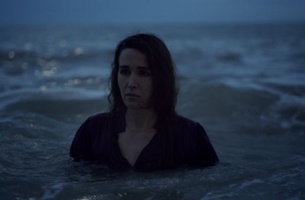
LBB> At the end of the video, I couldn’t help draw comparisons with folk tales and dark fairy tales – the siren, the Little Mermaid melting into the sea, even the Scottish selkie… Was that something that influenced that end scene? Are these stories something that interests you? Or am I projecting again?
EM> No, you are right, I’m pleased you picked that up. Yes, all forms of story interest me. Yes, it is like a little fable. 
She is luring him really, it’s her will, her dogged defiance that he ends up the victim of. She is the victor, the strength.
There’s a play by Georg Buchner called Woyzeck. It’s a favourite of mine; the final scene ends with this sad character who has killed his partner and his partner’s lover. He’s standing by a lake. He throws the murder weapon, a bloody knife out in to the lake. His paranoia fuelled by his guilt grips him and he wades out to reach down and retrieve the knife to throw it yet further. He finds it and throws it deeper again. Ever more paranoid and desperate to cover his blame, he repeats this several times until he drowns and never comes back. 
I’ve only ever read it as a play but I’ve imagined that scene again and again. It’s a hypnotically devastating end to a terrible story. 
The last scene was influenced by that. Water, submergence, complete disappearance. Water, the sea is like a kind of earthly physical heaven or other world. It is at once beautiful, sensual and indiscriminate, violent. Like sex.

-

Link to YouTube:

https://www.youtube.com/watch?v=KY0TZQTwwbk