16/12/2016

Jupiter 2017: 'Kin Sonic' sortira le 3 mars prochain


Le nouvel album de Jupiter et de son Okwess International band sortira le 3 mars prochain!


Jupiter & Okwess
Nouvel album : Kin Sonic
Sortie le 03/03/2017 chez Zamora Label
Avec Damon Albarn, Warren Ellis 
et 3D (Massive Attack)


Video:

Jupiter Okwess - 'Bengai Yo' (Official video)


Jupiter Okwess – Bengai Yo from the EP 'Troposphere 13' 
Shop : https://jupiterokwess.bandcamp.com/
Facebook : https://www.facebook.com/JupiterAndOk...

Deezer : http://www.deezer.com/album/13947238
Spotify : https://play.spotify.com/album/0bmyLh... 
iTunes : https://itunes.apple.com/fr/album/tro... 

Discovered in 2006 thanks to Jupiter's Dance, a documentary about the new music scene in Kinshasa, and still one of its iconic - even heroic - members. Jupiter Bonkodji is back with Troposphère 13, three years after the release of the exuberant Hotel Universe the album that launched his international career. 
A trance ferryman and genuine trade-modern alchemist, Jupiter is still that rebellious soul, that heightened consciousness, a tireless local campaigner through different social aid projects, and whose lyrics express the wisdom of benevolence.


Après un premier album "Hotel Univers", remixé par 3D de Massive Atttack, et des collaborations avec Damon Albarn (Africa Express), Jupiter Okwess revient avec un nouvel EP, réalisé avec Damon Albarn et Warren Ellis.
Passeur de transes et authentique alchimiste tradi-moderne, Jupiter n'en reste pas moins cette âme rebelle, cette conscience élevée, qui agit inlassablement sur le terrain local à travers différents projets d'entraide sociale et dont chacun des textes abrite la sagesse d'un bienveillant. 

Video credits :
Directing : Roland Hamilton
Images : Florent Delatullaye
Song credits : 
Lead vocals & percussions : Jupiter Bokondji
Drums & vocals : Montana Kinunu
Bass & vocals : Yende Balamba
Guitar : Eric Malu-Malu
Guitar : Richard Kabanga
Percussions & backing vocals : Blaise Sewika
Keyboards : Damon Albarn

(p) & (c) 2016 Zamora Label


-


Voici déjà ses prochaines dates de concert jusqu'au printemps :


-

A noter que le visuel de l'album a été réalisé à partir d'une oeuvre de Robert Del Naja, le leader du groupe britannique Massive Attack, qui a déjà collaboré avec Jupiter en 2013, sur son label Battle Box.


15/12/2016

Reposting: My interview with Syrian artist Tammam Azzam


One of the most important interviews I've done this year was with the unique Syrian artist, Tammam Azzam. 

Earlier in January, for my friends' French website but they let me publish it in English first. Talent and understanding. 

Reposting because we all need to be concerned but we also need more beauty...

[INTERVIEW] TAMMAM AZZAM FROM SYRIA

7 janvier 2016 Par Melissa Chemam

Syrian artist Tammam Azzam creates a ‘hybrid form’ of painting, as his the Ayyam Gallery presents him, through the application of various media, arriving at “interactions between surface and form that borrow and multiply as compositions evolve”. Born in Damascus, in Syria, in 1980, Tammam received his formal training from the Faculty of Fine Arts of Damascus, with a concentration in oil painting. He has participated in solo and group exhibitions, all around Europe and the Middle East.


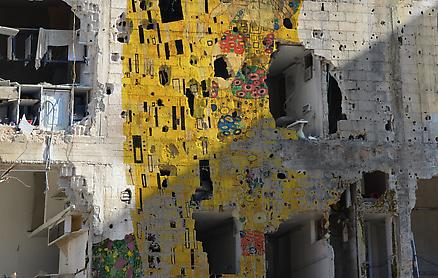
Tammam_Azzam_Freedom_Graffiti2
Forced to flee the war in his own country, since 2011, Tammam Azzam has been living and working in Dubai. Left out of his art studio, he moved into a form of digital art. He became known for digitally superimposing Western masterpieces onto photographs of Syrian bombed buildings. He also attracted the attention of Bristolian street artist Banksy and was invited in his very special exhibition named Dismaland, last summer, settled for six weeks in Weston-Super-Mare, in West England. Art is evidently for Tammam a form of resistance.
Interview with Melissa Chemam.
You were in Damascus when the revolution started in your country, which finally evolved into a civil war and the emergence of this violent islamist insurgency that gave birth to the organisation self-proclaimed the Islamic State in Syria and Iraq. How did you leave Syria and what kind of link do you managed to keep from abroad with your family in the country?
After seven months into the Syrian revolution, my wife and I felt it had become impossible to continue living there. Most artists were struggling and I have a young daughter that I could not put to school. The gallery that I work with moved to Dubai and they asked me to come with them. I decided to move, after consulting my wife. I haven’t been back in Syria since, but my parents are still there, in Sweida, where my family is from, in the south of Syria, which is a little more secure than the rest of the country. It’s not a good situation – they have no electricity or no water but there is no war there like in Damascus or Homs. I consider Dubai not as a final destination but only as a step in our life as we cannot go back home for now. Every side is an enemy.
How did you start your art in Syria and was it always politically motivated?
We grew up against Bashar Al Assad’s regime; it’s the worst anybody can imagine. I studied art at the University of Damascus and graduated from the oil painting section in 2001. I had a studio in Damascus and did my three first solo exhibitions there. I was also a graphic designer for many cultural centres in the capital, like the French Cultural Institute and the Goethe Institute. I have become familiar with graphic programming, especially since 2002, but the first time I used it as an art media was in Dubai. I had left my studio behind me and I felt like so much was missing. In another city I had to start another story. At first, there were so many difficulties just to find a home for my family and a school for Selma, my daughter, and I needed to find work. I concerted my work in graphic design and settled a mini studio at home. That’s how I started working with digital media.

You then came to fame with your piece reproducing ‘The Kiss’ from Gustav Klimt, when and how did you get that inspiration?
In 2013, after reproducing artworks from the Syrian museum, I started reproducing a painting from Francisco de Goya, ‘The 3rd of May’, created in 1808 to immortalize the killing of hundreds of innocent Spanish citizens. I reproduced it digitally, into a picture of a Syrian destroyed street. Then I reproduced ‘The Mona Lisa’ and pieces from Munch, Van Gogh, Andy Warhol, etc. The background being the Syrian war, the contrast with the piece by Klimt is even more striking. The scene comes from a picture of Douma, a small city near Damascus, one of the cities where the revolution started, and which has been destroyed completely since.
How did you find the motivation to keep on producing art and believe in resistance?
It was difficult and it is still more and more difficult. I think about art all the time but we went through terrible events in Syria, firstly, and now it is also a disaster in so many other places in the world. People call me a Syrian artist, but I prefer to be considered as an artist. I don’t consider myself as a political artist. I’m an artist who came out of this political background. I’m not producing posters against a dictator or a regime, but artworks about people, which is the main purpose for me. There are the stories in my mind, and where to get stories, except from your memory and your place? But I think that in no way art can stop armies or violence. How can I resist? How can I save a child’s life? As artists, we can just try and continue. This is the way we can express ourselves. But we cannot fight. As a person, how to change things? Politics always prevent us. For instance, if I need a visa to enter a European country, there are so many papers I need to gather, I feel powerless. How could we fight this world system? And when attacks occurred in Paris, it was considered more important worldwide that when it occurred in Damascus or Baghdad or Beirut. It’s always been like that and it’s very hard to change.
Do you believe art still has a power of conviction even in the current context?
I agree that we can probably convince the youth about the importance of democracy and freedom. But if the world had managed to stop the unfair regimes these past five years, Syria could have become a democracy or at least a form of good regime. But now, Syria has become a land of terrorists, with hundreds of terrorist groups that have spread all over the world. And the whole world is scary now. People in Syria now just want to stop all the fighting and keep on living. I believe artists and writers have a role to play to reach out to the youth, politicise them and call for peace. But in Syria nothing has changed in five years. It’s only worsening. And Europe is refusing to help refugees in a shocking way. I believe that both ISIS and the regime, and even the police in Greece or in Western Europe shooting at refugees are the dangers. It’s not about nationalities or religions. We would need to bring about a big change mentally. I’m therefore too confused to give a clear message. The only message I can give is by continuing my art, as I can, with the little I have. We should continue trying.


Visuel : ©Ayyam Gallery 


-

14/12/2016

From Belfast with words


My article on Belfast's street art scene:


Public Art Review


FEATURED 

Belfast: Walls Beyond Wars

Street artists in Northern Ireland turn away from the old angers


A mural by DMC. Photo courtesy DMC http://www.manchini.co.uk

by Melissa Chemam


BELFAST – Belfast’s walls have long been occupied by painted murals, mainly bearing political images and messages of protest. Catholics and protestants, feminists and conservative groups, anti-abortion and pro-choice movements used to fight with spray cans to own their territory.
But now, not quite 20 years after the Good Friday Agreement – which, in 1998, finally brought peace after decades of conflict – Belfast artists want to move away from the region’s tormented political legacy.
DMC, aka Dermot McConaghy, is a case in point. His portraits of sad blue ladies have helped to change the mood of Belfast’s walls. Missed Calls evoke human loneliness in the age of cell phones. He joins EMIC, Stephen Fagan (Faigy), Johnny McKerr (JMK), Kev Largey (KVLR), and Marian Noone (Friz) in this vibrant new street-art scene, which has developed over the past decade throughout Northern Ireland, and which the Ulster Museum recognized with a show in 2011.
“The country really changed a lot in the past ten years, socially and artistically,” says DMC, who, like Faigy, lives and works in Lurgan, south of Belfast. “Now a new, friendly net of connections makes things more interesting. And what makes the region special nowadays are its people, their sense of humor, an anger that has become an energy, and not its history anymore. That’s why I’m staying, anyway.”

International visitors
Belfast now has an annual event in October, Hit The North, during which artists from all over the world come to contribute: the famous Bristol-based street artists Inkie, Cheba and Andy Council have shown up quite a few times, along with Londoner Dan Kitchener, Irishman Joe Caslin, and Irish-born, now London-based Conor Harrington.
Some of the works that resulted allude to Belfast’s new spirit. Council’s Belfast Phoenix, which points to the city’s transcendence of its violent past, has become one of the city’s treasures; On Talbot Street, The Son of Protagoras, by French artist MTO, displays a dove of peace hit by two arrows, cradled in the hands of a young boy.
The man who has made the biggest contribution to the explosive growth of this artistic movement is probably Adam Turkington, who, with his Seedhead Arts group, negotiates access to walls and invites artists from Dublin, Rio de Janeiro, and all points in between to come to Belfast. Seedhead’s “Culture Night,” on the third Friday in September, attracts more than 90,000 people each year. And since January 2016, Turkington has been running a street art tour that takes visitors from Hill to North Street via Talbot Street and Saint Anne’s Cathedral.

Apolitical? Not exactly
Do the new directions in Belfast street art add up to a turn away from politics itself? Turkington doesn’t think so. “Artists refuse the narrative of the Orange and Green in this country,” he says, referring to the colors representing the two major political forces – Unionism and Irish Republicanism – and the two long-dominant parties, DUP and Sinn Fein. “By rejecting politics as it used to be here, they make a political statement.”
And political statements can take other forms in Belfast too. Joe Caslin did a very pro-LGBT artwork near the Black Box, a café and art venue on Hill Street. In early November, Robert Martin’s R-Space Gallery, in Lisburn, showed prints by Obey, the American master of subtly subversive street art also known as Shepard Fairey. Gary Rowe, aka Real1, an artist from Tottenham in London who also lived in Italy and Namibia before settling in Northern Ireland, redecorated the gallery’s exterior walls with a magnificent piece on Donald Trump, just a week before Election Day in the US – a hard-hitting set of images that became a source of inspiration for artists on the eastern side of the Atlantic as well.

Link with more visuals: http://forecastpublicart.org/public-art-review/2016/12/belfast-walls-beyond-wars/


Syria: Words from Janine di Giovanni


Twisted narratives won’t spare Aleppo a moment of its agony


A lament about feeling I’d failed as a war crimes reporter was met with abuse – it’s proof of how badly the complexities of the war in Syria have been communicated

The Guardian - Wednesday 14 December 2016 

Depending on your personal view, Aleppo has now fallen, or been retaken, or been liberated. But my interest is not with any political side. It’s with victims of state terror, and all the civilians whose lives have been shattered by a war that has been raging for more than five years. It is the most cynical conflict I have seen in 25 years of war reporting. Both the regime and opposition are guilty of war crimes, though one much more than the other.

What I’m considering now, from the comfort of my Paris home, is how a city falls. I am thinking of people cowering in basements and struggling with whether they flee from their city now, or wait. Who is coming to save them, or kill them? I know how that scenario goes. I lived through Sarajevo during the Bosnia war, and was in Grozny when it fell to (or was “liberated” by) Russian forces. I remember hiding in those basements waiting for the Russian tanks to come into the village, and wondering if I would be dead in a few hours.
I am thinking about the civilians – all of those people with whom I sat for hours while writing my book, or writing reports for the UN high commissioner for refugees – and what they are doing to survive.
My agonised frustration from watching the fall of Aleppo (or “retaking” it, in the words of the Syrian government) in real time was vented in a tweet I wrote: “Today I feel like a failure. Nearly 25 years reporting war crimes has added up to nothing. We said ‘never again’. What happened? #Aleppo”.
I use Twitter every day, but usually by re-posting articles of interest, and basically I only read tweets and articles on social media that are written about my region of speciality, the Middle East and north Africa. So when my tweet went viral I realised how many people misunderstood the Syrian conflict.
The response was a lesson in public awareness, and the failure of the international community – and our leaders – not only to do more to end the war, but to communicate this brutal crisis accurately. The war in Syria is not simply a war against terrorists – Isis and al-Nusra, the al-Qaida franchise in Syria – although this is the narrative the Russian Federation and its allies want us to believe. It started as a peaceful insurrection in 2011, an uprising in the long chain of the Arab spring, which turned to arms, and then turned into a civil war and a humanitarian catastrophe.
While many wrote to me to express their horror at the plight of the thousands of civilians who are trapped in Aleppo and suffering untold horrors, many replied to say I was “terrorist scum”, a “terrorist lover” and that “Aleppo is now cleansed”.
One tweeter, called Partisan Girl, wrote: “You started supporting Al Qaeda and regime change wars. Abject failure.” So, she thought I supported al-Qaida? And she attributed this so-called support to the fact that I wrote about war crimes in Syria, from both sides? If my reading of her response is correct, then it has verified for me the twisted narrative that has been applied to the crisis.
Another tweeter wrote: “When I served in the US military, al Qaeda was the enemy, not the ally of our illegally baked regime change proxies.” Who, I want to ask, is backing al-Qaida? Not me, and not civilians who just want to get on with their lives and live in peace.
I want to write back to the trolls who are now calling me “terrorist scum” that I loathe Isis – they beheaded my friend Steve Sotloff, a journalist just doing his job, in 2014. I equally loathe al-Nusra. Both unleashed untold murderous brutality throughout Syria.
But terrorists are not civilians, as our leaders have led us to believe by failing to act because they thought it was too “complicated”. Syria has become a proxy war, but it could have been stopped long ago. Now, however, all the countries that have a stake in this war are more concerned with their vested interests than with the fate of people starving to death or being told: “Surrender or die.”

The international community has a lot to answer for. President Obama checked out, morally and otherwise, after the 2013 Ghouta chemical attacks on rebel-held areas of Damascus – which the UN confirmed was the worst chemical weapons attack in 25 years. He ruled out any kind of US-led ground invasion because: the war had become too messy; the rise of Isis; his own concerns over his domestic optics. He left a void that was filled, too quickly, by other world leaders, such as Vladimir Putin.
Except Obama missed the point. It wasn’t just another Middle Eastern war. The sorrow of Syria has now spread its web across the region, and into Europe. Aside from the millions of refugees, the thousands of homes destroyed, the millions of children who are uneducated, the millions whose lives were cut in half – and the roll call of the dead – you will now have the anger of Muslim people around the world who believe Aleppo was left to rot.
The difference with Sarajevo is that my journalist colleagues and I were able to make a difference, somehow, on policy (though our warnings about Srebrenica went unheeded until it was too late). Throughout this war my sense was that Barack Obama and David Cameron (and now Theresa May) were never listening.

-

Link: https://www.theguardian.com/commentisfree/2016/dec/14/aleppo-syria-assad-war-crimes?CMP=share_btn_fb


MIA


If I wasn't me, I would want to be M.I.A. !!
But I'm me and it'll have to be good enough :)

Still tough, M.I.A.:


Clique x M.I.A.


Published on 3 Oct 2016
Mouloud Achour a rencontré M.I.A, à l’occasion de la Fashion week.
Au programme : Le Swagistan, son enfance au Sri Lanka, le peuple tamoul, son engagement à l’égard des réfugiés et son doigt d’honneur au concert du Superbowl.

Clique c'est une galerie de portraits d'acteurs du quotidien et de sujets qui dessinent les contours du monde de demain.
Chaque semaine, une nouvelle vidéo !

Abonnez-vous à la chaîne Clique : http://bit.ly/10UoT5i
Toutes les vidéos sur http://bit.ly/1cY7eJq


13/12/2016

Pour Alep... Demain à Paris


  Appel d'Amnesty :


MANIFESTATION

SOLIDARITÉ AVEC LES VICTIMES À ALEP


 Quand : 14.12.2016 au 14.12.2016
 Où : Place Stravinsky, Rue Brisemiche, 75004 Paris

MERCREDI 14 DÉCEMBRE À 18H

Rendez-vous à Paris sur la Place Stravinsky à côté du Centre Pompidou pour manifester votre solidarité avec les victimes d’Alep ! 
Venez habillés de rouge, ou avec un détail rouge (foulard, bonnet). Nous mettons à votre disponibilité des bougies. 

SOLIDARITÉ AVEC LES VICTIMES À ALEP 

A l’heure où les forces gouvernementales syriennes sont en train de prendre le contrôle de la quasi-totalité de l’Est de la ville d'Alep, des dizaines de milliers de civils doivent être protégés de toute urgence. 
Les événements des dernières 24 heures indiquent que des civils vivant dans ces secteurs seraient victimes d’actes de représailles commis par les forces loyales au gouvernement syrien : détention arbitraire, torture, disparition forcée et exécutions extrajudiciaires. Le Haut-Commissariat de l’ONU (HCDH) aux droits de l’homme dénonce l’exécution d’au moins 82 civils, dont 11 femmes et 13 enfants, par les forces pro-gouvernementales. 
« Nous avons été informés que des forces pro-gouvernementales ont pénétré dans des habitations et tué les civils qui s’y trouvaient, y compris les femmes et les enfants », a dit le porte-parole du HCDH, Rupert Colville.
Aujourd’hui, les blessés ne peuvent pas être évacués, et ceux qui essayent de fuir risquent leur vie. 
Nous demandons que : 
- Les parties au conflit autorisent les civils, s’ils le souhaitent, à quitter la ville sans restriction et en toute sécurité, et que leur évacuation soit facilitée.
- Un accès humanitaire soit garanti pour que l’aide dont ont besoin les civils puisse être acheminée.
- Les bombardements cessent.
- Des observateurs puissent assurer le respect des droits humains et du droit international humanitaire.
Nous vous appelons à venir nombreux pour exprimer votre solidarité avec les civils d’Alep.

SOYONS NOMBREUX. SOYONS SOLIDAIRES. MONTRONS AU PEUPLE D’ALEP QU’IL N’EST PAS OUBLIÉ.

Ils appellent au rassemblent :
- Amnesty International France
- CCFD - Terre Solidaire
- Collectif pour une Syrie libre et démocratique
- FIDH
-MRAP
- Souria Houria


Lien : https://www.amnesty.fr/agenda/solidarite-avec-les-victimes-a-alep


--

In English, read also from Amnesty:
https://www.amnesty.org.uk/press-releases/aleppo-reports-execution-style-killings-point-war-crimes


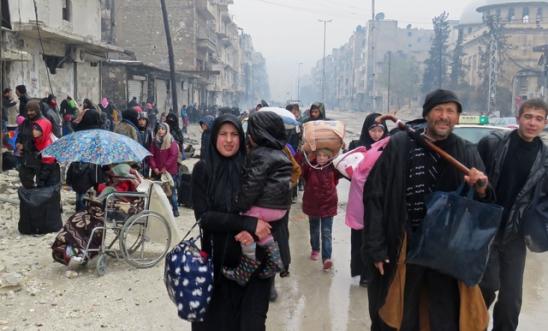
Civilians fleeing fighting in Aleppo earlier today © Stringer/AFP/Getty Images

Aleppo: reports of execution-style killings point to war crimes

Urgent call for independent monitors to ensure civilian protection and humanitarian access for life-saving aid
 
World has looked on as Aleppo has been ‘transformed into a mass grave’ - Lynn Maalouf
 
Shocking reports from the United Nations that scores of civilians have been extrajudicially executed by advancing Syrian government forces in eastern Aleppo point to apparent war crimes, said Amnesty International. Amnesty is making an urgent plea for all parties to the conflict to protect the civilian population.
 
The UN human rights office said it had reliable evidence that up to 82 civilians were shot on the spot by government and allied forces who entered their homes, or at gunpoint in the streets, over the past few hours.  
 
Lynn Maalouf, Research Deputy Director at Amnesty International’s Beirut office, said: 
 
“The reports that civilians - including children - are being massacred in cold blood in their homes by Syrian government forces are deeply shocking but not unexpected, given their conduct to date. Such extrajudicial executions would amount to war crimes.
 
“Throughout the conflict Syrian government forces, backed by Russia, have repeatedly displayed a callous disregard for international humanitarian law and utter disdain for the fate of civilians. In fact, they have regularly targeted civilians as a strategy, both during military operations and through the mass-scale use of arbitrary detention, disappearances and torture and other ill-treatment. 
 
“As government forces gain full control of eastern Aleppo the risk that they will commit further atrocities raises grave fears for thousands of civilians still trapped.
 
“In recent months the world, including the UN Security Council, has watched from the side-lines as civilians have been slaughtered on a daily basis and eastern Aleppo has been flattened and transformed into a mass grave. The global inaction in the face of such inhumanity is shameful. The lack of accountability for war crimes and crimes against humanity has allowed the parties, particularly government forces, to commit such crimes on a mass scale.
 
“It is now crucial that independent monitors are deployed to ensure that the civilian population is protected and that humanitarian access is granted so that life-saving aid can reach all those in need.”
 
At present those injured cannot be evacuated and those trying to flee are risking their lives. Amnesty is calling for all parties to the conflict to allow civilians wishing to flee the fighting to be granted safe passage to leave the area. As government forces advanced in recent weeks, civilians in eastern Aleppo told Amnesty they feared revenge attacks. Last week the UN reported that hundreds of men and boys went missing from government-controlled areas. 
 
Lynn Maalouf added:
 
“Amnesty International has previously highlighted the Syrian government’s widespread and systematic use of enforced disappearance to attack the civilian population in what has amounted to crimes against humanity. It is crucial that independent monitors are deployed to prevent further enforced disappearances, torture and other ill-treatment.” 

12/12/2016

My homage to Alberto Burri's Sicilian Land Art Masterpeace, 'Il Grande Cretto'


A Concrete Rebirth


Alberto Burri’s monumental land art project in Sicily finally came to completion—in the artist’s centennial year


Visitors can walk on top of the blocks or in the fissures between. More than 3,000 people attended AudioGhost68, which celebrated the work’s completion. Photo by Valentina Glorioso.


SICILY – In October 2015, the art world celebrated the centenary of influential Italian painter Alberto Burri with a major exhibition at the Guggenheim Museum in New York. In the same month Il Grande Cretto, Burri’s land art project in Sicily, was finally completed after 30 years—and the monumental work is now inspiring artists worldwide.
It was conceived by Burri in 1984 as a memorial to the town of Gibellina, destroyed when a violent earthquake struck western Sicily on January 15, 1968. The quake killed more than 400 people and left hundreds injured and a thousand homeless, evoking expressions of sorrow and sympathy throughout Italy.
Placed directly over the ruins of Gibellina, the 86,000-square-foot Il Grande Cretto is composed of large semi-rectangular blocks of white concrete a little more than five feet high. The blocks are broken by deep fissures that create walkable paths roughly corresponding to the ancient town’s pattern of streets.
The work’s title, which means “The Large Cretto,” establishes it as a huge, horizontal version of the cretti, or “fissures,” paintings that Burri created in the 1970s by inducing fissures or cracks in large black or white monochromatic fields of paint. The land art piece is so gigantic and imposing that it’s difficult to believe it came from the mind of an artist whose earlier works were scaled to the walls of galleries and museums.
The work was conceived when a new incarnation of the village, Gibellina Nuova, was planned a few kilometers away from the old site, and its art-loving mayor, Ludovico Corrao, engaged architects, urban planners, and artists of international renown in its construction. After a decade, Corrao realized that one name was missing from the roster of major artists working on Gibellina Nuova: Alberto Burri, celebrated worldwide since his retrospective at the Venice Biennale in 1960. So Corrao contacted Burri in 1984, and the artist agreed to take part—with a caveat.
Many pieces of public art had already been installed in Gibellina Nuova and Burri was not interested in intervening in the new city; his attention was drawn to the ruins, dubbed Gibellina Vecchia (“old Gibellina”). “His interest in Gibellina was stimulated by the tragic story of the town and the topography and site-specificity of the place,” says Emily Braun, curator of the Burri retrospective at the Guggenheim.
He proposed a gigantic work of land art to completely cover the ruins left by the earthquake. With artistic sensitivity and foresight unusual in an Italian politician at the time—unusual in politicians anywhere and at any time—Corrao sensed that, although the somber work was bound to be provocative, it would eventually come to be seen as a masterpiece and an appropriate homage to the deceased.

From Prison Camp to Gallery
Born in 1915 in Città di Castello, a small town in the Umbria region of Italy, Burri took a degree in medicine in 1940 and was forced to serve in World War II, first as a frontline soldier and then as a physician. Captured by American soldiers in Tunisia in May 1943, he was sent to a prisoner-of-war camp in Hereford, Texas. Assigned to peel potatoes in the camp kitchen, he began drawing on the burlap sacks the potatoes came in. Soon he was painting, and an art career was born.
Burri came back to Italy in 1946, arriving in a ruined Naples before settling in Rome. “The dire poverty of the south—exacerbated by the war and occupation—was what he first saw upon his return as the boat carried him back to Naples for his repatriation,” explains Emily Braun.
With Lucio Fontana and Piero Manzoni, Burri was a powerful force in Italian art in the 1960s, particularly influencing the painters who were later to start the arte povera movement: Alighiero Boetti, Mario Merz, and Giuseppe Penone, advocates of an art full of symbolic power in opposition to American pop and minimalism. Burri became known for his sacchi (bags or burlaps), cumbustioni (burnt plastic on canvas), and cretti—artworks mixing painting and sculpture.

Il Grande Cretto, A Unique Piece in the World of Land Art
The construction of Il Grande Cretto was launched in 1984, and it was three-quarters completed by 1989. But due to a lack of public funding, the project was halted for more than a quarter century, only to be completed 20 years after Burri’s death, on its original plan.
“His contribution to land art is singular,” says Emily Braun. “His Grande Cretto is a site-specific memorial based on an urban footprint. Moreover, the ‘style’ of the work, a cretto, relates to his own painterly vocabulary and process-interests as much as it does to the symbolism of an earthquake.… It strikes a balance between his personal vision as an artist and honesty to what happened there, drawing out the seismic power of the earth itself and the depths of the tragedy.”
Imbued with a spirit of mourning and commemoration, the Cretto is very different from American land art of the mid-1960s and ’70s and the work of British artists such as Richard Long and Andy Goldsworthy. It serves as “a memorial in and of the land, a record of the land or the earth, [which] was disastrous for human life,” says Emily Braun. “It represents a moment seized in time, as well as serving as a larger metaphor of cycles of nature and of life and death.”
The piece also places a capstone on the significance and influence of Burri, which reaches far beyond the Italian art world.

Celebrating and Interpreting a Masterpiece
To celebrate the piece’s completion, last October, the Gibellina Nuova city councillor in charge of art, sport, and tourism, Giuseppe Zummo, invited Giancarlo Neri to create an audiovisual performance.
Neri, born in Naples and now based in Rome, is one of Italy’s major installation artists and public art creators. Originally a painter, he later devoted himself to large public installations in the United States, Brazil, and Europe. He had already created light shows for Il Grande Cretto in the early 2010s; in 2015 he chose to collaborate with a friend, the Bristol-based artist Robert Del Naja, who is also a founding member of the British trip-hop band Massive Attack and has family connections to Naples. Together they created an installation/event entitled AudioGhost68.
Having placed portable radios within the Cretto to broadcast a soundtrack of audio from the year 1968, the artists invited Gibellina Nuova’s citizens into Burri’s labyrinthine masterpiece, giving each of them a flashlight. “One thousand white fireflies move and dance in the night in all directions inside the ‘veins’ of the Cretto, their moving light forming a great luminous mosaic in constant evolution,” Neri wrote in a press release. “[In] the air, came the sounds and voices of a long-gone era, a year that changed the world for a long moment but that here, in Gibellina, like a true Apocalypse, marked the end of it.”
“Alberto Burri’s Grande Cretto, remembering but also hiding the tragic event under concrete, represents a return to life through art,” Del Naja wrote.
More than 3,000 people attended the event, some of them coming for the first time to the site of the town where their family members used to live. For Emily Braun, this event “shows how alive the work continues to be.”
Since then, Il Grande Cretto has continued to inspire. In the summer of 2016, an exhibition dedicated to arte povera at the Centre Pompidou in Paris highlighted a painting by Burri, Rosso è Nero, and ended with the screening of three films shot in Gibellina. Raphaël Zarka’s film is very sober, taking a documentary approach to describing the site. Thierry De Mey filmed a dance performance in the Grande Cretto, and the third film, by Petra Noordkamp, was commissioned by the Guggenheim Museum to retell the whole story of the Sicilian city.
“The three films are presented in dialogue with the paintings and with the Grande Cretto itself,” explains Frédéric Paul, curator of the exhibition. “Even those who feared Burri’s megalomania have now recognized the impressive creativity of the Grande Cretto.”
In Gibellina, Giuseppe Zummo continues to program choreography and art events in the Cretto. A film shot by Giancarlo Neri and Giuseppe Lanno during the performance of AudioGhost68 was screened in Naples at Artecinema, the International Festival of Films on Contemporary Art, in early October 2016. Thanks to contemporary artists and the participation of local people, Gibellina Vecchia has never been more alive.

At AudioGhost68, this light and sound installation by Giancarlo Neri and Robert Del Naja featured hundreds of portable radios and a soundtrack from 1968. Photo by Stefano Esposito.

ISSUE 55


Freelance journalist and writer Melissa Chemam has been covering news and culture for 13 years. Born in Paris, she has lived in Prague, Miami, London, and Nairobi. Her nonfiction book about Bristol was published in France in October 2016.

--