15/09/2017

"When a Friendship Is More Than Friendship"


 I know, I post too much. I talk too much. And I love too much.
I know.
You can like it or not, I think it's too late to change now!

One thing I still love deeply, in these times of highly complex technology, is correspondance. Letters are not able to lie. When you write, you put too much of yourself, or you just don't.

And I particularly love correspondance between musicians and artists.

Here is an amazing, deep, thoughtful insight into the loving friendship between Clara Schumann and Johannes Brahms...

Enjoy.

--


When a Friendship Is More Than Friendship: The Tender Letters of Clara Schumann and Johannes Brahms

“I would gladly write to you only by means of music, but I have things to say to you to-day which music could not express.”


Half the beauty of life lies in its complexity — in those experiences whose depth and dimension cannot be sliced, flattened, and contained into neat categories. Nowhere is that complexity greater, richer, nor more replete with nuance than in the emotional universe of human relationships, the most expansive of which defy and interpolate between the various labels we try to impose on them. Those relationships we call platonic are difficult enough to taxonomize, but when a friendship becomes punctuated by the pulse-beat of romantic love, when two people cease to know what to call each other and know only what they mean to each other, the level of complexity crescendoes and can become either destructively shrill or transcendently symphonic. 
Those rare symphonies of connectional complexity, like the relationships between Rachel Carson and Dorothy Freeman and Kahlil Gibran and Mary Haskell, continue to enchant and fascinate me. One such uncommon connection blossomed between the virtuosic pianist Clara Schumann (September 13, 1819–May 20, 1896) and the composer Johannes Brahms (May 7, 1833–April 3, 1897). 
Clara Schumann and Johannes Brahms, 1853
The two became acquainted in 1853, when Clara’s beloved husband, the famed composer Robert Schumann, was struck by Brahms’s musical genius and took him under his wing. In a letter to Brahms’s father, Schumann called him a “darling of the Muses.” He then wrote an impassioned piece for one of the era’s leading music journals, extolling the young musician’s creative ingenuity and prophesying his forthcoming fame. For this Brahms was immensely grateful and wrote to his “Revered Master”: “You have made me so extremely happy that I cannot attempt to express my thanks in words. May God grant that my works will soon be able to prove to you how much your love and kindness have uplifted and inspired me.” He wished for himself to “always be worthy” of Schumann’s confidence in his talent.
But only four months after the Schumanns met Brahms and bestowed upon him their generous patronage, Robert suffered a nervous breakdown. On February 27, 1854, he climbed a bridge and threw himself into the river Rhine. He was rescued and dragged ashore, then immediately committed to a private psychiatric institution, where he spent the remaining two years of his life afflicted with auditory hallucinations and other psychological infirmities. But he remained so fond of Brahms that when Clara sent him a portrait of the young composer, Schumann wrote to Brahms saying that he had placed it “under the looking-glass” in his room — an assuring suggestion that he saw much of himself in his protégé.
Robert Schumann
Schumann never recovered from his mental illness and died in the asylum on July 29, 1856, leaving Clara to raise their three sons and four daughters as a single mother and a working artist who provided for them through her musical talent, performing and touring tirelessly to put them through school. 
During Robert’s illness and confinement at the asylum, Clara began corresponding directly with Brahms. He soon grew to be her closest confidante and most beloved friend. The doctors at the asylum had forbidden her to visit, for fear of overstimulating the ailing Schumann’s frail nervous system, so Brahms even served as a messenger between Clara and her husband. In the darkness following Robert’s death, he became Clara’s sole source of light and their friendship took on a new dimension. Clara would later write in a letter to her children:
You hardly knew your dear Father, you were still too young to feel deep grief, and thus in those terrible years you could give me no comfort. Hope, indeed, you could bring me, but it was not enough to support me through such agony. Then came Johannes Brahms. Your Father loved and admired him, as he did no man except [the violinist Joseph] Joachim. He came, like a true friend, to share all my sorrow; he strengthened the heart that threatened to break, he uplifted my mind, he cheered my spirit when[ever] and wherever he could; in short he was my friend in the fullest sense of the word.
Indeed, between them stretched a fullness of affection defying confinement and classification, blurring the line between the filial and the romantic, between friend and lover, so that rather than two distinct territories divided by a borderline, a rich and radiant spectrum is revealed. 
A century and a half later, the Pulitzer-winning poet Lisel Mueller would devote a beautiful poem to this remarkable and unclassifiable relationship, found in her collection Alive Together:
ROMANTICS
Johannes Brahms and
      Clara Schumann
The modern biographers worry
“how far it went,” their tender friendship.
They wonder just what it means
when he writes he thinks of her constantly,
his guardian angel, beloved friend.
The modern biographers ask
the rude, irrelevant question
of our age, as if the event
of two bodies meshing together
establishes the degree of love,
forgetting how softly Eros walked
in the nineteenth-century, how a hand
held overlong or a gaze anchored
in someone’s eyes could unseat a heart,
and nuances of address not known
in our egalitarian language
could make the redolent air
tremble and shimmer with the heat
of possibility. Each time I hear
the Intermezzi, sad
and lavish in their tenderness,
I imagine the two of them
sitting in a garden
among late-blooming roses
and dark cascades of leaves,
letting the landscape speak for them,
leaving us nothing to overhear.
But we do overhear a great deal of this singular tenderness in their surviving correspondence, collected in the out-of-print 1973 gem Letters of Clara Schumann and Johannes Brahms (public library). 
Clara Schumann and Johannes Brahms
At the outset of their correspondence, Brahms addresses Clara Schumann as “Honoured Lady,” perhaps because he saw her more as a benefactress than as an object of love. But beneath his grateful admiration, a slow-burning infatuation with his guardian angel soon takes hold of his heart. In a letter from August of 1854, 21-year-old Johannes writes to 35-year-old Clara while touring across Europe:
I should not have enjoyed a single moment of the trip. The [cities] which otherwise would have thrilled me with joy, leave me cold, so dull and colorless does everything seem to me.
I will go home and play music and read to myself until you appear, and I can do so with you. If you wanted to please me very much indeed you would let me find a letter in Düsseldorf… If the great longing that has possessed me during the last few days has any influence on my playing etc. it ought soon to enable me to cast a spell over people.
Five days later, in a sentiment that offers a counterpoint to Aldous Huxley’s memorable assertion that “after silence that which comes nearest to expressing the inexpressible is music,” Brahms writes:
I would gladly write to you only by means of music, but I have things to say to you to-day which music could not express.
And yet his devotion is unpossessive, holding Clara’s happiness as its highest object — a happiness darkened by her worries about her husband’s fate at the psychiatric institution. To relieve her restless anxiety, Brahms travels to the asylum himself to check on Robert Schumann and reports back to her with as much assurance as he can wrest from the circumstances:
His look is friendly and bright, his movements are the same as ever, he keeps one hand constantly to his mouth, and smokes in short puffs as he always used to.
He infuses with romantic air even the news of his visit to this grim and dispiriting place:
Herr Sch. then turned to look at the flowers and went further into the garden towards the lovely view. I saw him disappear with a glorious halo about him, formed by the setting sun.
In these early letters, there is almost a sense of deification — Brahms seems enamored not with Clara alone but with the Schumanns as a unit that embodies what he perceives to be the loftiest qualities of the human spirit:
Even I, before I knew you, imagined that such people as you and such marriages as yours could only exist in the imagination of the rarest people.
[…]
People … do not deserve that you two, Robert and Clara, should be on earth at all, and I feel uplifted when I think that I may see the time when people will idolize you — two such wholly poetical natures. I almost wish that the world in general might forget you so that you could remain all the more sacred to the elect…
By November of that year, Clara herself is insisting that Brahms address her by “thou” — the second person singular reserved for an intimate friendship. By the following March, Brahms not only begins using her first name, but addresses his letters to “My dearly beloved Clara” and, by June, simply to “My Clara.” 
In a letter from August of 1855, Brahms writes to his Clara:
Clara, dear Clara… I feel ever more happy and peaceful in my love for you. Every time I miss you more but I long for you almost with joy. That is how it is. And I knew the feeling already but never quite so warm as it is now.
The following May, he amplifies the warmth to a heat:
My Beloved Clara,
I wish I could write to you as tenderly as I love you and tell you all the good things that I wish you. You are so infinitely dear to me, dearer than I can say. I should like to spend the whole day calling you endearing names and paying you compliments without ever being satisfied.

At the end of another letter, penned after Clara and her four youngest children had come to celebrate Christmas with him in Düsseldorf, he signs:
With heartiest wishes for your welfare, and begging you to kiss me, 
Your Johannes
Four months earlier, Robert Schumann had died in the mental asylum. Clara had been forced to begin mourning his loss while witnessing his deterioration, but his death delivered a shock of grief for which no one could prepare. Brahms’s affectionate devotion became her only comfort. She threw herself into popularizing her late husband’s compositions, which she performed unwearyingly around Europe as she single-parented their seven children. But she was equally enchanted by Brahms’s own genius — she praised and encouraged his work privately, and extolled and recommended it publicly. This mutuality of artistic admiration became a centerpiece of their layered love.
In a letter from July of 1858, penned after she had made yet another spirited recommendation of Brahms’s work, Clara protests that her creative opinion isn’t influenced by “blind enthusiasm” for him and writes tenderly:
That I am often mightily captivated by the wealth of your genius, that you always seem to be one on whom heaven has showered its fairest gifts and that I love you and honor you for so many magnificent qualities — all this is true, dearest Johannes, and has taken deep root in my heart. So do not try to kill it all in me by your cold philosophizing — it is impossible.
[…]
I have always considered myself so fortunate to be able to be to you a friend who understands you, and who is in a position to recognize your value as a musician and as a man.
Indeed, what at first appeared as one-sided infatuation and idolization on behalf of Brahms has by this point deepened into a profound symmetry of affection. At the end of her lengthy letter, Clara adds:
I am waiting for another letter, my Johannes. If only I could find longing as sweet as you do. It only gives me pain and fills my heart with unspeakable woe. Farewell! Think kindly of Your Clara.
Write me as often as you can. One requires to be cheerful during a cure and whence would good cheer come to me if not from you?
In a letter from February of 1861, Clara touches on another essential element in their bond — their shared artistic integrity:
You cannot imagine how sad I am when I feel I have not put my heart into my playing. To me it is as if I had done an injury not only to myself but also to art.
I have been talking as if you had been patiently sitting listening at my side all the while. If only it were so! Oh, write to me often, my beloved friend! You know how you can show your love in this way, particularly when I can feel that you do it willingly and from your heart. Greet your dear ones for me and for yourself a thousand greetings from Your devoted Clara.
Rather than crumbling with the erosive passage of time, the way an infatuation does, their love only deepened as the years wore on. In a letter from the spring of 1872, nearly twenty years after they first met, Brahms writes on Easter Monday:
My beloved Clara,
I always enjoy festivals in solitude, quite alone, with perhaps just a few dear ones in my room, and very quietly — for are not all my people either dead or far away? But what a joy it is to me then to remember how big with love is a certain human breast. For, after all, I am dependent upon the outside world — the hurly-burly in which we live. I do not add my laughter to its medley of voices, nor do I join its chorus of lies, — but it is as if the best in man could shut itself up, and only half of him sallied forth dreaming.
How fortunate you are, or, I should say, how beautiful, how good, how right! I mean that you bear your heart as a conscious possession, securely; whereas we are obliged every minute to conceal ours. You see everything so warmly, with such beautiful serenity, just like a reflection of yourself; and then with the same serenity you give unto each his due. All this sounds so stupid, and I cannot say what I think; although it would be even more stupid to speak of lilies and angels, and then to come back to you and your sweet nature.
It is with this loving sweetness that Clara shares in Brahms’s growing success. In the spring of 1874, shortly after the Bavarian king Ludwig II awarded him the prestigious Maximilian Order for Science and Art, she writes:
Just received your letter, so I can thank you for it at once. The joy it has given me may well compensate you for the pains it cost you to write. What I like more particularly is that you frankly acknowledge the pleasure which such recognition must give you. It cannot be otherwise; an artist’s heart must feel warmer for it. And I must say that to witness your growing fame constitutes the happiest experience that the latter years of my life could bring.
Now please sacrifice a little more time and send me a few words after the festival. Think of the lonely friend who is concentrating all her mind upon you now, and to whom every stroke of good fortune that reaches you is an added joy. Your old Clara.
When Clara Schumann died at the age of 76, Brahms survived her by only eleven months.

-

Music:

Clara Schumann - Prelude and Fugue Op.16, No.3


Johannes Brahms - Hungarian Dance No. 5


-

Raoul Peck sur Karl Marx : « Connaissez votre histoire, organisez-vous et battez-vous ! »


 This blog is mainly written in English for a simple reason: I've lived in Prague, London, Miami, Nairobi and Bristol, so most of my friends around the world, people I interviewed and worked with are English-speakers. Also people I met in India, Mexico, Istanbul or in the Middle East are reading English and not French.

But sometimes, great things happen in France too!

The release of this film, The Young Karl Marx, or Le Jeune Karl Marx, by Raoul Peck, is among these events. I started working with Raoul on this film, when it was only a project, and worked regularly with him since.

And this is also my new family. On Monday, I'll join his fantastic and devoted team at Velvet Film to work on his next feature and documentary projects.

For now, if you read French, just enjoy this interview Raoul Peck gave to L'Humanité :


-

Raoul Peck : « Connaissez votre histoire, organisez-vous et battez-vous ! »

ENTRETIEN RÉALISÉ PAR LAURENT ETRE


VENDREDI, 15 SEPTEMBRE, 2017


Avec le Jeune Karl Marx, le cinéaste engagé nous montre une pensée émancipatrice se forgeant au cœur de l’action politique pour changer le monde. Son film sera projeté en avant-première dimanche matin.
Comment est née l’idée de ce film, le Jeune Karl Marx  ?
Raoul Peck Au départ, c’est Pierrette Ominetti, d’Arte, qui m’a sollicité. Je n’aurais jamais osé proposer moi-même à une télévision française de faire un film sur Marx. N’oublions pas que nous sommes alors avant la crise financière de 2008 : l’idée selon laquelle le capitalisme serait l’horizon indépassable de l’histoire est encore largement dominante ; parler de « lutte des classes » est perçu comme une aberration. Le capital avait gagné sur toute la ligne. Quoi qu’il en soit, quand Arte m’a demandé de travailler sur le sujet, j’ai sauté sur l’occasion. Car, pour moi, Marx a toujours été incontournable. On ne peut rien expliquer de la société (capitaliste) dans laquelle nous vivons sans revenir à sa pensée, aux concepts qu’il a forgés et à sa grille d’explication. Je me suis donc attelé à la tâche. Mais au bout d’un certain temps, réalisant l’ampleur du projet, et n’ayant pas réussi à trouver une façon efficace de traiter le sujet en docu-fiction, j’ai décidé de revenir à une fiction pure et de le produire avec ma société de production, Velvet Film.
Pourquoi avoir choisi de vous focaliser sur les années de jeunesse ?
Raoul Peck Je savais d’emblée que je ne pourrais pas me confronter au « vieux barbu ». Car, en ce cas, il m’aurait fallu non pas un, mais dix films, pour pouvoir défaire toutes les instrumentalisations et les déformations dont son œuvre a été l’objet. J’ai donc pris le parti de me concentrer sur la genèse de sa pensée, cette période qui court de la thèse de doctorat (1841) au Manifeste du Parti communiste (1848). C’est dans ces années que naît chez lui l’ambition d’établir une science de l’histoire des sociétés. Et tout est là.
Dans l’histoire du marxisme, l’évocation du jeune Marx renvoie, en France, à ce qu’on a appelé, dans les années 1960, la « querelle de l’humanisme », avec Louis Althusser postulant une « coupure épistémologique » entre le jeune Marx, empreint d’idéalisme humaniste, et celui de la maturité, du Capital, devenu pleinement « scientifique ». Aviez-vous cette idée en tête ?
Raoul Peck Je connais bien sûr ce débat, mais, en l’occurrence, non, ce n’était pas l’arrière-plan de ma démarche. Précisément, j’ai commencé par mettre à distance tous les « experts » de Marx, les interprétations, pour ne me baser que sur les correspondances. Je voulais montrer Marx, Engels et Jenny, la femme de Marx, dans leur vie concrète, à partir de leurs propres paroles. Ils sont jeunes, ils ont la vingtaine, ils sont révoltés et ils ambitionnent de changer le monde. C’est cela, le cœur du film. Et mon but, dès le début, a été que cette formidable histoire inspire les jeunes d’aujourd’hui, qu’elle nourrisse leurs propres combats. Je n’ai pas fait ce long métrage en regardant dans le rétroviseur, mais bien devant, vers le présent et l’avenir. Ce film se veut un appel à prendre sa vie en main, comme l’ont fait ces trois jeunes gens à leur époque, et à changer tout ce qui doit l’être, sans se poser de limites a priori. Connaissez votre histoire, apprenez à repérer les liens entre les événements à première vue épars, armez-vous intellectuellement, organisez-vous et battez-vous ! C’est un travail ! Tel est le message.
Votre film comporte une scène qui condense les débats ayant présidé à la transformation de la « Ligue des justes » en « Ligue des communistes ». L’exigence de scientificité paraît centrale dans le propos d’Engels, qui est alors à la tribune pour défendre les idées qu’il partage avec Marx…
Raoul Peck Oui, il met en avant la nécessité de sortir du romantisme. La Ligue des justes avait pour devise « Tous les hommes sont frères ». Engels confronte avec éloquence ce slogan à la réalité des contradictions sociales. Comment soutenir, en effet, que le patron et l’ouvrier, l’exploiteur et l’exploité, sont frères ? Non, décidément, tous les hommes ne sont pas frères. La nouvelle devise s’impose alors : « Prolétaires de tous les pays, unissez-vous ! » Bien entendu, aujourd’hui, à nous de savoir qui inclure dans le terme « prolétaire ».
L’idée centrale du film n’est-elle pas là, justement ? Dans la façon dont il montre la maturation d’un communisme partant des contradictions du réel pour aller à la réalisation de l’idéal, contre un socialisme utopique plaquant l’idéal sur la réalité, et désarmant, dès lors, les prolétaires ?
Raoul Peck Les réponses qui venaient dans l’esprit des gens de l’époque étaient celles de leur temps. On se trouve au début de la révolution industrielle, après la Révolution française. On commence juste à comprendre que ce sont les hommes qui font l’histoire, alors même que se met en place une nouvelle aliénation du travail, au travers des grandes fabriques. Ce contexte contradictoire favorise l’essor des grandes utopies, tel le Phalanstère de Fourier. Mais, c’est vrai, Marx a fondamentalement renouvelé la pensée du mouvement ouvrier naissant, en invitant à repartir de l’analyse méticuleuse des structures de la société. Pour lui, c’était la seule vraie méthode pour décider ensuite – ensemble – dans quelle direction s’engager. Le romantisme ne l’intéresse pas ; il veut des démonstrations, avec des arguments et des preuves. C’est une manière de penser très allemande, en un sens. En allemand, le verbe est placé en fin de phrase. Cela oblige à réellement réfléchir à ce que l’on veut dire, avant de le dire. C’est une langue structurante. Dans le film, la scène où Marx pousse Proudhon dans ses retranchements sur la question de la propriété illustre bien cette différence culturelle. Face à un Proudhon qui décrète que, « la propriété, c’est le vol », Marx demande : « Quelle propriété ? » Et il ne le lâche pas. Il ne peut se satisfaire de telles généralisations.
Comment êtes-vous parvenu à rendre captivants, à l’écran, des débats philosophiques complexes qui, sur le papier, peuvent rebuter les non-avertis ?
Raoul Peck Cela nous a pris dix ans pour y parvenir (rires). Il n’y a pas de secret. La première ébauche du scénario était beaucoup plus didactique. Il a fallu énormément travailler pour se rapprocher, version après version, du cinéma. Mais un cinéma basé sur le réel, un cinéma rigoureux ! Nous n’avons rien inventé. J’ai pu aussi compter sur le talent de mon ami scénariste Pascal Bonitzer, qui sait transformer des scènes susceptibles d’être trop théoriques en scènes vivantes, sans jamais rien lâcher sur le fond, sur la rigueur du propos. J’ai également choisi en priorité des acteurs venant du théâtre : August Diehl (Karl Marx), Stefan Konarske (Friedrich Engels) et Vicky Krieps (Jenny Marx). Ce sont des gens qui ont la capacité de créer d’authentiques personnages. Un dialogue, c’est une manière de se tenir, de bouger, d’habiter ou non les silences. Dans ma façon de filmer, j’ai par ailleurs souvent recours aux plans-séquences, qui offrent une vraie respiration aux acteurs, qui leur permettent de modeler véritablement leur personnage.
Quelles sont les idées-forces que vous retenez de Marx ?
Raoul Peck Contrairement à certains de mes contemporains qui ne retiennent de lui que la partie théorique, Marx est pour moi, d’abord, une façon d’appréhender le monde avec une insatiable curiosité. Dans une joute mémorable avec Wilhelm Weitling, la figure de proue du socialisme utopique allemand de l’époque, Marx a cette phrase, que je trouve particulièrement inspirante : « L’ignorance n’a jamais aidé personne. » Or, nous baignons aujourd’hui dans l’ignorance. Ignorance de l’autre, ignorance de notre histoire. On nous présente insidieusement les migrants comme une menace, l’Europe se referme sur elle-même… On assiste à la mise en œuvre de recettes de décadence, de recettes pour fin de règne. Il faut réapprendre à penser dialectiquement, en faisant apparaître les liens cachés, en replaçant les faits dans une historicité. Il n’y a pas plusieurs histoires sur cette Terre, mais une seule dans laquelle tout est lié. La création de richesse sur un point du globe est accompagnée de la création de pauvreté ailleurs. Lorsqu’une entreprise quitte une région, y créant ainsi du chômage et de la misère, elle ne se volatilise pas. Elle part seulement exploiter ailleurs, là où les salaires sont moindres, là où le rapport de forces capital-travail est davantage en faveur du capital. Et surtout, quel que soit le lieu, ce ne sont pas ceux qui créent les richesses qui en profitent, mais les propriétaires, les actionnaires.
Votre film met le doigt sur les clivages de classes de la société capitaliste. Autant dire qu’il n’est pas a priori au diapason de l’industrie du spectacle… N’avez-vous pas rencontré d’embûches ?
Raoul Peck Si, bien sûr ! Il faut réaliser que ce film sur Marx est le premier du genre, en Occident. Donc, forcément, on devait s’attendre à ce que des obstacles puissent surgir. D’abord, il existe encore une certaine autocensure. Moi-même, j’ai pu être pris dedans. Mais je m’en suis libéré bien volontiers. Et quand j’ai commencé à travailler, personne n’a tenté d’intervenir sur l’orientation du projet. Je ne l’aurais de toute façon jamais toléré. C’est sur le financement que nous avons connu quelques péripéties révélatrices. Avant tout, je tiens à dire que j’ai toujours pu m’appuyer sur un système qui reste largement démocratique, avec des aides, des institutions qui vous permettent, dans un cadre européen, d’atteindre un certain budget. En aucun cas je n’aurais pu faire ce film avec des investissements américains, vous l’imaginez bien… Donc, pour revenir à votre question, en France et en Belgique, nous avons obtenu plus ou moins les financements escomptés. La surprise est venue de l’Allemagne, où nous avons dû faire face, dans un premier temps, à des réactions de rejet. Lorsque nous avons soumis le film à la commission franco-allemande de soutien à la production de films, les trois membres allemands ont voté contre comme un seul homme, et le seul des trois Français à avoir également voté contre était d’origine allemande. J’ai du mal à croire à une coïncidence. Ils n’ont pas dû apprécier qu’un non-Allemand fasse un film sur une figure majeure de leur patrimoine intellectuel. À partir de là, nous avons décidé de politiser la chose et de le présenter ainsi à nos partenaires allemands. Une digue est tombée, paradoxalement devant une commission d’aide dans l’ex-Allemagne de l’Est. Après, ce fut plus simple. Le vrai scandale, en revanche, a été l’attitude de l’instance européenne d’appui au cinéma, Eurimages, qui nous a refusé une aide décisive, sous la pression de certains pays de l’ex-bloc de l’Est. Ils ont dit en substance : hors de question de faire Marx sans Staline. Un acte de censure politique pour une institution qui n’a aucune vocation d’instruire des contenus, mais de se prononcer sur le montage financier d’un projet de film et sur sa solidité. Un projet porté solidement par les trois nations les plus importantes en termes de cinéma en Europe (France, Belgique, Allemagne) a été éliminé d’office par Chypre et quelques autres pour des raisons politiques !
Votre film vise un large public. Mais que dit-il aux spectateurs qui se reconnaissent dans l’héritage de l’auteur du Capital ?
Raoul Peck Le Jeune Karl Marx met en question les fourvoiements dans les logiques répressives, autoritaires, en montrant tout le bouillonnement démocratique auquel Marx et Engels participaient au sein du mouvement ouvrier en voie d’organisation. Les deux amis sont durs ; ils ne mâchent pas leurs mots… Mais ils sont toujours ouverts à la discussion, ils ne renoncent jamais à convaincre leur auditoire. Toute la radicalité du film est là, dans le fait de montrer la portée transformatrice de ce geste démocratique, et surtout la nécessité d’une pensée claire. Le camp progressiste, au sens le plus large, n’a jamais pu, de bataille en bataille, réellement faire son autocritique. Or, il faut confronter les erreurs, les errances, les illusions, les crimes aussi, pour initier un autre combat. Et ce, dans la démocratie.

Le jeune Karl Marx à la fête 
Ministre de la Culture d’Haïti de 1996 à 1997, président depuis 2010 de la Femis (École nationale supérieure des métiers de l’image et du son), Raoul Peck participera à un débat au stand des Amis de l’Humanité, samedi 16 septembre, à 18 heures. Le lendemain, à 10 heures, à l’Espace cinéma, Halle Léo-Ferré, le public de la Fête pourra découvrir en avant-première le Jeune Karl Marx, avant la sortie en salle le 27 septembre.

-

Lien : https://www.humanite.fr/raoul-peck-connaissez-votre-histoire-organisez-vous-et-battez-vous-642056


Art: Borondo presents "Matière Noire" at Marseille’s Marché aux Puces


This exciting exhibition of international artists is coming to my beloved Marseille!
One more reason to go soon :)

"Matière Noire"

Opening: October 7th
Entry: free
Location: Marché aux Puces
Until: January 31st, 2018


Borondo presents Matière Noire at Marseille’s Marché aux Puces


Two years after his London show ‘Animal’, Spanish artist Borondo presents Matière Noirehis biggest exhibition to date, in the heart of Marseille’s famous antique Marché aux Pucesfrom October 7, 2017 to January 31, 2018.


Curated by Carmen Main, Matière Noire deals with the dark matter - everything we cannot directly see or detect but allows the universe to exist - as a metaphor of the invisible in our perception. The show is a reflection upon different cultural, social and generational human realities and the media through which they are filtered, from earlier forms of representations to contemporary digital technologies.

In the free entry 4,000-square-meter exhibition, Borondo will present its universe for the first time through more than 30 in-situ artworks - animations, holograms, installations, paintings, videos - in collaboration with 8 international multidisciplinary artists from the last generation, all born before the digital boom: BRBR FilmsCarmen MainDiego López BuenoEdoardo TresoldiIsaac CordalRobberto AtzoriSbagliato and A.L. Crego, author of the exhibition's dynamic visual content, such as gifs and videos.

Divided in 3 acts – projectionperception, and creation – the exhibition casts doubts on the uniqueness of reality and its representations, penetrating and questioning the edges of human perception; from Plato’s allegory of the cave to a 2.0 reality which shows a world flowing behind a screen, to the free creative contribution of each artist.

Unknown, imperceptible, invisible and yet so present, dark matter is the manifestation of a poetry inherent in the universe and in every individual. Matière Noire is the multisensory trail through which the dark world manifests itself: the rational thought encounters the infinite, the world of consciousness meets with the conscious one, in a fast-paced dialogue between old materials and new technologies, analog and digital, classical and contemporary.

While preserving the nature of public art, Matière Noire marks a step forward in the Spanish artist’s research, through which he explores the potentialities of indoor installation work and addresses a wider audience.

During the 3-month art residency in Marché aux Puces, the artists have lived and worked together, curating and organizing every detail of the show, sharing that space with merchants of a disappearing neighborhood, the dark matter of Marseille.

The overall result is a living organism in close connection with the place and its history, one of the last reserves of collective memories expressed through the objects found on site. They become the raw material used for most of the works, a fil rouge for the whole exhibition as opposed to the digital archive of our times.

Borondo makes use of collective symbols and myths, and touches archetypes and latent unconscious, bringing the audience to a kaleidoscope of infinite universes to explore and capture.

They are drafts of an invisible past without which our existence would not be possible, as the dark matter of our present.


M A T I È R E  N O I R E
BORONDO SHOW
7.10.2017 – 31.01.2018
FREE ENTRY


Featuring
BRBR Films
Carmen Main
Diego López Bueno
Edoardo Tresoldi
Isaac Cordal
Momo Lui Même
Robberto Atzori
Sbagliato


Curated by
Carmen Main

Visual content

A.L. Crego

Catalogue pictures
Blind Eye Factory

Co-produced by
Gonzalo Borondo
Edoardo Tresoldi

Presented by
Catherine Coudert
Galerie Saint Laurent
Association Marseille Street Art

Where
Marché aux Puces,
Hall des Antiquaires,
130 Chemin de la Madrague Ville
13015
Marseille

Dates and hours
Opening - October 7 at 06.00 pm
From Thursday to Sunday from 10.00 am to 06.00 pm


M A T I È R E  N O I R E
BORONDO SHOW
7.10.2017 – 31.01.2018
Marché aux Puces

-


En français :

L'artiste espagnol Borondo présente Matière Noire au célèbre Marché aux Puces de Marseille


Deux ans après son exposition "Animal" à Londres, Borondo présente "Matière Noire". Se déroulant du 7 octobre 2017 au 31 janvier 2018 au cœur du célèbre Marché aux Puces de Marseille, il s'agira de la plus grande exposition, à ce jour, de l'artiste espagnol

Avec Carmen Main en tant que commissaire d’exposition, Matière Noire aura pour sujet tout ce qu'on ne peut ni voir ni détecter directement, mais qui permet néanmoins à l'univers d'exister : une métaphore de l'invisible à notre perception. 
Une réflexion sur les différentes réalités humaines au niveau culturel, social et générationnel et sur les moyens qui permettent de les assimiler, des premières formes de représentation jusqu’aux plateformes digitales contemporaines.

L'exposition, gratuite, s’étend sur une superficie de 4 000 mètres carrés où Borondo présentera pour la première fois son univers à travers plus de 30 œuvres d'art - animations, hologrammes, installations, peintures, vidéos - avec la participation de 8 artistes multidisciplinaires internationaux appartenant à la dernière génération ayant grandi avant le boom digital : BRBR FilmsCarmen MainDiego López BuenoEdoardo TresoldiIsaac CordalRobberto AtzoriSbagliatoMomo lui Même and A.L. Crego, auteur également des contenus visuels dynamiques de l'exposition, tels que gifs et vidéos.

Déclinée en 3 actes – projection, perception et création – l’exposition remet en cause l’univocité de la réalité et de ses représentations, tout en pénétrant et interrogeant les extrêmes de la perception humaine.
Du mythe de la caverne de Platon à la réalité 2.0 où le monde est découvert à travers un écran,  jusqu'à la contribution créative de chaque artiste.

Inconnue, imperceptible, invisible et pourtant si présente, la matière obscure est l’expression de la poésie inhérente à l’univers et à chaque individu. Matière Noire est la trace multisensorielle à travers laquelle le monde obscur se manifeste : le rationnel entre en contact avec l’infini, le conscient avec le subconscient, dans un dialogue serré entre anciens matériels et nouvelles technologies, analogique et digital, classique et contemporain.

Tout en maintenant intacte la nature de l'art publique, Matière Noire constitue une nouvelle étape dans la recherche artistique de Borondo, lui permettant d’explorer les potentialités de l’art installatif d’intérieur, en s’adressant à un public plus vaste.

Au cours des trois mois de résidence artistique au Marché aux Puces, les artistes ont collaboré et vécu ensemble, organisant l'exposition dans les moindres détails et partageant les espaces avec les marchands d’un quartier en voie de disparition : la matière noire de Marseille.

Le résultat est un organisme vivant collectif en symbiose avec le lieu et son histoire, l’une des dernières réserves de mémoire collective exprimée à travers les objets ci-présent. Ces derniers constituent le matériel principalement utilisé pour la réalisation des œuvres, véritable fil rouge du parcours de l’exposition, en contraste avec les archives digitales de notre temps.   

Borondo, faisant recours aux symboles et mythes collectifs, tout en passant à travers archétypes et subconscients latents, nous conduit dans un kaléidoscope infini d’univers à saisir et explorer.
Des giclées d’un passé invisible, sans lequel notre existence serait impossible, matière obscure de notre présent.


_____________________

M A T I È R E  N O I R E
BORONDO SHOW
7.10.2017 – 31.01.2018
ENTRÉE GRATUITE

En collaboration avec
BRBR Films
Carmen Main
Diego López Bueno
Edoardo Tresoldi
Isaac Cordal
Momo Lui Même
Robberto Atzori
Sbagliato


Commissaire d’exposition
Carmen Main

Contenus visuels
A.L. Crego

Images du catalogue
Blind Eye Factory

Co-produite par
Gonzalo Borondo
Edoardo Tresoldi

Présenté par
Catherine Coudert
Galerie Saint Laurent
Association Marseille Street Art

Emplacement
Marché aux Puces,
Hall des Antiquaires,
130 Chemin de la Madrague Ville
13015
Marseille

Dates et heures
Vernissage 
7 octobre 18h00
Du jeudi au dimanche
De 10h00 à 18h00


-- 
M A T I È R E  N O I R E
BORONDO SHOW
7.10.2017 – 31.01.2018

Marché aux Puces, Hall des Antiquaires,

-

Edoardo Tresoldi:


Borondo:

14/09/2017

"Le Jeune Karl Marx" : Cinéphiles de partout unissez vous !


Un message de Velvet Film et Raoul Peck:


Le mouvement social se réveille enfin ! 

Ami(e)s des associations citoyennes, des syndicats, des partis de progrès plus que jamais l'héritage de la pensée de Marx nous aide à penser le futur...

N'hésitez pas à vous emparer du film pour organiser partout projections et débats citoyens... Contactez nous en MP, nous vous aiderons à contacter votre cinéma s'il ne l'a pas déjà programmé, à trouver des intervenants possibles si vous n'en avez pas, etc...

Cinéphiles de partout unissez vous !


Via la page Facebook : 

https://www.facebook.com/LeJeuneKarlMarx/


13/09/2017

Kate Tempest's 'Tunnel Vision'


"The winter of our discontent’s
upon us"...


Kate Tempest: 'Tunnel Vision'

Tunnel Vision
Indigenous apocalypse
decimated forests.
The winter of our discontent’s
upon us.
Desolate apostles
slurping Strongbow at the crossroads
We are nothing but an eating mouth
Oesophagus colossal
Will not stop until we’ve beaten down
The planet into pellets
Before the interstellar mission to inflict more terror.
It’s killing me it’s killing me
It’s filling me
I’m vomiting
It’s still in me.
Everything is fine really, silly me.
Poor kids shot dead
Poor kids locked up
Poor kids saying
this is the future you left us?
Stocked up, lunchmeat
Processed punch from an unclean fat cat
Tasty tasty poison.
Carcinogenic
diabetic
asthmatic
epileptic
Post-traumatic bi polar and disaffected
Atomised
Thinking we’re engaged
when we’re pacified
Staring at the screen so
we don’t have to see the planet die.
What we gonna do to wake up?
We sleep so deep
It don’t matter how they shake us.
If we can’t face it, we can’t escape it
But tonight, the storms come.
She’s screaming, she’s screaming.
The drones
Turned her beautiful boy into a pile of bones
No body to bury
Nobody is home
Running from war
The boats full
The boats sinking
a mile off shore.
No beds in the hospitals
Our minds are against us
Imagine your daughter was gunned down, defenceless
On her way to school, there’d be uproar
But she’s collateral damage.
It doesn’t matter.
If our kids are fine
That’s enough for us
You can’t love into a vacuum
There’s got to be a limit.
Welcome to the biggest crime that’s ever been committed
You think you and I are different kinds?
You’re caught up in specifics.
You and I apart are easier to limit
The illusions so complete
It’s impossible to bring it into focus
Cinematic stock footage:
People are locusts
Uniformed men keep unleashing explosives.
What we gonna do to
wake up?
We sleep so deep
It don’t matter how they shake us.
If we can’t face it
we can’t escape it.
But tonight the storms come.
Tunnel vision
tunnel vision
Work drinks. Heartbreak.
Can’t face the past, the past’s a dark place.
Can’t sleep.
Can’t wake.
Sitting in our boxes
Notching up our victories
as other people’s losses.
Another day another chance to turn your face away from pain
Lets get a take away
Meet me in the pub a little later, say the same things as ever
Life’s a waiting game
When we gonna see that life is happening?
And that every single body
bleeding on its knees is an abomination?
And every natural being is making communication.
We’re just sparks,
tiny parts
of a bigger constellation.
Miniscule molecules
that make up one body
The tragedy and pain
of a person that you’ve never met
Is present your nightmares,
In your pull towards
Despair
The sickness of the culture
and the sickness in our hearts
Is a sickness that’s inflicted
by the distance
that we share.
It was our bombs that started this war.
It rages at distance,
So we dismiss all its victims as strangers
But they’re parents and children
made dogs by the danger,
Existence is Futile so we don’t engage.
It was our boats that sailed
Killed stole and made frail
it was our boots that stamped
it was our courts that jailed
and it was our fucking banks that got bailed.
It was us who turned bleakly away,
looked back down at our nails and our wedding plans
in the face of a full force gale
we said it’s not up to us to make this place a better land.
It’s not up to us to make this place
a better land
Justice
Justice
Recompense
Humility
Trust is
trust is something we will never see
Till love is unconditional
The myth of the individual
Has left us disconnected lost
and pitiful.
I’m out in the rain
It’s a cold night in London
Screaming at my loved ones
to wake up and love more.
Pleading with my loved ones to
Wake up
And love more.

-

Kate Tempest - 'Tunnel Vision' - live at BBC


"Wells Tower Song"


 Song of the day:


Ciaran Lavery - 'Wells Tower Song'


Published on 8 Sep 2017

"Wells Tower Song"
Stream or buy now: https://ciaranlavery.lnk.to/WellsTowe...

Video by Kristoffer Hedley Platt

Follow Ciaran Lavery:
Facebook: http://facebook.com/ciaranlaverymusic
Twitter: http://twitter.com/ciaran_lavery
Instagram: https://www.instagram.com/ciaranlavery/
Web: http://www.ciaranlaverymusic.com 


Ciaran Lavery found his musical voice through the simplest of means “…listening to old 80s singles on my sister’s record player.” Cutting his young teeth in various (often noisier) incarnations over the last decade – that voice is now as soothing as it is timeless. 

Ciaran crafts heart-on-sleeve acoustic pop in the vein of ‘29’-era Ryan Adams; full of passion and meaning, “I come from a tiny village; you could literally drive through Aghagallon in thirty seconds, but it’s jam packed full of characters and real, genuine people. 

It’s the type of place where if you’re being an idiot someone will tell you. That’s just how the environment was. I guess that sort of honesty comes out in my music.”

-

In 2014, Lavery’s Kosher EP and Not Nearly Dark album went global, with the tracks ‘Shame’ and ‘Left For America’ leading the charge racking up more than 60 million listens on the Spotify streaming service and inspiring a raft of renditions from other countries. The plaudits kept coming in 2015, with the release of Sea Legs, a mini-album on which Lavery collaborated with electronica artist Ryan Vail, winning them a nomination for best album at the Northern Irish Music Prize.

In 2016 his sophomore album “Let Bad In “, won the Northern Ireland music prize
Fast becoming one of Ireland’s most in demand exports, Ciaran has appeared on German radio and television, Spotify television in USA and was selected to play at Willie Nelson’s BBQ at Luck Ranch in Texas by the man himself.


In 2017 Lavery is set to release his third studio album with his biggest tour to date taking in most of Europe, the UK, US, Ireland and Canada.


12/09/2017

Glorious Tori Amos


 Thank you Tori Amos for such a healing and profound night.

Here are a couple of extracts of her show in Belgium a few days ago:


Tori Amos Gent 2017 'Bliss'


Tori Amos Gent 2017 'Caught a lite sneeze' on the boundary bridge


And in Luxemburg:


Tori Amos Luxembourg 2017 'Crucify'


Tori Amos Luxembourg 2017 Reeindeer King


11/09/2017

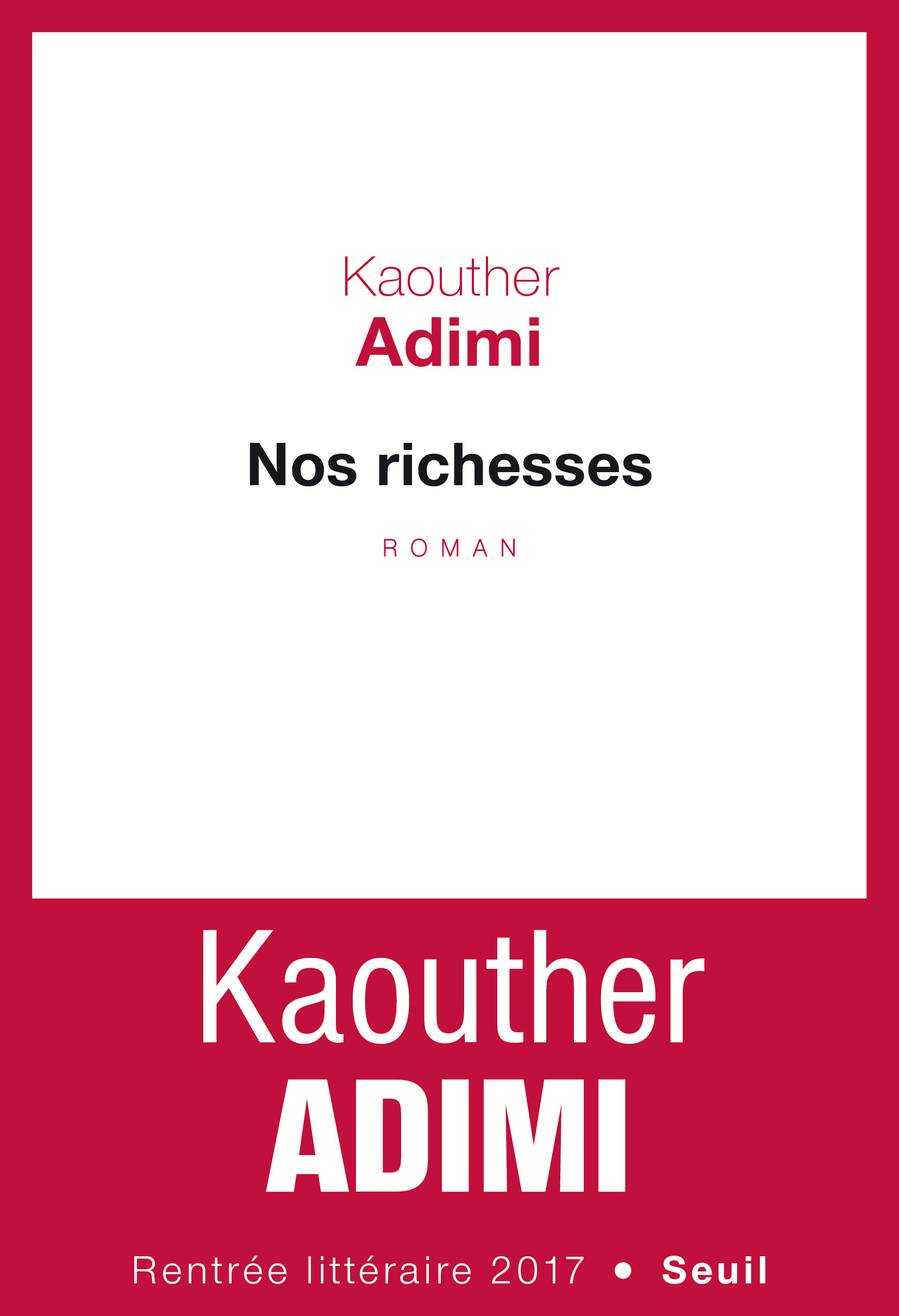
"Nos richesses" : un peu pauvres...


 La critique de la semaine :


ENTRE RICHESSE DU SUJET ET PAUVRETÉ DU

 RÉCIT, NOS RICHESSES DE KAOUTHER ADIMI 

PÊCHE PAR MANQUE D’AMBITION


11 septembre 2017 Par
Melissa Chemam

Avec son nouveau roman Kaouther Adimi s’empare de fils passionnants de l’histoire algérienne… Mais livre un croisement de récit un peu en dessous des espérances.


Quel beau sujet que celui de ce livre. Une époque littéraire passionnante, une vie politique en plein changement, et un lieu qui cristallise le désir d’accélérer ce changement : la librairie et maison d’édition Les Vraies Richesses, ouverte à Alger, rue Charras, en novembre 1936 par le jeune Edmond Charlot.
Découvrant le jeune Albert Camus lors de la rédaction de sa première pièce – qu’il publie parce que sa représentation est interdite, Charlot se retrouve, à 23 ans, jeune éditeur et libraire, en contact avec les plumes les plus prometteuses de l’Algérie de l’époque : Jean Amrouche, Himoud Brahimi, Mohammed Dib, Mouloud Feraoun, Max-Pol Fouchet, André Gide, Armand Guibert, Emmanuel Roblès, Jules Roy, puis Antoine de Saint-Exupéry, Kateb Yacine… Et il rêve de devenir le carrefour d’une « pensée méditerranéenne qui ne se limite pas au môle d’Alger », le tout, dans un local de quatre mètres sur sept seulement… Un vrai miracle littéraire. Et un bien beau sujet donc.
Mais quel étrange traitement… Le choix de la brièveté et d’une légèreté constante. A peine Kaouther Adimi ébauche-t-elle une description qu’elle l’arrête deux phrases plus tard, voire deux mots. Tout le livre n’est qu’une succession de courtes idées, courts chapitres, alternant avec la reconstitution imaginaire d’un hypothétique journal d’Edmond et avec le récit, lui aussi fictif, de la fermeture de la librairie par un commerçant algérien en 2017, qui veut la transformer en boutique de beignets… Symbolique choix de l’aliment gras et non raffiné pour succéder à la mémoire et aux textes. Mais ce récit contemporain est, lui aussi, évacué avec hâte, comme si l’auteur ne pensait qu’au potentiel ennui du lecteur. L’auteur ou l’éditeur ? Paradoxe ultime pour un livre qui se veut un hommage à une littérature profondément ambitieuse, politisée et risquée.
Pendant une centaine de page, cette lecture alléchante laisse l’impression, surtout à travers le journal fictif, de parcourir des ébauches… Puis un souffle s’installe un peu avec l’aventure parisienne de la maison Charlot. Entre les pages de journal, Kaouther Adimi insère de courts chapitres qui reviennent sur des dates clés de l’histoire algérienne : 1930, 1945 à Sétif, 1954 et le début de l’insurrection algérienne, ou encore la « décennie noire » des années 1990. Le tout reste… intéressant. Du fait de l’histoire originelle incroyable du groupe de Charlot. Des dizaines d’anecdotes passionnantes, sur la publication controversée de Silence de la mer de Vercors ou la mort accidentelle de Saint-Exupéry y apparaissent, évoquées seulement en deux lignes dans le journal fantasmé. Même le jour de la libération, le 25 août 1944, n’aurait inspiré à Charlot que : « Paris libéré ! Hourra ! ». Le 4 janvier 1960, la disparition d’Albert Camus ce simple : « Camus ! ».
Le livre forme toute de même une collection d’idées riches et passionnantes, mais limitée par la forme et le style, qui laissent malgré l’enthousiasme une impression d’inachèvement.
Nos richesses de Kaouther Adimi
Le Seuil, 222 pages, 17 euros

-


10/09/2017

#TRACKS20ANS - Massive Attack (2003)


L'émission d ARTE  Tracks fête ses 20 ans et ressort les archives. 
L'occasion de retrouver cette interview de 3D et Daddy G, l'un de leurs derniers entretiens télévisés en France... 
Avant-goût de notre discussion de mardi sur Massive Attack et Bristol à La Colonie !


#TRACKS20ANS - Massive Attack (2003) - TRACKS - ARTE


Published on 8 Sep 2017

Avec son premier album Blue Lines (1991), Massive Attack s’est imposé dans les oreilles de toute une génération, mais aussi dans les charts. Car le groupe anglais a tout bonnement inventé le trip hop, défrichant le terrain pour des artistes comme Tricky ou Portishead. Au début des années 2000, TRACKS a rencontré les musiciens de Bristol pour une interview-flashback lors de la sortie de leur quatrième album, 100th Window.
----


Evénement FB :