23/10/2017

"PHANTOM THREAD"


Finally, Paul Thomas Anderson's new film's trailer is available :


PHANTOM THREAD - Official Trailer [HD] - 

In Select Theaters Christmas


Published on 23 Oct 2017

Watch the official trailer for Paul Thomas Anderson’s #PhantomThread, starring Daniel Day-Lewis. In select theaters this Christmas.

Set in the glamour of 1950’s post-war London, renowned dressmaker Reynolds Woodcock (Daniel Day-Lewis) and his sister Cyril (Lesley Manville) are at the center of British fashion, dressing royalty, movie stars, heiresses, socialites, debutants and dames with the distinct style of The House of Woodcock. Women come and go through Woodcock’s life, providing the confirmed bachelor with inspiration and companionship, until he comes across a young, strong-willed woman, Alma (Vicky Krieps), who soon becomes a fixture in his life as his muse and lover. Once controlled and planned, he finds his carefully tailored life disrupted by love. With his latest film, Paul Thomas Anderson paints an illuminating portrait both of an artist on a creative journey, and the women who keep his world running. Phantom Thread is Paul Thomas Anderson’s eighth movie, and his second collaboration with Daniel Day-Lewis.

http://www.PhantomThread.com
https://www.facebook.com/PhantomThread
https://twitter.com/Phantom_Thread
https://www.instagram.com/phantomthread

News from Calais


  In The Guardian today:

Calais: hundreds of migrants remain a year after razing of camp


Site now barren land with nowhere to shelter but Help Refugees charity has been forbidden from giving out tents

Hundreds of refugees and migrants are believed to be in Calais and the surrounding area, a year after the refugee camp there was razed.

It is thought between 700 and 800 people are gathered in France’s northern port town, which continues to attract those hoping to start a new life in the UK.

The number could be as high as 2,000 for northern France, Annie Gavrilescu, who works for the charity Help Refugees, said. She also said the charity was not allowed to give out any tents, in case people set up a new camp.

Footage from what came to be known as the “Jungle” shows it now as barren land, and those desperately seeking shelter are forced to take cover in the thicket.

Gavrilescu said: “While the French authorities are trying to prevent a camp, all we want to do is provide people with some form of shelter and protection. Unfortunately last winter, a few people in Greece and Serbia have died just of the cold and it is a distinct possibility that it could happen in northern France as well.”

Speaking in Calais, Fawad from Afghanistan said: “We sleep in jungles and there are a lot of problems from police. They take our everything; tents, sleeping bags, clothes.” He said migrants were always on the run from police, fearing being beaten if caught.

Fawad, who only gave his first name, said: “We are afraid for winter. We will see what will happen because we don’t have a place to sleep and something to wear. And every day there is rain. It makes a lot of problems for us. That is why we are afraid of winter.”

Hamad, who is also from Afghanistan, said the blankets they had offered little protection from the rain, and the freezing cold nights.
On 24 October last year thousands of camp dwellers packed their bags on the first day of the exodus.

Calais has been home to refugees for years but the camp on the city’s edge sprang up around a day centre opened in April 2015 by the state. The population of people who fled war, poverty and persecution rapidly grew into the thousands.

Repeated efforts to cross the Channel to Britain have been made by migrants, prompting an Anglo-French operation to bolster security around the ports, including building razor-topped fences.

Last year French authorities cleared the camp in an attempt to relocate people or send them to centres around the country where they could apply for asylum.

-

My report from 2016:


Refugees welcome?

After the closure of the Calais migrant camp, French charities call for more state help with accommodation


Since the destruction of the informal settlement of refugees and transitional migrants in Calais – now known as the “Jungle”, in October 2016, the French government promised to find housing for all three to four-thousand people forced to leave the area. They have opened about 500 welcome centres to redistribute the fleeing population across the country, away from Calais, neighbouring Hauts-de-France and saturated Paris.  Meanwhile, the Mayor of Paris has opened two buildings to host a capacity of 500 refugees waiting to be registered for asylum. But they are already full and refugees are still arriving, notably via the Italian border. Those working with refugees on the ground say the system has the capacity to absorb people in need, but only with political will and a proper infrastructure.

Following the closure of the Calais infamous “Jungle”, in October 2016, one thing that Parisians have not been able to ignore is the increasing number of refugees from Sudan, Somalia, Eritrea and Afghanistan living on the streets. They’re mainly young men who have survived a very long journey to find almost no help. They congregate in areas that have regularly been the nerve points of the crisis in Paris: Boulevard de Stalingrad, Halle Pajol, Boulevard de la Chapelle, and along the North and East stations. Authorities estimate more than 50 foreign migrants arrive in Paris each day, and that more than 400 are living on the streets of the French capital. Most of them would qualify for asylum, as they have been fleeing war and devastation.

Pushing all refugees out of Calais has inevitably drawn some of them back to Paris, young men hoping to travel on to England, despite British efforts to keep them out and last year’s referendum on the U.K.’s withdrawal from the European Union.

France already has the infrastructure to house refugees

For Bruno Morel, executive director at Emmaüs Solidarité, a non-profit organisation charged with coordinating the settlement of migrants in the capital, “Paris and France in general have the capacity to host and settle every incoming refugee. And a lot has been done so far, but we should not weaken our efforts”.

Since June 2015, the police in Paris have organised 30 evacuations of informal settlements around Place Stalingrad, in the 18th arrondissement. But thanks mainly to non-profit organisation, 23,000 offers for temporary accommodation have been found and opened for the homeless refugees in France since the beginning of the crisis in 2015.

On May 31, 2016, Mayor of Paris Anne Hidalgo officially opened a temporary hosting structure and a humanitarian “camp”, with healthcare facilities, a kitchen and an information centre. It is meant as a first port of call, before a migrant is settled into more suitable housing. Set on Boulevard Ney, on the northern edge of the city, it has 400 beds and has hosted 6,800 people, in shifts, since November 2016. A women-only centre was opened soon after in Ivry, on Paris’ south side. Non-governmental organisations are looking after the refugees’ most basic needs, with Emmaüs Solidarité coordinating the site, helped by Médecins du Monde, Logique Habitat, and Doctors Without Borders (MSF), among others.

“We think everyone can be hosted in a proper camp”, adds Bruno Morel, “but we must stay organised and open new centres outside Paris and Calais, where the situation is getting saturated. We need fluidity. The government needs to open other centres in Strasbourg, Lyon or Marseille, and regularly check where there are free spaces”.

From the camp to the streets 

But the situation remains harsh for refugees in Paris. A recent report by the Refugee Rights Data Project shows that hundreds of them are still sleeping on the streets in freezing conditions, and are regularly having their blankets and sleeping bags taken by police or are “violently” moved on. Natalie Stanton, deputy director of the Project, describes “alarming” scenes in the La Chapelle area, where authorities launch repetitive clearance operations. MSF published similar reports during the winter.

Meanwhile, in Calais, refugees are again settling near the entrance of the Eurotunnel, aiming to travel to the UK. But the local authorities are refusing to open any more hosting centres. Mayor of Calais Natacha Bouchart, of centre-right party Les Républicains, has even forbidden the handing out of meals and snacks.

Her mayoral decree states the “regular, persistent and large presence of individuals distributing meals to migrants” in the area around the site of the former camp poses a threat to peace and security. It bans any “repeated, prolonged gatherings” in the area, making food distribution an offence. Most refugee charities have decided to ignore the ban and are taking legal advice.

Tensions are rising, especially as refugees continue to arrive at the Italian border, via Libya. Locals living between Ventimiglia in Italy, and Nice on the French Riviera, an area with a centuries-old tradition of migration, have often been welcoming. Not so the judicial system.

Unwelcome hospitality

In February, French farmer Cédric Herrou was handed a 3,000 Euro suspended fine for transporting three Eritreans across the French-Italian border. He has also housed dozens of migrants in caravans on his farm in the Roya valley, in south-east France.

“Forced eviction back to Italy is purely illegal,” Herrou tells me during a sit-in to protest abusive police control in Sospel, near Ventimiglia. “The police are controlling every car on our road and every black person found on the streets or trains. We cannot let them keep doing this”.
Herrou’s verdict comes less than three months before the first round of France's presidential elections, and many parties are using the issue of immigration to galvanise voters. But volunteers across France in support of the refugees are still out in force.

On 6 March, in a speech on the future of the European Union and the coming elections, French President François Hollande said the EU had to speed up its decision-making process, especially when it comes to the refugee crisis. But the interior minister, Bruno Leroux, already admitted a week before that it would be “difficult” to find shelter for all migrants. However, without a deal with the United Kingdom, French authorities will have no other choice that to act and open more accommodation for the homeless refugees, in transit or not.


-

Melissa Chemam
Paris
Freelance journalist Melissa Chemam has reported from more than 30 countries in Europe, America, the Middle East and Africa. Her non-fiction book, En dehors de la zone de confort, which explores the history of Bristol through its artists and musicians, was published in France in 2016. A version in English is planned for March 2018. 

21/10/2017

Black History Month: A few facts about Bristol's past


 Bristol's history is at the core of my book about Massive Attack. The band's music, art and social interaction with their environment had such an impact around them, from the first events of their predecessor, The Wild Bunch Collective to our days, that they literally di change their city, musically of course, but also politically and socially.

It was therefore key to write about the city's history to explain where the band were coming from and what environment shaped them before they came to re-shape the city.

Here is an article that digs into details about Bristol's dark past, linked to colonisation and the slave trad. As much as London. Or Liverpol, or its twin city, Bordeaux, or Paris for that matter. But for Bristol is was defining and it forced a large minority to react, say "stop" and look differently at their environment and their link with the rest of the world...

More in my book, to be out in English in the spring 2018.

-

From

Bristol's Free Museums and Historic Houses


link: https://www.bristolmuseums.org.uk/blog/bristol-and-the-tst-myths-and-truths/


Bristol and the Transatlantic Slave Trade: Myths and Truths

Posted on  by Lacey Trotman.

By Sue Giles, Senior Collections Officer World Cultures and edited by Hudi Charin, Participation Volunteer
The transatlantic slave trade is a dark area of Bristol’s history, and it’s important we can understand the city’s role in it. Do you know your fact from your myth? Read our list to find out… 

“Blackboy Hill got its name because enslaved Africans were auctioned here”

MYTH
The street name comes from the Black Boy Inn.  The pub name was probably linked to King Charles II, who was known as ‘the Black Boy’ because of his dark hair and complexion, rather than to the slave trade (not least because enslaved Africans never were auctioned on the Downs).

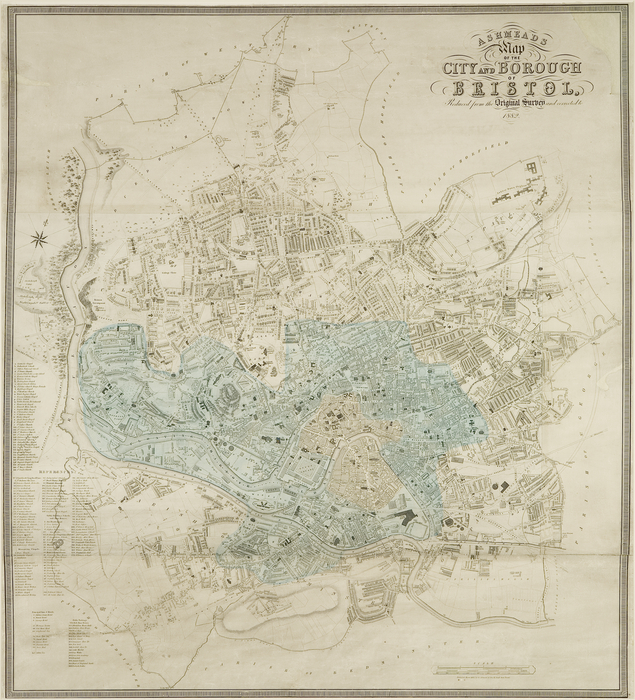
Image showing map of Bristol highlighting the port.“Bristol was a minor port in the trade.”

MYTH
Bristol played a major part in the transatlantic slave trade, with Bristol merchants financing over 2000 slaving voyages between 1698 and 1807. These ships carried over 500,000 enslaved Africans from Africa to slave labour in the Americas.

“Bristol residents were given billions in compensation for their lost ‘property’ in 1834.”

TRUE
Bristol’s plantation owners and merchants who invested in plantations received over £500,000 in compensation for the ‘loss’ of their enslaved ‘property’ when the Emancipation Act was passed, freeing the enslaved in 1834. Today, that could be worth up to £2,036,000,000.

Enslaved Africans were advertised in the local paper.”

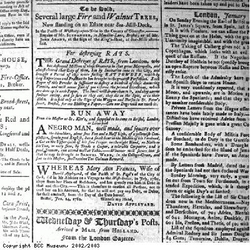
Cut out of Felix Farley’s Bristol Journal advertising slavery
TRUE 
If an enslaved African was brought into Bristol and sold as a house servant, it was usually by word-of-mouth or an advertisement in the local paper. Felix Farley’s Bristol Journaladvertised ‘A Negroe Boy, about Ten years old, He has had the Small-Pox’ for sale in August 1760, enquiries to the Printing Office in Small Street.

“Redcliffe Caves were used to house enslaved Africans.”

MYTH
Sand was dug here for the local glass making industry, creating the caverns. Very few enslaved Africans came to Bristol and were sold here, they were normally shipped directly from Africa to the Americas and sold there, where there was the demand for their labour. The caves were used to store goods, including those for the Africa trade, and may have been used as a temporary prison for French prisoners of war.

“St Mary Redcliffe church rang its bells in celebration when a bill to abolish slavery was defeated in 1791.”


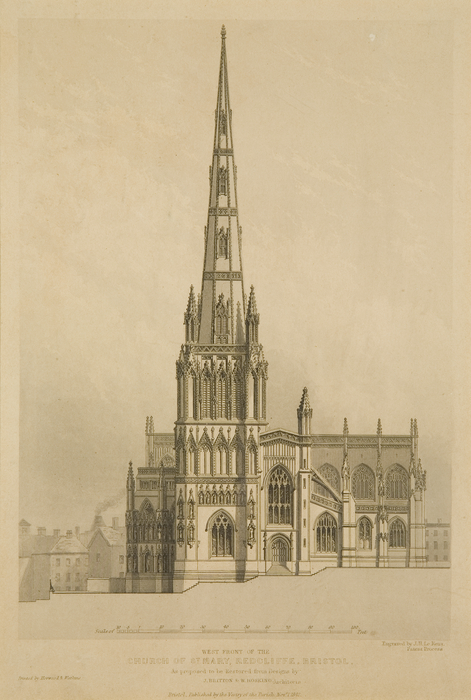
Drawing of St Mary Redcliffe Church.

MYTH
There is no record of payment for the bell ringers, so this is most likely a myth. However, the church certainly had links with the slave trade, and many of its congregants would have had some financial interest in the trade. One of the city’s biggest slave traders, Edmund Saunders, was Churchwarden in the early 18thcentury.

St Mary Redcliffe church kept enslaved Africans in the crypt.”

MYTH
The crypt was a temporary gaol, but for French prisoners of war in 1744.

“Whiteladies Road was where white women promenaded, with their black enslaved footmen in attendance.”

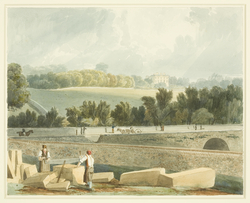
 Drawing/watercolour by Samuel Jackson. View of Tyndall's House from Park Place, showing Whiteladies Road.MYTH
The road was a dirt track then and ladies were unlikely to walk there and get their hems and shoes dirty. More probably, the road ran alongside the land belonging to a convent at the bottom of St Michael’s Hill. The nuns wore white habits, hence the name.

“Many street names are connected to slavery.”

 TRUE
Colston Street was named after Edward Colston, well known for his involvement in the slave and sugar trade: however there are many other lesser known connections.
To name just a few:
Elton Road – the Elton family were investors in the brass industry, and also owned slave ships.
Farr Lane – the Farrs were rope makers and slave traders.
Tyndalls Avenue – the Tyndalls invested in slaving ventures.
Winterstoke Road – Lord Winterstoke was head of the Wills family, associated with the slave-grown commodity of tobacco.

“Pero’s Bridge is named after an enslaved African.”

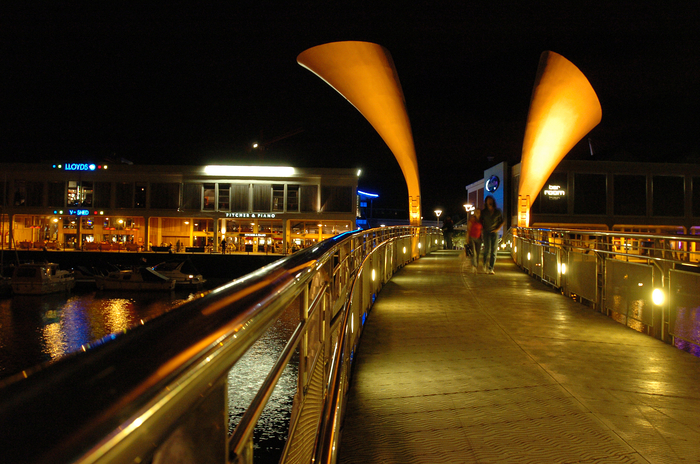
Photograph of Pero's Bridge over the harbour © Destination Bristol
TRUE
Pero Jones was born enslaved on Nevis.  He was bought by John Pinney and brought to Bristol around 1790, when the Pinneys left Nevis. Pero was Pinney’s valet, and worked for him for over 30 years, though he was never freed. The footbridge was named after Pero in tribute to the many unknown African men, women and children who were enslaved by Bristol’s merchants.

“Some of the buildings in King Street were built as a result of the slave trade.”

TRUE
The Theatre Royal was funded by 50 merchants, of whom at least 12 were slave merchants or slave ship owners, and at least another six were suppliers to the slave ships, plantation owners or sugar traders. The street was also home to Henry Webb, captain of the slave ship Nevis Planter, and Robert Walls, surgeon on the slave ship Guinea.

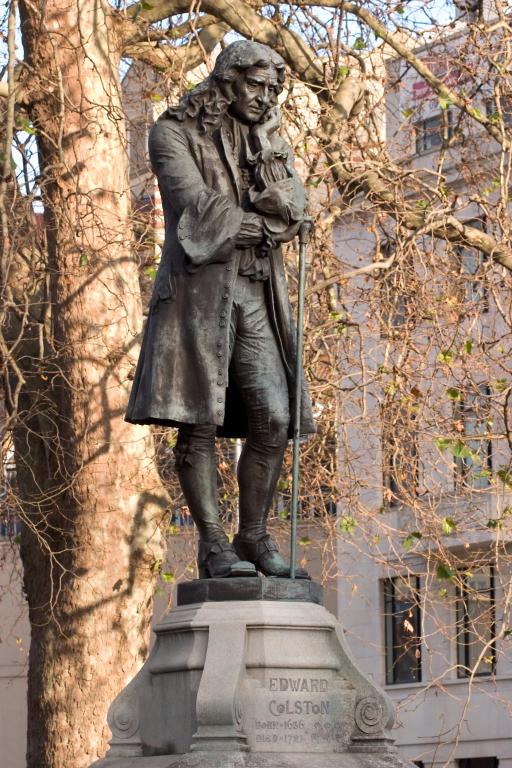
“Edward Colston’s statue explains how he made his fortune.”

Image of the Edward Colston statue in Bristol city centre
MYTH
Edward Colston’s statue in Bristol is a controversial monument to a wealthy man who founded schools and charities. Based in London, he traded with Europe, and as an investor in and a committee member of the Royal African Company he made part of his fortune from the slave trade and from sugar.  There is still no official mention of this on the statue, though there was an unofficial plaque referring to the slave trade.

“Between 1730 and 1746, Bristol’s slave voyages made up 20% of the whole of British trade.”  

MYTH
In fact, it was much more: about 40% of British trade was made up by Bristol’s slaving voyages in this period. In the 1730s, on average 36 slave voyages left Bristol each year, with 53 in 1738. For these 16 years, Bristol was the leading slaving port, overtaking London and being overtaken in turn by Liverpool.

“Bristol’s slavers were responsible for shipping over half a million enslaved Africans.”

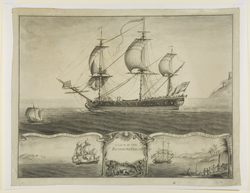
The Blandford Frigate, by Nicholas Pocock, 1760. This image illustrates the narrative of the transatlantic slavery through the border drawings depicting the ship: On the passage to the West Indies and On the coast of Africa trading
TRUE
British ships carried an estimated 3.1 million enslaved Africans altogether, although only 2.7 million survived the Atlantic crossing. Bristol traders were responsible for shipping about one-fifth of the total of enslaved Africans carried on British ships, that’s over 500,000.

Find out more about the myths and truths for yourself… 

Visiting our Transatlantic Slave Trade exhibit at M Shed.
Visiting Bristol Archives

Are you a teacher?  

Bring your class to Bristol and the Transatlantic Slave Trade school sessions for Year 7-10.

20/10/2017

"Melissa"


 Feeling called to share this...

I have told this story quite a few times to a few people upon meeting, but it might talk to some other people further away.

It is about my name, my given name, and its link to mythology.

Also, more personally, my father gave me this name. He actually changed my name soon after my birth, without telling my mother... Because my mother had another name in mind for me, long before I was conceived; she had chosen it when she was a child. It was inspired by a television show she loved.

My mother wanted to call me Laura.

But my father gave me the name Melissa. He was inspired to do so by his boss, whom he very much admired and who had studied in America, in Harvard. He told him it was an elegant name in the English-Speaking world...

And here I am writing in English most of the days. I know my writing is not perfect, but it all seems this situation was - somehow - guided from the start...

Anyway.

Here are the stories.


-

Greek origins

Melissa is a given name for a female child.

The name comes from the Greek word μέλισσα (mélissa), "bee," which in turn comes from μέλι (meli), "honey."

Melissa also refers to the plant Melissa officinalis (Lamiaceae family), known as lemon balm.

According to Greek mythology, perhaps reflecting Minoan culture, making her the daughter of a Cretan king Melissos, whose -issos ending is Pre-Greek, Melissa was a nymph who discovered and taught the use of honey and from whom bees were believed to have received their name.

 She was one of the nymph nurses of Zeus, sister to Amaltheia, but rather than feeding the baby milk, Melissa, appropriately for her name, fed him honey. Or, alternatively, the bees brought honey straight to his mouth. Because of her, Melissa became the name of all the nymphs who cared for the patriarch god as a baby.


Italian and Scottish poetry

The 16th-century Italian poet Ludovico Ariosto used the name "Melissa" for a good fairy (the good sorceress and prophetess who lived in Merlin's cave) in his poem Orlando Furioso.

The following is an ode to Melissa's birthday by Thomas Blacklock, a Scottish poet from the late 18th century.


Ode, on Melissa's Birth Day

Ye nymphs and swains, whom love inspires

With all his pure and faithful fires,
Hither with joyful steps repair;
You who his tenderest transports share
For lo ! in beauty's fairest pride,
Summer expands her heart so wide;
The Sun no more in clouds inshrin'd,
Darts all his glories unconfin'd;
The feather'd choir from every spray
Salute Melissa's natal day.

Hither ye nymphs and shepherds haste,
Each with a flow'ry chaplet grac'd,
With transport while the shades resound,
And Nature spreads her charms around;
While ev'ry breeze exhales perfumes,
And Bion his mute pipe resumes;
With Bion long disus'd to play,
Salute Melissa's natal day.

For Bion long deplor'd his pain
Thro' woods and devious wilds in vain;
At last impell'd by deep despair,
The swain proferr'd his ardent pray'r;
His ardent pray'r Melissa heard,
And every latent sorrow cheer'd,
His days with social rapture blest,
And sooth'd each anxious care to rest.
Tune, shepherds, tune the festive lay,
And hail Melissa's natal day.

With Nature's incense to the skies
Let all your fervid wishes rise,
That Heav'n and Earth may join to shed
Their choicest blessings on her head;
That years protracted, as they flow,
May pleasures more sublime bestow;
While by succeeding years surpast,
The happiest still may be the last;
And thus each circling Sun display,
A more auspicious natal day.

-


My father's story proven by statistics...


Popularity

Melissa became a popular name in the United States during the 1950s. Very popular from the 1960s through the 1990s, today Melissa is a relatively rare baby name; in 2010, fewer than 2,500 girls were given the name, compared with around 10,000 in 1993 and well over 30,000 at the name's peak popularity in 1979.

 In 2007, Melissa was the 137th most popular name for girls born in the United States, dropping steadily from its peak of second place in 1977. It was among the top ten most popular names for girls from 1967 to 1984.


-

This year, a young musician who hardly knows me and never met me in person wrote a song for me and named it 'Melissa'... A dream come true?

Otherwise, there is a song from America:


The Allman Brothers Band - 'Melissa' (Lyrics)


The Allman Brothers Band "Melissa" Eat a Peach. 1972


18/10/2017

M A T I È R E N O I R E - Suite


 Currently in Marseille. Article, in French, to come soon!

This event is of a rare kind in the French metropolis. A truly authentic expression of art, interacting with a traditional place, a flea market in the heart of the southern city's popular neighbourhood.

This group of Spanish and Italian artists, all friends and frequent collaborators, were give a "carte blanche" by the Saint-Laurent Gallery to occupy the marker for three months and interact with the place and its shops and "brocanteurs"...

This freedom gave a reflexion on our everyday interaction with objects and with reality, hence this interrogation of the "dark matter", la "matière noire", as the visible or invisible, tangible or intangible around us.

The artist used mixed media, from objects found in the market to photographs, video, sculpture and painting. A real moment of public, interactive art, the show is divided on three parts (Projeter / Percevoir / Interpreter) over two floors...

The opening on October 7th attracted hundreds of people. Most of the pieces were on sales; some are even still available.

Go and see the Facebook page: https://www.facebook.com/matierenoiretat2/?fref=mentions

Introduction below, with a few pictures, and article to come soon, after I've spoke more in depth with the curators, Carmen Main, and the main invited artist, Borondo.

-


M A T I È R E  N O I R E
BORONDO SHOW
7.10.2017 – 31.01.2018
Marché aux Puces
Marseille


Message from Borondo: 
#MATIERENOIRE  Borondo SHOW
Presented by Galerie Saint Laurent at Marché aux Puches, Marseille
\\\ In collaboration with  BRBR FilmsCarmen Main,  Diego López Bueno,  Edoardo Tresoldi,  Isaac Cordal, Robberto Atzori,  SBAGLIATO
\\\ © The Blind Eye Factory, Laura Aruallan, Laurent Carte
\\\ From Oct 7 to Jan 31
Thursday to Saturday 10.00 - 18.00
Sunday 10.00 - 13.00
\\\\\\\\\\\\\\\\\\\\\\\\\\\\\\\\\\\\\\\\\\\\\\\\\\\\\\\\\\\\\\\\\\\\\\\\\\\\\\\\\\\\\\\\\\\\\\\\\\\\\\\\\\\\\\\\
"It smells like dust and wood. We get into the limbo of memory. An endless number of carefully carved objects tell us that there was once a time when clocks could take their time.

There are mirrors of all sizes. Contained inside the glass is a heavy, sparkling history that is now coming across new eyes. I can’t stop wondering how many glances coexist in this
reflection.
Within this universe of furniture, certain vessels of different cultures materialise. Sound waves lie hidden in its curvatures, words from a past life that do not reveal its secret. Hundreds of statuettes, old-time icons, have gone from being avant-garde to being memories, to discover the sound of an unstoppable metronome that seems to set the beat faster and faster. Singing of the past, voices reverberate out of magnetic tapes and interfere directly in the present. At the same time, an absent-minded listener modifies these sounds with his contemporary perception in a return trip around the collective consciousness. Meters and meters of celluloid, immortalised memories are afraid of losing their eternal nature when confronted with fire.
On 8-millimeter film, a little girl looks at her dad’s camera while she is playing in the river. The little girl is laughing and dancing. She fascinates us speaking about the unique, yet it scares us when she shows us what is unrepeatable. She draws an invisible past, without which our existence would be impossible.
Dark matter of the present time.
According to cosmologists, dust, wood, mirrors, vessels, statuettes, the little girl and any other thing we can see with our eyes, or through using instruments at our disposal, are just five percent of the universe. The rest is dark energy and dark matter, a mysterious substance that reminds us just how much we do not know compared to what we know. 
That our perception is limited and subjective and that life would not be as it is without this mysterious and dark reality. Just as it would not be as it is if the little girl, her father, the camera or the river had not existed. Just as life anywhere in the world would be the same if all these thwarted realities at Marché aux Puces in Marseille had not taken place. Just as all the stories lying about in the market had not occurred if the rest of the universe had not been in motion.
My dark matter. 
A reality that is not there anymore and whose echoes are the only things I can still hear. A reality that is not mine and I do not mind, because I do not even know that it exists. A reality that I cannot touch and whose unknown nature scares me. The sleeping truth in the unconscious. The invisible.
My dark matter."

-


More on the artists:

BORONDO (SP)
Borondo’s artworks are deeply influenced by the theme of the sacred, of the human behavior and of the fragility of the psyche, with a peculiar research on the sign and the bodily position as expressive and emotional vehicles. He has made numerous public interventions around the world; since 2012 he presents exhibition projects all over Europe, where he expresses his art through multiple media and materials, suggesting paths and reflections through paintings and multimedia installations.

A.L. CREGO (SP)
GIF artist A.L. Crego believes the medium will one day "rule the world". He uses impressive loops to represent his very own mental images, giving his works a sci-fi classical aesthetic as if they came directly from his subconscious. He has been approached by various DJs, artists, and agencies, all interested in getting their own personal work made.

BRBR FILMS (SP)
London-and-Madrid-based visual and audio collective, with a background in cinema, visual arts and social sciences. Documenting reality, BRBR aims to push the boundaries of contemporary visual culture. Their work has been screened in film festivals and museums, and it ranges from feature films to music videos.

CARMEN MAIN (SP)
She has been collaborating with musicians, filmmakers, performers and plastic artists, focusing her work on the transdisciplinary research: a hybrid of artistic practices where different agents dance together for a common immersive experience. Thanks to her interest in the distinctive features of each discipline and in the comings and goings between analog and digital, she graduates specializing in painting and video art.

DIEGO LÓPEZ BUENO (SP)
Video artist whose work examines authorship issues through image appropriation. While establishing a dialogue between the new technologies and all the digital languages originating from the net, he analyses the communication through the Internet as a never-ending source of raw material to work with through the use of glitch, 3D or any kind of new “noise”.

EDOARDO TRESOLDI (IT)
Edoardo Tresoldi plays with the transparency of mesh and with industrial materials to transcend the timespace dimension and narrate a dialogue between Art and World, a visual summary which reveals itself in the fade-out of physical limitations. Since 2013, he performs public space interventions, focusing his research on the genius loci and the study of landscape elements.

ISAAC CORDAL (SP)
Isaac Cordal focuses his research on the human figure and its relationship with the surrounding landscape. His main project, Cement Eclipses, is a critical definition of our behavior as a social mass. Small statues, no more than 25cm tall, suspended in routine scenes where they take on multiple meanings and placed in locations that quickly open doors to other worlds.

ROBBERTO ATZORI (IT)
During his childhood he spent long periods cataloging stones, branches and animals in his garden, just a few steps from an abandoned graveyard. His aesthetics is tied to the worship of the dead, a memory-related veneration transferred to an object and the unleashed evocative power. He has worked with more than 100 international artists, including Richard Long, Tracey Emin and Jeff Wall.

SBAGLIATO (IT)
SBAGLIATO is an artistic project born from the desire to generate interference in the urban fabric by creating empty spaces within the rigid and composite order of the architectures. The installations of SBAGLIATO are the result of a synergy between architecture, graphics, photography and collage, through the use of the poster, an ideal medium due to its ephemeral nature and the camouflage aptitude.


-

More soon.

'Only Lovers Left Alive'


Going from Bristol to Lyon... I found this:

ONLY LOVERS LEFT ALIVE - Trailer


Their love story has endured several centuries, until...
Subscribe Here & NOW ➨ http://bit.ly/16lq78C
Best ROMANCES here ➨ http://www.youtube.com/playlist?list=...

Set against the romantic desolation of Detroit and Tangier, an underground musician, deeply 
depressed by the direction of human activities, reunites with his resilient and enigmatic lover. 

Their love story has already endured several centuries at least, but their debauched idyll is soon 
disrupted by her wild and uncontrollable younger sister. Can these wise but fragile outsiders 
continue to survive as the modern world collapses around them? 
A Movie Written & Directed by Jim Jarmusch
Cast :TOM HIDDLESTON, TILDA SWINTON, MIA WASIKOWSKA, 
JOHN HURT, ANTON YELCHIN, JEFFREY WRIGHT 
Release Date : Coming Soon (2014)

Official Selection 
Cannes Film Festival 2013 
Toronto International Film Festival 2013 
New York Film Festival 2013 

ONLY LOVERS LEFT ALIVE Trailer
© Sony Pictures Classic


-


"How can you have lived for so long and still not get it: this self-obsession is a waste of living, that could be spent on surviving things, appreciating nature, nurturing kindness and friendship, and dancing. You have been pretty lucky in love though, if I may say so."