March 8, D-2.
Reflecting about women in writing.
I think we are at the dawn of a new era.
I first want to thank to all the men who are able to be supportive for others - including female writers.
I've been lucky to work with a few of them, in the sea of competitive, jealous and controlling others.
We should always focus on the positive, beautiful outcomes of our lives.
Then I'm sorry for all the other men who are too afraid to do so... To support others, even when themselves are successful, to respect others and their views.
Creativity is not a threat to others. Creativity also implies taking a risk. To create, you need to be ready to add your voice.
But those types of male behaviours, fearful of us, ladies, and controlling, belong to the past now, simply.
Yesterday I had a deeply interesting conversation with a former soldier in the FLN army, an Algerian freedom fighter, who spent years in French prisons during the Algerian war. He wrote two books to leave his legacy, decades after the events. And he was so respectful, kind and insightful. And such a feminist. A 80 years old! It was really a source of great comfort.
-
While I was writing my recent book on Bristol, I was also discouraged by women themselves. A good friend of mine kept repeating: "why don't you write about a woman?"
Because, my friend, freedom and equality are about being able to choose freely what you want to do, not to be told where your battles should be. Thank you for your unwanted advice.
-
In order to celebrate this special week - as WOMEN, all women on this planet meaning more that half of humanity, are celebrated with ONE day, March 8, I will quote this article by this author and Guardian columnist:
'Women are better writers than men': novelist John Boyne sets the record straight
I don't actually believe than women are NATURALLY better writers than men. Or better parents, better teachers, better leaders or whatever you want. They just deserve their chance like any human being, women or not, and should not face more obstacles than men when defending their simple, basic rights.
But still, have a good read!
'Women are better writers than men': novelist John Boyne sets the record straight
Male authors are always pronouncing their own brilliance – or boasting about not reading books by women. So, after a lifetime of writing and attending literary festivals, John Boyne would like to get something off his chest …
Do you know what the literary tea towel is? It’s an Irish phenomenon that can be found hanging in half the pubs of Dublin and all the tourist shops. Also taking the form of a calendar, a beer mat, a T-shirt and a poster, the tea towel features images of 12 great Irish writers, most of whom look as if they’ve spent the morning drowning puppies.
There’s George Bernard Shaw looking constipated, while Flann O’Brien stares into the distance. Oscar Wilde at least has a half-smile on his face, as if Bosie has just lifted his shirt to show off his abs. Only Brendan Behan seems truly happy, but then he is sitting in a pub.
Twelve writers, supposedly our greatest ever, and not a vagina between them. Sorry about that, Molly Keane, Edna O’Brien and Maria Edgeworth. “You’ll be on the tea towel one of these days,” remarks a character in my most recent novel, The Heart’s Invisible Furies, speaking to the fictional writer Maude Avery, who is well regarded but eschews any form of public recognition. “That will never happen,” she replies. “They don’t put women on that. Only men. Although they do let us use it to dry the dishes.”
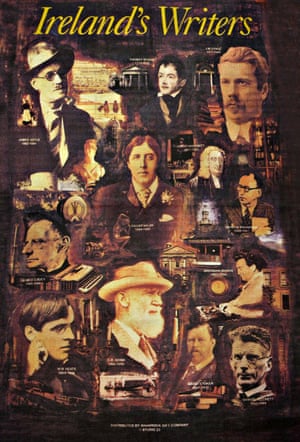
Every few years, there’s a bit of a kerfuffle when a prominent male writer or aged university professor declares that he doesn’t read or teach novels by women. The Nobel laureate VS Naipaul, for example, has said that there is no female writer his equal because of women’s tendency towards “sentimentality” and also because a woman is “not a complete master of a house … so that comes over in her writing”.
I’m not sure if Naipaul has read anything by Toni Morrison, Alice Munro or Penelope Lively, all born within a year or so of him. But if he has, he should recognise that sentimentality is a crime for which none of these could be convicted. And, however they run their homes, they are certainly masters of a good sentence.
It’s the same story whenever the world, or Time magazine anyway, feels the need to declare a new Greatest Living Novelist. Most recently, in a daring and original move, the dubious honour of “greatest American novelist” was awarded to a white male, Jonathan Franzen, despite his having produced only one novel of real merit, The Corrections. His two subsequent works – Freedom and Purity – were so wrapped up in their own self-importance that they only needed single word titles to signify their status as Significant Works of Literature. Franzen might take note that Pet Shop Boys albums have been employing this conceit for decades – and three and a half minutes of the Boys generally contain more insight and humour than 600 pages of Franzen’s tedium.
Throughout the mid to latter part of the 20th century, it was always the men who, like more bookish but less witty versions of Muhammad Ali, declared themselves the Greatest. In the US, it was John Updike, Norman Mailer, Gore Vidal, Saul Bellow and Philip Roth, all carping at each other from the sidelines, or having dust-ups on chatshows.
The first four are dead and the fifth is retired but, despite their determination to survive into posterity, can you imagine anyone today picking up a copy of Mailer’s Harlot’s Ghost or Vidal’s Live from Golgotha? To read, I mean – not just to dust the shelves around them. I can’t. But I could certainly see myself revisiting Harper Lee’s To Kill a Mockingbird or Carson McCullers’ The Heart Is a Lonely Hunter.
In a recent speech, the writer Anne Enright, displaying an agility with numbers that could yet see her installed in Carol Vorderman’s old role on Countdown, explored how books by women are rarely reviewed by men, as if it is beneath their dignity, while books by men are appraised by critics of both genders. The implication is that literary editors believe books by male writers express universal concerns while those by women are regarded as much narrower in scope, lacking the subtlety needed to engage the mind of the cerebral male.
I’ve been publishing novels for almost 20 years. In that time, I’ve become increasingly aware of similar double standards in the industry. A man is treated like a literary writer from the start, but a woman usually has to earn that commendation. There are exceptions. In recent years, some new female writers – Sara Baume, Belinda McKeon and Kit de Waal in particular – have broken through quickly due to the indisputable quality of their work, but others have struggled because they clashed with publishers over how female-oriented their book promotion should be.
I’ve known men who, on showing me a proposed jacket design, have felt pleased by the seriousness of the approach, a sign that their work is intellectual and provocative. And I’ve known women who’ve had to fight tooth and nail to prevent a bare-legged girl lying on her back in a field of hay, laughing her pretty little head off while holding a forget-me-not, being the first image readers associate with their work.
It doesn’t stop there. Last summer, I attended a literary festival where a trio of established male writers were referred to in the programme as “giants of world literature”, while a panel of female writers of equal stature were described as “wonderful storytellers”.
I recently debated with a friend the merits of a highly praised novel by a male author whose depiction of women made me wonder if he’d ever even met one. My friend disagreed, suggesting the book was a study of masculinity, so what mattered was how incisive the author was on that subject. But how are we to write about masculinity, or femininity, without reference to the other? And, if the men in a novel behave as if women are simply there to have sex with or to tell them how brilliant they are, what does that say about the novel’s relationship to gender?
I’ve read 113 books this year, 84 of them published in 2017. Of those new titles, 39 were written by men and 45 by women. (Clearly, Naipaul and I would not get along.) For me, the best were written by Min Jin Lee, Polly Clark, Elizabeth Day, Molly McCloskey, Gail Honeyman, Kamila Shamsie, Francesca Segal and Celeste Ng, while the best non-fiction was Gone by the violinist Min Kym.
So I’m going to make a claim now that will probably get me kicked out of the Fraternity of Underappreciated Male Authors (FUMA) and blacklisted from the annual Christmas football game. Here goes:
I think women are better novelists than men.
There, I’ve said it. While it’s obviously an enormous generalisation, it’s no more ludicrous than some half-wit proudly claiming never to read books by women. For the record, purporting to love literature while dismissing the work of female writers is like claiming to be passionate about music while refusing to listen to anything but Ed Sheeran. However, I’m going to try to back up my sweeping statement.
First, perhaps it is the historically subservient role women have played in society that has made them understand human nature more clearly, a necessity if one is trying to create authentic characters. Having been expected to bring up families while running a home and catering to society’s expectations of what women should be, they have a better grasp of human complexity. My female friends, for example, seem to have a pretty good idea of what’s going on in men’s heads most of the time. My male friends, on the other hand, haven’t got a clue what’s going on in women’s.
Second, many male writers, particularly younger ones, approach their work as if they – and not the books – are what’s important. They obsess about establishing a reputation, while ignoring the importance of just writing something good. I recall one highly ambitious young man telling me all the awards for which his first collection of stories would be eligible and rating his chances of winning each one. (In the end, the book made less of an impact than a pebble thrown in the Atlantic.) He never mentioned that he’d like his book to make a connection with readers and speak to our times. All he wanted was prizes. It felt to me like a sad reflection of our times.
Female writers, on the other hand, seem more concerned with just writing good books. Having taken part in countless literary festivals around the world, I can state categorically that the worst person to be paired with is the male novelist on his second or third book, particularly one who’s a fully signed-up member of FUMA. Typically, he arrives in dark jeans, crisp white shirt, blazer and thick-rimmed glasses, carrying a battered vintage leather bag, and remarking that Salman, Ian or Ish sent him a charming quote for his new book but, despite this, the bookshops ordered tiny quantities because it’s all political and his work is too cutting edge for modern readers.
Female novelists in the same situation are usually more interested in talking about books, in engaging with their readers and in sharing a platform with another writer rather than trying to dominate it. They seem grateful for the opportunities publishing has brought them, rather than accepting it as their due. And, it’s a small but important point, they seem to read a lot more. If a male writer appears in a green room carrying a book for everyone to see, nine times out of 10 it will be something obscure, something in translation, or something out-of-print. Preferably all three. Also, their bookmark will only be a few pages in.
But it’s in their depictions of both genders that female writers have the edge. I’ve grown weary of reading novels by men that portray women in one of four categories: the angelic virgin who manages to tame some quixotic lothario who’s spread so many wild oats that he has shares in Quaker; the pestering harpy who nags her boyfriend or husband, sucking all the fun out of his life; the slut who eventually gets murdered as payback for her wanton ways; the catalyst who is only there to prompt the man’s actions and is therefore not a human being at all, just a plot device. I find female writers are much more incisive in their writing of men, recognising that several billion people cannot be simply reduced to a few repetitive strains.
Towards the end of The Heart’s Invisible Furies, Maude Avery does in fact find herself on the legendary tea towel but, as she says herself, it’s not much of a legacy. Who wants their face to be used for eternity to dry someone else’s wet coffee cups? Maude, like most writers, male or female, would simply prefer to be treated with a little respect, her work judged on its merits and not on whether her DNA contains two X chromosomes or an X and Y.
One last thing. The Greatest Living Novelist? Easy. It’s Anne Tyler. Or maybe Sarah Waters. Or Margaret Atwood. Or Rose Tremain.
-
• John Boyne’s novel The Heart’s Invisible Furies is published in paperback by Black Swan on 14 December.
-
Link to the column: https://www.theguardian.com/books/2017/dec/12/double-x-factor-why-women-are-better-writers-than-men

