
06/05/2020

Nouveau reportage : Solidarité en Angleterre
Mon récent reportage pour la radio allemande DW en cette première semaine de mai :
pour écouter

VU D'ALLEMAGNE
L'Allemagne et le 8 mai 1945 // Solidarité envers les sans-abris en Angleterre
Le 8 mai 1945, la capitulation de l'Allemagne nazie mettait fin à la Seconde Guerre mondiale, une période qui a marqué comme aucune autre la mémoire européenne et allemande. // En Angleterre, pays durement touché par la pandémie de Covid-19, la solidarité s'organise autour des sans-abris.
Et pour écouter.
Solidarité avec les sans-abris en Angleterre
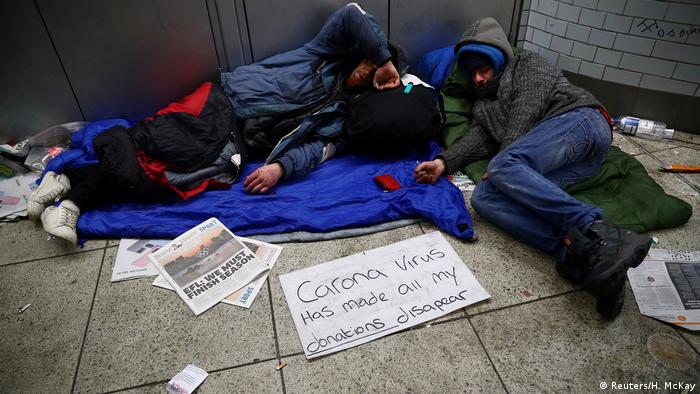
Face à un système public défaillant, la solidarité est assurée par des citoyens et associations
On verra ce que l'Histoire retiendra de cette drôle de période que le monde vit actuellement… Face au Covid-19, chaque pays essaie de trouver ses solutions. Certains comme le Royaume-Uni ont tenté dans un premier temps de laisser le virus se répandre pour atteindre une immunité collective.
Une stratégie qui a été abandonnée lorsque les chiffres ont commencé à prendre des proportions inquiétantes. La stratégie britannique a d'ailleurs laissé les voisins européens mais surtout ses citoyens perplexes. Après avoir renoncé à laisser agir l’immunité, le Premier ministre a lui-même été hospitalisé en soins intensifs.
Parallèlement, pour palier l’absence de nombreux services publics dans un pays qui a connu des années de restrictions des dépenses publiques, ce sont les citoyens et associations caritatives qui mettent en place des mesures de soutien et de solidarité.
Reportage de Melissa Chemam en Angleterre.
Reportage de Melissa Chemam en Angleterre.
Ont contribué à cette émission: Ralf Bosen, Melissa Chemam et Anne Le Touzé
-
-
Depuis l’expansion mondiale de la pandémie SARS-CoV-2, la stratégie du Royaume-Uni a laissé nombre de ses voisins européens et de ses citoyens perplexes… Mais après avoir renoncer à laisser agir l’immunité, le Premier ministre a lui-même été hospitalisé en soins intensifs. Parallèlement, pour palier à l’absence nombreux services publics dans un pays qui a connu des années de restrictions des dépenses publiques, ce sont donc les citoyens et associations caritatives qui mettent en place des mesures de soutien et de solidarité. Reportage – socialement distant – de Melissa Chemam en Angleterre.
-
Des applaudissements pour les soignants…
En lieu et place de budget d’urgence pour les services publics.
Voilà l’une des illustrations de la frustration qui gronde au Royaume-Uni.
Les citoyens britanniques sont encouragés à rester chez eux depuis fin mars, mais peuvent sortir se promener sans autorisation. Les parcs sont également restés ouverts. Et les cafés et restaurants été fermés plus tard qu’en Europe continentale…
Mais ce laisser-faire, s’il rend le confinement moins difficile, a aussi laissé les plus vulnérables à l’abandon. Les maisons de repos souffrent de manque de main d’œuvre, tout comme les hôpitaux publics.
Un autre exemple : la plupart de sans-domicile se sont trouvés sans ressources et sans possibilité de s’isoler dans un intérieur.
Pour remédier à cette crise humanitaire, ce sont des associations qui s’organisent, comme Caring in Bristol, dans l’ouest de l’Angleterre. Ben Richardson en est le directeur.
Ben Richardson, directeur de Caring in Bristol : « Ce qui s’est passé dans plusieurs villes est que les personnes sans domicile ont été retiré des rues ou des auberges où elles ne peuvent pas s’isoler pour être placer dans des hôtels. Cela s’est fait très vite et nous avons dû adapter nos services, pour répondre à leurs besoins, et le premier est qu’elles ont faim. La plupart des services de distribution de nourriture dont bénéficiaient les personnes vulnérables ont cessé abruptement, pour plusieurs raisons. Donc mon association de relogement s’est adaptée pour fournir un soutien vital en terme de nourriture, et produire environ 6500 repas par semaines qu’une véritable armée de bénévoles distribue. Des chefs de restaurants nous ont rejoints. Nombre d’entre eux n’ont plus de travail en ce moment donc nous les avons recrutés pour cette opération. Nous avons pu 2 à 3 cuisines en moins d’une semaines, grâce aux personnels de ces restaurants qui ne peuvent plus travailler, pour mettre en place cette opération. Maintenant ce dont nous avons besoin c’est d’un soutien financier. De toute évidence, ce projet coûte beaucoup d’argent à l’association et nous n’avions pas prévu un budget pour cela. Mais c’est important de parler de la valeur de ce travail et que des gens soient en mesure de nous soutenir d’une manière ou d’une autre. »
Le plus exigeant pour l’association est d’organiser ces distributions de nourriture quotidiennes. On croise souvent leurs camions, comme celui de Josh Eggleton, chef connu et à la tête de pas moins de 6 restaurants dans la région.
Josh Eggleton : « Je me suis retrouvé rapidement à travailler à temps plein avec Caring in Bristol, pour lancer l’initiative CHEERS DRIVE : il s’agit de distribuer trois repas par jour aux personnes vulnérables relogées. Nous avons mis en place trois cuisines, et pour cela un partenariat très organisé, avec Dom du restaurant Pasta Loco, moi-même et mon équipe, tous des volontaires, et l’équipe du café Emmeline. On travaille tous les jours, produisant environ 1000 repas par jour, et c’est fantastique. Personnellement, j’éprouve un très grand plaisir à nourrir les gens et c’est super de pouvoir se lever le matin, contribuer dans cette période de crise, et continuer à nourrir les gens. C’est vraiment thérapeutique aussi, et bon pour rester mentalement fort. »
Pour Ania Morris, fondatrice de la Food Union, il est important de ne pas seulement compter sur des dons et de rendre cette activité viable à moyen terme.
Aisne Morris, Food Union : « Il est aussi important de dire que notre union est autant basée sur la collaboration et la solidarité que sur le caritatif et la charité. Beaucoup d’initiatives font actuellement appel à des dons, mais nous trouvons des fonds auprès d’entreprises aussi, en plus du public, et nous payons aux restaurants impliqués 4 livres par repas produits. Ils sont ensuite distribués aux employés de la santé en première ligne, aux travailleurs sociaux et aux communautés les plus vulnérables. Le concept est de créer aussi un flux de revenus pour les restaurants, qu’ils utilisent pour acheter les produits alimentaires aux fournisseurs. Donc oui, nous nourrissons les personnes vulnérables et sans abris, mais nous essayons aussi de générer des sources de revenus pour toutes la chaîne de production alimentaire. »
A Londres comme à Hasting ou encore Liverpool, ces associations cuisinent aussi pour les employés médicaux, pendant que des citoyens lambda fabriquent des masques artisanaux ou organisent les courses pour des malades.
Des pétitions ont tout de même émergé pour exiger la production nationale de masques pour les soignants ainsi que des augmentations de salaires pour les infirmiers et des visas pour le personnel médical étranger de la NHS, qui dépend en grande partie de médecins européens, asiatiques et africains. Dans la 5e économie mondiale, c’est un paradoxe dont souffre cruellement des millions de victimes et héros du Covid19.
Melissa Chemam en Angleterre pour la DW.
05/05/2020
Arnolfini: Exhibitions to come post lockdown!
| |||||||||||||||||||||||||||
| - | |||||||||||||||||||||||||||
| |||||||||||||||||||||||||||
|


Podcast - Ep. 3: A Quarantini with Rosedale House
New episode!!
THE QUARANTINI PODCAST
Listen here: Episode 3
Episode 3
FULL
A Quarantini with Rosedale House
This week we 'visit' Rosedale House, a care home for people with dementia. Manager Julie Edwards and Deputy Manager Nikola Penevski tell us about life under lockdown and how the residents and staff are getting on.
We also have our usual round up and excitingly we bring you a recipe for a quarantini made by Derek Brown, author of Spirits, Sugar, Water, Bitters: How the Cocktail Conquered the World.
Music:
Covid 19, La Guerre, Patrick Sese Buluku
Merci Pour Tout, Vanessa Paradis
Opening and closing music: Hot Flu, The Old Bones Collective
Hosts: Melissa Chemam and Pommy Harmar
Producer: Pommy Harmar
-
THE QUARANTINI PODCAST
Listen here: Episode 3
Episode 3
FULL
03/05/2020
MINIBABE | BOOK WALKS IN LOCKDOWN: WALK WITH MELISSA CHEMAM
Latest from, with, for the wonderful Arnolfini gallery

In response to the government’s guidelines about exercise during the Covid-19 lockdown, we invited three local artists and writers to share with us where they’re walking.
-
MINIBABE | LOCKDOWN WALK with MELISSA CHEMAM
Arnolfini Writer in Residence, freelance journalist/reporter, radio producer and writer, Melissa Chemam shares with us her stories around walking in Bristol.
Water Once Washed Away My Pain, Now I See That It Also Liberated Me From Fears…
From the very first day I came to Bristol, I developed a strong attachment to the areas along the Floating Harbour…
After my nocturnal arrival, I walked into town the next morning for interviews, from Stokes Croft to Clifton then the city centre. On the second evening I arrived at Pero’s Bridge and the Arnolfini for the In Between Time Festival. I almost didn’t need to look at a map, as I felt that the city’s shape was naturally leading from the hills to the harbour. After a week, the Watershed and the Arnolfini had become both landmarks and headquarters for me. I knew I would have to come again.
Since then, walking in Bristol has been my only way to travel in town.
By the end of March 2020 however, as for everyone in here, in the country, in Europe and in most of the world, my outdoor activities came to a standstill. The epidemic that most of us (and myself, at first) had tried to overlook put the whole world under arrest.
And our lives changed, mine included.
We were suddenly faced with a choice: to keep on going out and jeopardising lives, or to abandon what we loved the most to protect our selves and others. Whether our job, our businesses, our friends or our favourite hobbies…
Like all lecturers, I could no longer teach in person to “my” students. As a freelance reporter, I could no longer work and investigate or interview people. As a citizen, I could no longer walk everywhere, no longer participate in the joys of Bristol’s great art and theatre scenes.
Living away from my hometown of Paris, the hardest part for me is that I cannot help my mother, alone in her social housing, and can’t be of any support to my sister, a doctor in an intensive care unit. Compared to their solitude and burden, I know I’m extremely lucky… Online teaching has been put into place, and I can keep on practicing journalism online and through my writing.
Sitting in my room in a shared house, what I’ve learned so far from this health crisis and lockdown is a valuable lesson: I have finally overcome my fear of loneliness… Because, for years, like so many people, I had dreaded solitude, but I could not admit it.
I’ve lived abroad a good 8 years. In Prague, Miami, London, Nairobi, then in Bangui in Central Africa, often days felt a long stream of loneliness. Or I felt estranged among the local citizens. I loved reporting but couldn’t feel that I belonged. Some nights I couldn’t even sleep. When posted in Bangui, for a mission with the World Food Programme, we were never allowed to go out alone, or to travel outside of a UN car… And we had a curfew. It was by far the worst lockdown I ever lived through. My family feared the risk of civil war; I was more afraid of being alone for so many hours in the soulless room I was put in… But I didn’t mention it.
In Bristol, over the past five years, I’ve finally learned to overcome that fear of solitude, a fear deeper for me than others.
I came here to write a book, my oldest and dearest dream, and that could not be done in a multitude; it had to be a solitary activity, after the magnetic and fascinating moments of reportage and interviewing. In and out of Bristol, somehow, the city cured me of my fear… I can witness this nowadays: the lockdown is not painful for me.
I believe that my cure was strongly linked to my walks along the Harbourside, alone, near water. I think about the magic of that cure, and must admit the proximity of water really calms me. Does it do the same to you?
In many forms of European symbolism, from pagan mythology to poetry, water is seen as an embodiment of emotion, but also of purification and healing. Purification of emotions, perhaps… I had already had this experience in Miami, when after a month of hard work took time to plunge in the ocean, a 20-minute walk away from my building.
For me it became even more real one day in January 2016, while in Bristol. Before a short trip to Dublin, I stopped on the Harbourside for a special ritual, to try and recover from a loss that had been haunting me for years. I wrote final words of goodbye on a piece of paper, burned it and threw the ashes into the water. I let my ghost depart and probably then slowly began to conquer solitude, progressively feeling liberated.
Crises, slowly, gradually, force us to overcome our limitations.
I know we’re living through the deepest crisis Europe has known since 1945, and I know how hard it is for many people. But personally, I focus on the fact that we’ll get through this, and we can learn from this. I’m hoping we’ll sooner or later have multiple occasions to make our world, our country, our city, better places – cleaner, more respectful of the environment, less marred by inequality. If we take the time to slow down and reflect on our human mistakes so far, we may get there, eventually.
I now live in Southville. I don’t live alone, my housemates are amazing and that helps tremendously. My heart goes to the ones left alone in their flat, like my mother, my best friend, and many thousands of others. But walking alone along one part or another of Bristol’s Harbourside has become an almost-daily personal ritual.
The light at dusk especially amazes me, as well as the beauty of the Marina, the quietness of the Baltic Wharf, the view on the Underfall Yard, the loveliness of Hannover and Capricorn Quays under this gorgeous sunny weather, of the whole area around Bathurst Basin and Redcliffe Bridge. The Floating Harbour has become my sanctuary, in my delectable lonesome strolls, a symbol of my inner upmost happiness, in harmony with the sound of the birds, the smiles of some of my fellow walkers, the beauty of the flowers, the general calmness of the area. Whatever happens, politically or socially.
And hopefully, for those of us still in pain and afraid, my story will be of some help to move towards more peaceful territories, to overcome fears, alone but, in a way, together too.
-
The Harbourside under the lockdown in pictures:


28/04/2020
3D-printed plastic clasps to improve masks for NHS staff
Solidarity at work...
Here in Bristol a few groups of people have started producing PPE and related items for NHS workers and carers.
That includes a team put in place with the help of Massive Attack's 3D - aka Robert Del Naja, using his personal 3D printer to produce plastic clasps to was the discomfort due to prolonged face mask use.

The plastic clasps are to share with NHS workers in Bristol, to help with improve the use of face masks.
A new design means they can potentially print 1000 a week.


Even though we are following protocol here, they recommend whoever receives them disinfecting them before using or distributing.
The team has new batches of two types of clasp and can post them forward.


More details about producing 3D-printed PPE here.
-
Get in touch if you know anyone in need of these clasps:
mchemam@gmail.com
'Teardrop' @ 22
So much to say about this song...
Where to begin?
With the music and the video, of course:
Massive Attack - 'Teardrop' (Official Video)
The third time I went to Massive Attack's studio, in July 2015, my goal was to talk more about their third album, Mezzanine... I knew it wouldn't be easy, because the band cherish mystery... And this album finally broke them apart.
The irony of such a peaceful, harmonious song ending up creating deep divided always saddens me. But there was more that the personal conflicts. The album was born out of sonic conflicts... i.e once more out of the band's "comfort zone".
In the meantime, I had been able to visit Christchurch Studios, in Clifton, to meet lengthily with Neil Davidge, and to run into Elizabeth Fraser and Damon Reece in a few Bristol streets...
Happy 22 'Teardrop', beautiful marvel.
-
More in my book:

Rough Trade Books of the Year 2019 No. 15
This book is dedicated to the history of the band Massive Attack and to their relationship with their home town of Bristol, a city built on the wealth generated by the slave trade. As a port Bristol was also an arrival point for immigrants to the UK, most notably the Windrush generation from the Caribbean in the 1950s.
Author Melissa Chemam's in-depth study first focuses on the influences that led to the formation of the hi-hip collective The Wild Bunch and then Massive Attack. It looks into Bristol's past to explore how the city helped shape one of the most successful and innovative musical movements of the last 30 years.
The book is based on interviews, meetings, encounters, discussions, exchanges, emails, research and more... With about 30 Bristol artists, from Robert Del Naja to Mark Stewart, Ray Mighty and many others, including Tracey Thorn, Tricky and Martina Topley-Bird.
It examines the band's inner tensions between the founding members of Massive Attack - 3D, Daddy G and Mushroom - their influences, collaborations, art, shows and politics. It also retells the way they opened the door for other Bristol musicians and artists from Tricky, Portishead and Alpha, but also Gorillaz and street artists such as Banksy.
Subscribe to:
Posts (Atom)