05/09/2020

12 Communities 1 Bristol: New podcast!


Happy and proud to have participated to this project, and met lovely people!

I've worked in radio since 2006, first as a guest cultural journalist and then as a reporter. My first radio package was produced in Haiti, then I worked intensely in East and Central Africa, and more recently in Europe. 

When I came to Bristol in 2015, I fell in love with its diversity, the creativity, kindness and openness of its citizens. 

I've been to many parts of Bristol as a reporter, and I am honoured to have participated in BCfm's project to represent more of Bristol. 

Out of the 12 communities, I chose to report on Knowle West because I live in Bedminster now, South Bristol, and also because what took me to Bristol in the first place was its music scene. I thought that Tricky's story, and Flynn's story were empowering and positive. 

I hope that listeners will get to understand these 12 communities more in depth and that it'll help all of us to reconnect, especially in such a disconnecting year.

On air soon: from 17 September!


Press release:


BCfm launches Bristol oral history podcast


BCfm is launching a new local oral history podcast called 12 Communities 1 Bristol.
The series, by Marcus Smith, is in partnership with Bristol Museums, Bristol Archives, UWE Bristol and funded by the National Lottery Heritage Fund.
Each of the 12 episodes will focus on a particular Bristol neighbourhood – Barton Hill, Knowle West, Lawrence Weston, Easton, Fishponds, Hartcliffe, St George, Hillfields, Southmead, Eastville, Stockwood and Avonmouth.
The podcast follows over a year of training and recording with a mixed pool of more than 40 volunteers and students from across the city.
Marcus Smith tells us more: “There are stories of an old man in Hartcliffe who eats snails and calls them wall-fish, funny tales of a female rugby team based in Avonmouth, plus hip hop from Knowle West and bee conservation in St George.
“Many of these areas are often overlooked or stigmatised. So we have created something to change perceptions and share unique local stories. This new podcast is for Bristolians, welcomed newcomers and future generations to come.”
Patrick Hart, Station Manager, BCfm Radio said: “The last 12 months have been a difficult year for the station with a major fire destroying our studios and just as we thought things were getting back to normal – Then coronavirus happened and hit us all.
“In the midst of this, Marcus and the team have managed to put together some simply amazing pieces of audio that really do represent those 12 communities of Bristol – I can’t wait for the city to hear them.”
Cllr Craig Cheney, Deputy Mayor, Bristol City Council adds: “I’m delighted to see the launch of a local podcast that will shine a light on the lives of people from across Bristol’s diverse and vibrant communities.
“Each community has its own stories to tell, and I’m looking forward to hearing about the uniqueness of each community and the things that tie us together as a city.”
‘12 Communities 1 Bristol’ will be available from September 17th on BCfm Radio, Spotify, Apple Podcasts, Google Podcasts and all mainstream podcast providers.


04/09/2020

Atlantics: A Ghost Love Story


What a film...

Thank you Watershed for a gripping screening. 

Atlantics: A Ghost Love Story / Atlantique (2019) - Trailer  


Directed by : Mati Diop Produced by : Les Films du Bal Genre: Fiction - Runtime: 1 h 44 min French release: 02/10/2019 Production year: 2019 Along the Atlantic coast, a soon-to-be-inaugurated futuristic tower looms over a suburb of Dakar. Ada, 17, is in love with Souleiman, a young construction worker. But she has been promised to another man. One night, Souleiman and his co-workers leave the country by sea, in hope of a better future. Several days later, a fire ruins Ada’s wedding and a mysterious fever starts to spread. Little does Ada know that Souleiman has returned.


The Markaz Review


We’re creating a new cultural review! 

On Middle Eastern issues, with a group of exceptional writers and researchers.

The Markaz champions a greater understanding of the Middle East and North Africa by presenting artistic and educational programs that bridge political and religious divides. 

In a search for common ground, the Center fosters discussions among artists and thinkers and offers classes and workshops that serve diverse ethnic communities.

- see here: The Markaz


First issue out mid-September, dedicated to Lebanon. 

More on this soon. 


27/08/2020

Banksy funds refugee rescue boat operating in Mediterranean


This made my (poor, let's be fair, until now) day:

Banksy funds refugee rescue boat operating in Mediterranean

Exclusive: UK artist finances bright pink motor yacht that set sail in secrecy to avoid being intercepted by authorities
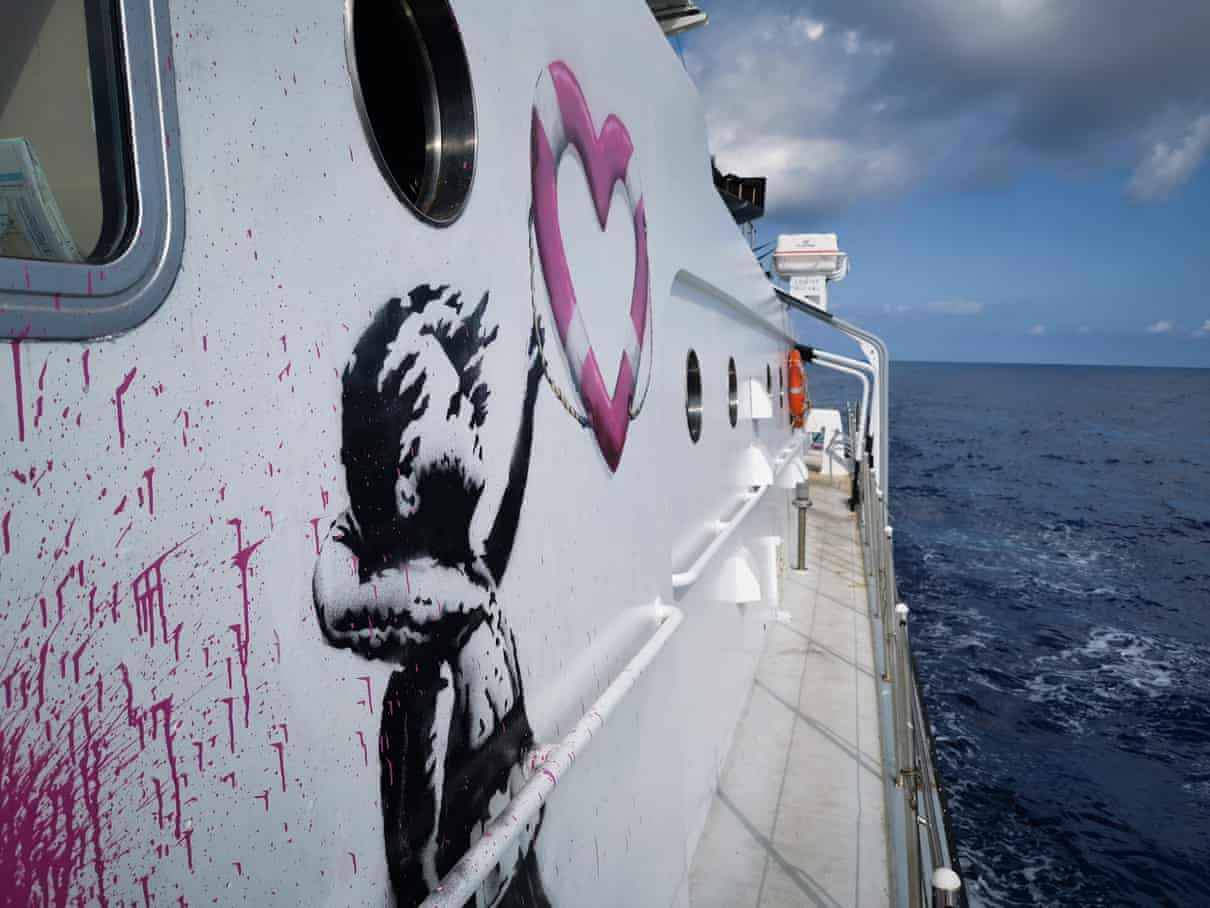
The boat, named Louise Michel, features Banksy artwork depicting a girl in a life vest.
The boat, named Louise Michel, features Banksy artwork depicting a girl in a life vest. Photograph: Ruben Neugebauer
 in Palermo and  in Berlin
The British street artist Banksy has financed a boat to rescue refugees attempting to reach Europe from north Africa, the Guardian can reveal.
The vessel, named Louise Michel after a French feminist anarchist, set off in secrecy on 18 August from the Spanish seaport of Burriana, near Valencia, and is now in the central Mediterranean where on Thursday it rescued 89 people in distress, including 14 women and four children.
It is now looking for a safe seaport to disembark the passengers or to transfer them to a European coastguard vessel.
The crew, made up of European activists with long experience in search and rescue operations, had already assisted in two other rescue operations involving a total of 105 people, who are now onboard the NGO vessel Sea-Watch 4.
Painted in bright pink and featuring Banksy artwork depicting a girl in a life vest holding a heart-shaped safety buoy, the Louise Michel sails under a German flag. The 31-metre motor yacht, formerly owned by French customs authorities, is smaller but considerably faster than other NGO rescue vessels.
Banksy’s involvement in the rescue mission goes back to September 2019 when he sent an email to Pia Klemp, the former captain of several NGO boats that have rescued thousands of people over recent years.
The vessel set off in secrecy last Tuesday from the Spanish seaport of Burriana, near Valencia, and is now in the central Mediterranean where it has already carried out its first mission.
The vessel set off in secrecy from the Spanish port of Burriana, near Valencia. Photograph: Ruben Neugebauer
“Hello Pia, I’ve read about your story in the papers. You sound like a badass,” he wrote. “I am an artist from the UK and I’ve made some work about the migrant crisis, obviously I can’t keep the money. Could you use it to buy a new boat or something? Please let me know. Well done. Banksy.”
Klemp, who initially thought it was a joke, believes she was chosen by Banksy due to her political stance. “I don’t see sea rescue as a humanitarian action, but as part of an anti-fascist fight,” she told the Guardian.
She has made clear that Banksy’s involvement in the operations is limited to providing financial support. “Banksy won’t pretend that he knows better than us how to run a ship, and we won’t pretend to be artists.”
With a top speed of 27 knots, the Louise Michel would be able to “hopefully outrun the so-called Libyan coastguard before they get to boats with refugees and migrants and pull them back to the detention camps in Libya”, said Klemp.
Pia Klemp in October 2017.
Pia Klemp in October 2017. Photograph: Lisa Hoffmann
Non-state sea rescuers have long criticised the mass return of migrants to Libya by the Libyan coastguard in collaboration with EU member states. International organisations have accused the Libyan coastguard of mistreating people at sea or selling them off to militias at Libyan harbours after intercepting them.
According to the International Organization for Migration, more than 7,600 migrants have been intercepted so far this year and returned to Libya, a war-torn country where different political factions continue to struggle for power. Often confined to informal camps, the situation for migrants in Libya is desperate, with acts of systematic torture and rape long documented by human rights organisations.

NEW BOOK: Narratives from Beyond the UK Reggae Bassline

 Happy to announce that, a bit more than two years ago, I was asked to contribute to this book! 

It will finally be coming out in January 2021:

Narratives from Beyond the UK Reggae Bassline -
The System is Sound

- with Palgrave in Studies in the History of Subcultures and Popular Music

I did the chapter on Bristol, of course, Bristol reggae!  


This book explores the history of reggae in modern Britain from the time it emerged as a cultural force in the 1970s. As basslines from Jamaica reverberated across the Atlantic, so they were received and transmitted by the UK’s Afro-Caribbean community. 

  • From roots to lovers’ rock, from deejays harnessing the dancehall crowd to dub poets reporting back from the socio-economic front line, British reggae soundtracked the inner-city experience of black youth. 
  • In time, reggae’s influence permeated the wider culture, informing the sounds and the language of popular music whilst also retaining a connection to the street-level sound systems, clubs and centres that provided space to create, protest and innovate. 
  • This book is therefore a testament to struggle and ingenuity, a collection of essays tracing reggae’s importance to both the culture and the politics of late twentieth and early twenty-first century Britain.

-


24/08/2020

Does diversity exist in the UK folk music scene?


Folk Talk Live - Lady Nade & Friends


As part of English Folk Expo's Folk Talk Live event, we hosted this discussion between Lady Nade, Yola, Allison Russell and Kyshona.


-


Lady Nade said: 

I recently put together a talk in connection with English Folk Expo conference. In this session with Grammy Nominated Yola, Kyshona and Allison Russell (Birds of Chicago, Our Native Daughters) I asked; “Does diversity exist in the UK folk music scene?”.

My enduring passion and love affair with music began at the tender age of 14, I recognised that creating music was borne from my desire to have a stable support system and an opportunity to honestly express myself and my personal experiences.

Learning that loss and grief isn’t something one can recover from alone with my music and recipes that I often create to pair with songs, I pride myself on creating a communal experience that everyone can enter into on their terms.

With the complicated times we’re living in, the lockdown has given many of us time for deep reflection and in light of the Black Lives Matter movement I have felt I’ve been given more of an opportunity to be heard and seen.

I hadn't always noticed any difference between myself and my musical peers. However, it became apparent as I progressed that my heritage would play a part in my artistry whether I wanted it to or not. 

Throughout my pursuit to sustain a music career I have faced many barriers: being objectified, working-class background and my accent. These have compounded the prejudices I have already faced and have made it harder to be taken seriously as an artist at times.

Encouraged by the more honest debate being sparked by the BLM protests and Blackout Tuesday.

It has opened up a direct dialogue about inequalities and systematic racism faced by black people. 

Some people have been shocked to realise what has gone on right beneath their noses. It has been brilliant to see people actively engaging in healthy debates and reflecting on the pitfalls of the current status quo.


-


“There is no mistaking the tender, powerful, velveteen vocals of
Lady Nade.”  Folk Radio 

"Love her voice - check her out’ "Mark Radcliffe - The Folk Show - BBC Radio2

-


23/08/2020

Brexit et double nationalité : Reportage


My last piece of reporting, in French for the German radio DW about the British exit from the EU and the rise of demands for dual citizenship (link to audio below):


DW - Brexit et double nationalité 


 Au Royaume-Uni, en plus d’une gestion désordonnée du Covid-19, la pire crise économique depuis les années 1970 a commencé. Les habitants ont peu de ressources et de plus en plus de personnes diplômées envisagent de s’expatrier… D’autant plus que le phénomène est aggravé par les conséquences du Brexit. Cela pousse des dizaines de milliers de Britanniques à demander une autre nationalité, le plus souvent irlandaise, car il suffit d’avoir un grand-parent originaire de l’île pour avoir droit au passeport. Mais les citoyens européens cherchent aussi à obtenir la nationalité britannique pour s’assurer de poursuivre une vie normale en Grande-Bretagne. Une course aux doubles nationalités qui entraînent aussi de nouveaux mouvements de migration… 
Reportage de Mélissa Chemam en Angleterre. 


-


Damien McManus est bibliothécaire. Il vient de Birmingham, a vécu en France, sa sÅ“ur vit en Allemagne et leurs parents sont irlandais. Il s’est donc toujours senti Européen. Nous nous retrouvons dans un café très europhile, dans une galerie d’art internationale… Selon lui, le Brexit est une punition que les Britanniques s’infligent à eux-mêmes… Et il était important pour lui de conserver un lien avec l’UE. Sa première réaction après le référendum a donc été la double nationalité…

Damien McManus : « J’ai immédiatement contacté l’ambassade irlandaise, oui, et demander un formulaire pour avoir un passeport irlandais. Mes deux parents sont irlandais, mon père est décédé alors j’ai dû apporté les documents de ma mère : certificat de naissance, de mariage, ainsi que mon certificat de naissance, un relevé de compte bancaire, une preuve d’adresse, 80 euros, et j’ai envoyé ce dossier par la poste. Deux jours avant que le Royaume-Uni ne quitte l’UE, je recevais mon passeport par courrier. C’était rassurant de savoir que j’avais une nationalité qui me permet de faire partie de l’Union européenne… Et je l’ai fait aussi pour passer ma nationalité à mes enfants. Il faut pour cela que je leur obtienne un passeport avant qu’ils aient eux-mêmes des enfants. Mais c’est aussi une question de solidarité, pour moi c’est évident… » 

D’autres, s’inquiètent surtout de la crise économique infligée par le Brexit et renforcée par la pandémie actuelle… Ils envisagent de s’installer dans un pays européen malgré le Brexit, pour s’assurer un meilleur avenir professionnel. Les procédures côté UE sont en effet bien plus accueillantes… 

Les départs ont déjà augmenté de 30% depuis 2016, passant de 56 000 par an à 74 000. Certains parlent de “brain drain”, véritable fuite des cerveaux. 

Pour Helen Oxenham, physiothérapeute britannique mariée à un Français, prendre la nationalité française était donc vital ; leurs deux filles sont sûres de devenir bi-nationales. Elles souhaite aussi pouvoir envisager un avenir en Europe si besoin. 

Helen Oxenham : « Le Brexit m’a poussé à le faire ? Je me suis rendue compte que si je voulais vivre dans un autre pays européen comme la Suède par exemple je ne pourrai plus. J’ai vécu en France pendant plusieurs années, en Martinique pendant 9 mois et à Aix-en-Provence pendant 2 ans, donc je parle français. Mais ce qui m’a vraiment décidé c’est de ne plus avoir le choix de vivre dans l’UE. Car financièrement je n’avais pas assez d’argent avant pour payer pour le passeport, donc jusque là cela m’avait retenue. J’ai fait les démarches petit à petit ? J’ai dû aller à Londres passer un test de langue, payer pour cela, et attendre car cela prend deux ans pour avoir confirmation ; et j’ai eu la réponse positive en septembre 2018. Le temps commençait à manquer… Ensuite il m’a fallu faire traduire mon certificat de naissance, payer pour cela, et rassembler d’autres papiers ; tout cela coûte aussi. Mais avec le Brexit qui arrivait fin janvier, je voulais régler cela avant. « 

Pour les Européens souhaitant rester au Royaume-Uni, la situation est souvent pire. S’ils vivent dans le pays depuis plus de 5 ans, ils peuvent demander leur « settled status », pour avoir le droit de rester, mais les conditions sont précaires. 

Joanna Booth est Grecque et Australienne ; elle vit en Angleterre depuis 24 ans ; son mari et ses enfants sont Britanniques mais elle n’a pas l’intention de prendre une 3e nationalité. Surtout que le coup est très élevé : au moins 2000 livres, plus si frais d’avocat... Cependant elle pense que le statut post-Brexit pour les Européens n’offre aucune stabilité et trouve que l’ambiance a déjà changé négativement…

Joanna Booth : « Je n’ai pas de raison de devenir britannique et je ne le ferai pas. Mais j’ai dû demandé le ‘settled status’ et je l’ai eu finalement, après deux mois. J’ai dû envoyer ma carte d’identité, les informations sur mes impôts, etc. Mais le plus ennuyeux ce sont les attitudes des gens qui ont changé, dès le lendemain du Brexit. Par exemple, des gens me regardent de travers quand je parle grec à mes enfants en public. J’ai donc arrêté de le faire pendant un temps mais quand j’ai repris les gens n’arrêtaient pas de me demander ‘d’où êtes-vous ?’ ou ‘d’où vient cette langue ?’ Et c’est vraiment ennuyeux. »

Par sécurité, sa famille envisage-t-elle de prendre sa nationalité grecque ?

Joanna Booth : « Je ne sais pas si l’on sait vraiment quelles vont être toutes les conséquences du Brexit. S’il nous faut le faire, nous le ferons. Car le Brexit m’a vraiment beaucoup stressée et j’étais prête à partir si je n’avais pas le statut. Cependant j’ai rencontré beaucoup d’Européens, des Lithuaniens, des Français, qui ne voyaient pas le danger. J’ai rencontré un Italien qui vivait ici depuis moins de 5 ans et qui ne s’inquiétait pas. Ils ne voulaient pas croire qu’on leur demanderait de partir… Mais moi je m’y suis préparée parce que même avec ce statut plus personne n’a de sécurité quant à un avenir ici. Beaucoup d’Européens qui vivent ici sont une nouvelle génération d’immigrants, ce ne sont pas de travailleurs agricoles comme mes parents, ou des balayeurs comme mon grand-père, ou des travailleurs à l’usine ; ils ont des diplômes, parfois des thèses et enseignent à l’université. Ils pensent avoir une stabilité et sécurité dans ce pays. Mais depuis le Brexit, il n’ya plus de stabilité. Mais ces travailleurs pourraient être exclus. »   

L’un des inconvénients de ce statut est qu’il ne permet plus aux Européens de passer du temps en Europe et de rentrer en GB. Pour Christophe Fricker, traducteur allemand travaillant entre plusieurs pays, il était donc urgent de devenir britannique. 

Christophe Fricker : « Ma décision a été provoquée par le Brexit, oui. Absolument. Avant je n’y pensais même pas parce qu’en tant que citoyens européens, nous avions tous les droits nécessaires. Nous n’avions pas besoin de dépenser ces sommes énormes pour avoir une autre nationalité. Mais le ‘settled status’ est une nouvelle catégorie d’immigration introduite sans raison réelle et c’est un ghetto administratif qui enferme 3 millions d’Européens vivant ici! Ils seront ensuite à la merci des gouvernements suivants pour connaître leurs droits. Je ne voulais pas être coincé ainsi et je n’aime pas la façon dont ce statut a été mis pensé. »  

Plus de 3 millions d’Européens ont déjà demandé ou obtenu ce statut mais l’avenir étant chaque mois plus incertains, des centaines de milliers d’autres pourraient se retrouver obligés de quitter le pays, s’ils ne sont pas éligibles à la précieuse double nationalité. 

Mélissa Chemam en Angleterre pour la DW. 


-