05/10/2020

Sonia Boyce: a revolutionary face of contemporary British art


 Latest article and favourite piece of writing this year, so far! For the mighty Art UK


Sonia Boyce: a revolutionary face of contemporary British art


Posted 02 Oct 2020

by Melissa Chemam


Colourful and feminine portraits, images representing internal emotions through patterns, paintings depicting historical events, animals and humans. When I read that Sonia Boyce (b.1962) had early on been influenced by Mexican artist Frida Kahlo (1907–1954) it made so much sense.
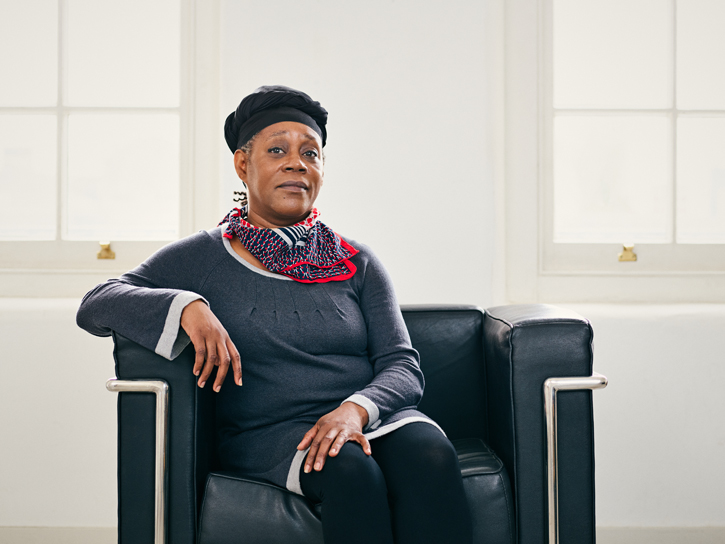
Sonia Boyce

photo credit: Emile Holba

Sonia Boyce, by Emile Holba


Boyce opened a new page in British art history, for women, Caribbean and also political artists, with aesthetically brilliant imagery and a strong personal narrative. She produces work involving a variety of media – drawing, print, photography, video and audio – exploring the interstices between sound and memory, time and space.
Born in 1962 in Islington, London, into a British Afro-Caribbean family, Boyce attended Eastlea Comprehensive School in Canning Town, East London. She was always drawing as a child, she said, so at 17 she decided to study art, and from 1979–1980 completed a Foundation Course in Art & Design at East Ham College of Art and Technology.

In Sonia Boyce: Beyond Blackness, art historian Anjalie Dalal-Clayton writes that the artist's early oeuvre was influenced by feminist artists Margaret Harrison(b.1940), Kate Walker and Monica Ross (1950–2013), and used an assemblage of texts, photography, drawings and magazine clippings. 'It was a revelation for Boyce,' Dalal-Clayton underlines, one which would come to define her practice.
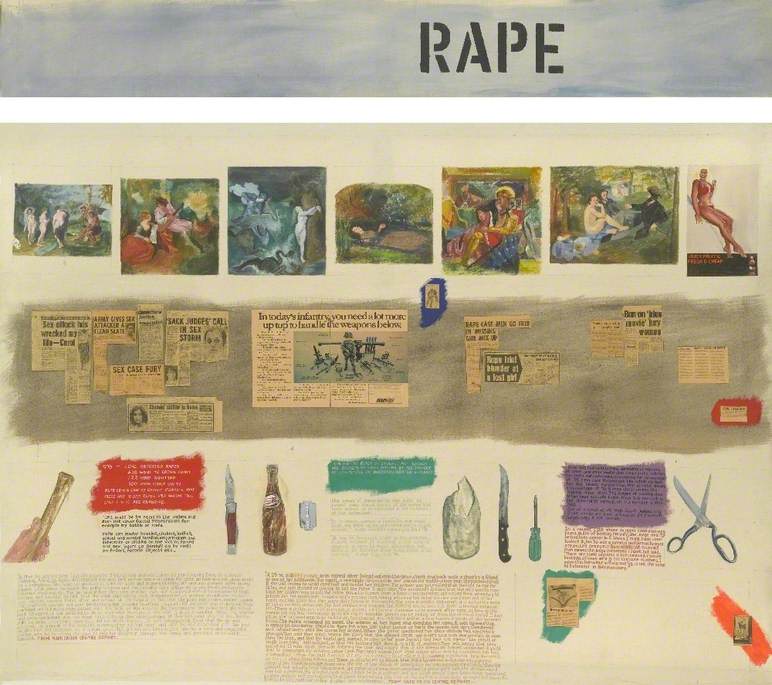
Rape

© the artist. Photo credit: Arts Council Collection, Southbank Centre

Rape 1978

Margaret Harrison (b.1940) 

Arts Council Collection, Southbank Centre

In 1980 Boyce started a BA in Fine Art at the prestigious Stourbridge College in the West Midlands. But she soon felt unease. Her intuitions on postmodernism and mixed media were dismissed as delusional. 'It was very clear that I was somehow out of place,' she told The Guardian in 2018; 'the system hadn't anticipated me, or anyone like me. Even though there were a lot of female students, they were thought about as though they were being trained to become the wives of artists, not artists themselves. As a Black person, there wasn't a narrative at all.'

Luckily in 1982 she attended the first national conference of Black artists and met the Tanzanian-born painter Lubaina Himid (b.1954), a leading figure promoting the work of Black women artists and encouraging them in 'making positive images' of themselves. Sonia soon took part in this wider Black British cultural 'renaissance', a movement that arose in reaction to Margaret Thatcher's conservatism, and was embraced by artists such as Eddie Chambers (b.1960) and Horace Ové (b.1939).
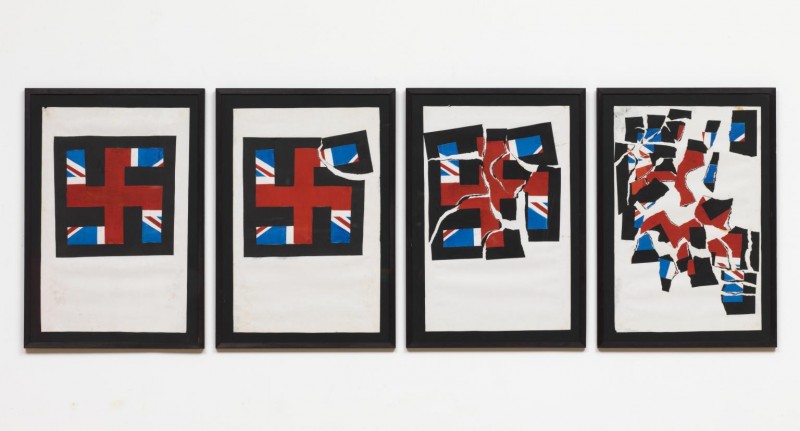
Boyce wanted to recapture the conventional English narrative surrounding the Black body, with the intention to challenge it. She started drawing herself into episodes of history from which people of colour had been excluded. She depicted friends, family and childhood experiences, including wallpaper patterns and bright colours associated with the Caribbean or the Windrush generation in England. In her pieces Boyce also included texts, using creolised language to enable 'vernacular culture to enter the space of art.'
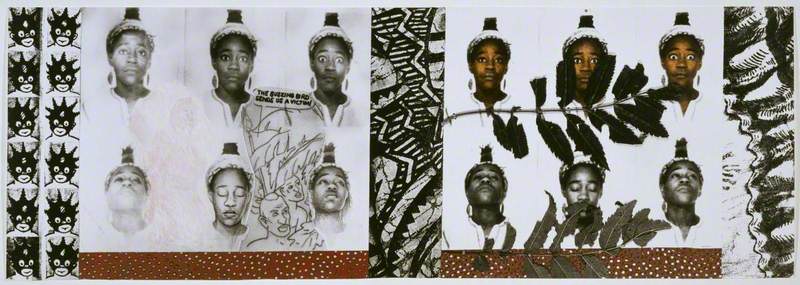
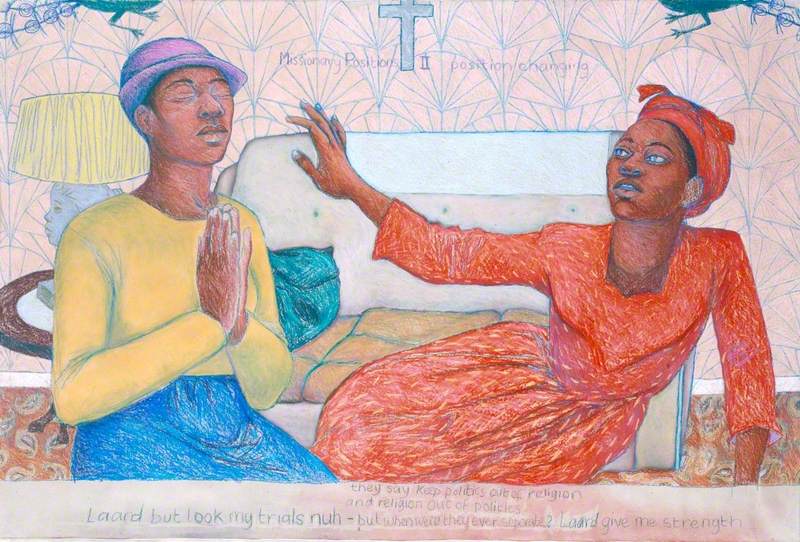
Curators began to notice how the artist examined her position as a Black woman in Britain and the historical events her experience was rooted in. As early as 1983, her piece Five Black Women was chosen to be exhibited at the Africa Centre, London. Sonia was only 21. Her works Big Women's Talk (1984), Auntie Enid – The Pose (1985) and Missionary Position II (1985) addressed issues of race and gender in day-to-day life, through large pastel drawings and photographic collages.

Made of watercolour, pastel and crayon on paper, Missionary Position II explores conflicting opinions on religious beliefs across different generations and cultures in Britain. The artist used herself as the model for the two figures, inspired (as mentioned earlier) by the work of the Mexican artist Frida Kahlo, then little known in the UK.

Boyce's practice was later influenced by the work of two other artists, according to Anjalie Dalal-Clayton: the feminist multimedia artist and performer Susan Hiller(1940–2019) and Donald G. Rodney (1961–1998), part of the BLK Art Group whose first exhibition 'Black Art An' Done' was shown at the Wolverhampton Art Galleryin 1984.
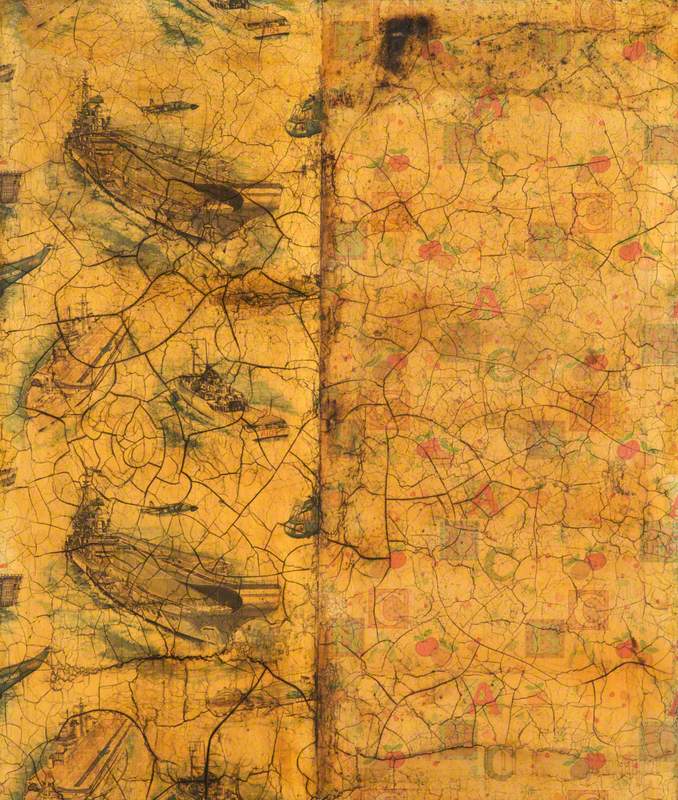
 

She became close to more Black British artists including John Akomfrah (b.1957) and his Black Audio Film Collective, as well as artist and curator Zak Ové (b.1966). Her work evolved toward collaborative art. Zak recalls: 'We all took part in the same group of artists coming out of early ventures into art together in and around Camden in London. We all felt like we were part of a family. Sonia exemplifies that sense of friendship in her work. She includes that closeness, offers positivity and radiance.'

In 1985, Himid selected some of Boyce's works for an exhibition she curated for the ICA titled 'The Thin Black Line'. And when Boyce was only 25, in 1987, Tate Modern bought her drawing Missionary Position II, making her the first British Black female artist to enter the collection.
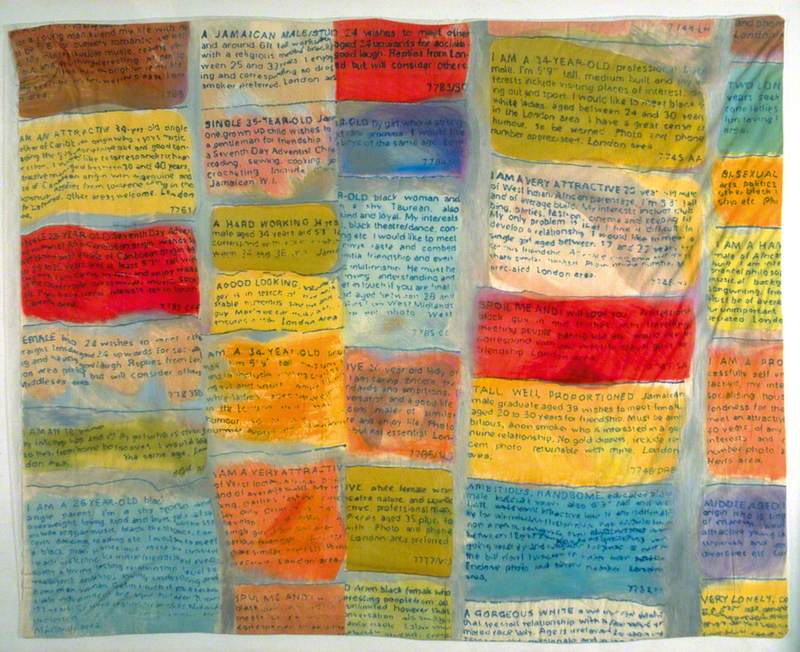
During the 1990s, Boyce's work toured the UK and was widely exhibited abroad. Boyce began to question her freedom as an artist, expressing a growing desire to be understood beyond her iconic image of 'the first Black woman to…' In a 1992 interview with Manthia Diawara, Boyce commented: 'Whatever we Black people do, it's said to be about identity, first and foremost. It becomes a blanket term for everything we do, regardless of what we're doing.'

Boyce was soon invited to teach Fine Art studio practice in several art colleges across the UK. She is now a Professor of Black Art and Design at the University of the Arts London. Her practice keeps on evolving and in 2018 her first retrospective exhibition took place at the Manchester Art Gallery.
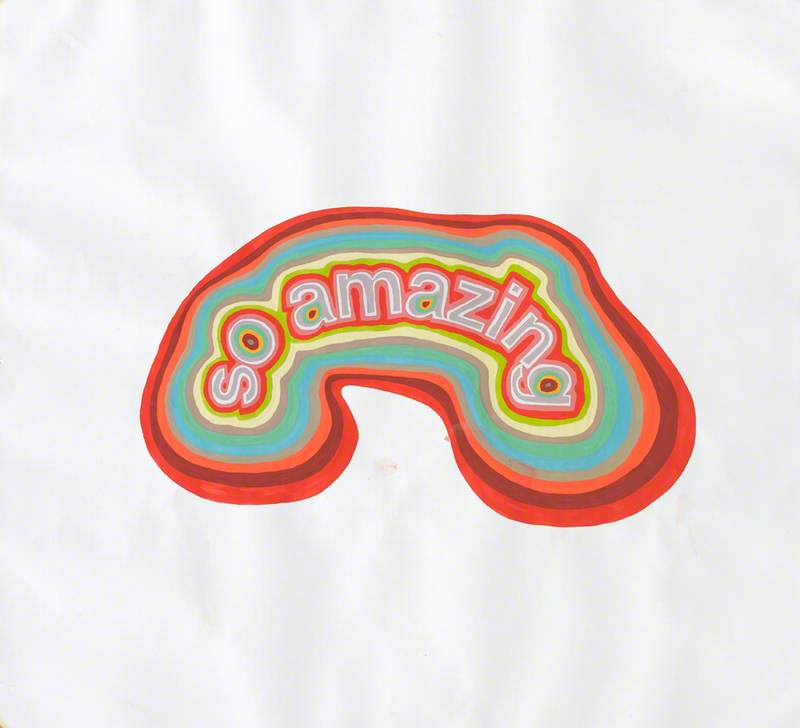
Now an OBE, Boyce will also be the 'first Black woman' to represent Great Britain at the prestigious Venice Biennale, in 2022. It is not her first appearance in Venice (she was included in the main exhibition in 2015 by late curator Okwui Enwezor), but this is still an unprecedented sign of recognition. On accepting the British Council commission, Boyce said: 'You could have knocked me down with a feather when I got the call to tell me I had been chosen to represent Britain at the Venice Biennale – it was like a bolt out of the blue.'

Boyce, as a Black artist, as a female artist, 'cannot help but be political in this world,' Hannah O'Leary, Head of Modern & Contemporary African Art at Sotheby's London, told me. 'I think often about the privilege and entitlement of white male artists that allows them the luxury of navel-gazing in their work. Much like Himid's Turner Prize win in 2017, the fact that Boyce became the first Black woman to achieve these milestones so late proves that we have only just begun to look at the representation of race and gender in this country, and that the true appreciation and celebration of this groundbreaking artist and her work, which resonates now more than ever, is clearly yet to come.'


 Melissa Chemam, writer, cultural journalist, reporter

-


Link to article: https://artuk.org/discover/stories/sonia-boyce-a-revolutionary-face-of-contemporary-british-art#


04/10/2020

Coronavirus: Lessons from Africa

 New article:

Coronavirus in Africa: The least affected continent should inspire us in the West


The World Health Organization (WHO) reported on 14 April that the number of confirmed cases of coronavirus in Africa had passed 15,000. ON 25 September, the organisation said the Covid-19 outbreak in Africa might have passed its peak.

JINJA, Uganda–A UN-standard level-2 mobile treatment facility 
(Photo by U.S. Army Staff Sgt. Grady Jones, Public Affairs, U.S. AFRICOM)

The news of 15,000 cases of Sars-Cov-2 in Africa came in April, as an emergency shipment of medical supplies for African nations’ health systems departed Addis Ababa. “This will help countries to scale up testing, treat more patients, and ensure health workers are protected,” WHO Regional Office for Africa said.

But since, Covid-19 has not taken hold across the continent, not in April, and still not in September. Many had feared that Sub-Saharan Africa would be the most ill-equipped region of the world to tackle such a disease. And the WHO’s Africa office estimated there were only about five intensive care beds per million people in Africa, compared with about 4,000 per million people in Europe.  

Unlike pre-Covid time, I wasn’t able to go and report there. Since 2009, I have worked as a journalist on African affairs, mainly for the BBC World Service, and was a freelance correspondent in East Africa between 2010 and 2012, then was posted in Central African Republic for the World Food Programme in 2014. In between, I reported in about 15 African countries. But 2020 is not a year for flying and risking spreading viruses across continents. So I have been monitoring the situation from England.

According to the WHO, in September, 77,147 cases were recorded in Africa, down from 131,647 in the previous four weeks. “Africa has not witnessed an exponential spread of Covid-19 as many initially feared,” said Dr Matshidiso Moeti, the WHO’s Regional Director for Africa. “The downward trend that we have seen in Africa over the past two months is undoubtedly a positive development and speaks to the robust and decisive public health measures taken by governments across the region,” she added.

Over the past four weeks (to 30 September 2020), there has been an average 3% fall in the number of weekly new cases being reported, according to the Africa Centres for Disease Control (CDC).

For analysts, the main reasons are younger and less dense populations, as well as hot, humid climates.

Africa is cautious, but still doing better than the rest of the world facing Covid-19

WHO still warns governments not to be complacent as countries relax their restrictions. The CDC too remained cautious: “I don’t think we are over the first wave yet, we have not yet hit the bottom at all,” said the CDC’s John Nkengasong.

The pandemic also had a serious impact on African economies, according to the New York Times, affecting foremost the continent’s growing middle class and deepening and extreme poverty.

Sub-Saharan Africa is disproportionally affected by communicable diseases such as HIV/AIDS, malaria, cholera, Ebola and tuberculosis, but Covid-19 was way less harmful. But this is hardly reported as newsworthy in the western media, because it doesn’t impact wealthier countries. For instance, in 2018, 228 million cases of malaria occurred worldwide, and an estimated 405,000 malaria deaths worldwide, but 93% of these cases occurring in Africa. Also Ebola is one of the world’s deadliest diseases, a highly infectious virus that can kill up to 90 percent of the people who catch it, causing terror among infected communities.

Southern and Northern Africa are the most affected African regions. The North Africa region recorded a 14% increase in cases in September. Morocco has been experiencing an increase in new cases and had the highest number of new cases on the continent over the past week. Libya and Tunisia were also among the five countries with the highest number of new cases over the week at number three and four. The others countries reporting high number of new cases are South Africa which was second late September, and Ethiopia at position five. South Africa is currently the first on the continent in cumulative cases, ahead of Morocco, Egypt and Ethiopia.

But most African countries didn’t have a problem getting people to wear masks, wash their hands, trace who was sick and, most of all, take care of their closest ones in their community.

According to the CDC, their experience in fighting AIDS, Ebola and malaria did benefit the African populations and governments in the case of the Covid-19.

In Liberia, the first case of covid-19 came from a person who brought the disease from Switzerland. This traveller’s household cook was the next to test positive for the infection. Health practitioners however did use their medical expertise gained in fighting Ebola to help public health authorities to prepare for this new pathogen.

In the same way, since mid-January 2020, the DRC’s Minister of Public Health, Dr Eteni Longondo, has been leading efforts to prepare the DRC for COVID-19, WHO reported. Dr Aaron Aruna, director of the Fight against Diseases in the Ministry of Public Health, said in February that “Having the Ebola screening in place made it easy for us to start screening for coronavirus disease. What we needed to do is not only check people leaving the country, or people travelling from North Kivu to other provinces, but also people coming in.”

In Nigeria, President Muhammadu Buhari announced on April 13, 2020 that the lockdown in place since March 30 in Lagos state, neighbouring Ogun state and Abuja, the nation’s capital, would continue for another 14 days. As of April 12, Nigeria had 343 confirmed cases.  

Africa has reported around 35,000 deaths and nearly 1.5 million confirmed cases in a population of 1 billion. This represents some 1,500 cases and 35 deaths per million compared to the US (the world’s worst affected country), with 2,100 cases and 600 deaths per million (nearly 7 million cases and 200,000 deaths in a population of 328 million).

The head of the WHO, Tedros Adhanom Ghebreyesus, is himself from Ethiopia; he warned the whole continent did need more investments to help provide masks and tests, and food support, but also to improve healthcare in general. The EU has already promise to freeze the debt.

But for now America, Europe and even Australia are definitely the ones that could learn a lesson or two from the African continent in the fight against Covid-19.


-

Melissa Chemam is a journalist, reporter and author. She covered African affairs from 2009 to 2017, travelling to 15 African countries. She is now a Bristol-based, a lecturer in journalism at UWE and the writer-in-residence at the Arnolfini Gallery.


Centre of Gravity at Soapworks Bristol: Outburst of creativity in times of dryness...

  Soapworks, a venue set in the old Gardiners of Bristol building, in Old Market, has become the newest art space in town.

In the midst of this catastrophic year for our cultural landscape, being able to spend the afternoon there was a complete breath of fresh air.  


60 Bristol artists have created visual arts, performance, talks and events, for a month-long programme gathered by Centre of Gravity, including Jo Lathwood, BEEF, Andrew Mania and Annabel Other, as well as emerging artists from Caraboo Projects, Rising Arts Agency and Latch.

The project is a collaboration between the Centre of Gravity arts collective and First Base, owner of the Soapworks site in the former home of Gardiner Haskins.

The team behind Centre of Gravity comprises curator Paula Orrell, artists Tim Knowles and Mariele Neudecker, and producers and art workers John O’Connor and Rosie Bowery.  

They all have responded uniquely to the context, history and architecture of the building.

In a press release, a few weeks ago, curator Paula Orrell explained the thinking behind their project: 

"It is an incredible opportunity to be able to use the former Gardiner Haskins warehouse, now known as The Soapworks. We hope whether it’s physically or digitally, everyone across Bristol and beyond can experience great contemporary art that is being made in this city right now and see this fantastic building in all its glory."

Here is a little tour, in pictures:


The place in itself is a former factory of gigantic dimension so the whole show runs on 5 different levels, in many rooms and around a old staircases - a space so immense it reminded me of some of Berlin's art gallery and an experience I had in Paris, at Théâtre du Châtelet / Théâtre de la Ville with the indescribable project known as DAU... 


Yes, there is a giant 'Brizopoly' as well, in the last top room, but you'll have to compete with children to get near it! 

You can also buy special soap, enveloped in artworks, as a souvenir... 

-


More on the artists here: Centre of Gravity


The exhibition is running from 3 October to the 1st of November.


-


Soapworks, Bristol, BS2 0FQ

Access via Old Bread Street

NO BOOKING REQUIRED


Wednesdays & Thursdays: 2:00pm - 6:00pm

Fridays: 2:00pm - 7:00pm

Saturdays: 12:00pm - 7:00pm

Sundays: 12:00pm - 5:00pm


-


About the building:

Situated between Straight Street, New Thomas Street and Broad Plain, the immense warehouse was built in 1865 by William Bruce Gingell and is known to be an example of the Bristol Byzantine style, a variety of Byzantine Revival architecture that was popular in the city from about 1850 to 1880 (many buildings in the style have been destroyed or demolished, but notable surviving examples include the Colston Hall, the Granary on Welsh Back, the Carriage Works on Stokes Croft, several buildings around Victoria Street, warehouses around the harbour including the Arnolfini, Clarks Wood Company warehouse & the St Vincent's Works in Silverthorne Lane and the Wool Hall in St Thomas Street).

Originally, the Gardiners warehouse was part of Christopher Thomas and Brothers' soap works and in 1958 became home to what is now known as Gardiner Haskins of Gardiner Sons & Co Ltd, an independent homeware retailer established in 1893. In 1966, English Heritage designated is as a grade II listed building.  

In 2018 Gardiner Haskins announced its intention to vacate Gardiners warehouse and move to a new showroom opposite the building. Since then, plans have been going on to transform the place into an art centre of incredible dimensions.


02/10/2020

Byliner of the Week


Happy to contribute to this wonderful group of publications: 

Great to have our very own Melissa Chemam picked as the Bylines Network's 'Byliner of the Week'!

Our Byliner of the Week is Melissa Chemam, writing for
West England Bylines
! A journalist of 16 years' experience, she grew frustrated with the drift of mainstream media towards popular figures and right wing voices, and began writing with Bylines. Her areas of interest include arts & culture, international politics, and social justice


01/10/2020

"Let’s give music all the support that it needs"

New column: 

Covid: Musicians are struggling, but it doesn’t have to be this way

Johnny Marr – Source: Author


Last week, I learned that one-third of British musicians could quit the music industry due to a lack of support during this coronavirus crisis. Some 2,000 members of the Musicians’ Union were recently surveyed on the issue in the UK. According to the results of the report, 34% of respondents are considering giving up their professional careers in music. Since lockdown began in March, those working in the music industry have been left unable to perform and thus have been hit sharply with financial difficulties.


The report published by The Guardian shows that almost half of the members surveyed have already found work outside the music industry, and 70% are unable to do more than a quarter of their usual work. “Musicians are working in supermarkets, being Deliveroo drivers, going back to things they trained for early in life,” Horace Trubridge, the union’s general secretary, told the Guardian.  

This autumn and winter threaten to be several months of no work for performing musicians and their crews if no extra financial support is coming from the government apart from universal credit.

Earlier this year, the Musicians’ Union conducted a survey which found that UK artists have lost £13.9 million in earnings because of coronavirus. The Musicians’ Union received responses from 4,100 of its 32,000 members, and 90% responded that their income had already been affected. Another survey from Music Venues Trust found that only 36% of British gig-goers feel safe returning to live music events. Yet, before the crisis the music industry was worth £5.2bn. How can the British government let this happen to one of the most admired and known sectors of the economy and culture of the United Kingdom?

The music industry doesn’t have to suffer so deeply! There are solutions; and others can be enabled and fostered.

I’ve personally spent the past six years writing on British music history and Bristol’s music scene and developing artists. I’ve also lectured on music journalism and given talks about how music has improved my life. During this pandemic music has been my greatest comfort, calming anxiety and filling the void left by cancelled events and inaccessible family members. It has brought meaningfulness and conveyed powerful messages.

My heart feels for the artists currently in turmoil. They are missing the possibility to express themselves and to perform, as much as their income.

Yet, music is still everywhere: on YouTube, on Spotify, on Apple Music, on Amazon Music, etc. These tech giants have made huge profits during the past six months, precisely because of the pandemic.

I’m pretty sure that music will keep me going through the worst days of the lockdown and a year without holidays in my home country, or anywhere else in the rest of Europe or the world.

So I want these artists to keep on receiving a decent amount of copyrights for all their production. Isn’t this the least we can do? I personally don’t use streaming platforms. I still buy albums, in physical copies or as MP3, because I’ve travelled a lot these past few years. But even if a few of us still do that, it can’t be enough. What musicians need is to receive better payment from these streaming services. We urgently need to rethink how revenues are shared between the artists, the record company, the distributors and the streaming platforms.

There are also political solutions to help supporting musicians while government restrictions prevent music events from happening.

The government has a responsibility to support an industry all of us cherish and benefit from.

According to the charity Help Musicians, “the vast majority of musicians are self-employed, and a recent survey carried out by the charity showed that 25% of these believed they would be ineligible for the Self-Employment Income Support Scheme.” Despite strong and sustained demands from across the music industry, the government has not changed the terms of the scheme. In response, Help Musicians has launched a second phase of funding to provide financial support for musicians left with nothing but Universal Credit, or struggling to survive on what other support they receive.

At this stage, the British government could start taxing tech giants and online platforms properly. This could generate an emergency fund for musicians and their touring teams. Many groups and activists are also campaigning for local basic income trials during the second phase of the pandemic; such schemes could support the most vulnerable and the artists, especially musicians, who have no replacement to their work and income. 

Many friends of mine working in music have turned to teaching music lessons online to survive. And parents love the opportunity to keep their children occupied creatively! The government could support a scheme for developing such lessons. 

What can help our musicians?

A measure that could support musicians as well as artists and self-employed people and the unemployed in general is simply the creation of a national basic income. In mid-September there was International Basic Income Week, and many events raised awareness on this issue. A Universal Basic Income (UBI) is a guaranteed, recurring payment to every member of society, sized to meet basic needs. It approaches the problem of people not having enough to live on by giving everyone a check equal to the cost of living. In its fullest form, it should serve all members of society, be unconditional and guaranteed for recipients’ lifetimes. On 25 September, a European Citizens’ Initiative for UBI has started to try and collect 1 million signatures for the EU parliament to start UBI schemes throughout the EU. A few British cities have started similar discussions, like Liverpool and Scottish Councils in Fife, North Ayrshire, Edinburgh and Glasgow. (More on UBI in my interview with its main thinker, Professor Guy Standing here: https://the-quarantini.captivate.fm/episode/a-quarantini-with-guy-standing-and-universal-basic-income).

Finally, locally, we can rethink our events. As cinemas and some theatres have reopened, some music venues could work on socially distant seated events. It seems like a consolation prize now but it might become a precious idea if restrictions continue for another few months. Here in Bristol, a venue like The Lanes has put this into place (https://thelanesbristol.com). Bands that have a huge fan base could start by performing many nights in a row in their home city, to replace touring. 

Audiences need live music just as much as musicians need to perform. The Musicians’ Union has listed all the funding sources that exist here and now: https://www.musiciansunion.org.uk/Home/Advice/covid-19/financial-support-musicians

 Let’s give music all the support that it needs.


-