Latest article: for West England Bylines
Bristol Students’ Rent Strike
-
Latest article: for West England Bylines
-
New article:
https://themarkaz.org/magazine/a-conversation-with-arundhati-roy-amp-colson-whitehead
The novelists and essayists discuss these difficult times, the rise of neo-fascism in India and the U.S., and “What Lies Ahead.”

As part of the Brooklyn Book Festival, Indian and American authors Arundhati Roy and Colson Whitehead were invited to read from their work and to discuss “What Lies Ahead.” Both have new books out. The reading, followed by a conversation, showed how much the two largest democracies in the world, currently deeply challenged, have in common.
Arundhati Roy has been issuing a siren call to the world against India’s fascist government for several years, while Colson Whitehead, as a New York writer in the Black community, has been confronted with decades of police brutality, as well as the advent of President Donald Trump, who openly embraces white nationalists.
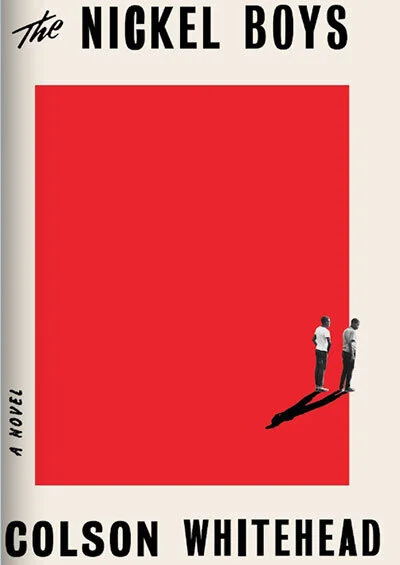
The Nickel Boys won the 2020 Pulitzer Prize in Fiction
In a virtual conversation that took place on October 4th, summarizing what for her are the commonalities between her work and that of Whitehead, author of the Pulitzer-Prize winning novels Underground Railroad and The Nickel Boys, Arundhati Roy—author of The God of Small Things and The Ministry of Utmost Happiness—mused, “It is, sadly, the writer’s fate to look at things with aching eyes, and not to blink...It’s the writer’s fate to look at the world’s fate.”
The two immensely talented writers couldn’t be further apart, as some 11,000 kilometers lie between New Dehli, India and Long Island, New York where each resides and from where each spoke remotely. Yet even as you factor in their different experiences in life, and their varied texts, when you listen to them concomitantly, the whole world starts to make sense.
For Roy, the current situation is the result of the 2,000-year-old Indian caste system, as much as an effect of 200 years of brutal British colonial rule—a reality she compared with the United States. “These two countries are built on denying the horrors of what they consider to be civilization. That’s what connects writers like Colson and myself.
“[Whitehead’s] Underground Railroad haunted me for years,” she said after Whitehead read from his work, “first because it’s so beautifully written and so powerful.” She cited anti-caste writers before her who have pointed out the connections between slavery in the US, the caste system in India and apartheid in South Africa. “However, there is no underground escape for any victim of the caste system here in India. There is no way to run away from it. Here, peoples’ minds are so vertical, so hierarchical, that Indians don’t know how to make it horizontal and create solidarity.”
To these thoughts, Whitehead responded that his novels always depict power structures and their violence, from slavery to our days, because these have to be uncovered. “I have to be all in,” he added, to confront the truth of what is country has remained.
Both writers have been challenged by the events of 2020, whether the current pandemic or the Black Lives Matter protests.
“For me, unfortunately, the current level of racism in America just proceeds from the same old business against Black people,” lamented Whitehead. “I grew up in New York in the ‘80s, when we’d have a famous case every three years…Police brutality hasn’t changed, even if now it is getting filmed on cell phones and these videos are seen by millions of people... When my books came out in Spain and in France, readers wrote me that they found them so prescient. But how could they be to me? This has happened so many times. America has remained the same.”
And the Covid-19 pandemic only amplified inequalities in the United States.
Arundhati Roy concurred as she compared the situation in India. “The pandemic was like an autopsy of a place in deep trouble: the lockdown forced ten million people to walk thousands of kilometers in one of the largest displacements in our recent history. In India a lockdown doesn’t insure social distancing, only some physical compressing. It only made things worse… Meanwhile, many violations of our rights are occurring daily. Just five minutes from my house [in New Delhi], there is a notorious police station, where friends I’ve known for years are being held, are being interrogated; there’s a massive sweep of arrests of all activists who rose up against the anti-Muslim citizenship law. As you know, there have been hundreds of Muslims lynched by mobs which are filmed and put up on YouTube.”
Brooklyn Book Festival moderator Anderson Tepper asked the two authors how the pandemic had affected their writing, a question that seemed to put Roy in disarray. She blamed the lockdown for an inability to easily articulate the many crises India is facing. “It’s like there are firing squads everywhere,” she said.
Tepper also wondered how Roy reacted after her essay in the Financial Times, “The Pandemic Is A Portal” circled the world across the net in April, almost like a calming mantra. In that piece, Roy wrote about the privatization of healthcare in India and how the free market is wreaking havoc among the less fortunate. But she also wrote:
Who can think of kissing a stranger, jumping on to a bus or sending their child to school without feeling real fear? Who can think of ordinary pleasure and not assess its risk? Who among us is not a quack epidemiologist, virologist, statistician and prophet? Which scientist or doctor is not secretly praying for a miracle? Which priest is not — secretly, at least — submitting to science?
“Yet,” she reckoned, appalled, “most people only quoted the last paragraph from that long essay.”
“Historically,” she wrote at the end of the column, “pandemics have forced humans to break with the past and imagine their world anew. This one is no different. It is a portal, a gateway between one world and the next.”
Yet for now she’s observed that in her country, the pandemic has only been “a portal for decisions that shouldn’t be made. The Indian government has suddenly changed the laws for agriculture, corporatized farming and privatized mining. The main point of my writing is about the violence, the privatization of healthcare, the lack of hospitals in India…That has happened to a lot of my writing: people take a quote from it and forget the main points.”
She cannot say she remains optimistic, though social media responses to her essay suggest that she is. That’s why she started writing political essays in the first place, after the release of The God of Small Things, facing praise for the novel but harsh backlash for her opinions. Her writing is now a weapon to fight the new nationalistic Hindu project. “It’s too hard to have other long-term plans,” she admitted during this online event.
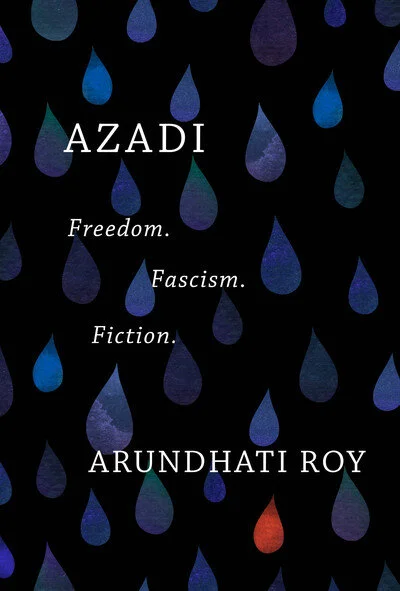
Arundhati Roy’s new collection from Haymarket Books.
Her new collection of essays, Azadi: Freedom. Fascism. Fiction, published by Haymarket Books this fall, helps us find parallels in the current numerous cases of extreme rightwing forms of fascism all over the world, from the US to Turkey and Brazil. It includes texts and lectures written over the past two years.
The first roots of nationalism in South Asia, the book reminds us, were consequences of the post-colonial era—India obtained its independence from the British Empire in 1947 at the cost of a partition with Pakistan and Bangladesh, along with deadly wars and huge shifts of populations, now responsible for Muslim-Hindu hatred. The politics of nationalism also resulted in an increasing differentiation in the languages themselves, in the former “Hindustan” into two separate ones, with discrete scripts—now called Hindi and Urdu—which enabled more discrimination.
The other root cause of the rise of violence emerged slowly after the collapse of the Soviet Union, when India’s alliance with the US opened wider doors to a stronger, more destructive form of capitalism.
Like many other observers, Roy hoped that Modi wouldn’t be reelected in 2019. But he was. “Only a year into his second term,” Roy wrote in the Paris Review in September this year, “through a series of horrifying moves, Modi has changed India beyond recognition. The infrastructure of fascism is staring us in the face, the pandemic is speeding up that process in unimaginable ways, and yet we hesitate to call it by its name.” And she can only see parallels with the situation in the United States.
Roy sees writing as a form of response. “My mind is in a mess right now! I haven’t found a way to write further about all this at the moment; there are so many crises on so many levels.” But when asked, “What lies ahead?” Roy pondered…and finally replied: “Reimagining the world. Only that.” And who could disagree?
As for Colson Whitehead, he tries to remain optimistic too. “If I thought Donald Trump were to be re-elected again in November, I’d probably go insane,” he told The Observer recently. “So, I have to think it won’t happen for my own sanity’s sake and for my children’s futures. One wants to be cautiously optimistic that these protests will make something happen, but also they might not.”
His new novel, Harlem Shuffle, will be published in 2021, and he’s already started working on another one. “There is always a fear of screwing up,” he confessed, “but I’m still doing the work. My anxiety has become some good quality control.”
These days—like the main character in her novel The Ministry of Utmost Happiness, Arundhati Roy remains anxious about the future of India’s communities, especially for the new generation, increasingly divided by Modi’s fascist and anti-Muslim rhetoric. As for Colson Whitehead, we will revisit with him on matters of anti-Black racism, police brutality and the neo-fascism of Donald Trump, after November 3rd.

Melissa Chemam is a Bristol-based journalist and author, and a contributing editor at The Markaz Review.
-
Read the 2nd issue of The Markaz Review here.
Latest article and favourite piece of writing this year, so far! For the mighty Art UK
Posted 02 Oct 2020
Colourful and feminine portraits, images representing internal emotions through patterns, paintings depicting historical events, animals and humans. When I read that Sonia Boyce (b.1962) had early on been influenced by Mexican artist Frida Kahlo (1907–1954) it made so much sense.
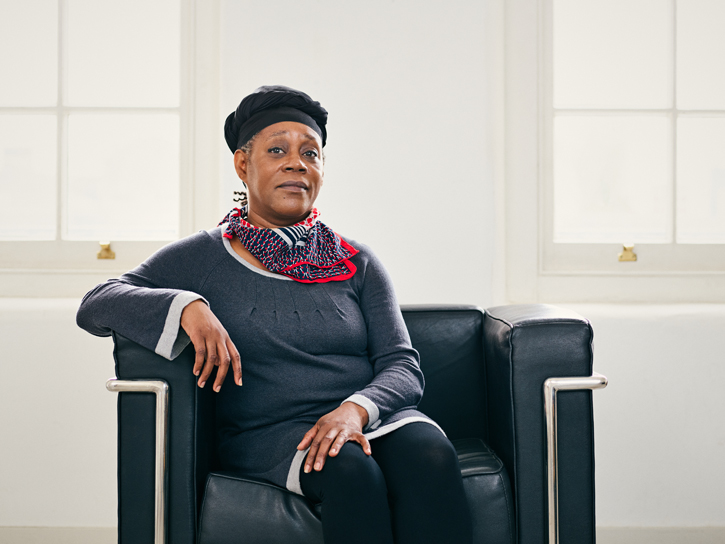
photo credit: Emile Holba
Sonia Boyce, by Emile Holba
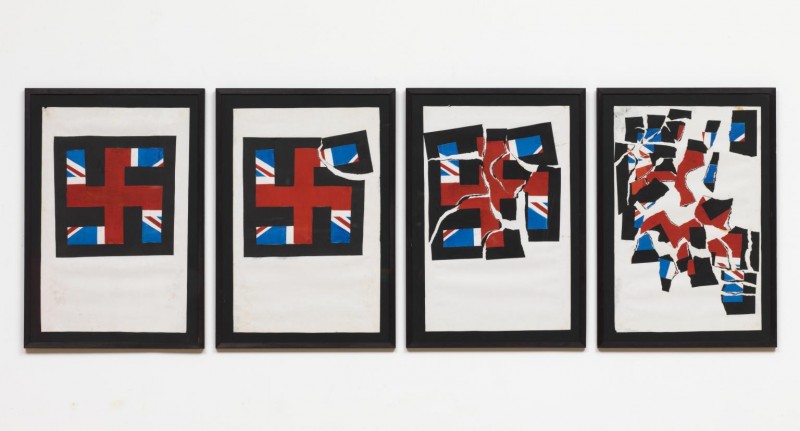
Boyce opened a new page in British art history, for women, Caribbean and also political artists, with aesthetically brilliant imagery and a strong personal narrative. She produces work involving a variety of media – drawing, print, photography, video and audio – exploring the interstices between sound and memory, time and space.
Born in 1962 in Islington, London, into a British Afro-Caribbean family, Boyce attended Eastlea Comprehensive School in Canning Town, East London. She was always drawing as a child, she said, so at 17 she decided to study art, and from 1979–1980 completed a Foundation Course in Art & Design at East Ham College of Art and Technology.
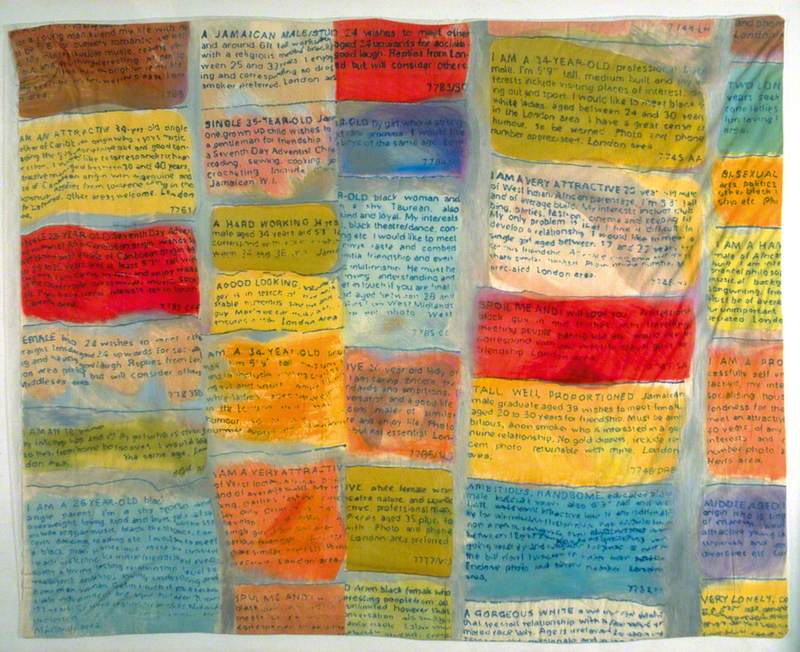
In Sonia Boyce: Beyond Blackness, art historian Anjalie Dalal-Clayton writes that the artist's early oeuvre was influenced by feminist artists Margaret Harrison(b.1940), Kate Walker and Monica Ross (1950–2013), and used an assemblage of texts, photography, drawings and magazine clippings. 'It was a revelation for Boyce,' Dalal-Clayton underlines, one which would come to define her practice.
In 1980 Boyce started a BA in Fine Art at the prestigious Stourbridge College in the West Midlands. But she soon felt unease. Her intuitions on postmodernism and mixed media were dismissed as delusional. 'It was very clear that I was somehow out of place,' she told The Guardian in 2018; 'the system hadn't anticipated me, or anyone like me. Even though there were a lot of female students, they were thought about as though they were being trained to become the wives of artists, not artists themselves. As a Black person, there wasn't a narrative at all.'
Luckily in 1982 she attended the first national conference of Black artists and met the Tanzanian-born painter Lubaina Himid (b.1954), a leading figure promoting the work of Black women artists and encouraging them in 'making positive images' of themselves. Sonia soon took part in this wider Black British cultural 'renaissance', a movement that arose in reaction to Margaret Thatcher's conservatism, and was embraced by artists such as Eddie Chambers (b.1960) and Horace Ové (b.1939).
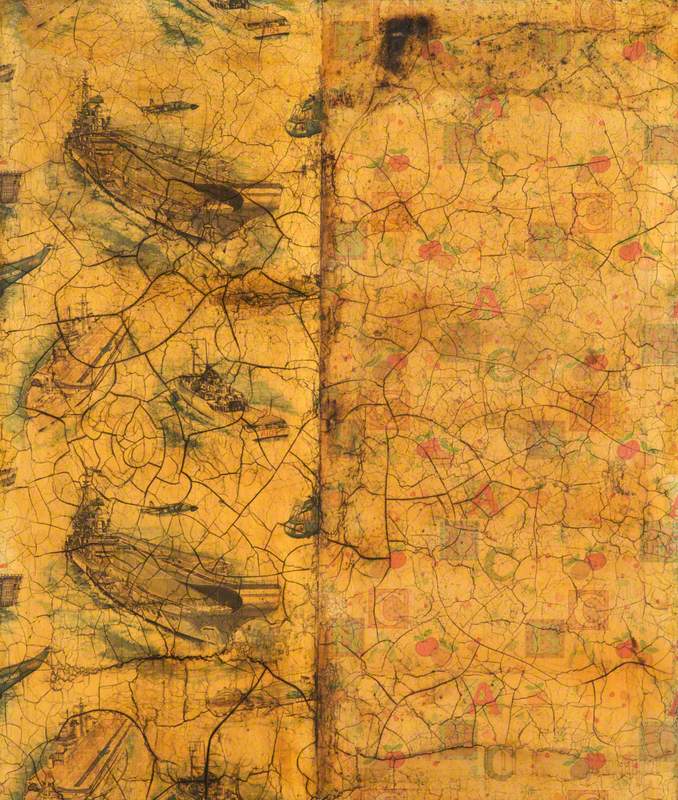
Boyce wanted to recapture the conventional English narrative surrounding the Black body, with the intention to challenge it. She started drawing herself into episodes of history from which people of colour had been excluded. She depicted friends, family and childhood experiences, including wallpaper patterns and bright colours associated with the Caribbean or the Windrush generation in England. In her pieces Boyce also included texts, using creolised language to enable 'vernacular culture to enter the space of art.'
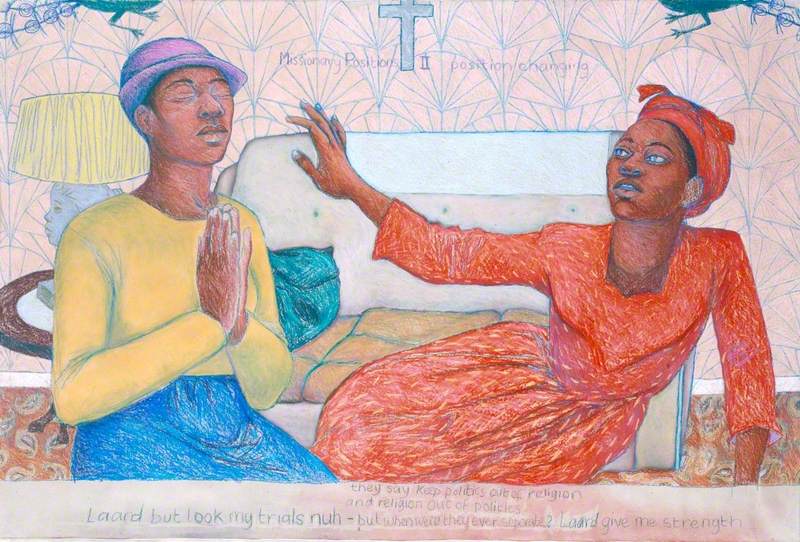
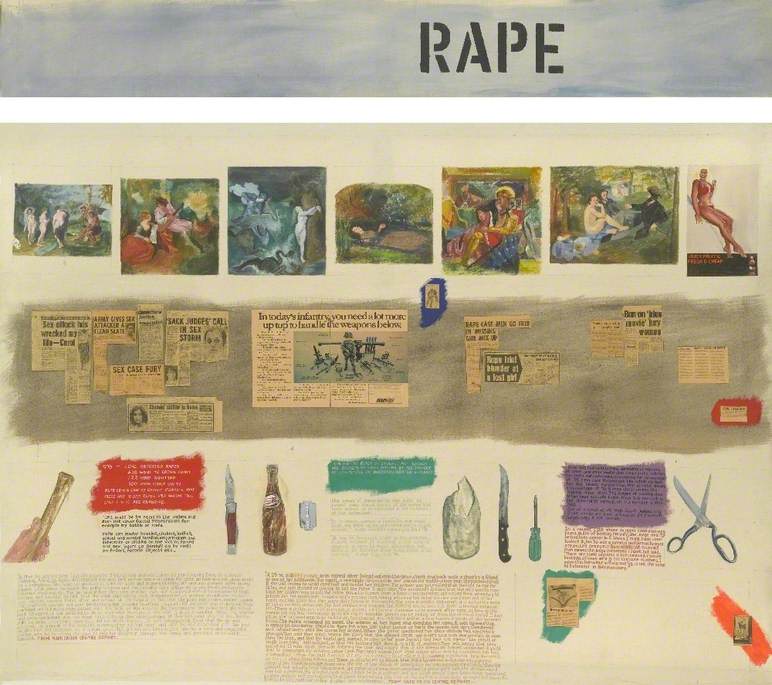
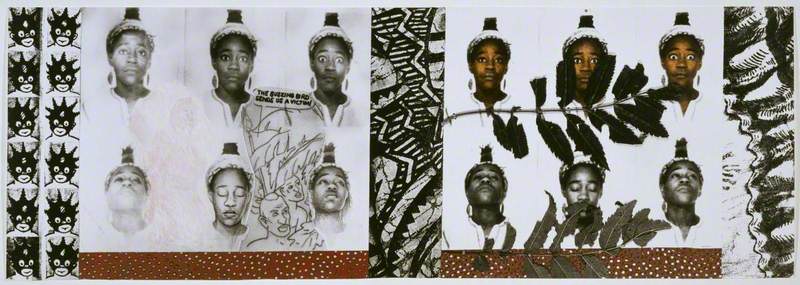
Curators began to notice how the artist examined her position as a Black woman in Britain and the historical events her experience was rooted in. As early as 1983, her piece Five Black Women was chosen to be exhibited at the Africa Centre, London. Sonia was only 21. Her works Big Women's Talk (1984), Auntie Enid – The Pose (1985) and Missionary Position II (1985) addressed issues of race and gender in day-to-day life, through large pastel drawings and photographic collages.
Made of watercolour, pastel and crayon on paper, Missionary Position II explores conflicting opinions on religious beliefs across different generations and cultures in Britain. The artist used herself as the model for the two figures, inspired (as mentioned earlier) by the work of the Mexican artist Frida Kahlo, then little known in the UK.
Boyce's practice was later influenced by the work of two other artists, according to Anjalie Dalal-Clayton: the feminist multimedia artist and performer Susan Hiller(1940–2019) and Donald G. Rodney (1961–1998), part of the BLK Art Group whose first exhibition 'Black Art An' Done' was shown at the Wolverhampton Art Galleryin 1984.
She became close to more Black British artists including John Akomfrah (b.1957) and his Black Audio Film Collective, as well as artist and curator Zak Ové (b.1966). Her work evolved toward collaborative art. Zak recalls: 'We all took part in the same group of artists coming out of early ventures into art together in and around Camden in London. We all felt like we were part of a family. Sonia exemplifies that sense of friendship in her work. She includes that closeness, offers positivity and radiance.'
In 1985, Himid selected some of Boyce's works for an exhibition she curated for the ICA titled 'The Thin Black Line'. And when Boyce was only 25, in 1987, Tate Modern bought her drawing Missionary Position II, making her the first British Black female artist to enter the collection.
During the 1990s, Boyce's work toured the UK and was widely exhibited abroad. Boyce began to question her freedom as an artist, expressing a growing desire to be understood beyond her iconic image of 'the first Black woman to…' In a 1992 interview with Manthia Diawara, Boyce commented: 'Whatever we Black people do, it's said to be about identity, first and foremost. It becomes a blanket term for everything we do, regardless of what we're doing.'
Boyce was soon invited to teach Fine Art studio practice in several art colleges across the UK. She is now a Professor of Black Art and Design at the University of the Arts London. Her practice keeps on evolving and in 2018 her first retrospective exhibition took place at the Manchester Art Gallery.
Now an OBE, Boyce will also be the 'first Black woman' to represent Great Britain at the prestigious Venice Biennale, in 2022. It is not her first appearance in Venice (she was included in the main exhibition in 2015 by late curator Okwui Enwezor), but this is still an unprecedented sign of recognition. On accepting the British Council commission, Boyce said: 'You could have knocked me down with a feather when I got the call to tell me I had been chosen to represent Britain at the Venice Biennale – it was like a bolt out of the blue.'
Boyce, as a Black artist, as a female artist, 'cannot help but be political in this world,' Hannah O'Leary, Head of Modern & Contemporary African Art at Sotheby's London, told me. 'I think often about the privilege and entitlement of white male artists that allows them the luxury of navel-gazing in their work. Much like Himid's Turner Prize win in 2017, the fact that Boyce became the first Black woman to achieve these milestones so late proves that we have only just begun to look at the representation of race and gender in this country, and that the true appreciation and celebration of this groundbreaking artist and her work, which resonates now more than ever, is clearly yet to come.'
Melissa Chemam, writer, cultural journalist, reporter
-
Link to article: https://artuk.org/discover/stories/sonia-boyce-a-revolutionary-face-of-contemporary-british-art#
New article:
The World Health Organization (WHO) reported on 14 April that the number of confirmed cases of coronavirus in Africa had passed 15,000. ON 25 September, the organisation said the Covid-19 outbreak in Africa might have passed its peak.

The news of 15,000 cases of Sars-Cov-2 in Africa came in April, as an emergency shipment of medical supplies for African nations’ health systems departed Addis Ababa. “This will help countries to scale up testing, treat more patients, and ensure health workers are protected,” WHO Regional Office for Africa said.
But since, Covid-19 has not taken hold across the continent, not in April, and still not in September. Many had feared that Sub-Saharan Africa would be the most ill-equipped region of the world to tackle such a disease. And the WHO’s Africa office estimated there were only about five intensive care beds per million people in Africa, compared with about 4,000 per million people in Europe.
Unlike pre-Covid time, I wasn’t able to go and report there. Since 2009, I have worked as a journalist on African affairs, mainly for the BBC World Service, and was a freelance correspondent in East Africa between 2010 and 2012, then was posted in Central African Republic for the World Food Programme in 2014. In between, I reported in about 15 African countries. But 2020 is not a year for flying and risking spreading viruses across continents. So I have been monitoring the situation from England.
According to the WHO, in September, 77,147 cases were recorded in Africa, down from 131,647 in the previous four weeks. “Africa has not witnessed an exponential spread of Covid-19 as many initially feared,” said Dr Matshidiso Moeti, the WHO’s Regional Director for Africa. “The downward trend that we have seen in Africa over the past two months is undoubtedly a positive development and speaks to the robust and decisive public health measures taken by governments across the region,” she added.
Over the past four weeks (to 30 September 2020), there has been an average 3% fall in the number of weekly new cases being reported, according to the Africa Centres for Disease Control (CDC).
For analysts, the main reasons are younger and less dense populations, as well as hot, humid climates.
Africa is cautious, but still doing better than the rest of the world facing Covid-19
WHO still warns governments not to be complacent as countries relax their restrictions. The CDC too remained cautious: “I don’t think we are over the first wave yet, we have not yet hit the bottom at all,” said the CDC’s John Nkengasong.
The pandemic also had a serious impact on African economies, according to the New York Times, affecting foremost the continent’s growing middle class and deepening and extreme poverty.
Sub-Saharan Africa is disproportionally affected by communicable diseases such as HIV/AIDS, malaria, cholera, Ebola and tuberculosis, but Covid-19 was way less harmful. But this is hardly reported as newsworthy in the western media, because it doesn’t impact wealthier countries. For instance, in 2018, 228 million cases of malaria occurred worldwide, and an estimated 405,000 malaria deaths worldwide, but 93% of these cases occurring in Africa. Also Ebola is one of the world’s deadliest diseases, a highly infectious virus that can kill up to 90 percent of the people who catch it, causing terror among infected communities.
Southern and Northern Africa are the most affected African regions. The North Africa region recorded a 14% increase in cases in September. Morocco has been experiencing an increase in new cases and had the highest number of new cases on the continent over the past week. Libya and Tunisia were also among the five countries with the highest number of new cases over the week at number three and four. The others countries reporting high number of new cases are South Africa which was second late September, and Ethiopia at position five. South Africa is currently the first on the continent in cumulative cases, ahead of Morocco, Egypt and Ethiopia.
But most African countries didn’t have a problem getting people to wear masks, wash their hands, trace who was sick and, most of all, take care of their closest ones in their community.
According to the CDC, their experience in fighting AIDS, Ebola and malaria did benefit the African populations and governments in the case of the Covid-19.
In Liberia, the first case of covid-19 came from a person who brought the disease from Switzerland. This traveller’s household cook was the next to test positive for the infection. Health practitioners however did use their medical expertise gained in fighting Ebola to help public health authorities to prepare for this new pathogen.
In the same way, since mid-January 2020, the DRC’s Minister of Public Health, Dr Eteni Longondo, has been leading efforts to prepare the DRC for COVID-19, WHO reported. Dr Aaron Aruna, director of the Fight against Diseases in the Ministry of Public Health, said in February that “Having the Ebola screening in place made it easy for us to start screening for coronavirus disease. What we needed to do is not only check people leaving the country, or people travelling from North Kivu to other provinces, but also people coming in.”
In Nigeria, President Muhammadu Buhari announced on April 13, 2020 that the lockdown in place since March 30 in Lagos state, neighbouring Ogun state and Abuja, the nation’s capital, would continue for another 14 days. As of April 12, Nigeria had 343 confirmed cases.
Africa has reported around 35,000 deaths and nearly 1.5 million confirmed cases in a population of 1 billion. This represents some 1,500 cases and 35 deaths per million compared to the US (the world’s worst affected country), with 2,100 cases and 600 deaths per million (nearly 7 million cases and 200,000 deaths in a population of 328 million).
The head of the WHO, Tedros Adhanom Ghebreyesus, is himself from Ethiopia; he warned the whole continent did need more investments to help provide masks and tests, and food support, but also to improve healthcare in general. The EU has already promise to freeze the debt.
But for now America, Europe and even Australia are definitely the ones that could learn a lesson or two from the African continent in the fight against Covid-19.
-
Melissa Chemam is a journalist, reporter and author. She covered African affairs from 2009 to 2017, travelling to 15 African countries. She is now a Bristol-based, a lecturer in journalism at UWE and the writer-in-residence at the Arnolfini Gallery.