21/10/2020

Daydreaming, still...


Latest piece on music history... For the Reader's Digest

Massive Attack & the birth of the "Bristol Sound"

Melissa Chemam


Thirty years ago, on October 15, 1990, the song “Daydreaming” by Massive Attack came out, six months before their debut album, Blue Lines. The song opened so many directions for Black British music. While writing a book about the “BristolSound”, I met many of these musicians and their collaborators, to retell this story.
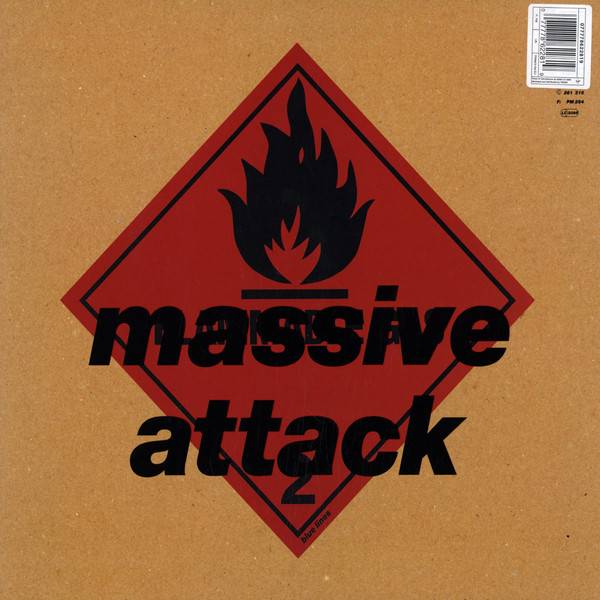
Released with a slick black and white video, with a hot climate fusing England and the Caribbean, “Daydreaming” reached number #81 in the UK Singles Chart, a first for a Bristol band.

The single featured Tricky, 3D and Shara Nelson on vocals, mixing rap, dub and reggae influences with a pinch of soul and funk, and opened a new era.

From reggae and punk to hip-hop and electro, came the “Bristol Sound”
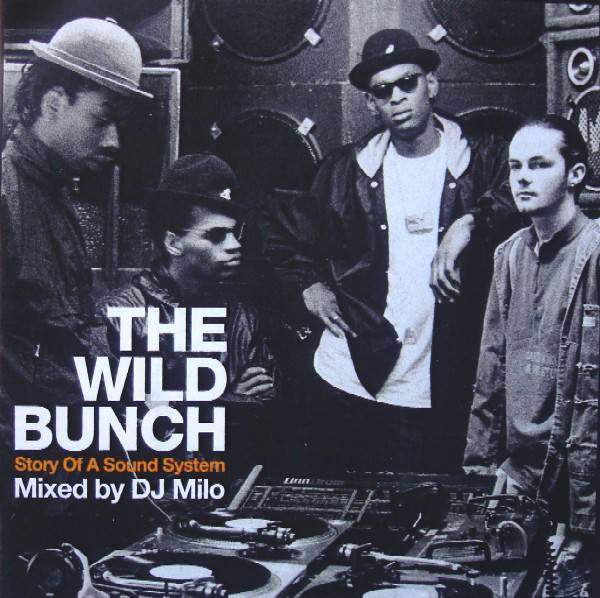
Before forming Massive Attack in 1988, Daddy G, Mushroom and 3D hung out in a club called The Dug Out. They were part of The Wild Bunch, a loose collective created by DJ Milo and Nellee Hopper in 1980. Milo, G and Mushroom are of Caribbean origins, and grew up to the sound of reggae and soul. 3D, born in an Italian-English family, and Nellee were as obsessed with Black music.

Reggae has indeed had a major influence on Bristol since the 1970s. The music helped immigrants to understand their post-colonial situation at a time of hostility. Bands like Black Roots and Talisman, DJs like Tarzan the High Priest and DJ Derek popularised the style in pubs and at St Paul’s Carnival. Soon, younger DJs started organising “blues parties” and events in warehouses or clubs like the Dug Out, described as Bristol’s little Studio 54 of the 1980s.

"Graffiti and rap came out of the cultural void left by punk"

“Graffiti and rap came out of the cultural void left by punk,” 3D told me. “I started writing vocals for Wednesdays at The Dug Out. It was very selective; The Wild Bunch wouldn’t let many on the mic. Daddy G did some reggae-style toasting. Willy Wee had a more New-York-style MC thing. And then there was me.”

Also part of the scene were young rappers from the same humble immigrant origins, like Tricky. Born of English, African and Jamaican parentage, Adrian Thaws aka Tricky infused his music with Bristolian and Caribbean references. He met The Wild Bunch in 1987. “It was a great time for us all,” he says, “we didn’t care about money, only about making the best music possible. I slept at friends’ or in squats. It was a life of total freedom.”
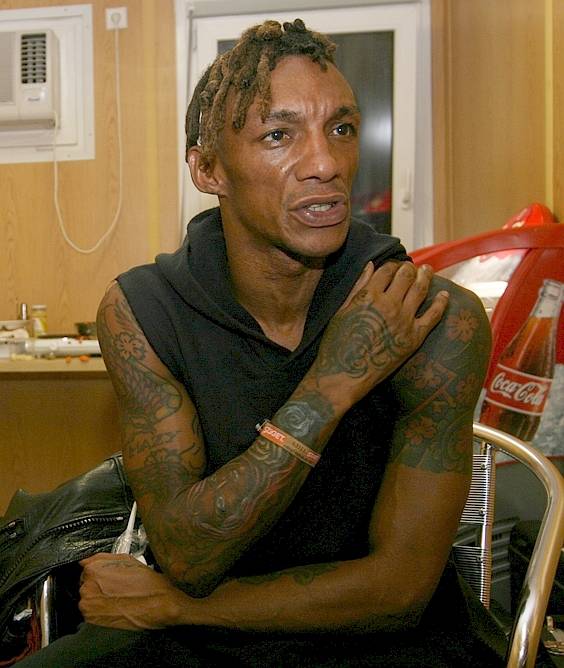

Tricky

In 1989, the collective dissolved though, and Nellee Hooper joined Soul II Soul in London, producing their second album, Vol. II: 1990—A New Decade, which peaked at number 1 on the UK Albums Chart.

3D and Mushroom started working with the Swedish singer based in London, Neneh Cherry, producing songs for her first album, Raw Like Sushi, released in 1989. Her partner and manager, Cameron McVey, saw a potential in the unconventional group and encouraged them to record… That’s how of Massive Attack came about and the songs that formed Blue Lines.

“Daydreaming” 30 years on

This mix of soul vocals and hip-hop started with a track, “Daydreaming”.

The band sampled the song “Mambo” by West-African French musician Willy Badarou, from his album Echoes (1984), adding their raps and soulful lyrics. 

Tricky was then 20 years old, was not part of the band but collaborated with 3D on lyrics. “It’s the first track I worked ever,” he told me. “I was so young at the time; I had no clue of how to release a track alone. 3D was my mate; we were always together in the clubs, in the underground scene. I was not at all interested in keeping a track for myself back then. I still hear people telling me how much they love it.”

The song, in a very Massive Attack way, was “reworked dozens of times”, 3D told me, with many producers like himself, Cameron Mc Vey and Johnny Dollar.

Massive Sound, Massive Influence

Since the release of Blue Lines in 1991, the song as well as “Unfinished Sympathy” and “Safe From Harm” have become some sort of national anthems.

Massive Attack has released four other albums, Tricky—14, and bands like Portishead have emerged from the city. The Bristol sound produced a new chapter for the history Black British Music, Massive working Horace Andy and the Mad Professor (who remixed their albums in dub versions), Nigerian Scottish singer Nicolette, Bristol stars Martina Topley-Bird and Yola, also inviting Black artists from the US such as Mos Def and Snoop Doggy Dog. Their influence is heard in the sound of London Grammar as much as Lana Del Rey.


Massive Attack live

More recently, they featured Young Fathers, Roots Manuva, Saul Williams and James Massiah, who read one of his poems on “Dear Friend” in 2016. “It was an incredible opportunity,” James told me. “An A&R at a record label sent one of my poems to their producer and we had two sessions before locking it in.”

In 1991, John McCready wrote in The Face magazine: “Hip hop heroes or Bristol’s answer to Pink Floyd? Either way, Massive Attack are the sound of 1991.” A sound that still resonates.


20/10/2020

Bristol Students’ want a Rent Strike to complain about their lockdown conditions


Latest article: for West England Bylines

Bristol Students’ Rent Strike


-

16/10/2020

“What Lies Ahead” - A Conversation with Arundhati Roy & Colson Whitehead

New article:

https://themarkaz.org/magazine/a-conversation-with-arundhati-roy-amp-colson-whitehead 


  TMR

A Conversation with Arundhati Roy & Colson Whitehead

The novelists and essayists discuss these difficult times, the rise of neo-fascism in India and the U.S., and “What Lies Ahead.”


As part of the Brooklyn Book Festival, Indian and American authors Arundhati Roy and Colson Whitehead were invited to read from their work and to discuss “What Lies Ahead.” Both have new books out. The reading, followed by a conversation, showed how much the two largest democracies in the world, currently deeply challenged, have in common.

Melissa Chemam

Arundhati Roy has been issuing a siren call to the world against India’s fascist government for several years, while Colson Whitehead, as a New York writer in the Black community, has been confronted with decades of police brutality, as well as the advent of President Donald Trump, who openly embraces white nationalists. 

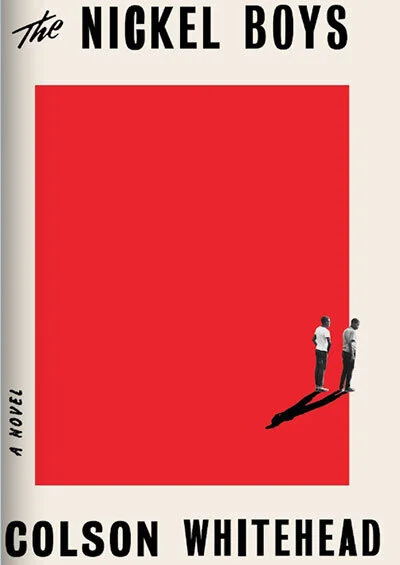
The Nickel Boys   won the 2020 Pulitzer Prize in Fiction

The Nickel Boys won the 2020 Pulitzer Prize in Fiction

In a virtual conversation that took place on October 4th, summarizing what for her are the commonalities between her work and that of Whitehead, author of the Pulitzer-Prize winning novels Underground Railroad and The Nickel Boys, Arundhati Roy—author of The God of Small Things and The Ministry of Utmost Happiness—mused, “It is, sadly, the writer’s fate to look at things with aching eyes, and not to blink...It’s the writer’s fate to look at the world’s fate.”

The two immensely talented writers couldn’t be further apart, as some 11,000 kilometers lie between New Dehli, India and Long Island, New York where each resides and from where each spoke remotely. Yet even as you factor in their different experiences in life, and their varied texts, when you listen to them concomitantly, the whole world starts to make sense.

For Roy, the current situation is the result of the 2,000-year-old Indian caste system, as much as an effect of 200 years of brutal British colonial rule—a reality she compared with the United States. “These two countries are built on denying the horrors of what they consider to be civilization. That’s what connects writers like Colson and myself. 

“[Whitehead’s] Underground Railroad haunted me for years,” she said after Whitehead read from his work, “first because it’s so beautifully written and so powerful.” She cited anti-caste writers before her who have pointed out the connections between slavery in the US, the caste system in India and apartheid in South Africa. “However, there is no underground escape for any victim of the caste system here in India. There is no way to run away from it. Here, peoples’ minds are so vertical, so hierarchical, that Indians don’t know how to make it horizontal and create solidarity.” 

To these thoughts, Whitehead responded that his novels always depict power structures and their violence, from slavery to our days, because these have to be uncovered. “I have to be all in,” he added, to confront the truth of what is country has remained. 

Both writers have been challenged by the events of 2020, whether the current pandemic or the Black Lives Matter protests. 

“For me, unfortunately, the current level of racism in America just proceeds from the same old business against Black people,” lamented Whitehead. “I grew up in New York in the ‘80s, when we’d have a famous case every three years…Police brutality hasn’t changed, even if now it is getting filmed on cell phones and these videos are seen by millions of people... When my books came out in Spain and in France, readers wrote me that they found them so prescient. But how could they be to me? This has happened so many times. America has remained the same.”   

And the Covid-19 pandemic only amplified inequalities in the United States.

Arundhati Roy concurred as she compared the situation in India. “The pandemic was like an autopsy of a place in deep trouble: the lockdown forced ten million people to walk thousands of kilometers in one of the largest displacements in our recent history. In India a lockdown doesn’t insure social distancing, only some physical compressing. It only made things worse… Meanwhile, many violations of our rights are occurring daily. Just five minutes from my house [in New Delhi], there is a notorious police station, where friends I’ve known for years are being held, are being interrogated; there’s a massive sweep of arrests of all activists who rose up against the anti-Muslim citizenship law. As you know, there have been hundreds of Muslims lynched by mobs which are filmed and put up on YouTube.” 

Brooklyn Book Festival moderator Anderson Tepper asked the two authors how the pandemic had affected their writing, a question that seemed to put Roy in disarray. She blamed the lockdown for an inability to easily articulate the many crises India is facing. “It’s like there are firing squads everywhere,” she said.

Tepper also wondered how Roy reacted after her essay in the Financial Times, “The Pandemic Is A Portal” circled the world across the net in April, almost like a calming mantra. In that piece, Roy wrote about the privatization of healthcare in India and how the free market is wreaking havoc among the less fortunate. But she also wrote:

Who can think of kissing a stranger, jumping on to a bus or sending their child to school without feeling real fear? Who can think of ordinary pleasure and not assess its risk? Who among us is not a quack epidemiologist, virologist, statistician and prophet? Which scientist or doctor is not secretly praying for a miracle? Which priest is not — secretly, at least — submitting to science? 

“Yet,” she reckoned, appalled, “most people only quoted the last paragraph from that long essay.”

“Historically,” she wrote at the end of the column, “pandemics have forced humans to break with the past and imagine their world anew. This one is no different. It is a portal, a gateway between one world and the next.”

Yet for now she’s observed that in her country, the pandemic has only been “a portal for decisions that shouldn’t be made. The Indian government has suddenly changed the laws for agriculture, corporatized farming and privatized mining. The main point of my writing is about the violence, the privatization of healthcare, the lack of hospitals in India…That has happened to a lot of my writing: people take a quote from it and forget the main points.”

She cannot say she remains optimistic, though social media responses to her essay suggest that she is. That’s why she started writing political essays in the first place, after the release of The God of Small Things, facing praise for the novel but harsh backlash for her opinions. Her writing is now a weapon to fight the new nationalistic Hindu project. “It’s too hard to have other long-term plans,” she admitted during this online event.

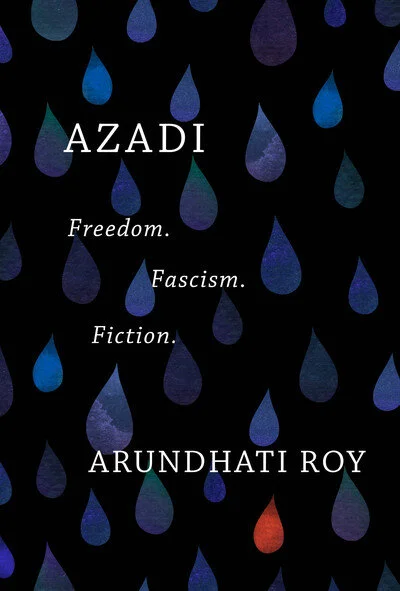
Arundhati Roy’s new collection from  Haymarket Books .

Arundhati Roy’s new collection from Haymarket Books.

Her new collection of essays, Azadi: Freedom. Fascism. Fiction, published by Haymarket Books this fall, helps us find parallels in the current numerous cases of extreme rightwing forms of fascism all over the world, from the US to Turkey and Brazil. It includes texts and lectures written over the past two years.

The first roots of nationalism in South Asia, the book reminds us, were consequences of the post-colonial era—India obtained its independence from the British Empire in 1947 at the cost of a partition with Pakistan and Bangladesh, along with deadly wars and huge shifts of populations, now responsible for Muslim-Hindu hatred. The politics of nationalism also resulted in an increasing differentiation in the languages themselves, in the former “Hindustan” into two separate ones, with discrete scripts—now called Hindi and Urdu—which enabled more discrimination.

The other root cause of the rise of violence emerged slowly after the collapse of the Soviet Union, when India’s alliance with the US opened wider doors to a stronger, more destructive form of capitalism. 

Like many other observers, Roy hoped that Modi wouldn’t be reelected in 2019. But he was. “Only a year into his second term,” Roy wrote in the Paris Review in September this year, “through a series of horrifying moves, Modi has changed India beyond recognition. The infrastructure of fascism is staring us in the face, the pandemic is speeding up that process in unimaginable ways, and yet we hesitate to call it by its name.” And she can only see parallels with the situation in the United States.

Roy sees writing as a form of response. “My mind is in a mess right now! I haven’t found a way to write further about all this at the moment; there are so many crises on so many levels.” But when asked, “What lies ahead?” Roy pondered…and finally replied: “Reimagining the world. Only that.” And who could disagree?

As for Colson Whitehead, he tries to remain optimistic too. “If I thought Donald Trump were to be re-elected again in November, I’d probably go insane,” he told The Observer recently. “So, I have to think it won’t happen for my own sanity’s sake and for my children’s futures. One wants to be cautiously optimistic that these protests will make something happen, but also they might not.”

His new novel, Harlem Shuffle, will be published in 2021, and he’s already started working on another one. “There is always a fear of screwing up,” he confessed, “but I’m still doing the work. My anxiety has become some good quality control.”

These days—like the main character in her novel The Ministry of Utmost Happiness, Arundhati Roy remains anxious about the future of India’s communities, especially for the new generation, increasingly divided by Modi’s fascist and anti-Muslim rhetoric. As for Colson Whitehead, we will revisit with him on matters of anti-Black racism, police brutality and the neo-fascism of Donald Trump, after November 3rd.

tmr-end-of-article-logo-50pix.jpg

Melissa Chemam is a Bristol-based journalist and author, and a contributing editor at The Markaz Review.


-


Read the 2nd issue of The Markaz Review here.


05/10/2020

Sonia Boyce: a revolutionary face of contemporary British art


 Latest article and favourite piece of writing this year, so far! For the mighty Art UK


Sonia Boyce: a revolutionary face of contemporary British art


Posted 02 Oct 2020

by Melissa Chemam


Colourful and feminine portraits, images representing internal emotions through patterns, paintings depicting historical events, animals and humans. When I read that Sonia Boyce (b.1962) had early on been influenced by Mexican artist Frida Kahlo (1907–1954) it made so much sense.

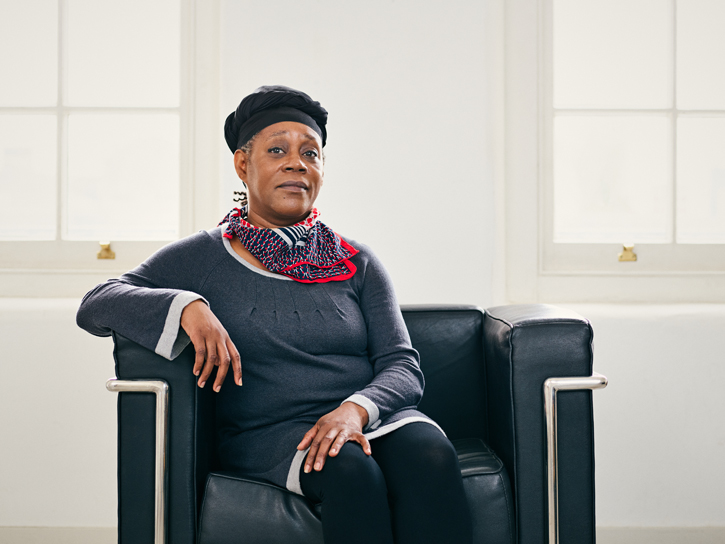
Sonia Boyce

photo credit: Emile Holba

Sonia Boyce, by Emile Holba


Boyce opened a new page in British art history, for women, Caribbean and also political artists, with aesthetically brilliant imagery and a strong personal narrative. She produces work involving a variety of media – drawing, print, photography, video and audio – exploring the interstices between sound and memory, time and space.

Born in 1962 in Islington, London, into a British Afro-Caribbean family, Boyce attended Eastlea Comprehensive School in Canning Town, East London. She was always drawing as a child, she said, so at 17 she decided to study art, and from 1979–1980 completed a Foundation Course in Art & Design at East Ham College of Art and Technology.

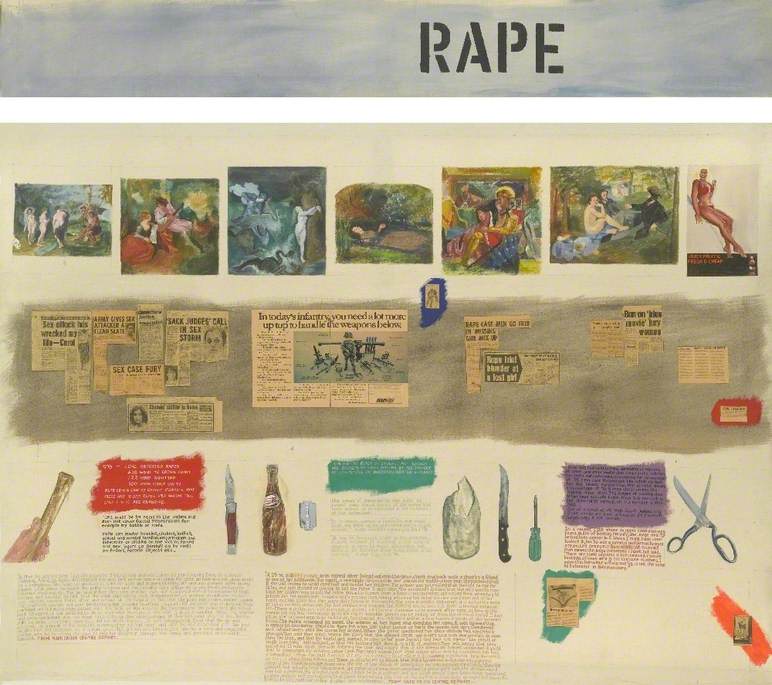
In Sonia Boyce: Beyond Blackness, art historian Anjalie Dalal-Clayton writes that the artist's early oeuvre was influenced by feminist artists Margaret Harrison(b.1940), Kate Walker and Monica Ross (1950–2013), and used an assemblage of texts, photography, drawings and magazine clippings. 'It was a revelation for Boyce,' Dalal-Clayton underlines, one which would come to define her practice.

Rape

© the artist. Photo credit: Arts Council Collection, Southbank Centre

Rape 1978

Margaret Harrison (b.1940) 

Arts Council Collection, Southbank Centre

In 1980 Boyce started a BA in Fine Art at the prestigious Stourbridge College in the West Midlands. But she soon felt unease. Her intuitions on postmodernism and mixed media were dismissed as delusional. 'It was very clear that I was somehow out of place,' she told The Guardian in 2018; 'the system hadn't anticipated me, or anyone like me. Even though there were a lot of female students, they were thought about as though they were being trained to become the wives of artists, not artists themselves. As a Black person, there wasn't a narrative at all.'

Luckily in 1982 she attended the first national conference of Black artists and met the Tanzanian-born painter Lubaina Himid (b.1954), a leading figure promoting the work of Black women artists and encouraging them in 'making positive images' of themselves. Sonia soon took part in this wider Black British cultural 'renaissance', a movement that arose in reaction to Margaret Thatcher's conservatism, and was embraced by artists such as Eddie Chambers (b.1960) and Horace Ové (b.1939).

Boyce wanted to recapture the conventional English narrative surrounding the Black body, with the intention to challenge it. She started drawing herself into episodes of history from which people of colour had been excluded. She depicted friends, family and childhood experiences, including wallpaper patterns and bright colours associated with the Caribbean or the Windrush generation in England. In her pieces Boyce also included texts, using creolised language to enable 'vernacular culture to enter the space of art.'

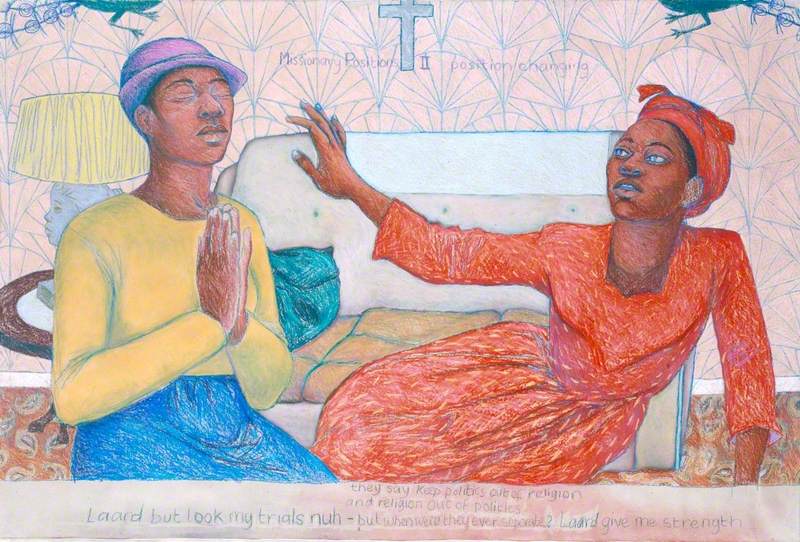
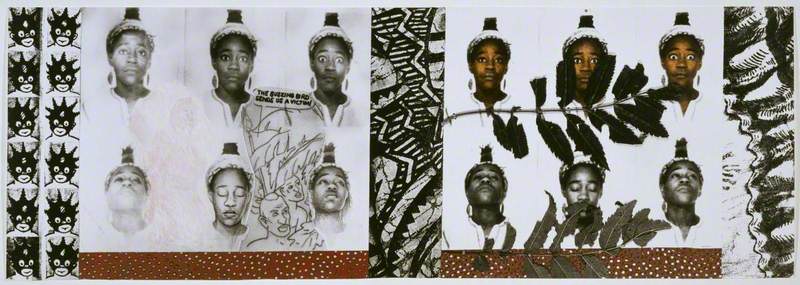
Curators began to notice how the artist examined her position as a Black woman in Britain and the historical events her experience was rooted in. As early as 1983, her piece Five Black Women was chosen to be exhibited at the Africa Centre, London. Sonia was only 21. Her works Big Women's Talk (1984), Auntie Enid – The Pose (1985) and Missionary Position II (1985) addressed issues of race and gender in day-to-day life, through large pastel drawings and photographic collages.

Made of watercolour, pastel and crayon on paper, Missionary Position II explores conflicting opinions on religious beliefs across different generations and cultures in Britain. The artist used herself as the model for the two figures, inspired (as mentioned earlier) by the work of the Mexican artist Frida Kahlo, then little known in the UK.

Boyce's practice was later influenced by the work of two other artists, according to Anjalie Dalal-Clayton: the feminist multimedia artist and performer Susan Hiller(1940–2019) and Donald G. Rodney (1961–1998), part of the BLK Art Group whose first exhibition 'Black Art An' Done' was shown at the Wolverhampton Art Galleryin 1984.


She became close to more Black British artists including John Akomfrah (b.1957) and his Black Audio Film Collective, as well as artist and curator Zak Ové (b.1966). Her work evolved toward collaborative art. Zak recalls: 'We all took part in the same group of artists coming out of early ventures into art together in and around Camden in London. We all felt like we were part of a family. Sonia exemplifies that sense of friendship in her work. She includes that closeness, offers positivity and radiance.'

In 1985, Himid selected some of Boyce's works for an exhibition she curated for the ICA titled 'The Thin Black Line'. And when Boyce was only 25, in 1987, Tate Modern bought her drawing Missionary Position II, making her the first British Black female artist to enter the collection.

During the 1990s, Boyce's work toured the UK and was widely exhibited abroad. Boyce began to question her freedom as an artist, expressing a growing desire to be understood beyond her iconic image of 'the first Black woman to…' In a 1992 interview with Manthia Diawara, Boyce commented: 'Whatever we Black people do, it's said to be about identity, first and foremost. It becomes a blanket term for everything we do, regardless of what we're doing.'

Boyce was soon invited to teach Fine Art studio practice in several art colleges across the UK. She is now a Professor of Black Art and Design at the University of the Arts London. Her practice keeps on evolving and in 2018 her first retrospective exhibition took place at the Manchester Art Gallery.

Now an OBE, Boyce will also be the 'first Black woman' to represent Great Britain at the prestigious Venice Biennale, in 2022. It is not her first appearance in Venice (she was included in the main exhibition in 2015 by late curator Okwui Enwezor), but this is still an unprecedented sign of recognition. On accepting the British Council commission, Boyce said: 'You could have knocked me down with a feather when I got the call to tell me I had been chosen to represent Britain at the Venice Biennale – it was like a bolt out of the blue.'

Boyce, as a Black artist, as a female artist, 'cannot help but be political in this world,' Hannah O'Leary, Head of Modern & Contemporary African Art at Sotheby's London, told me. 'I think often about the privilege and entitlement of white male artists that allows them the luxury of navel-gazing in their work. Much like Himid's Turner Prize win in 2017, the fact that Boyce became the first Black woman to achieve these milestones so late proves that we have only just begun to look at the representation of race and gender in this country, and that the true appreciation and celebration of this groundbreaking artist and her work, which resonates now more than ever, is clearly yet to come.'


 Melissa Chemam, writer, cultural journalist, reporter

-


Link to article: https://artuk.org/discover/stories/sonia-boyce-a-revolutionary-face-of-contemporary-british-art#