16/11/2020

The Markaz Review - Issue 3


The third issue of The Markaz is now The Markaz Review is out!

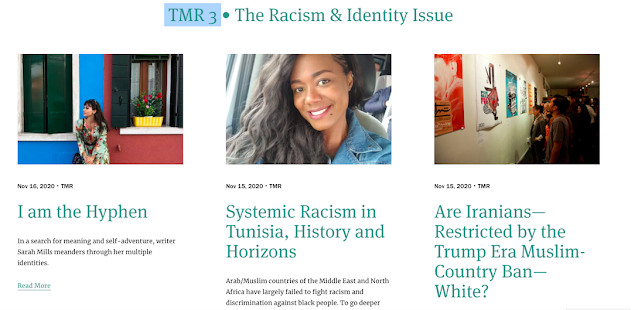
TMR 3 • The Racism & Identity Issue - have a read:
https://themarkaz.org/magazine


 TMR 3

The Racism & Identity Issue


-


My piece on the current situation in France:


Why is Arabic Provoking such Controversy in France?

Melissa Chemam

In the light of recent tragic events in France, in which young Muslims from Chechnia and Tunisia committed mortal knife attacks on a teacher from Conflans-Sainte-Honorine near Paris and three parishioners in a church in Nice, stereotyping discourses about Muslims and Arabic speakers are only adding fuel to the fire.  

It would seem obvious, however, that if more French people learned and spoke Arabic, intercultural exchanges and dialogue between France and the Arab world would be greatly facilitated, although it’s difficult to say whether this would mean a social sea change that could deter radicalized Islamists.

The subject of Arabic instruction in the schools has been fiercely debated in French media over the past few weeks, with far-right commentators describing Arabic as a threat to France. On television channels like CNews and on the mainstream radio France Inter or again in the daily local newspaper Le Parisien, xenophobic pundits are pushing back against the Arabic language.

Why so much resistance to a language?


Nada Ghosn is a French-born translator from Arabic into French. Her parents came to France from Lebanon in the early 1980s but her father didn’t teach her Arabic. She learned some conversational shami with her mother but mainly gained fluency at university, inspired by a French friend who had no connection to the Arab world. Ghosn later spent a year in Syria to improve her skills. “It’s a very difficult mission to learn Arabic in France,” she avows. “Schools only teach it in certain neighborhoods, the best students are advised to learn other languages. And it’s even more difficult to become an Arabic teacher: there are only three to four positions per year for hundreds of applicants. But also, the language was never made attractive at school; we were told it’s of no use, while there are 200 million speakers in the world. To me, it comes from an old colonial belief that Arabic cultures are beneath Western cultures.”

We cannot produce statistics about ethnic origins in France because a national census based on race or nationality is forbidden and described as discriminatory, so one can only find unscientific information about the country’s population makeup. According to these estimations, there may be more than six million French citizens of Arab heritage, who would thus form the second largest ethnic group in the country, after French people of “French origins” (often mixed with Spanish, Italian and Portuguese heritage).

As the population originating from Arabic-speaking countries is so large, it would only be reasonable for first- and second-generation children to be able to learn their family language properly and, if they learn it at home, to use their skills at school. And for years, some parents, scholars and teachers have been asking for more classes of Arabic in primary and middle schools in France.  

Yet, the best places to learn the language in France are in fact at cultural institutions, like the Institut du Monde Arabe and the Institut des Cultures d’Islam, and at some of the best universities, such as INALCO and Sciences Po in Paris, Aix and Strasbourg, and at the University of Montpellier. While France has spent decades creating economic relationships with the Middle East and North Africa, it is deplorable that the country currently has very few experts in the field, and too few Arabic speakers.

Because Arabic is associated with Islam in France, too many think it shouldn’t be promoted let alone taught in schools, as that would only foster terrorism. Yet a 2018 report from the Montaigne Institute entitled The Factory of Islamism urged the Ministry of National Education to relaunch learning of the Arabic language.

According to the report’s author, Hakim El Karoui, an academic at the University of Lyon, “It is essential to mobilize the Ministry of National Education to train managers and teachers in secularism that they do not always know. Teach them to interpret signs of religious extremism too. Understand what is admissible in the name of freedom of belief and what is not because it violates this same freedom of belief...Relaunching the learning of the Arabic language is essential as Arabic courses in mosques have become the best way for Islamists to attract young people to their mosques and schools.”


French national Sophie Claudet is an international journalist, trilingual in French, English and Arabic, a rarity in France. She has been based in Palestine, travelled to Iraq and Egypt among many other Arab countries. Yet she learned Arabic because she spent a lot of time in Morocco as a child, mainly listening to people speaking local dialectal Arabic, or Darija. “French high schools do not teach Arabic well,” she says. “Languages in general are not valued in France; they are very poorly taught. The French system does not help you maintain another culture. It only works if you’re a son or daughter of diplomats. But Arabic isn’t taught because of latent racism,” she added.

Sophie went on to learn classical and written Arabic not in France, but in the US, where she moved to study after high school. She reckons that while the US and the UK tend to value workers with a multicultural background, France does not, because of a fear of separatism. “In France, Arabic is automatically associated with Islam, not to a very diverse culture or literature,” she reckons, “and Islam is viewed as a threat to Western values.”

To her point, most politicians in the right-wing parties estimate that a possible strengthening of Arabic in school would fuel separatism of the Franco-Arab population, in a country already considered one of the most Islamophobic in the world.  

A number of French education ministers and media personalities, from both right and left parties, have described Arabic as the language of one religion, Islam, as if Latin was only the religion of Christianity and not of a long and eventful historical vehicle for knowledge. They also say that Islam doesn’t belong in France and therefore shouldn’t be promoted.

“But Arabic is simply a beautiful language,” Sophie says, “and a cultural asset in a global world, as well as a language very useful for business. France often thinks it doesn’t need foreign cultures.”

Nada Ghosn shares the same views. “It’s almost impossible to be accepted in France if you have a double culture; it’s considered a betrayal of Republican values. And Arab cultures are more stigmatised than any others. But to me, this is a fascist idea, and goes against values of tolerance and openness. It comes from a superior colonial belief.” She says for instance that her own nieces don’t want to learn Arabic and are often asked at school if they are Muslims, to which they feel safer saying no.

I grew up in a suburb of Paris in the 1990s, at a time when almost no school offered Arabic lessons. Now, in Paris, its suburbs and in big cities like Lyon, Marseille, Montpellier and Aix, more schools have put Arabic on offer, especially since 2003, when then-President Jacques Chirac launched a commission on laïcité and how Arabic and religion were taught in private classes. International high schools like the Lycée Balzac in Paris have taught Arabic for more than two decades. Currently about 400 middle and high schools in Metropolitan France as well as overseas territories offer Arabic as a first, second or third language—10 of them in Paris and 14 in Marseille. There are nearly 15,000 students of Arabic nationwide this year.

Yet only 0.1% of French pupils learn Arabic, while 96.4% are taught English. The most favoured second languages remain Spanish, German, Italian and Russian. The paradox is that Arabic is increasingly becoming an elitist language in some prestigious universities. In fact Arabic is trending, like Mandarin, among French and international students, who most often have no connection with the Arab world.

The United Nations recognizes six official languages which are used in its diplomacy and operations, at UN meetings, and for official documents. These are Arabic, Chinese, English, French, Russian, and Spanish. The first session of the United Nations General Assembly designated the first five of its official languages in 1946. Arabic was not among them. The Arabic language gained recognition as an official UN language more than 25 years later on December 18, 1973. Then in 2010, the UN Educational, Scientific, and Cultural Organization (UNESCO) established December 18 as Arabic Language Day in order to “celebrate multilingualism and cultural diversity as well as to promote equal use of all six official languages throughout the organization.”

At Sciences Po Paris, about 1,000 students learn Arabic every year, while some 300 devote themselves to the study of Middle Eastern cultures at the university in Menton. “Over the past five years or so, we have seen a steady increase in the number of students who register in Arabic at all levels offered in that language,” according Ruth Grosrichard, Arabic teacher and former head of the Arabic department at Sciences Po. Nowadays, Sciences Po is the French university program with the most students studying Arabic, just behind INALCO, which specializes in Asian and Eastern languages, far ahead of all other higher education institutions.

In a recent interview with France Info, Nada Yafi, director of the Arab Language and Civilization Center at the Institut du Monde Arabe, said that “at university, Arabic is a field of excellence while at primary and secondary school, this language arouses fear.”

So how to explain this discrepancy? According to Nada Yafi, it is a specifically French problem as “in other European countries, the language is not the subject of debate and does not generate tension.” Two years prior, she had penned in the review Orient XXI that “behind the debate of ideas, we see hidden passions resurface, old wounds: that of an unassimilated war in Algeria; that of national pride inconsolable at the loss of a vast empire.”

The French Minister of National Education, Jean-Michel Blanquer, and the Interior Minister, Gérald Darmarin, recently announced that they want to see more children learn Arabic in schools, instead of mosques for instance. They haven’t detailed a concrete plan yet to train more Arabic teachers. But specialists in Arabic language and cultures insist that Arabic should not be seen as a counter-actor against extreme religious beliefs. The language existed prior to Islam, wrote Francoise Lorcerie, researcher at the French scientific center CNRS, and it is used beyond the purpose of spirituality.

In the meantime, let’s hope that other educators manage to keep on teaching tolerance, along with an interest in foreign cultures and languages. 

tmr-end-of-article-logo-50pix.jpg

Contributing editor Melissa Chemam is a writer, broadcast journalist and author. She has been based in the USA, France, the UK and East Africa for the BBC World Service, AFP, Reuters, CBC, DW, etc. She was the main researcher for Award-winning director Raoul Peck for years, notably on his film The Young Karl Marx, released in 2019. Melissa is the author of a book on Bristol’s radical artists, Massive Attack: Out of the Comfort Zone.


-


10/11/2020

Zineb Sedira shortlisted for the Deutsche Börse Photography Foundation Prize 2021


Great news!! 


La Galerie Kamel Mennour vient d’annoncer que l'artiste franco-algérienne basée à Londres Zineb Sedira est nommée pour le Deutsche Börse Photography Foundation Prize 2021.
L'artiste a été sélectionnée pour son exposition « L’espace d’un instant » – sa première grande rétrospective à Paris – présentée au Jeu de Paume du 15 octobre 2019 au 19 janvier 2020.
Couvrant une période allant de 1998 jusqu'à nos jours, « L’espace d’un instant » met en lumière la façon dont l’artiste utilise les archives pour explorer la fonction et l'impact des images afin de (re)construire un sens à travers un processus de collecte et d'exposition.
L'exposition des projets sélectionnés, commissariée par Anna Dannemann, sera présentée à la Photographers’ Gallery à Londres du 19 mars au 27 juin 2021, puis au siège de la Deutsche Börse à Eschborn/Francfort du 5 juin au 12 septembre 2021. La ou le lauréat·e sera annoncé·e à la fin du printemps 2021.


The Kamel Mennour Art Gallery just announced today that Zineb Sedira is shortlisted for the Deutsche Börse Photography Foundation Prize 2021.
The London-based French-Algerian artist has been nominated for her exhibition “A Brief Moment” at Jeu de Paume (15 October 2019 – 19 January 2020), her first major retrospective in Paris. “A Brief Moment” spans a period from 1998 to the present day and focuses on Sedira’s use of archives to explore the function and impact of images to (re‑)construct meaning through a process of collecting and exhibiting.
The exhibition of the shortlisted projects, curated by Anna Dannemann, will be on show at The Photographers’ Gallery in London from 19 March – 27 June 2021 and then at Deutsche Börse’s headquarters in Eschborn/Frankfurt from 5 June – 12 September 2021. The winner will be announced in late Spring 2021.


Remembrance - Black Soldiers In WWI: Posters and Propaganda


#BlackHistory: Latest article

"Propaganda & How It Was Used To Get Black People Enlisted In WWI"
for I AM History


Propaganda & How It Was Used To Get Black People Enlisted In WWI


The Black presence in the First World War is nowadays quite well documented,  although not widely acknowledged; but originally the British War Office, led by Lord Kitchener, was opposed to the use of Black soldiers. Kitchener’s posters “Your country needs you” were planned for white men. Due to his racist vision of the Empire, he believed that Black faces would jeopardise the reputation of the army, that the Germans could mock “the mighty British Empire”. The Colonial Office and the King, George V, were keen to create the impression of a united, diverse and strong empire. 


According to historian Michael Scott Healy from Loyola University in Chicago, “the idea of European, or ‘White’ racial supremacy, and Black inferiority” was very pregnant at the time. Racism towards Africans and Asians grew, fostered by theories such as social Darwinism, some scholars arguing that non-Europeans suffered from a “biological inability to improve” and were “destined” to labour for “Whites”.

So new posters were soon targeted at the colonies. Indian recruitment posters were produced with blank strips to add text in local languages, Urdu and Hindi. Slogans called the West Indians to defend their “mother country”.

These soldiers were attracted by the idea to defend the Empire but also by the appeal of better wages, men being promised ‘very distinct advantages’ if enlisted, including medals, glory, discipline and free land at the cessation of hostilities. 


Films, pamphlets and newspapers were used to fuel the recruitment, and women to craft letters in local press, until 1917. In December 1916, Brigadier General Blackden wrote in the Jamaican daily The Gleaner: “I hope that you women who have sons, brothers, husbands who are of fighting age will not hold them back. But will encourage them to come forward”. The press in England was also used to depict the “joyful” arrival of Black soldiers.


Off to fight for the Empire

From 1915, thousands of men from Barbados, Grenada, Jamaica, Trinidad and other colonies joined the British Army.  The British West Indies Regiment (BWIR) was created in October 1915, most of them descendants of former enslaved Africans displaced to the Caribbean by slave traders. According to the Memorial Gate Trust, 15,600 men from the British Caribbean served in the Imperial Army during WWI – two third from Jamaica, the rest from Trinidad and Tobago, Barbados, the Bahamas, British Honduras (now Belize), Grenada, British Guiana (now Guyana), the Leeward Islands, St Lucia and St Vincent. The regiment was composed of 12 battalions serving with the Allied forces, mainly in Palestine against the Turkish Army, in France and Flanders.


The islands were also requisitioned to send commodities like cotton, sugar, cocoa and rice to England. The West Indian colonies contributed nearly £2 million from tax revenue and donations to the war efforts. 

1.4 million men from British India were also enrolled in the Imperial Army. On its side, France recruited nearly 500,000 colonial troops between 1914 and 1918, from West Africa, Indochina and North Africa, and when the United States joined the war, nearly 400,000 African American troops were inducted into the US forces. In total over 2 million Africans were involved in the conflict as soldiers or labourers.

But the context was particularly cruel for brown and Black soldiers. The Germans accused Britain and France of unleashing “Africans and Asiatic savages”. The French were convinced that West Africans, supposedly more primitive, could “better withstand the shock of battle and experienced physical pain less acutely,” as historian David Olusoga reported. “This justified deploying them as shock troops in the first line of battle.” Britain applied racist recruitment rules even in its own army, rejecting some Indians for being “too lazy,” according to their ethnicity. 

Thousands of soldiers from the Commonwealth transited via England to reach the battlefields, but by the end of the war Britain planned to send them back to their islands, often without any pension. Some of them remained in England however. While in 1914 Britain counted around 10,000 ‘Black’ people, by 1918 they were 30,000, according to historian Stephen Bourne in Black Poppies – Britain’s Black Community and the Great War, (The History Press, 2014). 

This was just the beginning of a greater migration trend, growing with the Second World War, the reconstruction through the 1950s and1960s and the decolonisation movements. 


08/11/2020

World News and the West: Beyond the US


Mood of the week...

I know many disagree but as a foreign news journalist, I can't take it anymore.


The British press is obsessed with the American elections… While there are so many issues to deal with here and worldwide!


By Melissa Chemam


The US election 2020 took place on Tuesday 3 November. We're Sunday 8 and all I can see in the news is continuous obsession with the process, result and focus on power.


As a journalist who has worked on foreign affairs since 2005, it seems obvious that this focus has only intensified. And I think it's terribly harmful.


Based in the USA in 2008, I settled in Miami, Florida, for the reason that most people know: In 2000, the voting system was famously messy in this key swing State with a high number of electors in the Electoral College. But I was also in Florida to travel to Haiti (which I did in April 2008) and write about the Haitian, Cuban, and other Hispanic communities in one of the most ethnically diverse states of this country. 


The problem with our journalistic coverage of America is that:


 1. It focuses on the powerful, and therefore on the White upper class in power 

 2. It erases most of the space for the rest of the world. 


So back in Europe after the election of Barack Obama, really depressed by this polarisation of foreign news, I applied a few months later for a job at the BBC World Service. And fortunately, I was hired. From 2009, I have been working on African Affairs full time, until 2015, for the BBC then other broadcasters and online reviews. And I still do regularly today, with a focus on culture. I write more predominantly on multiculturalism in Europe, Diaspora, and African - European - American relations. I'm actually writing a book on African, Caribbean and Black British artists at the moment.


Seeing the world between New York, Washington DC and London makes no one more able to understand the world we live in. And in the middle of a pandemic, which means a GLOBAL epidemic, it's more than ever outrageous. It is because our news should not be driven only by the most powerful economically and diplomatically; but also because the American model, which claimed to be a democratic inspiration for the world after WWII, certainly isn't and has become toxic and highly polluting.  


How to explain?


From our community of journalists, I see why this still dominates. 


Firstly, it's due to laziness! 


British media read the American press every day; French ones translate wires from the US. They just follow the trend. 


-It would indeed require much more effort, and more investment to send reporters in Karabakh / Artsakh in Azerbaijan to cover the war with Armenia, currently jeopardising the peace in the whole region, up to Iran, Russia and Turkey. 


-It’s much harder to cover 54 states in Africa, or to understand the causes of the multi-levelled crisis in Lebanon. 


-It's much more delicate to try to explain the roots of islamophobia in France, in its dark colonial past, and to decry the way Macron's government is instrumentalising the death of innocent people in terrible attacks to compete with the far right in xenophobic and stereotyping discourses that help neither the educators nor the health workers. 


-And it's become near to impossible to hold the British government into account for its irresponsible handling of the Brexit negotiations, which will lead us all in a disastrous departure from the European Union without any deal with Britain's stronger commercial and political partner, while, again, we're facing the worst health crisis since 1945 and the worst economic crisis.  


But this journalistic choice has stark implications. 


One example is that only The Times of India reported that, on US election day, Israel razes most of a Palestinian Bedouin village in the West Bank, though the press agency Reuters was the source (see here: https://timesofindia.indiatimes.com/world/middle-east/israel-razes-most-of-palestinian-bedouin-village-in-west-bank-on-us-election-day/articleshow/79060639.cms). Other publications in the Western world just ignored this fact.  


Meanwhile, urgent talks about the climate emergency have been sidetracked, and the headlines about the environment get the small share. The UN conference on climate, the COP 26, should have taken place this November 2020 in Glasgow, Scotland, for instance, it’s been postponed for a year because of the Covid-19 crisis, what are the consequences for the environmental emergency?


Same interrogations about decisions on nuclear disarmament, while the UN Treaty on the Prohibition of Nuclear Weapons is due to become international law. 


With the current health crisis, we urgently need financial support for workers, many cities and councillors are calling for a basic income, but there is no space in the news to discuss issues impacting millions of people, because we focus on only one, the leader of the “greatest power.”


How about the future of journalism?


Since September 2019, I’ve also been teaching journalism here in England, on top of practicing it. And many of my students are foreign ones from China, India, Malaysia, Oman, Egypt, Bulgaria, Czech Republic, the Netherland, etc. I don’t want to contribute to reproducing this cycle. I’ve been talking with them about matters of representations, and hope they have had a look at my articles for Black History Month or those on the Lebanese crisis. 


Though the consequences of this election affects the whole world, we urgently need to rethink our foreign affairs in the news, as the English language still dominates the world of communication on most platforms but languages like Spanish (or Castilian, I should say), Mandarin and Arabic are swiftly taking over. Even in the U.S of A! 


The “greatest power” today should actually be seen as Russia, a country that has managed to influence deeply both the 2016 US election and the Brexit referendum, as the Cambridge Analytic scandal revealed. The most populous economy in the world and the richest is now China; the most populous democracy is India, facing immense dangers as well, as much as Brazil and Nigeria, where people have been protesting against police brutality for more than two weeks now. 


The domination of American politics over the rest of the world, especially in Europe, is an anomaly. It is man-made, and by white, male, business-oriented men “made”. We give power to what we focus on. And during the 2016 American campaign, most media gave all their attention to the candidate Donald Trump, in a sensationalist move. All media does at the moment is giving too much attention to male bullies who took too much power, against the law. 


It’s time for a radical shift. 


It’s time to focus on the “others”, whether women, unelected people, so-called ‘minorities’, oppressed and unfairly treated people. Let’s not forget that those who are called ‘minorities’ here in England or in the USA, are the vast majority in the whole world… Asians and Africans.


 As a journalist who has spent most of her 15-year career in public broadcasting, working with the values of public services in mind, I see how much the world has changed, and the domination of the few over the many cannot live on. Even in the media, and mostly not in the media. 


The world is vast, and includes more than 200 countries. If the western way of thinking has defined the way we see and describe the planet for decades, if not centuries, the “rest of the world” is definitely ready for a change. 


If we claim diversity is important inside our country, how could it not be worldwide?


-


Melissa Chemam

Writer, Cultural Journalist, Reporter

UK Correspondent for European media

Former BBC World Service Reporter

Writer-in-residence @ Arnolfini Gallery

Associate Lecturer in journalism @ UWE Bristol

24/10/2020

Africa at Arnolfini: New Bristol Book

 A bit more about this project! 


African Art at the “Arnolfini”, Bristol

Arnolfi – Source: Hannah Atkinson

Since September 2019, I have had the pleasure to be the writer in residence at the Arnolfini art gallery, here in Bristol, writing mainly on feminism, women artists and themes around resistance, worldwide. The exhibitions I covered include the feminist show ‘Still I Rise’, Amak Mahmoodian’s ‘Zanjir’, Angelica Mesiti’s ‘Assembly’ and later on, after the lockdown, Hassan Hajjaj’s ‘The Path’.

During the lockdown, the gallery had the idea of assembling a little art book, more than commissioning other blog posts, so they asked me if I’d like to work on a text dedicated to all the African, Caribbean and Afro-Caribbean British artists, the ones they invited to exhibit over the years since their opening in 1961.

It sounded so very relevant to me, as I’ve spent most of my adult life as a reporter on African news, on or in Africa, and worked lengthily for a film production company stemming from Haiti. I started working on a book that is now to me a sort of short history of what could be designated as “Black Art” in the UK and beyond.

As we’re now in the middle of Black History Month in the UK, I feel it’s a good time to say a bit more about them and this book.

Focus on black artists who made history

These include British artists like Veronica Ryan, Keith Piper and Donald Rodney – two key members of the ‘Black Art Group’ in the 1980s, but also a history of Carnival festivities, artists who took part in the Harlem Renaissance in New York in the 20thcentury, and some brilliant filmmakers and video artists like John Akomfrah. Some were born in the UK, others in Trinidad, Jamaica, Morocco, Sudan or Ghana…

This project gives me room to try to weave together the different parts of the African continent and the “triangular” routes that binds it to America and Europe. These themes have haunted my own work as a journalist, researcher and writer since the mid-2000s as well.

One example: My favourite show at the Arnolfini was definitely ‘Vertigo Sea’ by Ghanaian British filmmaker John Akomfrah. His work with the Black Audio Film Collective and lately Smoking Dogs Film definitely challenged this recent history of cinema and political art. Another relevant show I’ll cover in this book ‘Trophies of Empire’, and I had a very insightful discussions about it with artists and curators such as Keith Piper, Nav Haq and Graeme Evelyn, notably on what ‘Black Art’ really means, how this notion constantly evolves between a political meaning to a more sociological perspective or even, more recently, a strictly racial views.

In the 1970s, the most radical ‘Black’ British artists was probably Rasheed Araeen, who born in 1935 in Karachi and is therefore Pakistani, not African. In the 1980s, Jamaican and other Caribbean/South American British artists like Sonia Boyce and Frank Bowling revolutionised the artistic landscape. Since then, African British artists took centre stage like John Akomfrah and Lubaina Himid, whom I interviewed a few months before she received the Turner Prize. More recently artists from Nigeria, Morocco or Algeria have also left their mark, and been invited to key British art centre like The Arnolfini and the Hayward Gallery in Londone. It is a fascinating journey, everything but one-sided.

Bristol: A bridge between England, the Caribbean and Africa

Before I came to Bristol to start my research on the ‘Bristol Sound’ in 2015, I had lived in Paris, Prague and Miami, travelling to Haiti before  settling in London. I then moved to Africa, living in Kenya, travelling to Uganda, Tanzania, Somalia, Central Africa and Liberia, which changed my view of the UK and the western world in general…

And in a way, after these experiences, Bristol too shifted my perception of the UK, because its history is so much more overtly linked to the triangular trade with the Americas and Africa, and therefore to displacements and slavery. I first came to Bristol to visit Massive Attack’s studio when the city was the European Green Capital. Quickly, Bristol became both an exciting territory to explore, and a familiar cosy second home. It’s quite a peculiar experience.

Since then, Brexit followed, making myself not a welcome guest but an immigrant potentially facing a loss of civic rights, or even departure. More recently, Edward Colston’s statue was torn down, a complete watershed moment for Black Bristolians, after years of campaigning from different organisations and artists. I had much earlier discussed Colston with Massive Attack, who had always demanded a change of name for the auditorium bearing his name.

Over the years, writing about artists like TrickyMad Professor (the genius of dub music) or even Banksy embodied a story that included the consequences of colonialism, here in Britain, in the Caribbean, in Africa but also in Palestine or Iraq. These are the issues that have pervaded throughout everything I do as a journalist, writer, or researcher because they define our modern civilisation.

Moreover, my own family is from North Africa, which is a part of the continent that is underreported in the English-speaking world; North African people are almost never mentioned, let alone artists. The Arnolfini however did receive artists from Sudan, Algeria, Morocco and Egypt; so did the Watershed cinema with films. Elsewhere in Bristol, my experience is that Bristolians can be very vocal, quite territorial, and polarised on the relations between white English citizens and their Caribbean counterparts.

That leaves very little room to bring in voices from South Asia, South America, East Africa, the Middle East or North Africa – where other people of colour have a different but sometimes really relevant experience of colonialism, religions and racism. I even feel sometimes that it’s delusional to want to be part of such a city. This is compounded by Brexit and misrepresented debates on history, polarised divisions and also high inequalities.

So more than ever, writing about art opens a way to relate to a different community, beyond borders and beyond the ‘colour line’, around shared values of inclusivity, creativity and knowledge.

My book for the Arnolfini is still a work in progress. I’ve looked into catalogues and archives, reflected on the meaning of these artists’ works, on different levels. I’ve been in touch with some of the artists and curators involved: some have sent me some articles, links, video recordings about their art, from back then and now; others have had time for an interview.  

My own memories of some of the exhibitions, or encounters with these artists’ work in other places, as well as some of my research done from 2015 for my previous book, on Bristol’s music scene, also nourished this project.

What I know for sure is that writing about such socially aware and even sometimes politically engaged art allows much more depth. It enables – just like my work in fiction – one to dig into different sorts of subjectivities, recognised and accepted as such, to explain our very complex world with multiple shades of colours.

Ed: Melissa’s book will be out in March 2021, as part of the celebrations for the 60 years of Arnolfini. 
Arnolfini is Bristol’s International Centre for Contemporary Arts located on the harbourside in the heart of the city.


-


Link to West England Bylines: https://westenglandbylines.co.uk/african-art-at-the-arnolfini-bristol/


23/10/2020

On White Privilege and Black History


Black History Month, White Privilege and Kemi Badenoch


In the middle of Black History Month, the UK government sent a black minister, Kemi Badenoch, to tell the House of Commons that 'Teaching white privilege as uncontested fact is illegal'.   


Yet past and present racism continue to run deep in the country, as well as in the entire world...


As a journalist, I've worked on African affairs since 2006, joining Velvet Film, a company set up between Haiti, New York and Paris to produce films on Haitan and African history. 


That gave films like 'Lumumba', 'Sometimes in April' on the Rwanda genocide, and more recently 'I Am Not Your Negro' on James Baldwin, winner of the BAFTA for best documentary film on 2018... 


In the meantimes, I joined the BBC African news section in 2009 and became a correspondent in East Africa a year later. I have since reported in 14 African countries, in the Caribbean and in Europe about racism and colonial history.


2020 has so far been a watershed year for minorities' rights and especially for Black Lives Matter, at the price of extreme suffering. 


Teaching the reality of 'black' history, of colonialism history, of displacement and slavery should not, and never, just like the criticism on extreme capitalism, be reduced to teaching secondary subjectivities or subjective points of views. 


These are facts, based on events documented by historians and to these days by sociologists, journalists and activists.


I've covered anti-racist protests since the toppling of the Colston Statue here in Bristol, spoken to activists like educator Aisha Thomas recently and filmmaker Michael Jenkins, listened to historians Olivette Otiele and David Olusoga, started writing a book on Black art and Caribbean / African artists living or invited in the UK. 


 Details here: https://arnolfini.org.uk/africa-at-arnolfini/?fbclid=IwAR3iuErzpTJiAzAIW4RTBzfelYCttiSHyoczsyMo2skmHQcWJy3WVH5a4-A 


I felt the country had made so much progress in the past few years, since my first book on Bristol's music scene, a scene deeply inspired by reggae and soul music, by artists from the Caribbean and Africa. 


 See details here: https://www.readersdigest.co.uk/culture/music/massive-attack-the-birth-of-the-bristol-sound   


But this debate in Parliament, just like the attempt to forbid teachers to address critical thinking that came out last month, are dangerous paths to revisionism.


'A Countervailing Theory'

My favourite art exhibition of this autumn in London:

A narrated walk through Toyin Ojih Odutola's 'A Countervailing Theory'

Nigerian-American artist Toyin Ojih Odutola takes us through her exhibition 'A Countervailing Theory', highlighting key moments in the story unfolding before our eyes on the artworks


Toyin Ojih Odutola: A Countervailing Theory is on in the Curve until 24 Jan 2021: https://bit.ly/37AAyM6 Show your support for the Barbican by making a donation and help inspire more people to discover and love the arts. https://www.barbican.org.uk/donate Pushing the boundaries of theatre, dance, film, music and visual art, the Barbican is a world-class arts and learning centre. Subscribe: http://ow.ly/O44tx Like: http://www.facebook.com/barbicancentre Follow: http://www.twitter.com/barbicancentre Discover: http://www.instagram.com/barbicancentre Explore: https://www.barbican.org.uk/read-watc... What’s on? http://www.barbican.org.uk Welcome to the Barbican Centre's YouTube channel. From exclusive trailers and specially commissioned interviews to concert recordings, behind the scenes tours and insights into the unseen areas of the Barbican, subscribe to our channel for all the latest Barbican videos.