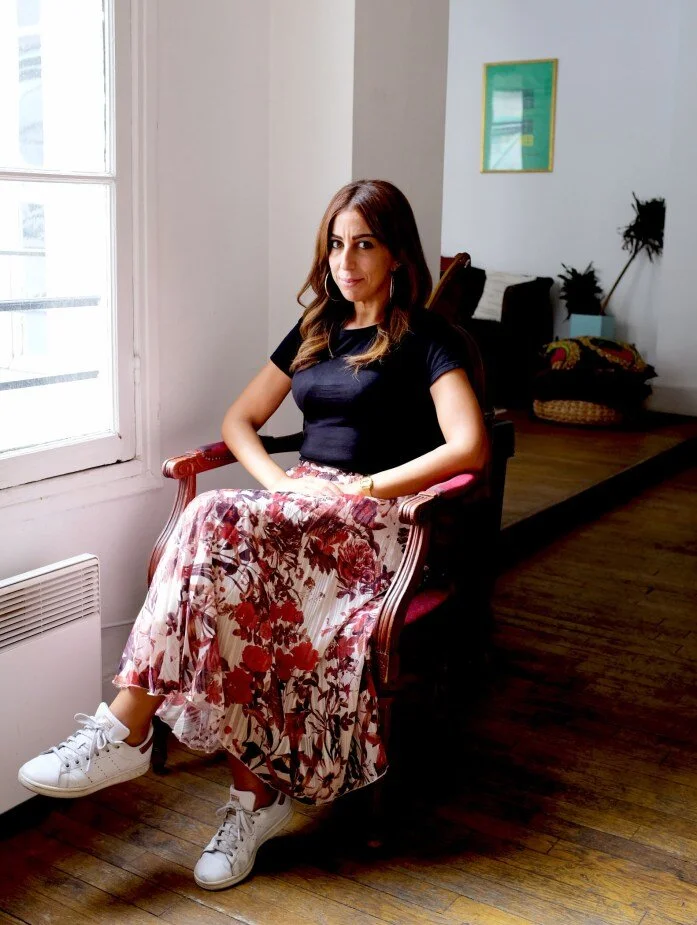
Journalist at RFI (ex-DW, BBC, CBC, F24...), writer (on art, music, culture...), I work in radio, podcasting, online, on films.
As a writer, I also contributed to the New Arab, Art UK, Byline Times, the i Paper...
Born in Paris, I was based in Prague, Miami, London, Nairobi (covering East Africa), Bangui, and in Bristol, UK. I also reported from Italy, Germany, Haiti, Tunisia, Liberia, Senegal, India, Mexico, Iraq, South Africa...
This blog is to share my work, news and cultural discoveries.
La scène musicale de Bristol et le groupe Massive Attack
Une plongée dans la scène musicale de Bristol des années 90 et de son groupe phare, Massive Attack, précurseur de la musique trip hop. Avec Melissa Chemam comme guide, autrice de "De Massive Attack à Banksy, l’histoire d’un groupe d’artistes, de leur ville, Bristol, et de leurs révolutions".
Les invités
Mélissa Chemam est journaliste, elle vit à Bristol et a écrit "En dehors de la zone de confort - De Massive Attack à Banksy, l’histoire d’un groupe d’artistes, de leur ville, Bristol, et de leurs révolutions" (Editions Anne Carrière).
Thylacine est musicien et compositeur de musique électronique.
Programmation musicale
One Love - MASSIVE ATTACK
The Look of Love - DUSTY SPRINGFIELD
The Look of Love - THE WILD BUNCH
Unfinished Sympathy - MASSIVE ATTACK
Safe From Harm - MASSIVE ATTACK
Blue Lines - MASSIVE ATTACK
Five Man Army - MASSIVE ATTACK
Karmacoma - MASSIVE ATTACK
Protection - MASSIVE ATTACK
Song 2 - BLUR
Teardrop - MASSIVE ATTACK
Angel - MASSIVE ATTACK
Paradise Circus - MASSIVE ATTACK
La jetée - LAURA CAHEN
Bibliographie
En dehors de la zone de confort - De Massive Attack à Banksy, l’histoire d’un groupe d’artistes, de leur ville, Bristol, et de leurs révolutions de Mélissa Chemam, Editions Anne Carrière, 2016.
Dit le poème, le passé vient plus vite qu'on le pense
À genoux j'implore ciel et mer
Et ce brin de bruyère
Un souvenir pour récompense
Quel est cet endroit, où, dans l'ombre confuse
Les démons et les anges se mélangent
Ah je te rejoins dans cette brume épaisse
Que le tabac, le bon joint, obscurcissent
Alors je pleure ton nom
Oui je pleure ton nom
Un oiseau chante je ne sais où
C'est je crois ton âme qui veille
Les mois, comme toujours, ont passé, les saisons
Mais moi je suis resté le même
Qui attend que revienne le printemps
Qui aime et qui espère
Connaître la fin de l'hiver
Nous ne nous reverrons plus sur Terre
Dit le poème, le passé vient plus vite qu'on le pense
À genoux j'implore ciel et mer
Et ce brin de bruyère
Seul souvenir pour récompense
Ouais, comme Apollinaire
Un souvenir pour récompense
Nous regagnerons la confiance
Nous regagnerons la confiance
Comme une terre ferme
Comme une terre ferme
À jamais
Nous regagnerons la confiance
Nous regagnerons la confiance
Comme une terre ferme
Comme une terre ferme
À jamais
De l'autre côté, de l'autre côté de la mer
Il ne me reste plus rien de toi
Que seule ton absence m'appartient
On s'est laissé à l'orée de ce bois
C'est un joli jardin, je crois
C'est un joli jardin, je crois
C'est un joli jardin, coloré il se voit
L'orée de ce bois, où l'on s'est laissé
Nous ne nous reverrons plus
Nous ne nous reverrons plus
Nous ne nous reverrons plus
Nous ne nous reverrons plus
Que de l'autre côté de la mer
À jamais
Nous ne nous reverrons plus
Nous ne nous reverrons plus
Nous ne nous reverrons plus
Nous ne nous reverrons plus
Que de l'autre côté de la mer
À jamais
Il ne me reste plus rien de toi
Que seule ton absence m'appartient
On s'est laissé à l'orée de ce bois
On s'est laissé là
Le passé qui nous hante est un jardin vivant.
ALBUM - L’OISELEUR :
https://feuchatterton.lnk.to/LOiseleurYD
Ecouter/télécharger le titre ici :
https://FeuChatterton.lnk.to/Souvenir
Réalisation : Antoine Marie
Images : Elisabeth Marie, François Marie & Antoine Marie
Montage : Antoine Marie & Arthur Teboul
Assistant réalisation : Elie Gattegno
Régie, cookies et maquillage : Victoria Werlé
Typographie : Edgard Teboul
What Faiza Guène’s new novel La Discrétion tells us about French Algerians and their perception in the French literary world
La Discrétion, a novel by Faïza Guène Plon 2020 ISBN 9782259282444
Melissa Chemam
Back in 2004, a 19-year-old French novelist of Algerian heritage named Faiza Guène shook the French literary world out of its phlegmatic complacency with Kiff kiff demain (published in the UK as Just Like Tomorrow). A teenager from the disadvantaged suburbs of Paris, Guène’s debut novel, written mostly in French vernacular, went on to sell over 400,000 copies and was eventually translated into 27 languages. At the time, Guène declared her surprise, noting that for her, writing had so far been just a hobby. “There wasn’t really a role model for me…I grew up in a working-class neighborhood. I didn’t imagine I was going to make a career out of it,” she told RFI’s Tirthankar Chanda.
I must say that I feel very grateful to Faïza Guène. She broke new ground as a young Franco-Algerian woman turned into a booksellers’ sensation with a story about the banlieues. In fairy-tale fashion, this happened just a year before major riots in Paris’s suburbs. Yet Kiff kiff demain was not about life in the troubled or dangerous suburbs, it was about adolescence.
16 years and several books later, the author published her sixth novel in September 2020 in France. This time, in La Discrétion, she writes more intimately, deriving truth from her own family. The main character is Yamina, a 70-year-old mother of four children, living in Aubervilliers with a husband. They wedded 40 years prior, in Algeria, in an arranged marriage. That took her to France, where she had never before set foot. This is a story of migration that is very familiar to North Africans in France—working-class communities in which many factory workers opted in the 1950s and 1960s for an arranged marriage with a younger woman from their homeland, and not a local, French (white) spouse. Yamina, a petite, kind-hearted woman, never had a job but raised their children. She and her husband have a lot in common with Faïza’s parents, born around the same time in the same circumstances and with the same destiny of migration.
The story isn’t so much about life-changing events, or even Algerian independence as it is about the everyday tribulations of a very humble family, in which all members feel at a point or another—and some feel this oppression on a weekly basis—humiliated by their position on the French social ladder, which is often characterized by a kind of invisibility. As the title suggests, this “discretion” starts with themselves, as Yamina chooses to remain discreet when mistreated, even when her doctor hurts her physically, or speaks to her too casually. The novel doesn’t address the issue in depth, but through a few anecdotes we feel that the French system doesn’t give her a chance to speak up for herself.
I started this review by saying I was grateful to the writer because, for once, a book by a well-known bestselling author doesn’t mention the Algerian war only through the eyes of French people, pieds noirs who had to leave their “beautiful Algeria” because of ungrateful locals chasing them away. Writers like Yasmina Khadra and Alice Zeniter have both written fine books about the 1950s in French Algeria, but not through the eyes of local natives who believed in their independence. Here, La Discrétion is divided into two sorts of chapters: the first ones retell the non-eventful, family-oriented life of Yamina and her intimates, with the intention to pay homage to the anonymous in French society and especially stay-at-home mothers in working-class families; and the other chapters dig into Yamina’s memories and past life in Algeria, from the harassment of her family by French soldiers; her birth “in a cry”, as the narrator describes, a metaphor for her future moral strength; her family’s exile in Morocco during the independence war; and her marriage and her move to France, in tears. Yamina’s father was a fellaga, a freedom fighter who battled for his country’s independence from France.
The chapters featuring Yasmina’s memories are the most charming. They describe her difficult but meaningful childhood in Algeria, with her war-traumatized mother and a father she puts on a pedestal for his involvement in the independence movement. Yamina worships the memories of their fig tree back home; all her family responded with courage, even when the women were sent away in exile in Morocco to avoid the war, facing famine. These chapters are also filled with other characters, and not reduced to a narrow sort of unaccomplished sub-life only, as are the chapters set in Aubervilliers and Paris in 2019-2020, which are characterized by a fair amount of repetition.
When dealing with France, the novel follows Yamina’s family, described as people who would only be minor characters with a brief mention in other books, as they are in Leila Slimani’s award-winning novel, Chanson Douce (Lullaby in English), in which the Arabs are only of secondary interest, if that. Here, the main characters are all workers with humble jobs and all Algerians, which is formidably rare. The father, Brahim, was a miner before retiring; the brother, Omar, is an Über driver; one of the sisters, the eldest, Malika, works in the local town hall; the other one, Imane, the youngest, is a saleswoman; and Hannah is… more or less professionally angry for everyone else in this society that appears profoundly discriminatory and sometimes outwardly racist.
None of them ever escapes their milieu. For instance, for years, Omar drives by the luxury hotel Lutetia, but never dares to actually go in until the very end. Most of them feel they don’t belong in nice French places and in most of central Paris.
Fortunately, none behaves in the way that typical suburban stories in French films depict French North Africans, as drug dealers, thieves or thugs (consider La Haine, Les Misérables or even Taxi, set in Marseille). Here, for 250 pages, we observe a loving family, and especially a mother who went through a lot of pain as a child, and whose story will never be heard by her neighbors, her children think, let alone any other French citizen. People making no particular trouble.
It’s a very noble goal, and the book reads extremely easily.
Yet, as a French woman who also grew up in a Parisian suburb, with an Algerian dad who came to work in Paris in a factory in the 1950s, and a mother who married him in the late 1970s, then joined him in France without having ever seen the country previously, I can’t help but feel frustrated at these portraits of lovely people whose main social occupation is to remember the price of every item they ever buy.
Yes, Hannah praises her mother for her strength, and she is angry at racism and humiliation she undergoes, but she doesn’t do anything about it. Actually, none of them ever really tries to change their lives. Malika, the first born, has to endure an arranged marriage just like her mother did, and unfortunately her father chooses really unwisely so she divorces once she discovers her husband had a child with a French lover. Afterwards her father only feels pity for her, sees her as “damaged goods.” She never remarries and none of her sisters even try to. They all seem to have trouble falling in love—they resent French men for not being masculine enough, and Arab men for looking for French trophy wives to reward their self-projected integration, the Holy Grail for an immigrant in France. In that matter, La Discrétion is no feminist novel.
The family’s culture is also limited to a few television programs and the mother’s quotes from her prayers and the Qu’ran. They don’t feel French and don’t even try to be French, spending all their summer vacations in Algeria with their mother’s family, except the last one, in 2020, when they discover the Poitou-Charente region.
The depiction of these first-generation French Algerians wants to be loving and accepting, but it risks being alienating by virtue of the sum of its clichés on Muslims and their cultural desert, naming more supermarkets, brands and suburban malls than a Simpsons episode ever could. Something in me is really saddened by the fact that French immigrants can only represent themselves as humiliated, not fitting in, feeling half the time like failures or looking a bit like caricatures, wearing burkinis and eating cheap halal Chinese food. It’s not Faïza Guène’s fault, of course; it’s mostly because France has so few Muslim or Arab writers, the most successful and known being Nina Bouraoui (whose mother is Algerian), Rachid Djaïdani and Sabri Louatah (author of the brilliant novels Les Sauvages or Savages in English and 404).
(We should note that Kaouther Adimi writes in French but she is Algerian, like Yasmina Kadra; she was born in Algeria, spent a few years in France as a child, but studied in Algeria and was living in Algeria until 2009.)
Faïza Guène is calling for more acceptance, through the eyes of her female characters especially, in a France that is every day nearly as racist as it was in the 1950s, considering that the Macron administration is openly discussing the arrest of so-called Muslim “separatists”. And she mentions in passing that the attacks on the World Trade Center and Charlie Hebdo only made the country more Islamophobic.
The French literati has mostly praised La Discrétion, while they came down hard on her first novel, often not taken seriously because of its heavy use of slang and humor.
Unfortunately for now, unlike the likes of Salman Rushdie and Zadie Smith, whose novels have become more broadly universal both in the UK and within the Anglophone literary world, France’s generation of Arab/Muslim novelists mostly represents members of ethnic minorities as lonely outcasts, with no sense of belonging or desire to fight for greater inclusion. Too often, their stories end with some version of failure and tristesse. This may be a reflection of the state of French diversity, or lack thereof. For now, with her novels, Faïza Guène doesn’t really celebrate the empowerment of first-gen French citizens of immigrant heritage; she puts them on the radar and describes their isolation well, but doesn’t embody a bold and proud appearance into the French cultural landscape. But she definitely stands as a rare and important French-Algerian female voice.
According to Faïza Guène’s English translator, Sarah Ardizzone, Discretion will be published in early summer 2022, while her novel Men Don’t Cry (Un Homme ça ne Pleure Pas) will be published by Cassava Republic in July 2021.
Melissa Chemam is a writer, broadcaster, cultural journalist and author. She has been based in the USA, France, the UK and East Africa (for the BBC World Service, AFP, Reuters, CBC, DW, RFI, etc), also traveling to North Africa, the Middle East and the Caucasus regularly. She works mainly on multiculturalism, post-colonial issues, East-West and North-South relations, and is an associate lecturer at the University of the West of England in journalism. She is a TMR contributing editor.
History was recently made when Dr Ngozi Okonjo-Iweala was appointed the new Director-General of the The World Trade Organisation (WTO). Dr Konjo-Iweala took on the role formally March 1st 2021, becoming the first woman and the first African to hold the office. We can’t wait to see her shine and make an impact in her new role.
Headquartered in Geneva, Switzerland, WTO is an intergovernmental organisation that regulates and facilitates international trade between nations. It officially started operating on 1 January 1995, according to the 1994 Marrakesh Agreement, replacing the General Agreement on Tariffs and Trade, known as GATT, established in 1948, a few years after the United Nations’ main organisations.
10 interesting things to know about Dr Ngozi Okonjo-Iweala:
Born into a royal family in Nigeria
Ngozi Okonjo-Iweala was born 13 June 1954 in Nigeria in Ogwashi-Ukwu, Delta State, where her father Professor Chukwuka Okonjo was the Obi (King) from the Obahai Royal Family of Ogwashi-Ukwu.
Educated in Nigeria and in the United States
She went to Queen’s School, Enugu, St. Anne’s School, Molete, in the state of Ibadan, and to the International School Ibadan. She then moved to the USA in 1973 at 19 years old to study at Harvard University, graduating magna cum laude with an AB in Economics in 1976.
Started her research in the USA
Ngozi Okonjo-Iweala began research in Cambridge, Massachusetts, in the late 1970’s and received an international fellowship from the American Association of University Women (AAUW) that supported her doctoral studies.
In 1981, she earned her PhD in regional economics and development from the Massachusetts Institute of Technology with a thesis titled ‘Credit policy, rural financial markets, and Nigeria’s agricultural development’.
An economist and international development expert
Ngozi Okonjo-Iweala spent 25-years at the World Bank in Washington DC as a development economist, scaling the ranks to the number two position of Managing Director, from 2007 to 2011. A position overseeing an operational portfolio of over $81 billion, in Africa, South Asia, Europe and Central Asia.
Worked on solving poverty
She spearheaded several World Bank initiatives to assist low-income countries during the 2008–2009 food crises, and later during the financial crisis.
The first woman to serve as the country’s finance minister and the first woman to serve in that office twice
In Nigeria, she was the only finance minister to have served under two different presidents: President Olusegun Obasanjo (2003–2006) and President Goodluck Jonathan (2011–2015).
Sits on the board of many leading companies
That includes Standard Chartered Bank, Twitter, Global Alliance for Vaccines and Immunization, and the African Risk Capacity (ARC).
A Multi-Awarded Leader
Okonjo-Iweala has received numerous recognition and awards and has been listed as one of the 50 Greatest World Leaders (Fortune, 2015), the Top 100 Most Influential People in the World (TIME, 2014), the Top 100 Global Thinkers (Foreign Policy, 2011 and 2012), the Top 100 Most Powerful Women in the World (Forbes, 2011, 2012, 2013 and 2014), the Top 3 Most Powerful Women in Africa (Forbes, 2012), etc.
Her first move at the head of WTO has been to ask for more cooperation between members
“WTO members have a further responsibility to reject vaccine nationalism and protectionism while cooperating on promising new treatments and vaccines,” Ngozi Okonjo-Iweala wrote in the Financial Times.
Cares deeply about the links between trade and climate change
Ngozi Okonjo-Iweala hopes to reactivate and broaden the negotiations on environmental goods and services, while stating that WTO must also assist developing countries as they transition to the use of more environmentally friendly technologies.
We finish off season 4 with an interview with three remarkable women who are behind the festival and 4-part documentary "Nature Through Her Eyes" which airs on March 8th 2021 on CuriosityStream. The interview features Emma Tyrell, Development Executive and Festival Producer; Jacqueline Farmer, Film Director and Producer and Gail Jenkinson, Director of Photography.
They talk about the world of Natural History film-making mainly being dominated by white men and how this needs to change. In a time of climate crisis, stories about nature and our environment need to be told through a diversity of lenses including women and people of colour.
ALSO - we've chosen a brand new track from Helefonix called 'Jackie Weaver's kicked him out'. Yes Jackie Weaver from the notorious Handforth Parish Council meeting. All proceeds to to the NALC Make a Change campaign.
PLUS - we bring you our usual round up of positive responses to the virus from around the world....
The unfinished Arab revolutions deserve our support.
Melissa Chemam
As world media began to follow the early days of the misnamed “Arab Spring” in January and February 2011, I found myself in Uganda, covering that country’s presidential election for the BBC, where the opposition candidate, Kizza Besigye, had no chance to defeat the incumbent president, Yoweri Museveni, in power since 1986. I had studied journalism in Paris and one of my best friends there was from Tunisia. I immediately thought of her: she had grown up under Ben Ali but had always hoped she would see change in her country during her lifetime. She was then based in Cairo, and soon had to deal with two revolutions.
“This is above all a moment of new possibilities in the Arab world, and indeed in the entire Middle East,” Rashid Khalidi, the Edward Said professor of Arab Studies at Columbia University, wrote in Foreign Policy on February 24, 2011. “We have not witnessed such a turning point for a very long time,” he added. “Suddenly, once insuperable obstacles seem surmountable. Despotic regimes that have been entrenched across the Arab world for two full generations are suddenly vulnerable. Two of the most formidable among them — in Tunis and Cairo — have crumbled before our eyes in a matter of a few weeks.”
I came back from Kampala, feeling thrilled for them. Having grown up in France in a town led by a communist city council, I had always thought of revolution as a positive, radical and necessary source of change. In primary school, our teacher organized a play for us to celebrate the 200th anniversary of the 1789 French Revolution. My own parents and grandparents had also participated in their own revolution with the liberation of Algeria, but at the time—especially in France— this was a complete taboo. No one ever mentioned Algerians as revolutionaries, in public or even in private, yet in our house that’s what we were. Later on, when I studied history and politics more in depth, I met quite a few French people and even Arabs who despised revolutions, seeing them as form of violence coming from “the people,” meaning the unimportant lower classes. What they valued was order and hierarchy. However, I learned over the years that their reaction was a symptom of allergy to change, based on fear, and that no revolution was ever completed in one day.
It didn’t take long for skeptical voices to carp at the Arab Spring. Can Tunisia and Egypt really succeed in their popular revolutions? Will Libya and Yemen ever shake off their despots…with pundits implying that democracy in the Arab would always be an oxymoron.
Back from Africa, in 2013 I joined the newsroom of the international radio in Paris, RFI, in the African section. As the only North African in the team, I often had a chance to cover Tunisian, Algerian and Libyan issues. North Africa had always had this weird place in foreign news, in the UK as well as in France: it’s not completely Africa, but it isn’t the Middle East either… I noticed that many journalists often walked on eggshells when they talked about the region. But by 2013/2014 the general sentiment was that the revolutions had failed… Tunisia had an Islamist government (Ennahda won a plurality of votes in the October 2011 Constituent Assembly election). Egypt was a military dictatorship again. And Libya was in limbo.
But whenever the subject of the Arab revolutions arose, I wondered aloud and still wonder why no one ever compares them with at least the French Revolution—to be more historical, we should say the French revolutions. Victor Hugo, one of France’s literary greats, was born in 1802 into a bourgeois family but later became a true republican. Thirteen years after the French Revolution of 1789, he was forced into exile, however, for decades. He wrote Les Misérables, published in 1862, in exile. Because after “The Revolution”, France had two brutal empires—under Napoleon and Napoleon III—and as many royal “Restaurations” that only brought wars, more inequality and social conservatism. Had the French Revolution failed?
Well, in 1830, Paris had a second revolution after the collapse of Napoleon’s egotistic desire to dominate the whole of Europe… But the three days of the July 1830 Revolution soon led to the return of a French king: Louis-Philippe Ier. Then in 1848, France was swept away by a vaster movement of revolutions that shook the whole of Europe, known as the “Springtime of the Peoples” or the “Spring of Nations”. Italy and Germany didn’t exist back then, but were comprised of a cluster of sovereign provinces speaking dialects of Italian or German. It was a high time in European history. The same year, Karl Marx and Friedrich Engels, who had fled Germany, published their Communist Manifesto. How did this revolution end? Well, in France it concluded with the election of Louis-Napoleon Bonaparte in 1851, who soon declared himself… an Emperor. In the rest of Europe, in oppressive, conservative regimes mostly, and Marx had to leave France and Belgium for England.
All these revolutionary events led to violence and to very conservative regimes, also kick-starting imperial and colonial rivalry between the European powers over their control of half of Africa and Asia. But it doesn’t mean they had failed; they were part of a longer process.
“If revolution is a regime change involving collective physical force, then the key dates are 1789, 1830 and 1848,” observed Peter Jones, a professor of French history at the University of Birmingham in the United Kingdom. In the end, France had at least three major revolutions, and arguably a fourth one—La Commune de Paris in the spring of 1871—before it had a stable regime, the Third Republic. Yet even this regime didn’t lead France to become entirely democratic, not until at least the turn of the 20th century and not until the country had been torn apart by the Dreyfus Affair from 1894 until 1906. Victor Hugo didn’t live to see the Third Republic, for he died in 1885, while the French regime was still very conservative. Then of course, even after 1910, women still could not vote (they couldn’t until 1944!), and the largest part of the population of colonized Algeria—declared French territory—was deprived of fair parliamentary representation.
The transition to a republic didn’t prevent Vichy or Dien Bien Phu. The French Third Republic ended up in the painful and disastrous Second World War, and the humiliating collaboration period. Then the Fourth Republic, established after WWII, died out in a civil war, over the horrifying settler colonialism in Algeria, in 1958. This gave birth to a Republic of “emergency” or what François Mitterrand often called “la République du coup d’Etat permanent,” the Fifth Republic and current French regime.
Paris 1968.
Even then, revolutions weren’t over, for a socialist and labor/student-led uprising broke out in Paris in 1968 and soon engulfed the country, bringing the French economy at one point to a grinding halt. May ‘68 marked the world much in the way the 1789 Revolution had.
We could also draw parallels with American history.
One revolution that is too often forgotten is probably the most important of all in terms of balance between the West and the rest of the world: From August 21, 1791 to January 1st, 1804, the Haitian Revolution made European domination over the Caribbean a reversible phenomenon. One might say that the Haitian revolution isn’t over; certainly Toussaint Louverture has become a hero inspiring Africans and African Americans to this day.
The American Revolution, which took place between 1765 and 1783, only concerned colonial North America, meaning 13 states and their white settlers, in a fight to free themselves from their British oppressor. But all the other human beings living on North American soil at the time were simply ignored and denied citizenship, first and foremost the Native population, the First Nations, as well as the displaced African slaves. Up until the mid-20th century, American democracy remained a nuanced reality: despite the 13th, 14th and 15th Amendments to the Constitution passed in the 1860s—all intended to enfranchise Black Americans—most could not vote until the passage of the Voting Rights Act in 1965.
The Egyptian-American journalist Mona Eltahawy, author of The 7 Necessary Sins for Women and Girls (2019), actually referred to the civil rights movement as a revolution on Twitter on January 25, 2021, while commenting on the Arab Spring. She wrote that: “A revolution does not happen overnight. And because, as Audre Lorde insisted, ‘Revolution is not a one-time event.’ I will not write its obituary.”
Ten years after 1789, France was about to have a new Emperor and to plunge Europe into war. Ten years after 1848, it was at the height of the Second Empire, and its best author was writing in exile. So, ten years after the Arab Spring began, I would argue that we should give Arab revolutions some time.
Melissa Chemam is a writer, broadcaster, cultural journalist and author. She has been based in the USA, France, the UK and East Africa (for the BBC World Service, AFP, Reuters, CBC, DW, RFI, etc), also traveling to North Africa, the Middle East and the Caucasus regularly. She works mainly on multiculturalism, post-colonial issues, East-West and North-South relations, and is an associate lecturer at the University of the West of England in journalism. She is a TMR contributing editor.
'Where the Nightingale Sings' (Redux) - 3D x Gang of Four feat. Nova Twins
3D x Gang of Four feat. Nova Twins - "Where the Nightingale Sings (Redux)" - https://gang-of-four.ffm.to/wherethen...
'Nightingale' is the 2nd single to taken from the forthcoming album, "The Problem of Leisure".