Journalist at RFI (ex-DW, BBC, CBC, F24...), writer (on art, music, culture...), I work in radio, podcasting, online, on films.
As a writer, I also contributed to the New Arab, Art UK, Byline Times, the i Paper...
Born in Paris, I was based in Prague, Miami, London, Nairobi (covering East Africa), Bangui, and in Bristol, UK. I also reported from Italy, Germany, Haiti, Tunisia, Liberia, Senegal, India, Mexico, Iraq, South Africa...
This blog is to share my work, news and cultural discoveries.
In the 80's, Bristol was one of the pioneering graffiti art hotspots in the world. A new exhibition at the M Shed museum in Bristol pays tribute to its history.
Meanwhile, as some of you may know, I worked for a year on a book with and for the art gallery Arnolfini, here in Bristol, as their writer in residence, I'm so excited to share the result!
Here, There... Evenwhere:
African & Diaspora Artists at Arnolfini
The art book will be released in October, and we are organising events, at the gallery, the university and online, to generate a wider discussion.
Some of the artists mentioned are from the UK, others were born in the USA, Trinidad, Jamaica, Montserrat, but also Morocco, Sudan, Algeria, Ethiopia or Ghana... But most of them had to work in the margins, or to form their own groups and find their personal space to be exhibited and deliver another vision of the arts / the world we live in.
Donald Rodney, 'Double Think', 1992
This alternative part of history of art gave me room to try to weave together different parts of the African continent - that I have visited or lived in. The project also retraces the routes that binded Africa with the Americas and Europe over the centuries.
These are themes that have haunted my work as a journalist, researcher and writer since the mid-2000s at least...
'Still I Rise', Arnolfini, 2019
Since the 2000s, many of these artists have been simultaneously exhibiting in London, Liverpool, Nottingham, New York, Berlin, Venice and further. John Akomfrah, Veronica Ryan, Keith Peiper, Donald Rodney, Sonia Boyce, Frank Bowling, Hassan Hajjaj, etc.
That's why I'd love to create dialogues and generate further encounters with African artists exhibiting in other parts of the world, when this book is out.
Do get in touch if you're interested in taking part in our wider discussion!
-
Here are other related articles, recently released:
I AM History
My latest articles for the online magazine on 'Black' art and culture:
2021 is a great year of reckoning for many Black women artists in the UK. And an amazing set of exhibitions allows us to enjoy their powerful work this summer. It starts with the exceptional Mother of Mankind exhibition on view at the House Of Fine Arts Mayfair space in London, which is free and open until 31 August.
The two pioneering artists paved the way for Black women artists in Britain. Both have incredible work on display this year that you absolutely must see.
My interview with Frank Bowling will soon be available to read on Art UK here.
Television Series
on Colonial History
In the spring, I've been working as a researcher on a historical TV series still in the making... While the documentary series I've worked on for years has been released on HBO in the USA on Sky and NOW TV in the UK: 'Exterminate All the Brutes'.
'Exterminate All the Brutes', by acclaimed filmmaker Raoul Peck ('I Am Not Your Negro', HBO’s 'Sometimes in April'), is a four-part hybrid docuseries offering an expansive exploration of the exploitative and genocidal aspects of European colonialism, from America to Africa, and its impact on society today.
Based on works by three authors and scholars — Sven Lindqvist’s Exterminate All the Brutes, Roxanne Dunbar-Ortiz’s An Indigenous Peoples’ History of the United States, and Michel-Rolph Trouillot’s Silencing the Past— 'Exterminate All the Brutes' revisits and reframes the profound impact of the Native American genocide and American slavery as it fundamentally informs the present.
Review: 'HBO’s Exterminate All the Brutes Is a Radical Masterpiece About White Supremacy, Violence and the History of the West' - Time Magazine
Bristol - Fall of Colston,
One Year On
The statue of 17th century merchant and slave trader Edward Colston was pulled down here in Bristol during a Black Lives Matter protest, on 7 June 2020. 125 years later.
One year on, the statue now is part of a new display at M Shed museum, on the docks, in partnership with the We Are Bristol History Commission.
I really enjoy working with UWE; our campus is one of the greenest in Europe and my team is brilliant and creative. I look forward to new projects next year!
In June, I also interviewed one of our students on how the past year went, you can have a listen on The Quarantini Podcast here.
I intend to pursue my research on multiculturalism and
African-American-European exchanges & relations.
Working-Class
Writers Festival
Finally, a dynamic new literary festival of national significance will also take place in Bristol in October 2021.
It aims to enhance, encourage and increase representation from the 'working class' across the country, whilst connecting authors, readers, agents and editors.
The artistic director is Natasha Carthew, an award-winning working-class writer and poet, a passionate campaigner for working-class representation in the arts.
I've been asked to be part of it! I'll run a workshop on 'Writing in English as a Second Language', the weekend of 21-22 October here in Bristol.
2021 is a great year of reckoning for many Black women artists in the UK, from the great winner of the 2017 Turner Prize Lubaina Himid to critically acclaimed Sonia Boyce, but also for young and upcoming artists. And an amazing set of exhibitions allows us to enjoy their powerful work this summer and autumn.
It starts with the exceptional Mother of Mankind exhibition on view at the House Of Fine Arts Mayfair space in London, which is free and open until 31 August. The Ghanaian gallerist Adora Mba especially curated it to feature 16 global Black women artists, with each of them portraying a unique sense of what Black female consciousness can be. Mother of Mankind is a reference to the African continent as the origin of humanity, the exhibition creates cross-continental dialogues around the subject of Black femininity.
Adora Mba
Adora Mba is the founder and director of ADA \ contemporary art gallery, established in Accra, Ghana, in 2020. She felt privileged to “showcase the works of these remarkably talented artists in one of the cities I call home”, she said. The artists presented in this show are in the early days of their artistic careers, yet they are “already making waves and drawing attention amidst an industry, which tends to be more supportive of their male counterparts,” Adora added.
Joined together in a virtual discussion, the artists’ works compose a reflection of different parts of the African continent and its diaspora, from Nigeria to South Africa, the UK, the USA, and Canada. Featured works by award-winning artists, such as Emma Prempeh (British artist based in London), Jamilla Okubo (an interdisciplinary artist exploring the intricacies of belonging to an American, Kenyan, and Trinidadian identity) and Adebunmi Gbadebo (born and based in New Jersey).
I visited the gallery on the 23rd of July and could immediately feel that the curator definitely united powerful pieces. This exhibition is the result of years of work with young women artists, from a curator with a deep interest in promoting Black painters.
With ‘Spectators’, Cece Phillips reverses the gaze, showing African women in a gallery looking at a painting depicting naked white people. Jamilla Okubo’s ‘I do not come to you as a reality. I come to you as The Myth’ shines with a bright red background, sunbeams and a golden bird overlooking its characters.
And Emma Prempeh’s portraits of missed relatives, including the artist’s grandmother, covered in gold, represent the feeling of separation haunting every transatlantic family. Curators from the arts organisation V.O Curations said of Prempeh’s paintings that her main subject, “family and generational continuity”, explores and questions relational ties in a search for spirituality enabling her to analyse existential questions about memory, ancestral ties, and human fear of death.
The shows display of work by a young generation of artists includes Ekene Emeka-Maduka (b. 1996 in Nigeria, working in Winnipeg, Canada), Cece Philips (self-taught visual artist based in London), Chinaza Agbor (from Texas, USA), Ayobola Kekere-Ekun and Marcellina Akpojotor (both from Nigeria), Brixton-based British-Nigerian artist Sola Olulode, Ohio-based Alexandria Couch, Muofhe Manavhela (multi-disciplinary visual artist based in Johannesburg), Cinthia Sifa Mulanga (b. in Lubumbashi, Democratic Republic of Congo in 1997), Mookho Ntho (from Lesotho), Bria Fernandes (USA), Sophia Oshodin (self-taught figurative storytelling painter based in London), Damilola Onosowbo Marcus (from Lagos), Nigerian British artist Tobi Alexandra Falade and Dimakatso Mathopa (b. in 1995 in Mpumalanga, South Africa).
Some of these artists will also be part of the 1-54 London African Art Fair in London in October 2021.
-
Lubaina Himid And Sonia Boyce, Pioneers Of Black British Art
The pioneering Lubaina Himid and Sonia Boyce paved the way for Black women artists in Britain. Both have incredible work on display this year that you absolutely must see.
Sonia Boyce
Sonia Boyce’s exhibition In The Castle Of My Skin (11 June 2021 – 12 September 2021) is currently on show at MIMA – the Middlesbrough Institute of Modern Art. Next year she will also be the first Black female artist to represent Britain at the Venice Biennale.
In 1982, she attended the first national conference of Black artists and met Lubaina Himid, then a leading figure promoting the work of Black women artists. In 1985, Himid selected some of Boyce’s works for the exhibition The Thin Black Line, at the ICA. In 1987, at only 25, Boyce had her first drawing bought by Tate Modern, Missionary Position II, becoming the first British Black female artist to enter the collection. Since the 1990s, her work has been largely exhibited in the UK and abroad.
Lubaina Himid’s next exhibition will land at the Tate Modern in London on 25 November 2021. Born in Zanzibar in 1954, she moved to Britain as a child with her parents in the 1960s and grew up in London. She studied theatre design, before entering the Royal Art College. From then, she never stopped supporting other Black artists’ debuts, including Sonia Boyce, Sutapa Biswas, Claudette Johnson, Veronica Ryan and Ingrid Pollard.
These past five years, she received superb praises for her wonderful exhibitions Navigating Charts, Naming The Money and Invisible Strategies. The pieces addressed the trauma and memory of slavery, touring the UK for year. “I was, very early on, a political teenager,” Lubaina Himid told me a few years ago. “In the 80s, the political situation was extreme in the UK for minorities. Working with Black artists was luckily never a lonely path: We did some early collaborative exhibitions with the Black Art Group, the Black Art Gallery in London, Nottingham, and Bristol. It was the opposite of lonesome. But it was a battle.”
This is still true today. But these pioneers are now seconded by a new generation, as vivid and creative.
-
Summary of exhibition details below:
Sonia Boyce, ‘In The Castle Of My Skin’ is at the MIMA - Middlesbrough Institute of Modern Art from 11 June 2021 to 12 September 2021
Lubaina Himid’s next exhibition at the Tate Modern in London opens on 25 November 2021 - 3rd July 2022
In the first rooms, artists and photographers have shared personal photos and archives of their work on walls during a key decade for graffiti culture: the 1980s. From then on, Bristol played a huge role in the evolution of this art movement and remains today a major hub for street art from around the world. Melissa Chemam, who wrote a book about Bristol’s main artists from the era, is taking us back in time…
Looking back 40 years later at 1981, it appears as a key year for the evolution of popular culture. Hip-hop and graffiti had taken over New York, Paris, Berlin, and were arriving in a few cities in England. Bristol was one of these new cultural hot spots.
Birthplace of pioneering sound systems and the Caribbean Carnival in St Paul’s, the city became known in the late 1970s for its underground clubs, a love of reggae and dub, and exciting music collectives. One of them, The Wild Bunch, became legendary by mixing events, breakdancing, DJ sets and an interest in DIY art. It’s not surprising that their DJs soon met with Bristol’s first graffiti writer, known as 3D, real name Robert Del Naja.
B Boys in front of a Graffiti by 3D and the Z Boys, 1984 (photo: Beezer)
From 1983, Robert started spraying at night in a few part of Bristol. His first mural read “Graffiti Stylee” and Robert added three letters “D” to sign, his pseudonym came about: 3D. The rebellious teenager was into comics, electro and punk music, especially The Clash.
They inspired him to follow the footsteps of graffiti writers from New York City like Futura 2000, who worked on the band’s record sleeves. 3D’s murals got noticed and some amateur photographers started following him around to capture his work, like Andy “Beezer” Beese, whose photographs are now at the heart of the “Vanguard” exhibition, open from 26 June to 31 October 2021 in Bristol’s M Shed museum.
Most Bristolians who lived through the era remember their parties as the best night outs… 3D’s reputation became so strong that Bristol’s contemporary art centre, Arnolfini, decided to organise an exhibition around the movement, “Graffiti Art”, as early as 1985.
3D also had forged connections with graffiti writers from elsewhere in England, such as Goldie in Wolverhampton, and in the USA, like Brim and Bio from the Bronx in New York, who all came to the show “Graffiti Art”. Together, they participated in graffiti competitions and were interviewed in 1986 for the film Bombin’, directed by Dick Fontaine, now iconic. Photos of that era, by Martin Jones and Henry Chalfant, are among the highlights of the “Vanguard” show, which also brings new pieces on canvas by contemporary artists such as Conor Harrington and Lucy McLauchlan.
3D’s murals like No Great Crime and The Day The Law Died had from the start a unique edge, and a political and critical feel. Arrested twice by the police, he started painting for pubs’ owners and friends, inspired by the economic recession and anti-Thatcher sentiment among Bristol’s working class. He experimented with stencils and collage, looking into the work of Andy Warhol and Jean-Michel Basquiat. In 1987, he was invited to exhibit in London.
Soon, other artists made a name for themselves in Bristol, especially Inkie, aka Tom Bingle, who is still very active today and co-founded festivals such as the current Upfest, taking place every year in July in South Bristol, inviting artists from around the globe. Inkie and other artists like Pride, Jaffa, FLX and a few years later Nick Walker, worked not only on Bristol’s walls but also in London, Paris, Amsterdam, Berlin and beyond.
But around 1989, the situation shifted for these pioneering artists: the police were very repressive against graffiti, and found one artist’s phonebook during Operation Anderson, thus arresting many of them including friends of Inkie and 3D. In the meantime, 3D, Daddy G from The Wild Bunch and a younger producer known as Mushroom founded the band Massive Attack, and D worked on the visuals for their record’s sleeves.
When their first album, Blue Lines, came out in April 1991, the graffiti scene was still in pieces but the band success and strong visual ethos put Bristol on the world’s cultural map—the band posing on the cover ofThe Face Magazineand theNME. That soon deeply transformed Bristol’s artistic landscape, opening doors for followers and new musicians/artists.
Slowly, with the help of resilient people such as Inkie and the social worker John Nation, street artists came back to their spray cans. That’s about when a new artist started to paint in Bristol, inspired by his early memories of 3D’s murals.
He is nowadays one of the most well-known street artists in the world. Banksy benefited from the support of John Nation and his youth club and worked a lot with Inkie. In the late 1990s, he had added impressive stencils all over Bristol, some we can still see today, before leaving for East London in 2000. His Mobile Lovers, which appeared in Bristol in April 2014, is reproduced in “Vanguard”.
What changed the game for Banksy was his choice to remain strictly anonymous. At the same time, 3D had reached global fame with Massive Attack, touring the world with their album Mezzanine, signing sleeves for the Mo’Wax label, working with Snoop Doggy Dog and Mos Def. He collaborated with photographers, designers and filmmakers, the likes of Nick Knight, United Visual Artists (UVA), Giles Duley and Adam Curtis, but regularly came back to spray cans for DIY projects.
Banksy asked him to work with him; he designed the placards for the marches against the war in Iraq in 2002 and 2003 that 3D had an active role in. Banksy also invited him to exhibit in his unauthorised ‘Santa’s Ghettos’ exhibitions from 2005. Their two names are now synonymous with Bristol’s booming post-modern culture.
While Banksy’s art is now exhibited all around the world, and Robert Del Naja just received an Honorary Doctorate from the Royal College of Art, the “Vanguard” show is a nice reminder of how it all began, with self-taught, humble and anti-establishment protest art, before street art became a global, established movement.
-
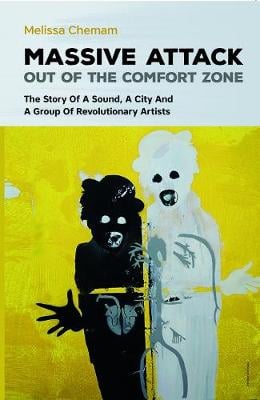
Melissa Chemam is a journalist and lecturer. After a decade as a reporter in America, Europe and Africa, from 2015 she spent years researching the cultural history of Bristol, interviewing historians, musicians, rappers, engaged Bristolians, and graffiti artists. Her book, Massive Attack - Out of the comfort zone, first published in 2016, came out in the UK in 2019.
It will be shared in September and we're preparing an event / discussion at Arnolfini.
More about it soon.
INTERVIEW WITH ARNOLFINI’S WRITER IN RESIDENCE,
MELISSA CHEMAM
To coincide with Black History Month, our writer in residence Melissa Chemam talked to us about her new project
What are you writing about, Melissa?
After about six months as the writer-in-residence at the Arnolfini, writing short pieces on women artists, feminism and resistance worldwide, we had the idea of assembling a little art book. A text dedicated to all the African, Caribbean and Afro-Caribbean British artists who Arnolfini has invited to exhibit over the years since 1961… That was in April 2020 and it sounded very relevant to me, as I’ve spent most of my adult life as a reporter on African news, in and out of Africa; I’ve worked for a film production company from Haiti; and as the daughter of Algerian immigrants to Paris, I’m a member of the African diaspora myself.
I started working on this book that is now to me a sort of short history of the art of African diaspora, or - as some liked to call the movement in the 1980s - “Black Art”, especially in the UK but also in the USA, the Caribbean, Europe and of course some artists from Africa.
Some of the artists are from the UK, other were born in Trinidad, Jamaica, Morocco, Sudan or Ghana, so it gives me room to try to weave together the different parts of the African continent, as well as the “triangular” routes that bind it with the Americas and Europe. These are themes that have haunted my work as a journalist, researcher and writer since the mid-2000s as well.
How have you been researching it?
I’ve started by trying to get in touch with some of the artists and curators. Some sent me articles, links, video recordings about their art, from back then and from now. Others have had the time for an interview. Then I’ve looked into catalogues, at Arnolfini, and also at Bristol Archives(which was a great chance to visit this wonderful place, despite the current Covid restrictions). Writing about art is one of my favourite endeavours as a writer, because it allows so much depth, and to dig into all different sorts of subjectivities. And the rest is about my own memories of some of the exhibitions, or some of these artists’ work in other places, as well as things I was researching from 2015 for my previous book, on Bristol’s music and graffiti scene Out of the Comfort Zone (Tangent Books, 2019).
Could you tell us a bit about your relationship with Bristol?
Before I came to Bristol, I had lived in London for years and thought I knew and loved England… But Bristol revolutionised my vision of the UK. I came after years reporting mainly in Africa, to write more about art and music than about immigration and politics. I came precisely because it has links with both the Americas and Africa. Links with the consequences of colonial conquests, from the 1500s up to recently.
The city was then the European Green capital. I immediately fell in love with Bristol people and their energy. I felt a strong sense of community here, and an interest in climate justice, so I came again and stayed for weeks. I met so many people – artists, writers, historians, curators, charity workers, etc. I walked mostly, from the Arnolfini and Watershed to St. Andrews and Gloucester Road, or Trinity in Easton and artists’ homes in Clifton, in Hotwells and Bedminster, in St. Paul’s and St. Werburgh’s. I stayed in these different neighbourhoods with different people of different ages and origins and always found commonalities.
Bristol became both an exciting territory to explore and a familiar second home. It’s been quite a unique experience for me.
I moved here finally a year ago, and since we have been through a lot… First there was Brexit! Then the Covid crisis, with the quasi-impossibility to travel… For a nomad like myself, it took a special place to not feel desperate. I walked almost daily along the Harbourside or in one of Bristol’s parks. And of course Edward Colston’s statue was torn down! A statue which I had discussed with a member of Massive Attack very early on…
Bristol and I, it’s a weird relationship, in a way. I’m from a North African background, lived in warm climate for years, and always thought I would one day settle somewhere like Italy… And sometimes some Bristolians can be a bit territorial, so I can feel like it’s delusional to want to be part of such a city, with complex history, divisions. I regularly wonder: where do I fit? But I’m still here and there is mostly joy, learning and friendship on a daily basis!
Are there any spoilers or favourite stories you’d like to share?
My favourite show at the Arnolfini was definitely ‘Vertigo Sea’ by Ghanaian British filmmaker John Akomfrah, in 2016! His work with the Black Audio Film Collective and lately Smoking Dogs Film has had a huge influence on my tastes in art and reflections on our post-modern world…
The other show on the top list is ‘Trophies of Empire’; my discussion with Keith Piper was very insightful, notably on what ‘Black Art’ really means, between a political meaning to a more sociological perspective, not even strictly racial. In the 1970s, the most radical British ‘Black’ artist in the UK was probably Rasheed Araeen, born in 1935 in Karachi.
Then Jamaican and other Caribbean British artists like Sonia Boyce and Frank Bowling revolutionised the artistic landscape. And more recently, African artists born on the African continent have left their mark, etc. It is a fascinating journey, and everything but one-sided.
-
Melissa’s book will be launched in September 2021, as part of the celebrations to mark Arnolfini’s 60th anniversary.
More information to follow.
Frank Bowling is exhibiting at Arnolfini this Summer 2021.
What a week on the international front... North America is burning, Covid is resurgent and the President of Haiti has been Killed.
I can't stop thinking about Haiti though.
Haiti: Petionville market, Port-au-Prince, 2008 - Photo by M. Chemam
There is so much not written in the media about the whole story of the island and its turmoil.
The latest by The Guardian:
"A struggling and chaotic Haiti is reeling from the assassination of President Jovenel Moïse followed by a reported gun battle in which authorities said police killed four of the murder suspects, detained two others and freed three officers who were being held hostage."
Haiti is one of the first nations to free itself from slavers and colonialists, the world has failed it.
I went there in 2008 when living in and reporting from Miami, but mostly I worked with a Haitian filmmaker for years.
An important book to understand Haiti's history is 'Silencing the Past: Power and the Production of History', by Michel-Rolph Trouillot. It was one of the inspirations for the doc series 'Exterminate All the Brutes', and I spent months reviewing it and thinking about how to adapt it/include its ideas.
In this review by Kenneth Maxwell in Foreign Policy's July/August 1996 issue, the reviewer wrote: "Trouillot, a distinguished Haitian scholar who teaches at The Johns Hopkins University, has produced a sparkling interrogation of the past. He examines the suppression of the role of Africans in the Haitian Revolution to demonstrate how power silences certain voices from history. The background is the "war within the war." As Napoleonic France attempted to reestablish imperial control and eventually slavery, black creoles -- natives of the island or the Caribbean -- fought dissident groups composed of Bossales -- African-born ex-slaves mainly from the Congo."
He adds "Haiti was, Trouillot convincingly shows, the first modern state of the so-called Third World, and it experienced all the trials of postcolonial nation-building when new elites partially appropriated the culture of the masses and silenced dissent. The silencing was doubly effective because the Haitian Revolution, the most successful slave revolt in history, was largely written out of the texts by historians of the period. Trouillot places the Haitian story within the context of the denial of the Holocaust, the debate over the Alamo, and the meaning of Columbus. A beautifully written, superior book."
Haiti was failed by the West from its independence in 1802, forced to pay an immense debt to France to get its freedom back, and thrown into the turmoil of trying to build a society for traumatised former slaves while the whole continent around them, the Americas was against them. First the Spanish invaders of the island, founding the Dominica Republic on half of the island. Second the United States of America, at the time still built on slavery and a system exploiting displaced African people to this day. Finally, by the 'aid' and emergency help business...
For more on this, the same filmmaker made a documentary titled 'Fatal Assistance'. Here is the trailer:
And the film in French here:
There would be so much to add; but that's a start.
Keep in mind that what you see about a country in the news for 1 minute only reflect a biased point of view, erasing most of its history...
As the academic year 2020/2021 ends, I have the privilege to have been chosen to become UWE's new Senior Lecturer in Journalism and Media Production, within the Faculty of Arts, Creative Industries and Education (ACE).
Senior Lecturer at UWE Bristol - School of Creative and Cultural Industries
After 9 months as a guest lecturer in Music Journalism at BIMM Bristol and 18 months as an associate lecturer in journalism & in the creative industries at the University of the West of England (UWE), I've learned so much, and I intend to focus on critiquing the news, decolonising the news, and cross-media creativity...
I really enjoy working with UWE; the teams are brilliant and creative. I look forward to new projects next year!
In June, I also interviewed one of our students to talk about how the past year and all its challenges affected them: you can listen on The Quarantini Podcast here.
In the meantime, my writing and reflections about art, multiculturalism, African & post-colonial history, activism... led to interesting encounters, projects and collaborations.
Here are a few articles already published:
I AM History
My latest article for the online magazine on 'Black' history and culture.
Reflecting on a pivotal year in my life, 2015, I decided to share a poem I started writing after my first trip to Bristol and in the midst of a year of terrorist attacks in my city of birth, Paris, followed by a huge backlash on Muslim people in France.
I started working on this book last summer. Some of the artists are from the UK, others were born in Trinidad, Jamaica, Morocco, Sudan, Algeria, Ethiopia or Ghana, so it gives me room to try to weave together the different parts of the African continent - that I have visited or been based in.
The project also retraces the routes that bound Africa with the Americas and Europe.
These are themes that have haunted my work as a journalist, researcher and writer since the mid-2000s as least...
I'd love to create dialogues and generate further encounters with African artists exhibiting in other parts of the world, when this book is out. Do get in touch if you're interested!
-
Many thanks for your attention!
I hope to see some of you soon in 'reopening' Bristol or London; or in Europe later in the summer, hopefully...