22/05/2023

UN biodiversity day turns 30, but is the world doing enough?


New piece for RFI English - read here: https://www.rfi.fr/en/science-and-technology/20230522-un-biodiversity-day-turns-30-but-is-the-world-doing-enough


BIODIVERSITY

UN biodiversity day turns 30, but is the world doing enough?


Brazil's rich biodiversity is under attack from multiple fronts. © AFP/File 


The International Day for Biodiversity was created in 1993 to shine a light on issues affecting nature. Three decades later, protecting ecosystems has become more urgent than ever. The EU is one region rolling out ambitious policies, but the clock is ticking.

The UN says there's growing recognition that biological diversity is a global asset of tremendous value to future generations, yet the number of species is being significantly reduced by human activities.

In December last year, the UN’s Cop15 biodiversity talks in Montreal managed a breakthrough deal, which has been compared to the Paris Agreement, after repeated delays and more than four years of negotiations.

The EU this month adopted an historic anti-deforestation law. The goal is to ensure that commodities linked to deforestation and forest degradation won’t be able to enter the EU market unless proven to be sustainably sourced.

First law of its kind 

This law means that imports of palm oil, cattle, soy, coffee, cocoa, timber and rubber will have to comply with strict traceability obligations. Evidence must show they have not been grown on deforested or degraded land.

It is reported to be "the first law of its kind in the world", according to the NGO Global Witness, and "a historic blueprint" for the approaches that other markets should look at to help preserve the world’s forests.

These steps are considered as essential in the fight against climate breakdown and biodiversity loss.

Global Witness added that: "Now the first milestone towards deforestation-free supply chains has been achieved, it’s time to ensure that the European Union can fully end its role in forest destruction – which means cutting the money pipeline to deforesting businesses.  This is the final piece of the puzzle."

But it warned that "the new law does not oblige EU-based banks or investors to stop funding deforestation through its investment portfolios and via financial services."

From Brussels to Brazil

EU Parliamentarians also want to become leaders on the matter of biodiversity for the rest of the world.

On 18 May, EU lawmakers arrived in Brazil to ensure that the South-American country shows it is serious about protecting the environment and the Amazon rainforest to conclude a long-stalled EU trade deal with South American nations. 

"The European side needs a clear commitment and clear mechanisms on sustainability," European Parliament member Anna Cavazzini of Germany told AFP in Sao Paulo.

Need for strong implementation

When the Cop15 agreement was adopted six months ago, the Democratic Republic of Congo had unsuccessfully demanded that it includes more funding for developing countries.

Cameroon and Uganda also expressed opposition to the text, and WWF International director Marco Lambertini said the deal would only be as good as its implementation, as it lacked a "mandatory ratcheting mechanism that will hold governments accountable to increase action if targets are not met”, Lambertini added.

The same will go for the new EU anti-deforestation law.

-


NB. I've taken a new full-time job with the publish broadcaster, as a journalist, African news specialist and International reporter. You can now read all my my work from here: https://lnkd.in/eJFbPM8G 


21/05/2023

Printemps de l’Art Contemporain à Marseille : Des Rencontres professionnelles pour penser la culture de demain


Après trois semaines d'expositions, performances et festivités, le Printemps de l’Art Contemporain s'est clôturé le 21 mai, après avoir investi Marseille, Aix-en-Provence et de nombreuses communes du pourtour de l’Étang de Berre et du pays d’AixLes 10-11-12 mai, le PAC a notamment accueilli des rencontres professionnelles, à la Friche La Belle de Mai ou encore aux novateurs Ateliers Jeanne Barret, dans le quartier des Crottes, au nord de Marseille. Occasions de mettre à l'honneur l'intérêts des artistes et des institutions locales pour les questions écologiques et l'avenir du statut des artistes. Compte-rendu.

-

Les trois jours de Rencontres Professionnelles ont permis de proposer des événements gratuit, sur entrée libre.

La première journée a démarré sur le thème des "Industries Culturelles et Créatives (ICC) et l'économie de l’art", au Frac Sud - Cité de l’art contemporain de Marseille.

Cette table ronde a réuni Jérémie Choukroun, coordinateur des stratégies industries culturelles et créatives et référent transition écologique de la DRAC, Jean-Paul Fourmentraux, socio-anthropologue (PhD) et critique d’art, Pamela Grimaud, conservatrice au Musée Granet, Pierre Pauze, artiste plasticien, et l'artiste Fouad Bouchoucha. Une rencontre soutenue par la DRAC (Direction Régionale des Affaires Culturelles Provence-Alpes-Côte d’Azur) dans le cadre du SODAVI et du Printemps de l'Art Contemporain.

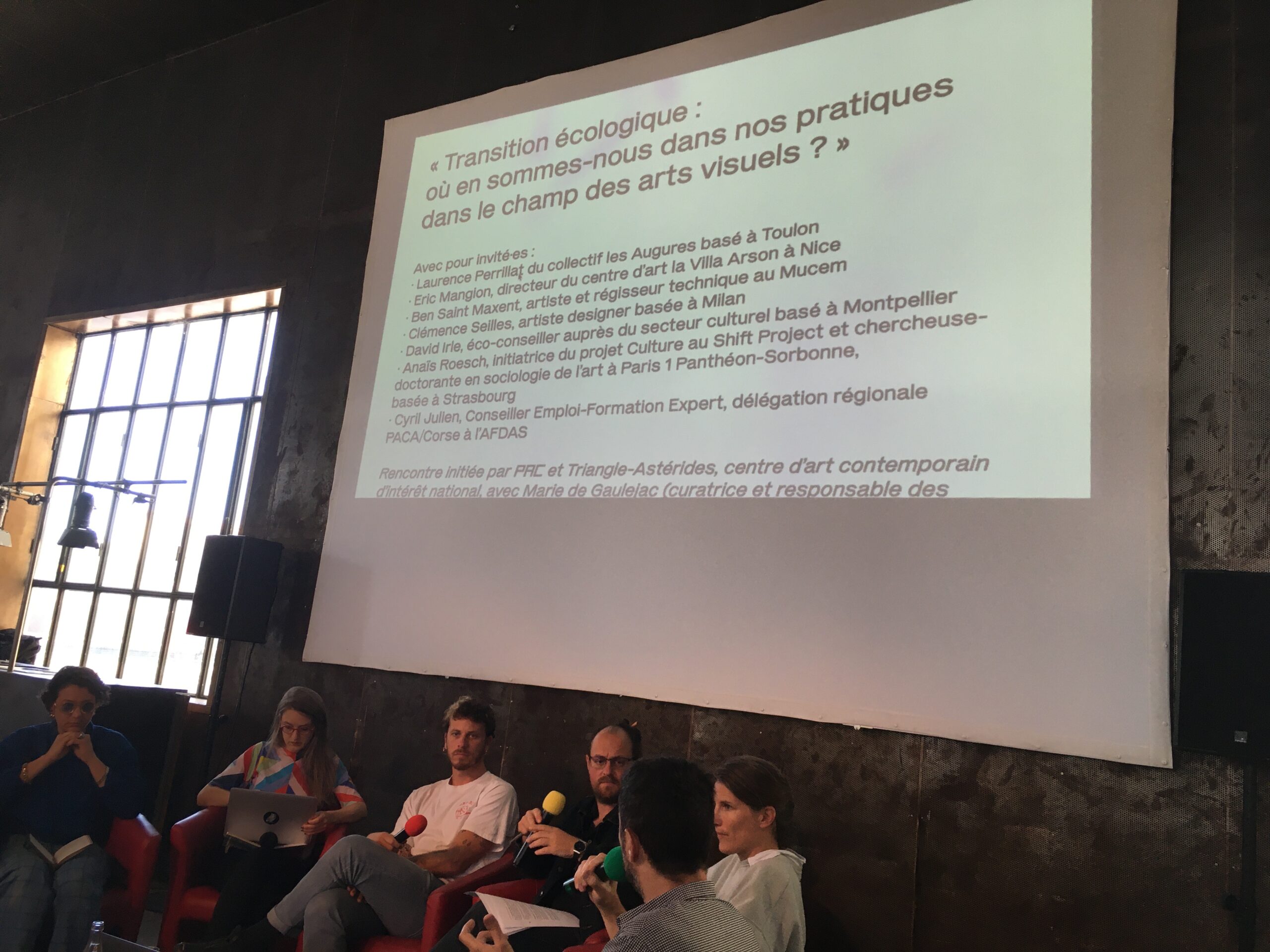
Pour la deuxième journée des Rencontres Professionnelles du réseau PAC, une table ronde, retransmise en direct sur Radio Grenouille, s'est attaquée à la question de la transition écologique, sur le thème : "où en sommes-nous dans nos pratiques dans le champ des arts visuels ?" Les discussions se sont tenues de 10h00 à 17h30 à la Friche la Belle de Mai.  

Elle a réuni Laurence Perrillat, du collectif les Augures ; Ben Saint Maxent, artiste et régisseur technique au Mucem ; Clémence Seilles, artiste designer – du Stromboli Studio ; David Irle, éco-conseiller auprès du secteur culturel – cabinet Aladir Conseil ; Anaïs Roesch, initiatrice du projet Culture au Shift Project et chercheuse-doctorante en sociologie de l’art à Paris 1 Panthéon-Sorbonne ; et Cyril Julien, conseiller Emploi-Formation Expert, à la délégation régionale PACA/Corse à l’AFDAS.

Marie de Gaulejac, curatrice et responsable des programmes de résidence et d’artistes associé·es à Triangle-Astérides, Centre d’art contemporain d’intérêt national, a organisé la table ronde, animée par Jean-Baptiste Imbert.

De nombreuses questions ont été abordées, des matériaux utilisés par les artistes au recyclage et aux investissements en matière d'économies d'énergie des institutions comme des lieux de cultures, dans les arts visuels, mais aussi plus largement dans tous les secteurs de la culture. 

Ce qui en est ressorti est l'investissement de ces intervenants en faveur du changement, et l'existence de nombreuses solutions et réponses, comme la mutualisation des installations scéniques, etc.

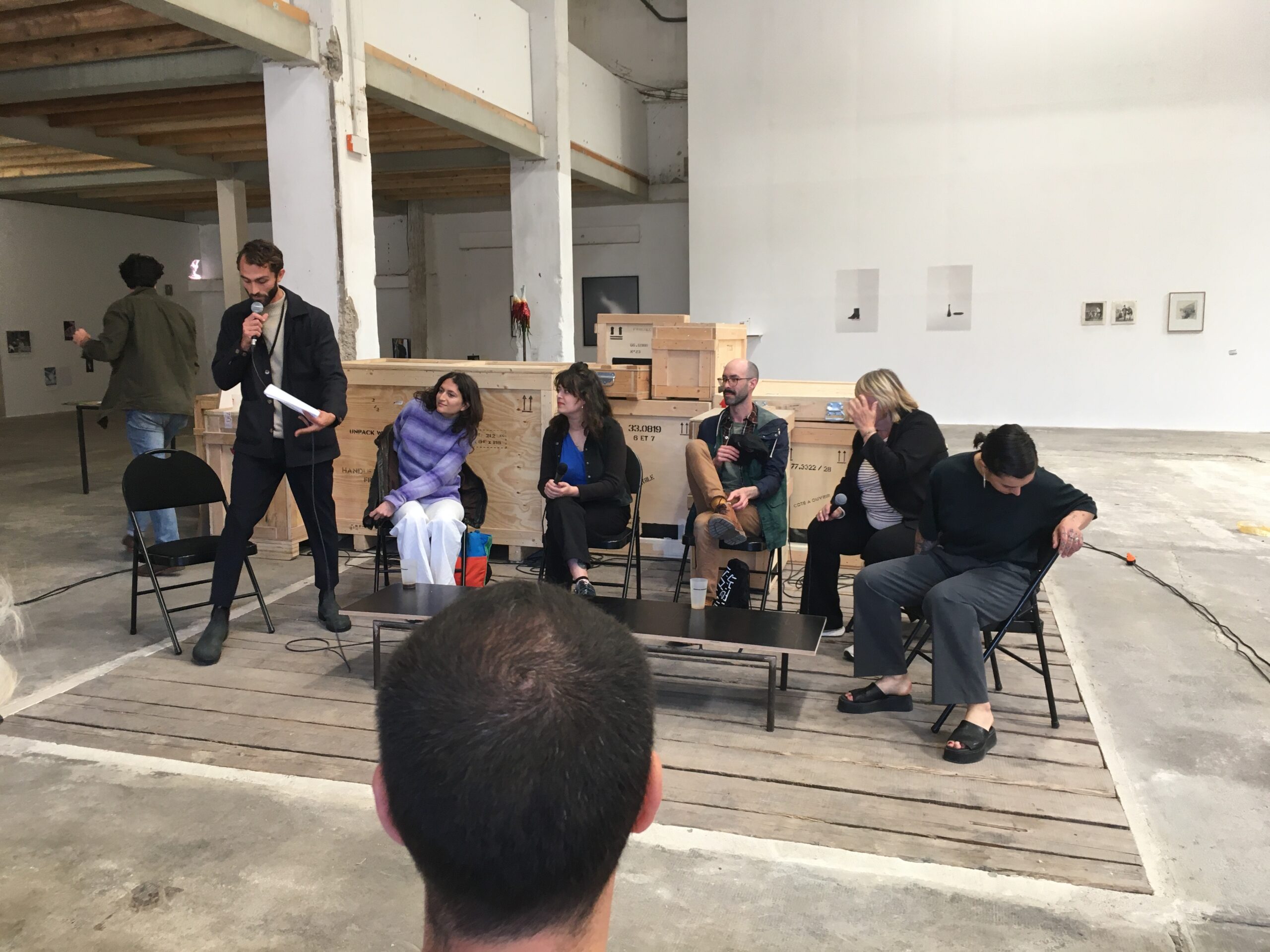
La troisième et dernière journée de débat s'est articulée autour de la question "Sommes-nous en compétition ou en coopération avec les autres acteurs du champ de l’art contemporain ?", à l'atelier Jeanne Barret. 

Avec Valentin Heinrich à la modération (sociologue et directeur éditorial de l’Observatoire de l’Art Contemporain), le débat a réuni Véronique Senez-Traquandi, consultante, ex-conseillère pour les arts plastiques au Conseil Général des Bouches-du-Rhône ; Sara Fiaschi, artiste et co-présidente de la Fédération Artistique de Marseille ; Salomé Burstein, chercheuse, curatrice indépendante, et fondatrice de l’espace Shmorévaz à Paris ; Aurélien Catin, auteur et militant pour les droits économiques, membre du collectif La Buse  ; et enfin Zoé Ledoux, artiste et théoricienne.

Cette dernière a également ouvert la journée par une lecture-performance mettant en scène son expérience de jeune artiste sortie des Beaux-Arts de Marseille, face au Marché de l'art et à la professionnalisation de l'artiste.

Ces débats et tables rondes ont notamment donné l'occasion aux participants, journalistes et publics de visiter les exhibitions en cours dans ces lieux, avec curateurs et artistes. Dont les passionnantes expositions de la Friche La Belle de Mai :

L'une, autour de l'artiste Bassem Saad, intitulée 'Des fumées dans la ville voisine' (11 février – 21 mai 2023) : Une exposition conçue et produite par Triangle–Astérides, centre d'art contemporain d'intérêt national, en co-production avec la SCIC Friche Belle de Mai. Partenaires : Beaux-Arts de Marseille - INSEAMM, Frac PACA, MOCO, Mucem, Instants vidéo, VDS Bâti Renov, Picto. 

Cette première exposition personnelle de l'artiste libanaise en France, réunit ses trois films réalisés à ce jour, ainsi que deux sculptures, des collages, des textes, dont deux nouvelles productions, autour de thèmes liés à l'histoire récente de Beyrouth, des déplacements / exils de l'artiste, et de sa relation au traces post-coloniales entre le Liban et la France.

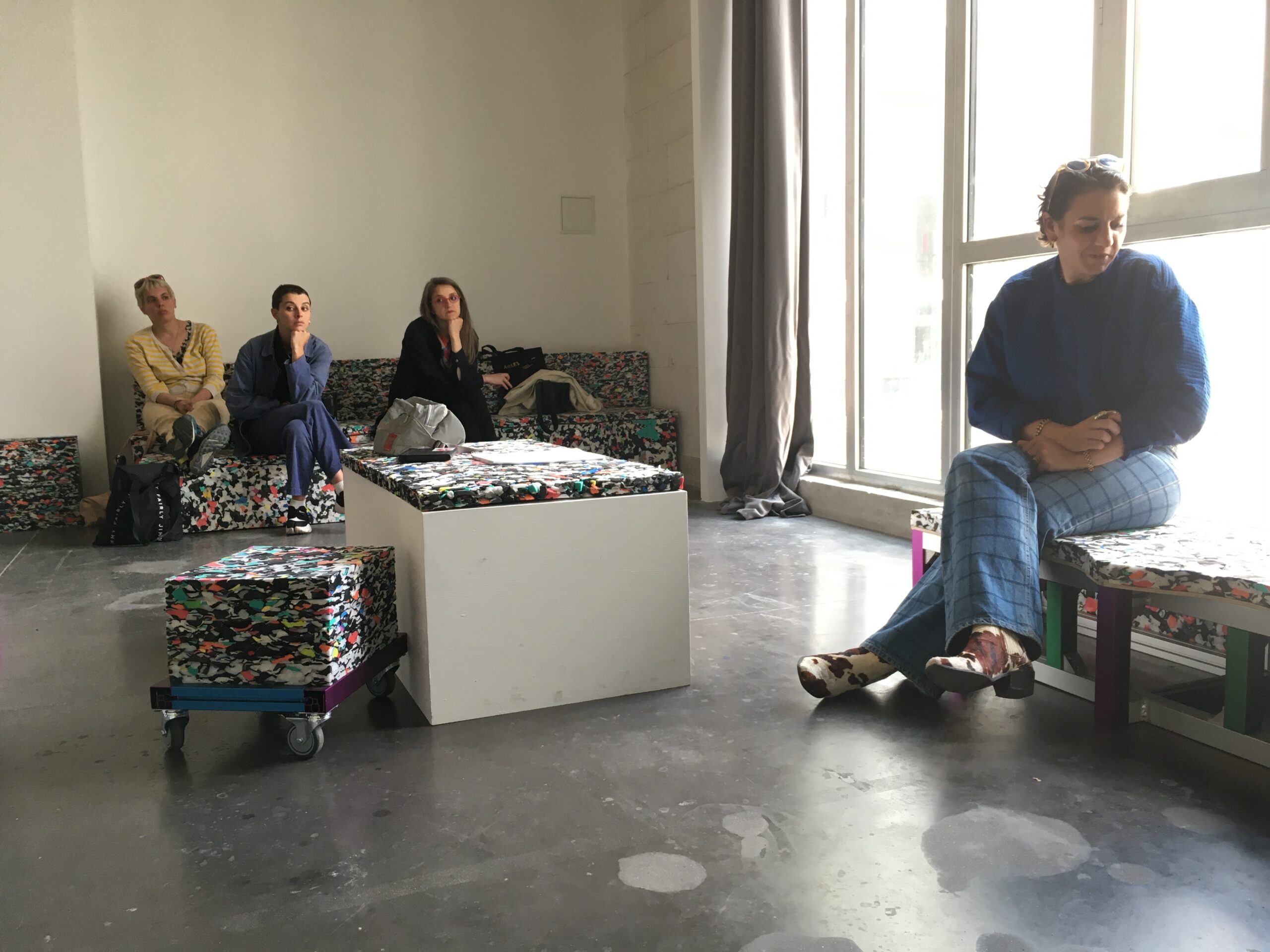
L'autre, autour du Collectif Polymer, qui s'est créé pour "sensibiliser sur la pollution plastique au travers de l’art pluri-media", et qui présente 'Plasticoscène', jusqu'au  27 mai 2023. 

Les artistes invité·e·s ont travaillé à partir de plastiques récoltés dans la région de Marseille : Museo Aero Solar, Thomas Mailaender, Southwhay Studio, Côme Di Meglio, Elvia Teotski, Coline Le Quenven, Maxime Verret, James Shaw, Marion Flament, Wendy Andreu, IGO Studio, NSDOS, Gangui Collectif, Ateliers Laissez Passer.

Au final, on rentre de Marseille avec une sensation de bouillonnement culturel, ainsi que de véritable volonté de réfléchir à la culture de demain, une culture à la fois ancrée dans le territoire et ouverte sur le monde.


16/05/2023

WOMEN / LIFE / FREEDOM - Bristol Old Vic, 9 June 2023


زن، زندگی، آزادی 

WOMEN 

/ LIFE 

/ FREEDOM


For those of you in Bristol, the musician and artist Roxana Vilk organises this wonderful event to support women in Iran on Friday 9 June at the Bristol Old Vic:


A rare and exciting opportunity to hear new writing by Iranian female playwrights. 

Directed by Bristol based, British-Iranian artist Roxana Vilk, actors will perform an hour of script-in-hand readings in
The Weston Studio.
These will be extracts from four plays written by female writers in Iran, translated into English and encompassing a
wide range of powerful and contemporary themes. 

Ticket sales from this event will go to local Bristol charity Aid Box Community, which provides support, supplies and
sanctuary for refugees and people seeking asylum in Bristol. 

Book here: https://bristololdvic.org.uk/whats-on/زن-زندگی-آزادی-women-life-freedom 


11/05/2023

Conversation with Hew Locke at The Royal Academy, London, Wed, 5 July 2023


hello again! and happy to announced that I have been invited to lead a conversation with another artist I admire deeply, in London this summer: Hew Locke.

Conversation with Hew Locke at The Royal Academy, London


Guyanese British artist Hew Locke - in Conversation with art writer Melissa Chemam

Wed, 5 July 2023 18:00 - 18:30 BST

 Royal Academy of Arts - Burlington House, Piccadilly, London W1J 0BD, United Kingdom  

Book here: https://www.royalacademy.org.uk/event/hew-locke-in-conversation

As part of the Summer Exhibition - Exhibition details:
 
https://www.royalacademy.org.uk/exhibition/summer-exhibition-2023

Read my interview with the artists from 2022, for Art UK here:
  
https://artuk.org/discover/stories/hew-lockes-the-procession-transforming-darkness-into-joy 


Link to book coming soon! 
-


Hew Locke in conversation

Wednesday 5 July 2023 6.30 - 7.30pm

The Benjamin West Lecture Theatre, Burlington Gardens, Royal Academy of Arts or digital livestream


£15 / £9 conc in person or £8 / £5 conc online


Join artist Hew Locke RA and Melissa Chemam for a conversation exploring whether creativity can inspire connection.

This event can be enjoyed in person at the Benjamin West Lecture Theatre, or via a digital livestream.

In this talk, artist Hew Locke RA discusses art and connection, inspired by the RA’s Summer Exhibition theme ‘Only Connect’.

Hew Locke produces works that invite us to engage with the past. Chaired by Melissa Chemam, this conversation explores the ways in which we re-enact, re-imagine and re-perform history.

Looking to the future, this discussion also focuses on new opportunities for creative connection, and the importance of art in bringing us closer together.


Hew Locke RA spent his formative years in Guyana before returning to the UK to study art, later completing an MA in Sculpture at the Royal College of Art. His work explores the languages of colonial and post-colonial power, and how cultures fashion identities through visual symbols of authority. In 2022, Hew was awarded Tate Britain’s Duveen Hall commission (culminating in his work The Procession) and The Metropolitan Museum of Art Facade Commission, as well as becoming a Royal Academician. His work is held in numerous collections, including the Government Art Collection, the V&A and the British Museum.

Melissa Chemam is a journalist, broadcaster and writer on art, music, social change, multiculturalism, African affairs, North/South relations, and activism. She is the author of the book Massive Attack - Out of the Comfort Zone (2019), and has been published by BBC Culture, Al Jazeera, RFI English, Art UK, CIRCA Art Magazine, the Public Art Review, the New Arab, The Independent, Reader’s Digest, UP Mag and Skin Deep. She also worked as a journalism lecturer and as the writer in residence at the Arnolfini art centre, in Bristol, from 2019 to 2022.

This event is supported by the Natalia Cola Foundation.


Marseille, exploring further: talking arts and ecology at La Friche


As part of the PAC (Printemps de l'art contemporain) Marseille, a festival / series of contemporary art events, I'm in La Friche La Belle de Mai, under the sun, to explore their exhibitions, and listened to a conversation on ecology and sustainability in the field of visual arts.


Here is the Milan-based French artist Clémence Seilles discussing her work on recycled design:


Spring is a great time to enjoy all the vibrant art Marseille has to offer.


More soon.


06/05/2023

Contemporary Art in Marseille Blooms at PAC


Marseille is shining during the Printemps de l'art contemporain (PAC)!

Contemporary artists and curators invade galleries and museums, institutions and outdoors space, for a whole month.

A few snapshots from the first days, before my articles...


-


Arrival in Marseille by train: 


Fotokino, 1er arrt, photographs by Laurent Millet:


Château de Servières

Mayura Torii
'Domestique' (Dessin)
Du 5 Mar 2023 au 1 Juil 2023.


Delphine Mogarra
'Latente'
Exposition du 5 mai au 1er juillet 2023


Javiera Tejerina-Risso
'Lignes de désir'
Exposition du 5 mai au 1er juillet 2023


The view from Anse du Pharo, where an artist is in residence... (More soon): 


La Traverse

'Mers, Terres, Corps Traversés' - 28 Avril - 21 Mai 2023 (brunch Dimanche 7 mai sur reservation et performance à 15h meta-potatoes de Jean Paul Thibeau, ouvert à tous) 

With: Malala Andrialavidrazana, Francis Alÿs, Shivanjani Lal, Louisa Marajo, Tuli Mekondjo, Otobong Nkanga, Jean-Paul Thibeau


Clément Louis, « 𝑨𝒄𝒕𝒔 𝒐𝒇 𝑳𝒐𝒗𝒆 », Double V gallery: 


Marseille-based Russian artist Daria Krotova, 'Carcasse', 33


Arti, Rue Paradis :


Southway Studios:


Glasswork at CIRVA:


03/05/2023

PAC - Direction Marseille!


15e Printemps de l'Art Contemporain à Marseille :

Journées d'ouverture les jeudi 4, vendredi 5 et samedi 6 mai


2023 : la 15e édition


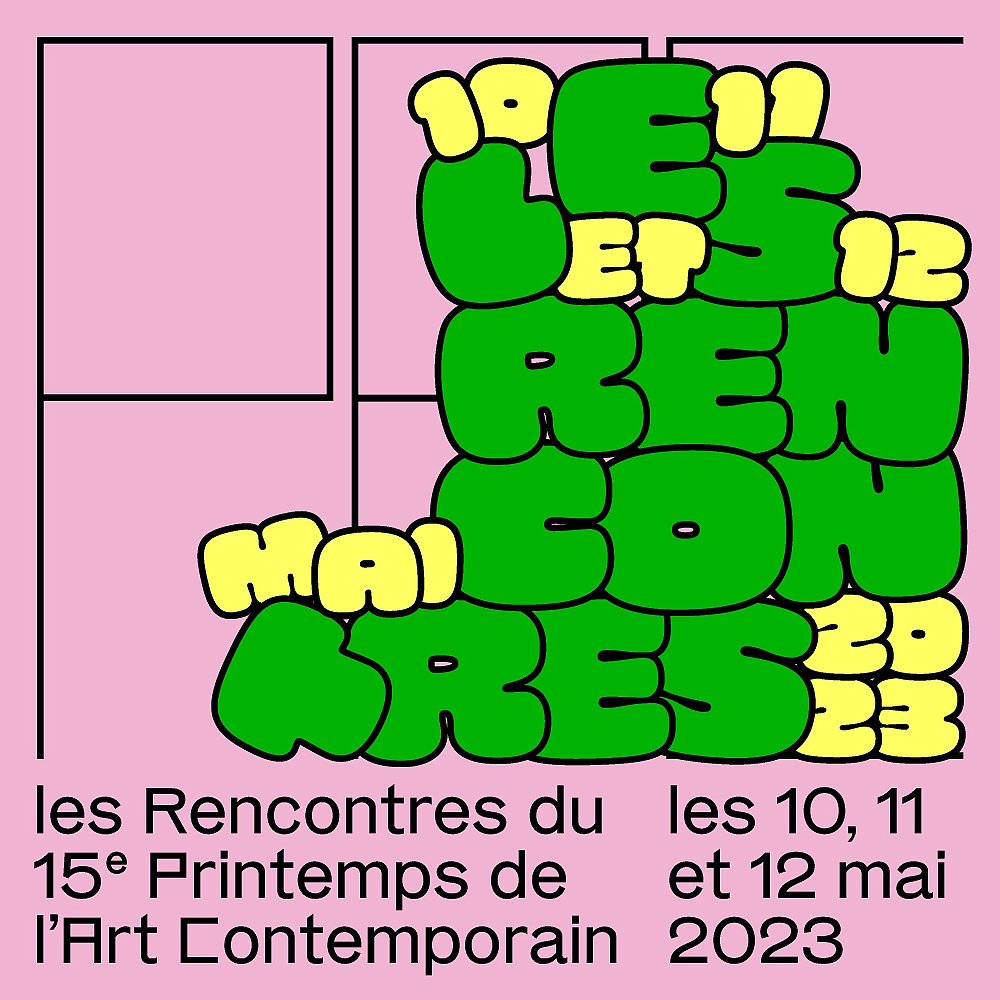
Le Printemps de l’Art Contemporain revient du 4 au 21 mai 2023 à Marseille, Aix-en-Provence, et dans de nombreuses communes du pourtour de l’Étang de Berre et du pays d’Aix ; et une programmation enrichie par des rencontres professionnelles les 10, 11 et 12 mai à Marseille.

Lancée par une grande ouverture à Marseille du 4 au 7 mai, cette 15e édition du PAC propose au public une découverte de sa programmation par quartier, en nocturne et en journée, en centre-ville et en bord de mer, des quartiers Sud aux quartiers Nord. Ponctuée par une journée dans les centres d’art autour de l’Étang de Berre, le PAC se clôturera à Aix-en-Provence et en pays aixois avec deux jours de propositions artistiques et de circuits guidées ouverts à tou·te·s.

Avec plus de 100 expositions, vernissages, performances et installations, la scène émergente française et internationale s’active dans plus de 70 lieux du territoire – sur la mer, à la campagne, dans les galeries, les musées, les parcs et dans des sites patrimoniaux exceptionnels –, confirmant la place essentielle des acteurs et actrices fédéré·e·s par le réseau Provence Art Contemporain dans le paysage des arts visuels.


-


réseau PAC (Provence Art Contemporain)

Regroupant depuis 2007 les volontés et actions des lieux, opérateurs, structures et associations œuvrant pour la diffusion et la promotion de l’art contemporain auprès du public à Marseille et dans son agglo­mération, le réseau PAC (Provence Art Contemporain, anciennement Marseille Expos) est au fil des années devenu le plus grand réseau territorial d’art contemporain en France.

Parmi ses 75 membres, s’y retrouvent des institutions muséales, des galeries associatives ou issues du secteur concurrentiel, des espaces expérimentaux et associatifs, des collectifs de commissaires, les Beaux­-Arts de Marseille, des lieux de résidences et de production, accueillant et accompagnant au quotidien les artistes, produisant, soutenant ou montrant leur travail.

Le réseau bénéficie du soutien attentif du Ministère de la Culture / DRAC PACA. Pour les collectivités territoriales, la Ville de Marseille et la Région Sud sont ses principaux partenaires, aux côtés du Département des Bouches-­du­-Rhône et d’Aix­-Marseille­ Métropole.
L’ADAGP accompagne nos événements.

www.p-a-c.fr


02/05/2023

After the hassle, welcome Month of May


A season in a journalist's life... 


Dear friends and readers,

I'm not going to lie, this has been a very difficult couple of months... Probably the hardest time in my life since the winter I lost my dad, in 2009, and the February/March/April that followed. 

Politically, the UK is crumbling down, and I still love Bristol so much; it's hard to think of these anti-protests and anti-immigration laws without cringing... And the French government only showed despise for the beautiful movement of resistance coming from the anti-pension reform demonstrations.


Work-wise, I had to tackle many jobs at the same time, only to learn that one of my employers cancelled their budget for our work from a day to another. 

One of my editors has also cancelled my music column (and another contributor's travel column on the SWANA region), just out of pettiness, and with no justification.

And I received the horrible news regarding the plagiarism of my book, that I worked so long on... 

*

My book has been vastly copied by a very-privilege younger French white woman journalist, who read and loved my book years ago, wrote to send me praise then entirely copied my work with no reservation. 

The type of person you would expect respect and solidarity from, as she's much more well-off, very supported and well introduced by extremely well-known and much older French powerhouses in French media, also, in passing, proper millionaires.

How in France in 2023, a privileged person with no background or experience in England or in the global South can steal my work on a story like Bristol with almost no cultural journalists checking the real origins of the ideas is completely beyond me.

And it only reinforces my utter disillusionment about the current French society, marred with anti-intellectual sentiment.

*

I've been complaining about it for too long now: we live through an anti-intellectual time.

Corroborating these feelings and reflections, recents worrying events resonated, especially the arrest of a left-wing publisher from La Fabrique at St Pancras, while on his way to the London Book Fair, apparently on a list sent by the French government.

In parallel, I read more and more often from friends in the academic world that plagiarism is becoming a common practice, and that many young writers even tend to erase the work of previous researchers to posture as pioneers in their own dissertations and journal's articles.

Often, in the same way that in the case of my book, they are young, powerful and well-supported, pushing the mainstream media to congratulate them, without looking into the origins of their so-called personal work.

While I was figuring out that my work had been copied, pasted and used with almost no credit, I read on Twitter complains from brilliant academic researchers, also denounced the practice of young and nepotist newcomers erasing the very work they are supposed to mention, just in the hope of advancing their career a little quicker.

In the meantime, in England, while discussing with the brilliant artist Alfredo Jaar and his close circle of friends in art criticism and academia at his exhibition opening's private dinner, I also learned about similar practice in art history in the UK.

One case: 'The Story of Art Without Men' by the 29-year-old Guardian writer Katy Hessel, which turns out to be rewriting history and erasing the work of two generations of less famous hard-working feminist historians, as you can read herehere and here.

Extract:

Advertising works. I kept seeing this book everywhere—on social media, in the news, on the shelves at my local bookstore. I like art. I’m an advocate for feminism, to use bell hooks’s preferred phrase. Surely, I’d get on well with this book. I bought it and started reading.

Unfortunately, the problems start on pretty much the first page.

The real inspiration for this book: E.H. Gombrich’s 1950 The Story of Art. 

(...) The fact that Hessel’s project takes for its centre of gravity a concept so deeply rooted in white supremacy and patriarchy speaks to a lack of critical engagement with feminist histories and historiography. 

For art historian Maura Reilly, ‘revising the canon to address the neglect of women and/or minority artists is fundamentally an impossible project because such revision does not grapple with the terms that created that neglect in the first place’.

(...)

Secondly, despite the long parade of names of women artists from the seventeenth century to today, the book’s politics suck. Without any real sense of self-awareness, The Story of Art Without Men enacts a huge erasure of other women. Namely, women (and men) art historians, academics, artists journalists, curators and other art workers. Not a single one of the words written in this 450-page book would have been possible without the vital contribution of the people who have dedicated themselves to the study of the artists mentioned throughout.

*

Hopefully, this coming month seems to bring change, like it happens after many ordeals.

In April 2009, I was lucky enough to apply and get a job interview with the BBC World Service, and to be chose for the job. 

Mid-May 2009, I moved to London after three months of horrible grief and mourning and a new life started for me. I finally realised my dream to work on African news, not only International news, which in general only cover the global north...

This profoundly changed my life and my work, and also led me to write my book on the African-Caribbean British community and culture, and their counter-cultural allies and activism.

18 months later I moved to Kenya, and from 2010 to 2014, I went to report in 14 African countries, on top of my parents' native Algeria, where I had already been regularly since the age of 8 months... I was actually almost born there, as my mother kept going back to Algiers, missing her family, until the very last weeks before my birth... 

In the same way, I now hope that this month for May 2023 will be a time for a new departure and some healing.

Though he would not always have chosen the same methods, a lot of what I do in my work, I do it for the memory of my father, and his family of resistants and freedom fighters, as much as my mother's father was. They lost their brothers, cousins, sons and daughters during a terrible war of resistance again an oppressive regime that never acknowledged publicly or demanded forgiveness for its acts of spoliation, violence and even torture, over 130 years...

My family re-emerged from this fight owning strictly nothing, and both my parents had to immigrate to find work.

*

Of course, this winter and early spring also brought wonderful events my way. First, the latest eye-opening exhibitions I covered, like the photographs of Zanele Muholi at MEP Paris, the new Basquiat exhibition at La Philharmonie, the showing of ‘Grenfell’ by Steve McQueen at the Serpentine Galleries, and the great artist-activist I interviewed: Alfredo Jaar. 

My piece on his most recent exhibition for Art UK comes out on 2 May 2023:

Alfredo Jaar: poetic visual interventions

https://artuk.org/discover/stories/alfredo-jaar-poetic-visual-interventions


*


I also met wonderfully warm and engaged people, sharing my values, and received comments from readers showing deep support. 

All compensating for the few old friends I thought I’d rejoice to see more often in France, now that the Covid crisis is over, but who have been of very little support, unavailable, and for some of them just cynical regarding all the aforementioned issues... 

Finally, I'm about to start a new full-time job, working on African news again, and international affairs, more on it very soon! 

I hope that this month of May will thus be the start of a new dawn, for my work, art writing. and new, better friendships, the joy of life. 

And I wish the same for you. 


MC


-


-

My latest articles:


Alfredo Jaar: : poetic visual interventions

Alfredo Jaar is most often referred to as a photographer, and he was even awarded the prestigious Hasselblad Award in 2020. Yet, he sees himself more as a critic of our visual culture, a commentator on the 'politics of images', as he says. 

Art UK: https://artuk.org/discover/stories/alfredo-jaar-poetic-visual-interventions


'Two Basquiat exhibitions in Paris shine light on art superstar' (April 2023)

On art: Basquiat has been one of my favourite artists for years, and influenced so many of my other favourite artists! Lucky Parisians!! Read on RFI English's website: https://www.rfi.fr/en/culture/20230415-two-basquiat-exhibitions-in-paris-shine-light-on-art-superstar


Ugandan activists brace for ratification of harsh anti-homosexuality bill

Covering African & International news for RFI English. Latest feature - on Uganda and LGBTIQ+ rights and worries, from April 2023: https://www.rfi.fr/en/africa/20230414-ugandan-activists-brace-for-ratification-of-harsh-anti-homosexuality-bill


All for RFI English on African news:

https://www.rfi.fr/en/author/melissa-chemam-with-rfi/

'Herstory' sings new song for Saudi Arabia's female musicians

An exciting scene of women musicians has emerged in Saudi Arabia. Two filmmakers have decided to document their emergence with a ten-episode series. The result: ‘Herstory’, broadcast on Shahid, the largest streaming platform in South West Asia. Read my feature / interviews for The New Arab here: https://www.newarab.com/features/herstory-sings-new-song-saudi-arabias-female-musicians


Meet Ghoula—Arabic Music Remixed Via Tunisia

This is sadly the last episode of my disappearing monthly column on music & the SWANA region (the review cancelled it without notice)... I chatted with the talented Tunisian electronic music artist Wael Sghaier, aka Ghoula, part of a very select but exciting underground electronica scene from North Africa, who have managed to find in Paris the means to showcase his music.
Read more here: https://themarkaz.org/fr/meet-ghoula-arabic-music-remixed-via-tunisia/


-


You can check my newsletter for free here: 

https://melissa.substack.com/