25/05/2023

Africa Day: Celebrate the 60 years of the African Union


African Union celebrates 60 years of unity on Africa Day, despite huge challenges


The African continent this Thursday marked the 60th anniversary of the Organisation of African Unity (OAU), which became what is today known as the African Union (AU). The date has become Africa Day, celebrated in Africa and in the diaspora. But if the Union helped achieve a lot, many outline its shortcomings too.


The AU says that the organisation is celebrating the OAU/AU 60th Anniversary with “commemorative event featuring an opening ceremony, leadership statements, and a tribute to the founding fathers of the OAU.” 

It also focuses on the role of women in particular, with lots of posts on their website and social media. "This Africa Day,” it posted on Twitter, “we remember the often-forgotten women of Africa’s independence movement instrumental in fighting apartheid, to end colonial rule, and  encourage you to learn more about them."

Activities are marking the "historical moment", commemorated all over the African continent by the 55 member-countries of the AU.

They are expected, among other things, to "showcase major successes, milestones, challenges, and way forward under Agenda 2063."

The organisation "invites all African citizenry on the continent and in the diaspora to join in commemorative activities that reflect on the spirit of pan-Africanism," in celebrating 60 years of the continental organisation.

The AU encourages people in Africa, the diaspora and among allies to "use hashtag #OurAfricaOurFuture on social media to share images, videos and knowledge materials that showcase Africa driving it’s own development agenda and pride in our culture and herniate."


An organisation proudly responsible in helping with decolonisation and regional cooperation


The AU gathers 48 countries on the area of mainland Africa, plus six island nations considered as part of the continent. The organisation represents 1.3 billion people speaking 3,000 languages.

The first steps leading to the union began with the First Congress of Independent African States, held in Accra, Ghana on 15 April 1958. It was convened by Prime Minister of Ghana Dr. Kwame Nkrumah, the first African country to get its independence from the British Empire, in 1987.

The Congress welcomed representatives from Egypt (then a constituent part of the United Arab Republic, with Syria), Ethiopia, Liberia, Libya, Morocco, Sudan, Tunisia, the Union of the Peoples of Cameroon and of the host country Ghana. The Union of South Africa was not invited.

The conference showcased progress of liberation movements on the African continent in addition to symbolising the determination of the people of Africa to free themselves from foreign domination and exploitation.

On this anniversary day, Kwame’s daughter, Samia Nkrumah, a politician herself, told RFI that the AH “should rejoice”. She added: “I am an optimist. I also think that there is enough material in favour of this African unity. If we look at Ghana's proposal in 1963, when Kwame Nkrumah addressed African leaders and urged them to unite, not only economically but also politically, he spoke of the need for us to achieve a continental union, not to be satisfied with ratifying trade agreements, but to have a common vision, a common political basis to advance this unity. If it took us so long, it is because we did not focus on this common political vision.” 

Five years after the congress, on 25 May 1963, representatives of thirty African nations met in Addis Ababa, Ethiopia, hosted by Emperor Haile Selassie, to create a regional body: the Organisation of African Unity (OAU). 

The charter was signed by all attendees, with the exception of Morocco, due to the attendance of Mauritania and the ongoing border dispute between the two nations.

By then more than two-thirds of the continent had achieved independence, mostly from imperial European states. And the OAU was founded to encourage the decolonisation of Southern Rhodesia, Angola, and Mozambique, and the end of apartheid in South Africa. Which eventually happened between the 1960s and early 1990s. 

Later, in 2002, the OAU was replaced by the African Union, with headquarters still based in Addis Abeba in Ethiopia.

Since, two states joined the union: South Sudan, which seceded from Sudan on 9 July 2011, on 27 July 2011, and Morocco, on 31 January 2017.

Yet, the AU has faced many challenges and in the past few years powerlessness more conflicts.


Africa Day is celebrated all over the world


Since 1963, Africa Day has been celebrated both in Africa and around the world, on 25 May, with themes are set for each year's Day.

The AU says it's a day to "promote the use of culture and arts to demystify & de-stereotype narratives about Africa and to promote the authentic history of Africa and African life", notably through "exhibitions and galleries or museum on the history of the continent," but also to "combat stereotypes and harmful social norms", to support African women and to highlight African success.

Beyond public and international organisations, Africa Day can be celebrated by anyone, including many sport and youth organisation.

In Uganda, for instance, the city of Jinja invites people to gather to 'The Dining Area' of the Railway Museum, "for an evening of Afro beverages, snacks, a quiz & a pan-Africanist biopic screening". 

Russian authorities published a statement claiming that their country "share with the peoples of the African countries the joy of celebrating the date that marks the anniversary of the liberation of the African continent from the colonial yoke," and that "the Russian Federation, a continuation State of the Soviet Union, played its role in the process of decolonisation."

And in France, cities likes Clermont-Ferrand offers a special programme for Africa Days 2023, including dinners with African food and film screenings.

Even companies joined in, like Google, which didn't miss the opportunity to create a special playlist and tweet it...

The Afro-Arab Youth Council (AAYC) tweeted that they celebrate Africa Day tomorrow by remembering "the African leaders that were created this day."

The United Nations Educational, Scientific and Cultural Organisation (UNESCO), based in Paris, also celebrates Africa week, a series of a flagship events from its Africa Group, a body that "brings together the Member States of the African continent." The celebrations take place from 25 to 29 May. 


NB. My friends from the Africa Centre in London also wrote:


Today marks the 60th anniversary of the establishment of the Organisation of African Unity now the African Union. We join the world in promoting and raising awareness of the values, vision, missions and Pan-African ideals of the continental organisation. Happy #AfricaDay2023!


24/05/2023

Bristol: Forty Years of Graffiti Arts - Part 1/3 - Where It All Began


A three-part series of articles on Bristol street art history for the excellent New-York-based UP Magazine


Bristol: Forty Years of Graffiti Arts

Melissa Chemam May 23, 2023

As the Saatchi Gallery in London celebrates four decade of Graffiti history, Melissa Chemam retraces the history of the artists who emerged from Bristol, in this three-part series.


Bristol: Forty Years of Graffiti Arts - Where It All Began


Being based between Paris, London and Bristol since 2014, I’ve been working at
re-tracing the evolution of graffiti into street art, through the experience of artists
from the three cities.

These include InkieBanksyNick Walker, Goldie, eL Seed, and Robert Del Naja,
aka 3D, whose work at the centre of my book on Bristol, Out of the Comfort Zone 
(Anne Carrière, 2016, and Tangent Books, 2019). He was the first graffiti artist in
Bristol and one of the first in the UK.

To me, it’s obvious that Bristol had a key role in building up a platform for street
artists and for graffiti art from the early days, in 1983.

Since, the city’s artists contributed really interestingly to the scene, up to the making
of the most famous and most anonymous street artist in the world: Banksy.

If Banksy is the most talked about, and 3D the pioneer, Bristol never stopped
providing new graffiti writers and street artists.

In this series of three articles, I’m going to retrace the journey of this scene, through
their work of artists.


3D – Photo by Beezer


Thanks to UP Magazine.


Melissa Chemam is a writer and journalist, author of a book on Bristol’s music
and art scene, Massive Attack – Out of the Comfort Zone, published in March 2019
by Tangent Books.

She worked as a reporter from Europe, the Americas and Africa, for the BBC World
Service, DW, CBC, RFI, Art UK, Skin Deep, and more recently the New Arab.

Instagram: @melissaontheroad

Website: https://sites.google.com/view/melissachemam


22/05/2023

UN biodiversity day turns 30, but is the world doing enough?


New piece for RFI English - read here: https://www.rfi.fr/en/science-and-technology/20230522-un-biodiversity-day-turns-30-but-is-the-world-doing-enough


BIODIVERSITY

UN biodiversity day turns 30, but is the world doing enough?


Brazil's rich biodiversity is under attack from multiple fronts. © AFP/File 


The International Day for Biodiversity was created in 1993 to shine a light on issues affecting nature. Three decades later, protecting ecosystems has become more urgent than ever. The EU is one region rolling out ambitious policies, but the clock is ticking.

The UN says there's growing recognition that biological diversity is a global asset of tremendous value to future generations, yet the number of species is being significantly reduced by human activities.

In December last year, the UN’s Cop15 biodiversity talks in Montreal managed a breakthrough deal, which has been compared to the Paris Agreement, after repeated delays and more than four years of negotiations.

The EU this month adopted an historic anti-deforestation law. The goal is to ensure that commodities linked to deforestation and forest degradation won’t be able to enter the EU market unless proven to be sustainably sourced.

First law of its kind 

This law means that imports of palm oil, cattle, soy, coffee, cocoa, timber and rubber will have to comply with strict traceability obligations. Evidence must show they have not been grown on deforested or degraded land.

It is reported to be "the first law of its kind in the world", according to the NGO Global Witness, and "a historic blueprint" for the approaches that other markets should look at to help preserve the world’s forests.

These steps are considered as essential in the fight against climate breakdown and biodiversity loss.

Global Witness added that: "Now the first milestone towards deforestation-free supply chains has been achieved, it’s time to ensure that the European Union can fully end its role in forest destruction – which means cutting the money pipeline to deforesting businesses.  This is the final piece of the puzzle."

But it warned that "the new law does not oblige EU-based banks or investors to stop funding deforestation through its investment portfolios and via financial services."

From Brussels to Brazil

EU Parliamentarians also want to become leaders on the matter of biodiversity for the rest of the world.

On 18 May, EU lawmakers arrived in Brazil to ensure that the South-American country shows it is serious about protecting the environment and the Amazon rainforest to conclude a long-stalled EU trade deal with South American nations. 

"The European side needs a clear commitment and clear mechanisms on sustainability," European Parliament member Anna Cavazzini of Germany told AFP in Sao Paulo.

Need for strong implementation

When the Cop15 agreement was adopted six months ago, the Democratic Republic of Congo had unsuccessfully demanded that it includes more funding for developing countries.

Cameroon and Uganda also expressed opposition to the text, and WWF International director Marco Lambertini said the deal would only be as good as its implementation, as it lacked a "mandatory ratcheting mechanism that will hold governments accountable to increase action if targets are not met”, Lambertini added.

The same will go for the new EU anti-deforestation law.

-


NB. I've taken a new full-time job with the publish broadcaster, as a journalist, African news specialist and International reporter. You can now read all my my work from here: https://lnkd.in/eJFbPM8G 


21/05/2023

Printemps de l’Art Contemporain à Marseille : Des Rencontres professionnelles pour penser la culture de demain


Après trois semaines d'expositions, performances et festivités, le Printemps de l’Art Contemporain s'est clôturé le 21 mai, après avoir investi Marseille, Aix-en-Provence et de nombreuses communes du pourtour de l’Étang de Berre et du pays d’AixLes 10-11-12 mai, le PAC a notamment accueilli des rencontres professionnelles, à la Friche La Belle de Mai ou encore aux novateurs Ateliers Jeanne Barret, dans le quartier des Crottes, au nord de Marseille. Occasions de mettre à l'honneur l'intérêts des artistes et des institutions locales pour les questions écologiques et l'avenir du statut des artistes. Compte-rendu.

-

Les trois jours de Rencontres Professionnelles ont permis de proposer des événements gratuit, sur entrée libre.

La première journée a démarré sur le thème des "Industries Culturelles et Créatives (ICC) et l'économie de l’art", au Frac Sud - Cité de l’art contemporain de Marseille.

Cette table ronde a réuni Jérémie Choukroun, coordinateur des stratégies industries culturelles et créatives et référent transition écologique de la DRAC, Jean-Paul Fourmentraux, socio-anthropologue (PhD) et critique d’art, Pamela Grimaud, conservatrice au Musée Granet, Pierre Pauze, artiste plasticien, et l'artiste Fouad Bouchoucha. Une rencontre soutenue par la DRAC (Direction Régionale des Affaires Culturelles Provence-Alpes-Côte d’Azur) dans le cadre du SODAVI et du Printemps de l'Art Contemporain.

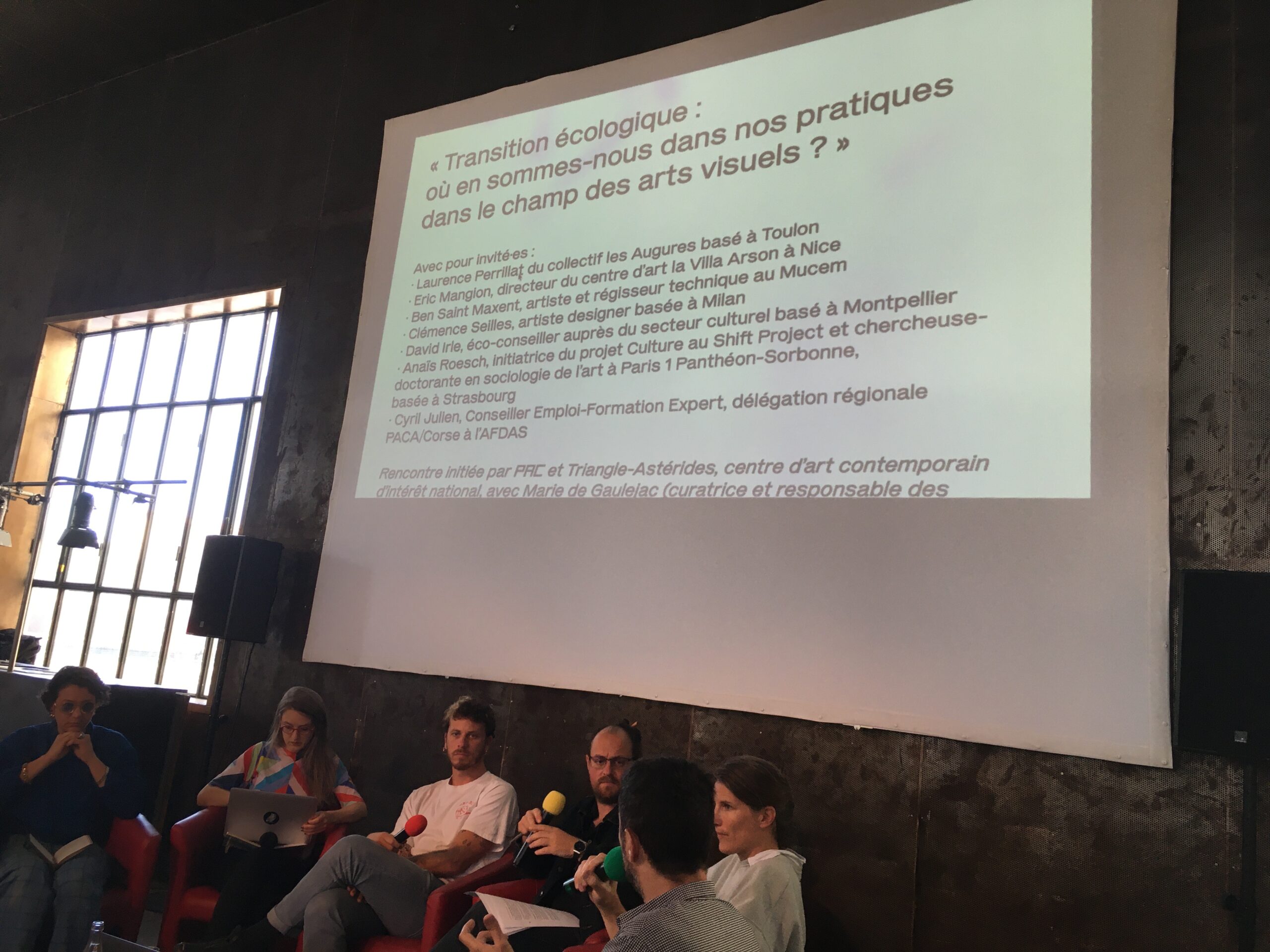
Pour la deuxième journée des Rencontres Professionnelles du réseau PAC, une table ronde, retransmise en direct sur Radio Grenouille, s'est attaquée à la question de la transition écologique, sur le thème : "où en sommes-nous dans nos pratiques dans le champ des arts visuels ?" Les discussions se sont tenues de 10h00 à 17h30 à la Friche la Belle de Mai.  

Elle a réuni Laurence Perrillat, du collectif les Augures ; Ben Saint Maxent, artiste et régisseur technique au Mucem ; Clémence Seilles, artiste designer – du Stromboli Studio ; David Irle, éco-conseiller auprès du secteur culturel – cabinet Aladir Conseil ; Anaïs Roesch, initiatrice du projet Culture au Shift Project et chercheuse-doctorante en sociologie de l’art à Paris 1 Panthéon-Sorbonne ; et Cyril Julien, conseiller Emploi-Formation Expert, à la délégation régionale PACA/Corse à l’AFDAS.

Marie de Gaulejac, curatrice et responsable des programmes de résidence et d’artistes associé·es à Triangle-Astérides, Centre d’art contemporain d’intérêt national, a organisé la table ronde, animée par Jean-Baptiste Imbert.

De nombreuses questions ont été abordées, des matériaux utilisés par les artistes au recyclage et aux investissements en matière d'économies d'énergie des institutions comme des lieux de cultures, dans les arts visuels, mais aussi plus largement dans tous les secteurs de la culture. 

Ce qui en est ressorti est l'investissement de ces intervenants en faveur du changement, et l'existence de nombreuses solutions et réponses, comme la mutualisation des installations scéniques, etc.

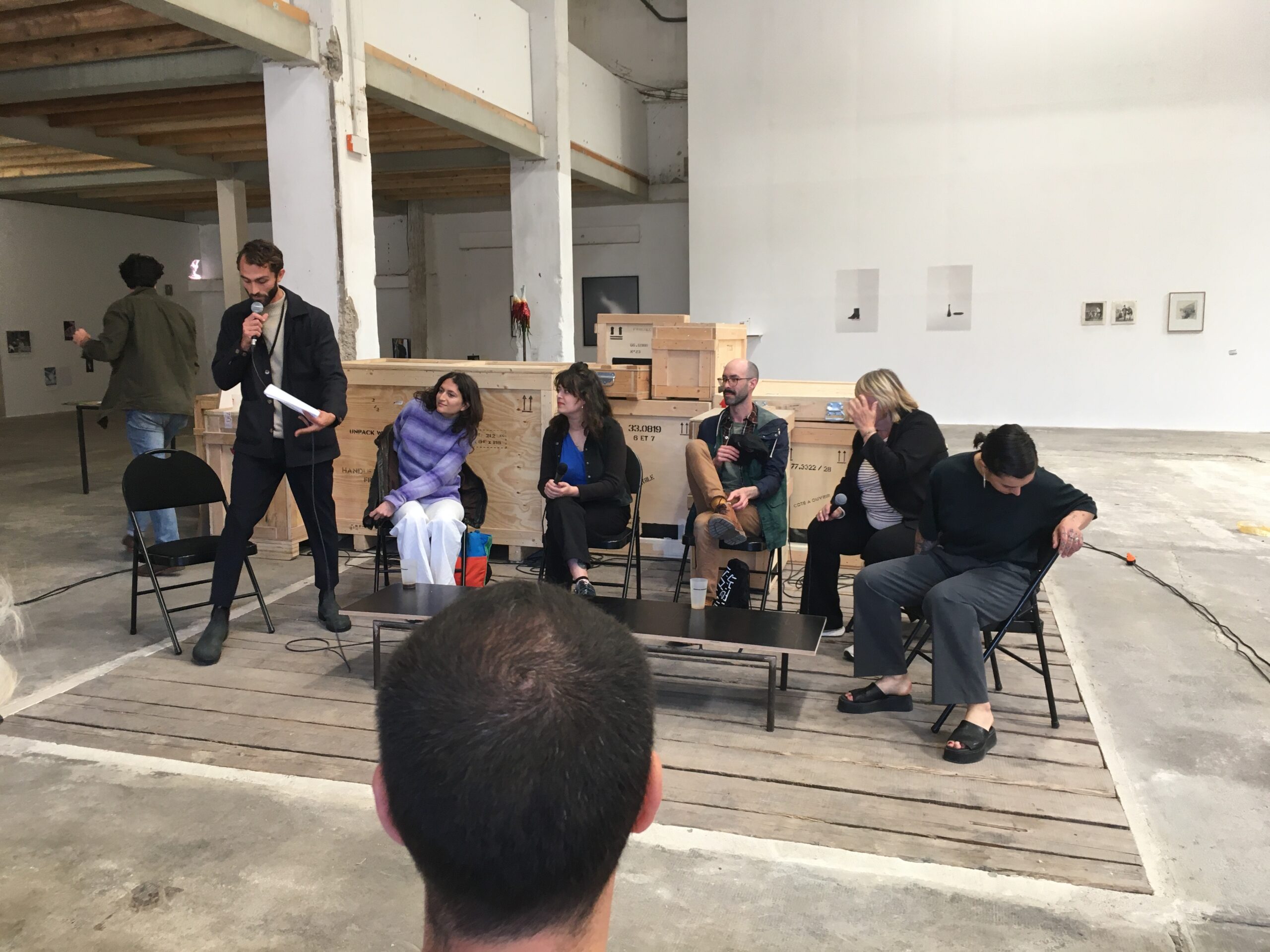
La troisième et dernière journée de débat s'est articulée autour de la question "Sommes-nous en compétition ou en coopération avec les autres acteurs du champ de l’art contemporain ?", à l'atelier Jeanne Barret. 

Avec Valentin Heinrich à la modération (sociologue et directeur éditorial de l’Observatoire de l’Art Contemporain), le débat a réuni Véronique Senez-Traquandi, consultante, ex-conseillère pour les arts plastiques au Conseil Général des Bouches-du-Rhône ; Sara Fiaschi, artiste et co-présidente de la Fédération Artistique de Marseille ; Salomé Burstein, chercheuse, curatrice indépendante, et fondatrice de l’espace Shmorévaz à Paris ; Aurélien Catin, auteur et militant pour les droits économiques, membre du collectif La Buse  ; et enfin Zoé Ledoux, artiste et théoricienne.

Cette dernière a également ouvert la journée par une lecture-performance mettant en scène son expérience de jeune artiste sortie des Beaux-Arts de Marseille, face au Marché de l'art et à la professionnalisation de l'artiste.

Ces débats et tables rondes ont notamment donné l'occasion aux participants, journalistes et publics de visiter les exhibitions en cours dans ces lieux, avec curateurs et artistes. Dont les passionnantes expositions de la Friche La Belle de Mai :

L'une, autour de l'artiste Bassem Saad, intitulée 'Des fumées dans la ville voisine' (11 février – 21 mai 2023) : Une exposition conçue et produite par Triangle–Astérides, centre d'art contemporain d'intérêt national, en co-production avec la SCIC Friche Belle de Mai. Partenaires : Beaux-Arts de Marseille - INSEAMM, Frac PACA, MOCO, Mucem, Instants vidéo, VDS Bâti Renov, Picto. 

Cette première exposition personnelle de l'artiste libanaise en France, réunit ses trois films réalisés à ce jour, ainsi que deux sculptures, des collages, des textes, dont deux nouvelles productions, autour de thèmes liés à l'histoire récente de Beyrouth, des déplacements / exils de l'artiste, et de sa relation au traces post-coloniales entre le Liban et la France.

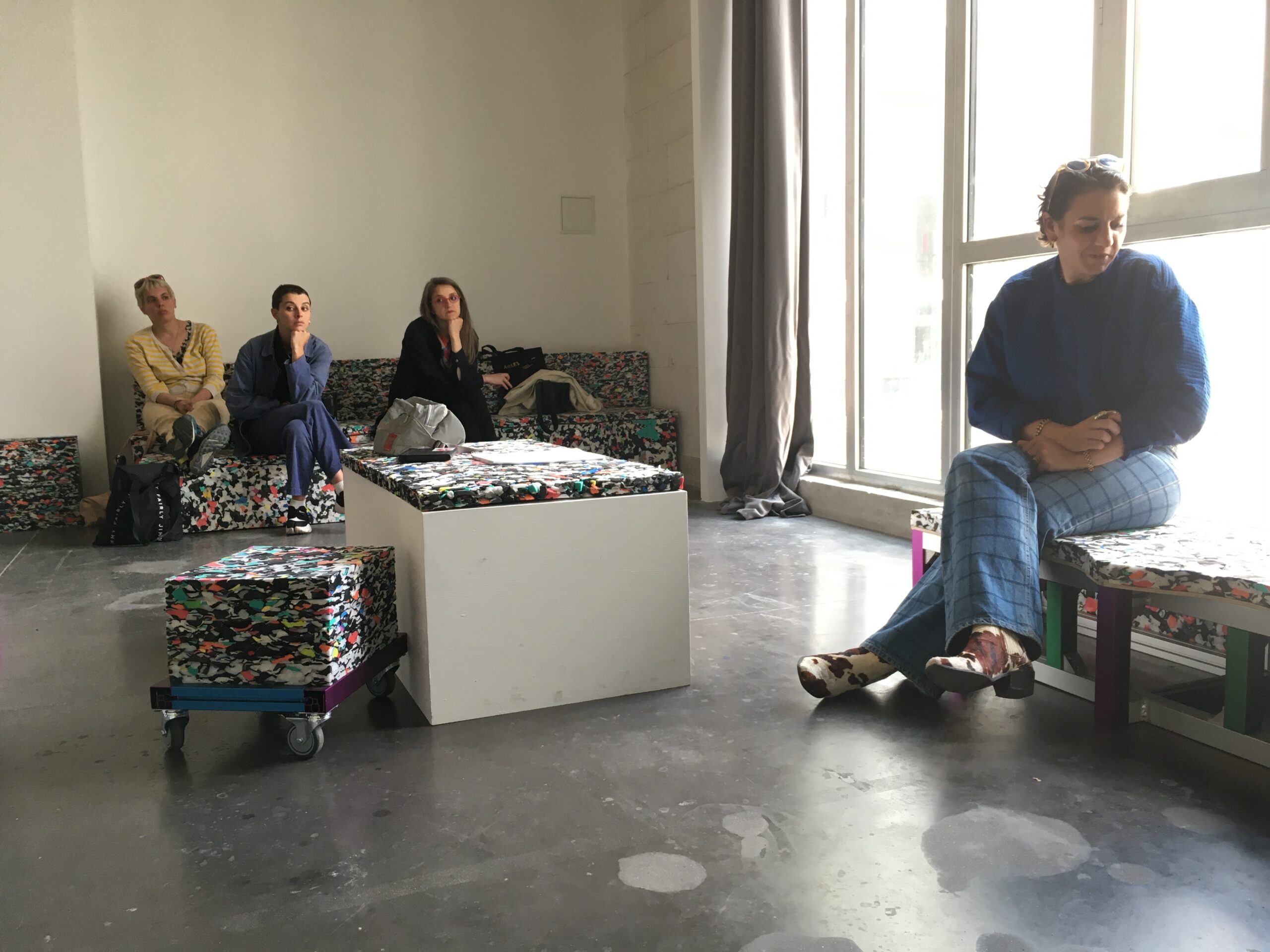
L'autre, autour du Collectif Polymer, qui s'est créé pour "sensibiliser sur la pollution plastique au travers de l’art pluri-media", et qui présente 'Plasticoscène', jusqu'au  27 mai 2023. 

Les artistes invité·e·s ont travaillé à partir de plastiques récoltés dans la région de Marseille : Museo Aero Solar, Thomas Mailaender, Southwhay Studio, Côme Di Meglio, Elvia Teotski, Coline Le Quenven, Maxime Verret, James Shaw, Marion Flament, Wendy Andreu, IGO Studio, NSDOS, Gangui Collectif, Ateliers Laissez Passer.

Au final, on rentre de Marseille avec une sensation de bouillonnement culturel, ainsi que de véritable volonté de réfléchir à la culture de demain, une culture à la fois ancrée dans le territoire et ouverte sur le monde.


16/05/2023

WOMEN / LIFE / FREEDOM - Bristol Old Vic, 9 June 2023


زن، زندگی، آزادی 

WOMEN 

/ LIFE 

/ FREEDOM


For those of you in Bristol, the musician and artist Roxana Vilk organises this wonderful event to support women in Iran on Friday 9 June at the Bristol Old Vic:


A rare and exciting opportunity to hear new writing by Iranian female playwrights. 

Directed by Bristol based, British-Iranian artist Roxana Vilk, actors will perform an hour of script-in-hand readings in
The Weston Studio.
These will be extracts from four plays written by female writers in Iran, translated into English and encompassing a
wide range of powerful and contemporary themes. 

Ticket sales from this event will go to local Bristol charity Aid Box Community, which provides support, supplies and
sanctuary for refugees and people seeking asylum in Bristol. 

Book here: https://bristololdvic.org.uk/whats-on/زن-زندگی-آزادی-women-life-freedom 


11/05/2023

Conversation with Hew Locke at The Royal Academy, London, Wed, 5 July 2023


hello again! and happy to announced that I have been invited to lead a conversation with another artist I admire deeply, in London this summer: Hew Locke.

Conversation with Hew Locke at The Royal Academy, London


Guyanese British artist Hew Locke - in Conversation with art writer Melissa Chemam

Wed, 5 July 2023 18:00 - 18:30 BST

 Royal Academy of Arts - Burlington House, Piccadilly, London W1J 0BD, United Kingdom  

Book here: https://www.royalacademy.org.uk/event/hew-locke-in-conversation

As part of the Summer Exhibition - Exhibition details:
 
https://www.royalacademy.org.uk/exhibition/summer-exhibition-2023

Read my interview with the artists from 2022, for Art UK here:
  
https://artuk.org/discover/stories/hew-lockes-the-procession-transforming-darkness-into-joy 


Link to book coming soon! 
-


Hew Locke in conversation

Wednesday 5 July 2023 6.30 - 7.30pm

The Benjamin West Lecture Theatre, Burlington Gardens, Royal Academy of Arts or digital livestream


£15 / £9 conc in person or £8 / £5 conc online


Join artist Hew Locke RA and Melissa Chemam for a conversation exploring whether creativity can inspire connection.

This event can be enjoyed in person at the Benjamin West Lecture Theatre, or via a digital livestream.

In this talk, artist Hew Locke RA discusses art and connection, inspired by the RA’s Summer Exhibition theme ‘Only Connect’.

Hew Locke produces works that invite us to engage with the past. Chaired by Melissa Chemam, this conversation explores the ways in which we re-enact, re-imagine and re-perform history.

Looking to the future, this discussion also focuses on new opportunities for creative connection, and the importance of art in bringing us closer together.


Hew Locke RA spent his formative years in Guyana before returning to the UK to study art, later completing an MA in Sculpture at the Royal College of Art. His work explores the languages of colonial and post-colonial power, and how cultures fashion identities through visual symbols of authority. In 2022, Hew was awarded Tate Britain’s Duveen Hall commission (culminating in his work The Procession) and The Metropolitan Museum of Art Facade Commission, as well as becoming a Royal Academician. His work is held in numerous collections, including the Government Art Collection, the V&A and the British Museum.

Melissa Chemam is a journalist, broadcaster and writer on art, music, social change, multiculturalism, African affairs, North/South relations, and activism. She is the author of the book Massive Attack - Out of the Comfort Zone (2019), and has been published by BBC Culture, Al Jazeera, RFI English, Art UK, CIRCA Art Magazine, the Public Art Review, the New Arab, The Independent, Reader’s Digest, UP Mag and Skin Deep. She also worked as a journalism lecturer and as the writer in residence at the Arnolfini art centre, in Bristol, from 2019 to 2022.

This event is supported by the Natalia Cola Foundation.


Marseille, exploring further: talking arts and ecology at La Friche


As part of the PAC (Printemps de l'art contemporain) Marseille, a festival / series of contemporary art events, I'm in La Friche La Belle de Mai, under the sun, to explore their exhibitions, and listened to a conversation on ecology and sustainability in the field of visual arts.


Here is the Milan-based French artist Clémence Seilles discussing her work on recycled design:


Spring is a great time to enjoy all the vibrant art Marseille has to offer.


More soon.


06/05/2023

Contemporary Art in Marseille Blooms at PAC


Marseille is shining during the Printemps de l'art contemporain (PAC)!

Contemporary artists and curators invade galleries and museums, institutions and outdoors space, for a whole month.

A few snapshots from the first days, before my articles...


-


Arrival in Marseille by train: 


Fotokino, 1er arrt, photographs by Laurent Millet:


Château de Servières

Mayura Torii
'Domestique' (Dessin)
Du 5 Mar 2023 au 1 Juil 2023.


Delphine Mogarra
'Latente'
Exposition du 5 mai au 1er juillet 2023


Javiera Tejerina-Risso
'Lignes de désir'
Exposition du 5 mai au 1er juillet 2023


The view from Anse du Pharo, where an artist is in residence... (More soon): 


La Traverse

'Mers, Terres, Corps Traversés' - 28 Avril - 21 Mai 2023 (brunch Dimanche 7 mai sur reservation et performance à 15h meta-potatoes de Jean Paul Thibeau, ouvert à tous) 

With: Malala Andrialavidrazana, Francis Alÿs, Shivanjani Lal, Louisa Marajo, Tuli Mekondjo, Otobong Nkanga, Jean-Paul Thibeau


Clément Louis, « 𝑨𝒄𝒕𝒔 𝒐𝒇 𝑳𝒐𝒗𝒆 », Double V gallery: 


Marseille-based Russian artist Daria Krotova, 'Carcasse', 33


Arti, Rue Paradis :


Southway Studios:


Glasswork at CIRVA: