New post on my newsletter:
South Africa resists the United States
What's behind the accusations coming from Trump and Musk against Pretoria

New post on my newsletter:
My new video for RFI:
Post-colonial artists reimagine the future in new Pompidou exhibition in Metz • RFI English
After The End is an exhibition opening at the Pompidou Centre in Metz, showcasing artists from the Caribbean, the Mediterranean, and other post-colonial regions.
Through their work, these artists from former colonies seek to present a fresh perspective on the world, offering new ways of imagining the future and inspiration for navigating today’s multiple crises.
-
To read my article:
One of my favourite singers:
Video : written by Khalil & Yasmine Hamdan Directed by Khalil Music: Marc Collin, Yasmine Hamdan Lyrics : Yasmine Hamdan, Anas Alaili
Lyrics :
Hon هون
هون
شو صاير هون
انهيار
وكوم حبّ
يوم
يوم ورا يوم
بستجوب التلفون
قتيل بغرفة النوم
كلّ يوم پروڤة قتل هون
مش قادرة إفصل
خَلَص
خلِص الحكي هون
أرض صغيرة وجرح كبير
ناس تضلّ وناس تغيب
غيمة
بوسط الصالون
غيمة حزن
معي هون
هزّة بدَن وعالتّلفزيون
خَلَص
خلِص الحكي هون
أرض صغيرة
وجرح كبير
ناس تضلّ
ناس تضلّ وناس تغيب
Hon هون
What happened here? A collapse And a mountain of love Day after day I am questioning my phone There is a dead body in my bedroom Everyday they rehearse their killing I can’t dissociate Done What’s left to say A tiny land With a gaping wound Some people linger And some go absent Clouds in the living room Darkness sitting with me My body is shaking and the TV is on Done What’s left to say A tiny land With a gaping wound Some people linger And some go absent
My latest for RFI:
A joint summit between the East African Community and the Southern African Development Community will take place today and Saturday in Dar es Salaam, Tanzania. The Presidents of Rwanda and the Democratic Republic of the Congo, Paul Kagame and Félix Tshisekedi, are both expected to attend.
Issued on:

Both presidents were supposed to meet in December in Angola and sign a peace agreement, but the meeting was cancelled.
Both parties blamed each other for failed talks as tensions escalated.
A source close to the Congolese presidency said: "From this summit, we expect an immediate ceasefire, the unconditional withdrawal of Rwandan troops and their auxiliaries, the reopening of Goma airport for humanitarian reasons, and the return of the city to the official administration."
Tina Salama, the spokesperson for Félix Tshisekedi, added, "We also expect severe sanctions against Rwanda."
The situation is at a "pivotal moment" United Nations Secretary-General Antonio Guterres said, adding that the conflict "risks engulfing the entire region" and urged the parties to work together for peace.
-
Read on from here:

Link:
'Le Miroir (Act I)' is Performance by artist Miles Greenberg, here performed by a group of artist at the 1-54 art fair in Marrakesh, Morocco, on 1st February 2005. It explores 'human duality, self-confrontation, and emotional transformation.'
Set against the surreal and historic backdrop of El Badi Palace, pairs of performers engage in ritualistic actions that unravel the tension between violence and intimacy, highlighting temporality and its transformative effects on the body and mind.
My visual insight:
Latest, from this morning:

M23 is a member of the political-military coalition of groups called the Alliance Fleuve Congo (River Congo Alliance), and the group said in a statement late Monday that it would implement a ceasefire from Tuesday "for humanitarian reasons," it said.
It added that it had "no intention of taking control of Bukavu or other localities", despite the M23 having said last week that it wanted to "continue the march" to the Congolese capital, Kinshasa.
The M23 started attacking Goma, the provincial capital of North Kivu, last week, with the support of some Rwandan troops.
Fighting has now stopped in the city of more than a million but clashes have spread to the neighbouring province of South Kivu, raising fears of an M23 advance to its capital Bukavu.
Half a dozen ceasefires and truces have been declared in the past four years of fighting, all systematically broken.
Call for truce
Meanwhile, on Tuesday morning, a UN spokesperson announced that the DRC has requested an emergency session of the UN Human Rights Council to discuss the situation in Goma.
Congo requested the session to take place on 7 February in Geneva. It is still subject to approval.
In South Africa, one of DRC's allies, President Cyril Ramaphosa said "a ceasefire is a necessary precondition for peace talks that must include all parties to the conflict whether they are state or non-state actors, Congolese or non-Congolese."
He also vowed on Monday to continue providing support to the Tshisekedi.
Pretoria had sent troops to North Kivu, as part of an armed force sent to the eastern DRC in 2023 by the SADC bloc, but 14 South African soldiers were killed in the recent fighting.
"Diplomacy is the most sustainable pathway to achieving a lasting peace for the DRC and its people," Ramaphosa added.
"The fate of our population is being put to the test," the DRC's Communication Minister Patrick Muyaya said on Saturday.
"Every day, our brave soldiers fall on the front line defending the integrity of our territory. A humanitarian carnage is taking place, and we must not remain idle. Our compatriots expect a strong response from us," he added.
Difficulties setting talks
The Kenyan presidency announced on Monday that Tshisekedi and Kagame would attend a joint extraordinary summit of the East African Community (EAC) and the Southern African Development Community (SADC) in the Tanzanian city of Dar es Salaam on Saturday.
Amid fears of a regional conflagration, the 16 member countries of the southern African regional organisation had called for "a joint summit" with the eight countries of the EAC, of which Rwanda is a member.
Nairobi currently holds the presidency of the EAC, and hopes to get the authorities of the DRC to finally talk face to face to their counterparts in Rwanda, accused of supporting the M23 rebellion.
"Given the race against time following the verbal and military escalation, the fact that it has been announced so quickly is a positive sign," according to Onesphore Sematumba, an analyst for the Great Lakes region at the NGO International Crisis Group.
The goal of new talks is to try to "rekindle diplomacy and put an end to the cycle of clashes" in the east of the DRC, Sematumba added.
The participants are said to include regional leaders, including the presidents of Uganda and Somalia, plus the president of South Africa.
But the two groups have differing views on solutions to the conflict.
The EAC advocates direct negotiations between the Congolese government and the M23, a solution that Congolese President Félix Tshisekedi has so far refused to consider.
This event led him to replace the EAC’s peacekeeping force in the DRC with that of the SADC, which is calling on Rwanda to first withdraw from Congolese territory, as the government in Kinshasa wants.
"We should not have too high expectations," the analyst said, for whom simply holding this summit with all the announced participants would already be "a diplomatic success" in itself.
In Kigali, Paul Kagame’s participation has already been confirmed, so he will be present in Dar es Salaam on Saturday. However, a source close to the Congolese presidency has said that Felix Tshisekedi has not yet decided whether he will attend in person or join the meeting remotely.
A UN expert report said last year that Rwanda had up to 4,000 troops in the DRC, seeking to profit from the mining of minerals, and that Kigali has "de facto" control over the M23.
Eastern DRC has deposits of coltan, the metallic ore that is vital in making phones and laptops, as well as gold and other minerals.
Rwanda has however never admitted to military involvement in support of the M23 group. It alleges on the contrary that the DRC supports and shelters the FDLR, an armed group created by ethnic Hutus who massacred Tutsis during the 1994 Rwandan genocide.
-
For more on the conflit, listen to my podcast episode from here:
DRC takes on Apple: can conflict mineral mining be stopped?
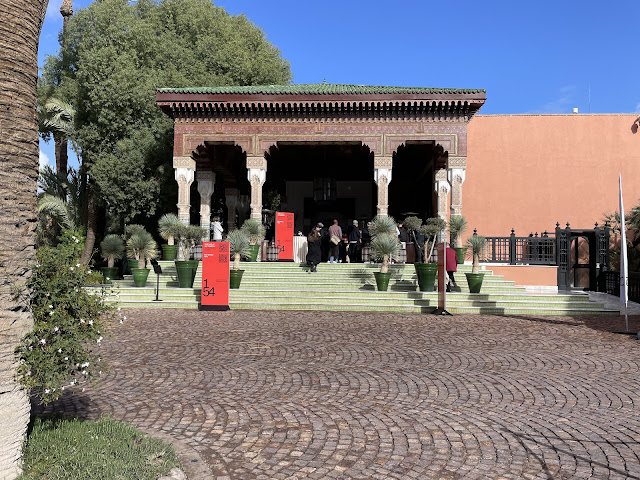
Touria El Glaoui, the director of the 1:54 contemporary African art fair, opens the Marrakesh edition in Morocco, in La Mamounia, 30 January 2025
Just a few snapshots for now... A few more days to go!
1:54 Contemporary African art fair - Marrakesh



Goma, DR Congo, Jan 28, 2025 (AFP)
Goma, the main city in the Democratic Republic of Congo's volatile east, is set to fall to the M23 armed group and Rwandan army -- the latest upheaval in a region devastated by three decades of war.
- Who is on the offensive? -
The blitzkrieg on Goma has been led by Rwandan soldiers and the M23 ("March 23 Movement") armed group, which had wrested control of the city in late 2012 before being driven out.
The M23, estimated to be 3,000 strong, has seen a spectacular revival since the end of 2021 with the support of Rwanda and its army.
Between 3,000 and 4,000 Rwandan soldiers, who are highly trained and have state-of-the-art equipment, are fighting alongside the M23, according to the United Nations.
The two allies entered the city on Sunday evening. On Tuesday, they wrested control of the city's airport.
- What is the Congolese army doing? -
On Saturday, Goma was still defended by several thousand soldiers from the Congolese Armed Forces (FARDC) and local militias, grouped under the name "wazalendo", or "patriots" in Swahili.
The FARDC, known for being undisciplined, poorly equipped and corrupt, are supported by some 10,000 peacekeepers from the United Nations Mission in the DRC, known by its French acronym MONUSCO, soldiers from the Southern African Development Community regional bloc, as well as two private security companies.
They have never managed to stem the onslaught.
- Why Goma? -
Goma is the capital of North Kivu province, rich in natural resources, particularly minerals.
Adjoining the Rwandan border, it is one of the main export routes for products from eastern DRC and of key importance in a sprawling nation with shambolic infrastructure and abysmal roads.
Goma also has an international airport and a lake port, serving the large city of Bukavu, capital of the neighbouring province of South Kivu.
Control of Goma is of huge symbolic significance for the governments of both DRC and Rwanda.
The DRC accuses Rwanda of using the M23 to plunder the natural resources of the east, allegations partly confirmed by UN experts.
Rwanda alleges that its neighbour supports and shelters the Democratic Forces for the Liberation of Rwanda (FDLR), an armed group created by former Hutu leaders of the 1994 genocide in Rwanda who massacred Tutsis.
- Can M23 govern Goma? -
The M23 denies it is supported by Rwanda and portrays itself as a homegrown movement aiming to overthrow the government of President Felix Tshisekedi.
In the areas under its control, the M23 instals a parallel administration -- a model that could be replicated in Goma. However, since 2021, the M23 has never taken a city of such size or importance.
The Congolese army, which has been losing ground to M23 for three years, does not appear to be able to retake Goma.
Before the offensive, hundreds of thousands of displaced people were already crammed in teeming makeshift shelters on the outskirts of the city in extremely precarious humanitarian and security conditions.
The recent escalation has forced half a million people to flee since the start of the month, according to the United Nations.
After the recent fighting, several humanitarian warehouses containing food and medicines were looted, exacerbating the situation.
- Risk of regional conflict? -
The conflicts in the region involve a multitude of players -- both armed groups and countries.
Uganda and Burundi have deployed troops in the east, officially to support the Congolese army, but both are accused of wanting to extend their influence in an area that is increasingly beyond Kinshasa's control.
The resurgence of the M23 in 2021 was partly caused by a rivalry between Rwanda and Uganda over resources in the region.
Eastern DRC experienced a relative lull after the signing of a ceasefire agreement between Kinshasa and Kigali in late July. However, the negotiations never led to a concrete peace agreement.
In December, a summit organised through Angolan mediation was cancelled as Rwandan President Paul Kagame refused to attend.
