22/12/2016

"Cosmic Love"


Florence + The Machine - 'Cosmic Love'


"Cosmic Love"

A falling star fell from your heart and landed in my eyes
I screamed aloud, as it tore through them, and now it's left me blind

The stars, the moon, they have all been blown out
You left me in the dark
No dawn, no day, I'm always in this twilight
In the shadow of your heart

And in the dark, I can hear your heartbeat
I tried to find the sound
But then it stopped, and I was in the darkness,
So darkness I became

The stars, the moon, they have all been blown out
You left me in the dark
No dawn, no day, I'm always in this twilight
In the shadow of your heart

I took the stars from my eyes, and then I made a map
And knew that somehow I could find my way back
Then I heard your heart beating, you were in the darkness too
So I stayed in the darkness with you

The stars, the moon, they have all been blown out
You left me in the dark
No dawn, no day, I'm always in this twilight
In the shadow of your heart

The stars, the moon, they have all been blown out
You left me in the dark
No dawn, no day, I'm always in this twilight
In the shadow of your heart


20/12/2016

"born to share love"


"Je ne suis pas faite pour haïr, mais pour aimer", Antigone à Créon dans la pièce "Antigone" de Sophocle.

-

“I was born to share love, not hate”, said Antigone. “Go then, and share your love for the dead”, responds Creon.”

(Sophocles, Antigone)


'Little Town'


The new video for The Pop Group's 'Little Town' - Directed by Douglas Hart:


The Pop Group - Little Town (Official Video)


19/12/2016

Tricky on BBC Radio 1


 Amazingly touching interview with Tricky on BBC Radio 1.

The super talented rapper is talking about his own label, his independence and his new E.P., Obia.

But he is also very open-hearted about reunited with his father in Bristol and being about to spend his first christmas with him in 48 years...

You can also here the fantastic tracks he produced for the E.P., including a collaboration with London rapper CasIsDead and another one - under the name of EuanWhosArmy - with 3D from Massive Attack, an old friend, as he insists.


Tricky and AJ Tracey


The legendary Tricky joins Benji in the studio, and AJ Tracey steps up for In 3 Records. Plus Benji delves into a sci-fi selection in the final hour.

http://www.bbc.co.uk/programmes/b08495kj

-

The ‘OBIA EP’ is a seven track collection showcasing works by established and emerging artists specially chosen by Tricky.

WOODJU and Syava are both Russian artists with whom Tricky struck up a close relationship while on tour.

Los Angeles- and Berlin born Kiko King & creativemaze contribute two tracks, and UK rap sensation CASISDEAD voices a new version of Tricky’s “Does It.”

Euanwhosarmy is a new project produced by Robert Del Naja (aka 3D of Massive Attack) and Euan Dickinson.

-

Listen to the tunes:


Euanwhosarmy Feat. Lyndsey Lupe – 'For Nothing' 
(Produced by Robert Del Naja & Euan Dickinson)


Tricky feat. CASISDEAD - 'Does It' 
[The Obia EP]


Tricky and AJ Trac

ey

Nouvelle interview sur mon livre, 'En-dehors de la zone de confort' (Mes Sorties Culture)


J'ai récemment donné une interview au très sympathique site culturel "Mes Sorties Culture".

Et le texte :

Melissa Chemam, sur les pas de Banksy et de Massive Attack à Bristol

Melissa Chemam est une journaliste polyglotte et une infatigable voyageuse. Elle traite aussi bien de sujets d’actualité que d’art et de culture. Née à Paris, elle a vécu à Prague, Miami, Londres et Nairobi. Elle vient de publier une somme culturelle, historique et particulièrement vivante au terme d’une longue enquête : « En-dehors de la zone de confort », sous-titré : « de Massive Attack à Banksy, l’histoire d’un groupe d’artistes, de leur ville, Bristol, et de leurs révolutions » aux Editions Anne Carrère. Nous avons eu la chance de la rencontrer, et c’est avec une passion communicative qu’elle a évoqué ses rencontres avec les artistes explosifs de Bristol, où elle a passé plusieurs mois pour les besoins de son livre.   


MSC : Pourquoi avoir choisi d’écrire sur ce sujet ?
   

Melissa Chemam :
 D’abord parce que c’est un groupe que j’aime beaucoup. Ensuite parce que c’est une musique qui réfléchit sur elle-même, contrairement à beaucoup d’autres courants (jungle, brit-pop) qui ont souvent été dans une logique commerciale. Le rap à la Massive Attack, qui a donné naissance au trip-hop, est une musique « consciente », polysémique. Les musiciens du groupe sont très cultivés, ils s’inscrivent vraiment dans leur temps et dans une histoire. Robert Del Naja (3D), le cofondateur du groupe, est tout le temps entrain de lire, de regarder des documentaires, de voyager. Il ne cesse jamais de réfléchir à l’état du monde et à la façon dont il peut éveiller les consciences à travers son art, avec beaucoup de modestie.  J’ai aussi été frappée au fil de mes interviews par la richesse de son vocabulaire : on sent qu’il cultive un amour incommensurable du verbe.   

Les Massive Attack se pensent d’ailleurs comme un collectif, qui intègre tous les aspects de la musique et de la scène, mais aussi le street art.
3D est un artiste multi facettes, qui a commencé par le graff et dont l’influence irrigue la scène artistique britannique encore aujourd’hui. Banksy est très proche du groupe aussi, et il a énormément appris de 3D. Au niveau musical, Gorillaz a beaucoup emprunté à l’esthétique et à l’univers de Massive Attack. Dans leur galaxie, il y a aussi Tricky, Neneh Cherry, ou encore Martina Topley-Bird.   

Tu dis que Massive Attack a une approche moins commerciale que les autres. Pourtant ça marche bien, leurs tournées font un carton, leurs disques se vendent comme des petits pains…
  

Oui ils ont signé avec le label Circa en 1990 qui est ensuite devenu Virgin mais ils ont conservé un rythme de production très lent malgré les pressions, ils sortent peu d’albums (5 en 25 ans, NDLR), et ils ont réussi à garder leur indépendance. La preuve, ils font des choix politiques qui ne plaisent pas à tout le monde, par exemple en diffusant sur scène des portraits géants de réfugiés syriens pendant leur dernière tournée. Ce sont de vrais rebelles, complètement autodidactes, qui ont grandi ensemble dans des quartiers pauvres, ils sont impossibles à dévoyer. Cette culture punk leur a permis d’opérer une vraie révolution mentale, en faisant rentrer la culture populaire dans les foyers britanniques bien-pensants (avant eux, il n’y a guère que Mick Jagger qui y était parvenu). Voyez cette scène où la duchesse d’York (Sarah Ferguson) leur remet un prix à la fin des années 90 : ils restent complètement eux-mêmes, montant sur scène avec une bière et lui faisant un pied de nez.  D’ailleurs, ils sont aussi restés à Bristol.   

Cet engagement, c’est important pour toi ?
   

Très important. En 2014, Massive Attack est allé au Liban, ils ont joué pour les réfugiés palestiniens, mais aussi à la Fête de l’Humanité. En 2003, le groupe était déjà engagé contre la guerre en Irak. Toutes ces actions, tous ces engagements ont piqué ma curiosité de journaliste et ma sensibilité personnelle, d’autant que j’étais déjà fan du groupe. Et puis j’ai découvert que sur ce sujet (la scène hip-hop et street-art à Bristol) presque rien n’avait été écrit, c’est un pan de la culture qui n’a pas été pris au sérieux, alors que Massive Attack a été le fer de lance d’un mouvement très important, que je n’hésiterais pas à comparer à l’impact de la Motown à Detroit. Massive Attack interprète le monde à travers ses créations, avec en plus un groupe très métissé musicalement (rap/punk/reggae) et métissé culturellement (les parents de Grant Marshall, dit Daddy G, sont originaires de la Barbade, Horace Andy est Jamaïcain, le père de 3D est Napolitain, etc.). Tous ces musiciens de la scène rap et hip hop de Bristol ont grandi ensemble, ils se connaissent tous. Les street artists aussi : c’est une petite ville. Beaucoup se sont rencontrés en pointant au Pôle emploi local, dont les membres de Portishead.   

Et donc ta démarche a été celle d’une enquête sur les lieux du « crime », à savoir Bristol, où tu as interviewé les acteurs de ce mouvement
   

Effectivement, j’ai voulu explorer 30 ans de création  artistique en rencontrant les acteurs de cette révolution culturelle. J’ai pu recueillir leurs témoignages, leur parole directe. Et j’ai vite constaté qu’en écrivant l’histoire d’un groupe, d’un courant et de son ancrage local, je parlais du global, du métissage, de la complexité du monde dans lequel on vit. Il y a aussi une authenticité dans la démarche de Massive Attack, une authenticité qui me touche. Ces gars-là parlent de ce qu’ils connaissent, de ce qu’ils sont. Ils ne trichent pas. Au début des années 90, en France, on voyait émerger NTM et I Am avec la même sincérité. Ils se racontaient avec un certain lyrisme : c’est l’essence même du rap.   

Parle nous du street art à Bristol
  
Le street art est partout, mais surtout il est complètement intégré au paysage, c’est ça qui est magnifique. Banksy est évidemment une star locale, mais tout le monde protège son identité. Impossible de savoir de qui il s’agit. Pour moi, il pratique un art de la rapidité (avec le pochoir), intelligent et qui marque les esprits. Mais je trouve son travail moins touchant que celui de 3D (qui a réalisé plusieurs de ses pochettes de disque lui-même, dont la première à une époque où ça ne se faisait pas du tout). On peut lire l’histoire du graff dans les rues de Bristol, voir le jeu entre différents artistes, les évolutions de style. Les studios Aardmann sont aussi installés à Bristol. On sent qu’il y a de la place pour que tout le monde s’exprime. En plus, la ville est préservée, car suffisamment loin de Londres. Le mépris londonien pour cette ville provinciale est aussi paradoxalement ce qui protège les artistes qui y vivent.   

Récemment, un blogueur a émis l’hypothèse que Banksy et 3D n’étaient qu’une seule et même personne. Qu’en penses-tu ?   

Je pense que, même si l’idée plaît, c’est peu probable. Leur style et leurs techniques, d’abord proches avec l’usage des pochoirs que Banksy a emprunté à 3D et Blek Le Rat, diffèrent désormais. Banksy a une approche complètement différente, centrée sur les messages écrits, le détournement d’images, l’humour. 3D a évolué vers la peinture et une démarche plus abstraite, plus esthétique aussi. Et puis il est tellement occupé !   

Pourquoi 3D a-t-il finalement opté pour la musique au détriment du graff ?
   

Pour lui, je pense que c’est un moyen d’expression plus riche, moins limité, et qui laisse une large place à la collaboration. En plus avec la musique électronique, on peut vraiment tout faire, créer tous les sons qu’on veut, recréer un orchestre symphonique, sampler à l’envi, c’est très riche ! Et puis, même si on ne comprend pas l’anglais, l’avantage de la musique, c’est que tout le monde parle et comprend cette langue. Il aime aussi partager ce qu’il crée directement avec le public. Les tournées l’ont amené partout dans le monde. Le groupe est adoré au Mexique et en Australie par exemple. C’est beaucoup plus difficile dans le street art, surtout quand vous êtes anonyme ! Enfin, sur scène, 3D peut intégrer l’image, faire dialoguer la musique et le visuel.  


Massive Attack a encore mille projets, et dieu sait que 3D et Daddy G ne font pas du tout leur âge…mais à quoi ressemble la relève, le jeune groupe qui peut se réclamer de Massive Attack aujourd’hui en Grande-Bretagne ?
  

Oui c’est sûr, leur passion et leur curiosité leur permet de rester très jeunes ! Bristol est une ville emplie de musiciens, mais 3D est allé chercher de nouvelles voix avec lesquelles collaborer à Londres, dans la scène rap, et jusqu’en Ecosse. Pour la relève, 3D le dit lui-même, c’est Young Fathers ! Ils ont d’ailleurs fait la première partie de leur dernière tournée.   

Retrouvez ici les coups de cœur musique, art et vidéo de Melissa Chemam


18/12/2016

'No Room For Doubt'


Lianne La Havas - 'No Room For Doubt'  
(A Take Away Show)


You caught me, guilty
Taking the pieces of you
That night, you took flight
I couldn't decide what to do
I won't let a safe bet
Continue to make me go blue
I could go solo
Would that be the right thing to do?
We all make mistakes, we do
I learnt from you
We all make mistakes, we do
I learnt from you
I tiptoe, too slow
Out of the door to your house
I know you know
That this way leads me out
Outside, too bright
You're within I'm without
You're within
We all make mistakes, we do
I learnt from you
We all make mistakes, we do
I learnt from you
Please sleep softly
Leave me no room for doubt
Please sleep softly
Leave me no room for doubt
Please sleep softly
Leave me no room for doubt
Please sleep softly
Leave me no room for doubt
We all make mistakes, we do
I learnt from you
We all make mistakes, we do
I learnt from you
We all make mistakes, we do
I learnt from you
We all make mistakes, we do
I learnt from you
Oh
Please sleep softly
Leave me no
Please sleep softly
Leave me no room for doubt


UNHCR For Syria


Statement on Aleppo by UN High Commissioner for Refugees:


Syria’s conflict must be ended, now, and without delay.

17 December 2016

UN High Commissioner for Refugees Filippo Grandi said:
“With the situation in Aleppo, Syria’s war has reached an historic low. A great city and its population are in tatters and catastrophic failings have been exposed in the international community’s collective resolve. Together with other organizations, UNHCR is doing what it can for the many thousands of civilians who have been forced to flee. But humanitarian action alone can do little to protect in a situation where there is seemingly a collapse of common humanity on all sides.
There are nonetheless clear steps that must be taken now. All military action must halt. All remaining civilians must be allowed safe conduct out from Eastern Aleppo. Priority must be placed on saving lives. Civilians should not be hostage to negotiations.
But this is not all.
Aleppo has become a metaphor for the disastrous situation that Syria is in today, with half the population having been forced from their homes. The forcibly displaced of Syria as a whole, urgently need help as another bitter winter sets in. The protection of ordinary people has to be a priority, and for that to happen better humanitarian access in all areas is essential. This is a plea to all, and for real, practical and meaningful change.
UNHCR and partners have provided trauma help to more than 8,000 children in recent days. Atrocities have been allowed to become commonplace. So many lives have been lost. There is grave risk now that such displacement and suffering will not stop, but will be repeated elsewhere, in other wars. For the sake of civilian protection everywhere, Syria’s conflict must be ended, now, and without delay.”
-
-

16/12/2016

Jupiter 2017: 'Kin Sonic' sortira le 3 mars prochain


Le nouvel album de Jupiter et de son Okwess International band sortira le 3 mars prochain!


Jupiter & Okwess
Nouvel album : Kin Sonic
Sortie le 03/03/2017 chez Zamora Label
Avec Damon Albarn, Warren Ellis 
et 3D (Massive Attack)


Video:

Jupiter Okwess - 'Bengai Yo' (Official video)


Jupiter Okwess – Bengai Yo from the EP 'Troposphere 13' 
Shop : https://jupiterokwess.bandcamp.com/
Facebook : https://www.facebook.com/JupiterAndOk...

Deezer : http://www.deezer.com/album/13947238
Spotify : https://play.spotify.com/album/0bmyLh... 
iTunes : https://itunes.apple.com/fr/album/tro... 

Discovered in 2006 thanks to Jupiter's Dance, a documentary about the new music scene in Kinshasa, and still one of its iconic - even heroic - members. Jupiter Bonkodji is back with Troposphère 13, three years after the release of the exuberant Hotel Universe the album that launched his international career. 
A trance ferryman and genuine trade-modern alchemist, Jupiter is still that rebellious soul, that heightened consciousness, a tireless local campaigner through different social aid projects, and whose lyrics express the wisdom of benevolence.


Après un premier album "Hotel Univers", remixé par 3D de Massive Atttack, et des collaborations avec Damon Albarn (Africa Express), Jupiter Okwess revient avec un nouvel EP, réalisé avec Damon Albarn et Warren Ellis.
Passeur de transes et authentique alchimiste tradi-moderne, Jupiter n'en reste pas moins cette âme rebelle, cette conscience élevée, qui agit inlassablement sur le terrain local à travers différents projets d'entraide sociale et dont chacun des textes abrite la sagesse d'un bienveillant. 

Video credits :
Directing : Roland Hamilton
Images : Florent Delatullaye
Song credits : 
Lead vocals & percussions : Jupiter Bokondji
Drums & vocals : Montana Kinunu
Bass & vocals : Yende Balamba
Guitar : Eric Malu-Malu
Guitar : Richard Kabanga
Percussions & backing vocals : Blaise Sewika
Keyboards : Damon Albarn

(p) & (c) 2016 Zamora Label


-


Voici déjà ses prochaines dates de concert jusqu'au printemps :


-

A noter que le visuel de l'album a été réalisé à partir d'une oeuvre de Robert Del Naja, le leader du groupe britannique Massive Attack, qui a déjà collaboré avec Jupiter en 2013, sur son label Battle Box.


15/12/2016

Reposting: My interview with Syrian artist Tammam Azzam


One of the most important interviews I've done this year was with the unique Syrian artist, Tammam Azzam. 

Earlier in January, for my friends' French website but they let me publish it in English first. Talent and understanding. 

Reposting because we all need to be concerned but we also need more beauty...

[INTERVIEW] TAMMAM AZZAM FROM SYRIA

7 janvier 2016 Par Melissa Chemam

Syrian artist Tammam Azzam creates a ‘hybrid form’ of painting, as his the Ayyam Gallery presents him, through the application of various media, arriving at “interactions between surface and form that borrow and multiply as compositions evolve”. Born in Damascus, in Syria, in 1980, Tammam received his formal training from the Faculty of Fine Arts of Damascus, with a concentration in oil painting. He has participated in solo and group exhibitions, all around Europe and the Middle East.
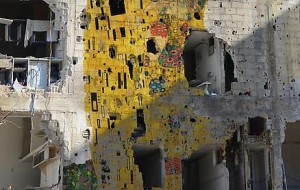


Tammam_Azzam_Freedom_Graffiti2
Forced to flee the war in his own country, since 2011, Tammam Azzam has been living and working in Dubai. Left out of his art studio, he moved into a form of digital art. He became known for digitally superimposing Western masterpieces onto photographs of Syrian bombed buildings. He also attracted the attention of Bristolian street artist Banksy and was invited in his very special exhibition named Dismaland, last summer, settled for six weeks in Weston-Super-Mare, in West England. Art is evidently for Tammam a form of resistance.
Interview with Melissa Chemam.
You were in Damascus when the revolution started in your country, which finally evolved into a civil war and the emergence of this violent islamist insurgency that gave birth to the organisation self-proclaimed the Islamic State in Syria and Iraq. How did you leave Syria and what kind of link do you managed to keep from abroad with your family in the country?
After seven months into the Syrian revolution, my wife and I felt it had become impossible to continue living there. Most artists were struggling and I have a young daughter that I could not put to school. The gallery that I work with moved to Dubai and they asked me to come with them. I decided to move, after consulting my wife. I haven’t been back in Syria since, but my parents are still there, in Sweida, where my family is from, in the south of Syria, which is a little more secure than the rest of the country. It’s not a good situation – they have no electricity or no water but there is no war there like in Damascus or Homs. I consider Dubai not as a final destination but only as a step in our life as we cannot go back home for now. Every side is an enemy.
How did you start your art in Syria and was it always politically motivated?
We grew up against Bashar Al Assad’s regime; it’s the worst anybody can imagine. I studied art at the University of Damascus and graduated from the oil painting section in 2001. I had a studio in Damascus and did my three first solo exhibitions there. I was also a graphic designer for many cultural centres in the capital, like the French Cultural Institute and the Goethe Institute. I have become familiar with graphic programming, especially since 2002, but the first time I used it as an art media was in Dubai. I had left my studio behind me and I felt like so much was missing. In another city I had to start another story. At first, there were so many difficulties just to find a home for my family and a school for Selma, my daughter, and I needed to find work. I concerted my work in graphic design and settled a mini studio at home. That’s how I started working with digital media.

You then came to fame with your piece reproducing ‘The Kiss’ from Gustav Klimt, when and how did you get that inspiration?
In 2013, after reproducing artworks from the Syrian museum, I started reproducing a painting from Francisco de Goya, ‘The 3rd of May’, created in 1808 to immortalize the killing of hundreds of innocent Spanish citizens. I reproduced it digitally, into a picture of a Syrian destroyed street. Then I reproduced ‘The Mona Lisa’ and pieces from Munch, Van Gogh, Andy Warhol, etc. The background being the Syrian war, the contrast with the piece by Klimt is even more striking. The scene comes from a picture of Douma, a small city near Damascus, one of the cities where the revolution started, and which has been destroyed completely since.
How did you find the motivation to keep on producing art and believe in resistance?
It was difficult and it is still more and more difficult. I think about art all the time but we went through terrible events in Syria, firstly, and now it is also a disaster in so many other places in the world. People call me a Syrian artist, but I prefer to be considered as an artist. I don’t consider myself as a political artist. I’m an artist who came out of this political background. I’m not producing posters against a dictator or a regime, but artworks about people, which is the main purpose for me. There are the stories in my mind, and where to get stories, except from your memory and your place? But I think that in no way art can stop armies or violence. How can I resist? How can I save a child’s life? As artists, we can just try and continue. This is the way we can express ourselves. But we cannot fight. As a person, how to change things? Politics always prevent us. For instance, if I need a visa to enter a European country, there are so many papers I need to gather, I feel powerless. How could we fight this world system? And when attacks occurred in Paris, it was considered more important worldwide that when it occurred in Damascus or Baghdad or Beirut. It’s always been like that and it’s very hard to change.
Do you believe art still has a power of conviction even in the current context?
I agree that we can probably convince the youth about the importance of democracy and freedom. But if the world had managed to stop the unfair regimes these past five years, Syria could have become a democracy or at least a form of good regime. But now, Syria has become a land of terrorists, with hundreds of terrorist groups that have spread all over the world. And the whole world is scary now. People in Syria now just want to stop all the fighting and keep on living. I believe artists and writers have a role to play to reach out to the youth, politicise them and call for peace. But in Syria nothing has changed in five years. It’s only worsening. And Europe is refusing to help refugees in a shocking way. I believe that both ISIS and the regime, and even the police in Greece or in Western Europe shooting at refugees are the dangers. It’s not about nationalities or religions. We would need to bring about a big change mentally. I’m therefore too confused to give a clear message. The only message I can give is by continuing my art, as I can, with the little I have. We should continue trying.


Visuel : ©Ayyam Gallery 


-

14/12/2016

From Belfast with words


My article on Belfast's street art scene:


Public Art Review


FEATURED 

Belfast: Walls Beyond Wars

Street artists in Northern Ireland turn away from the old angers


A mural by DMC. Photo courtesy DMC http://www.manchini.co.uk

by Melissa Chemam


BELFAST – Belfast’s walls have long been occupied by painted murals, mainly bearing political images and messages of protest. Catholics and protestants, feminists and conservative groups, anti-abortion and pro-choice movements used to fight with spray cans to own their territory.
But now, not quite 20 years after the Good Friday Agreement – which, in 1998, finally brought peace after decades of conflict – Belfast artists want to move away from the region’s tormented political legacy.
DMC, aka Dermot McConaghy, is a case in point. His portraits of sad blue ladies have helped to change the mood of Belfast’s walls. Missed Calls evoke human loneliness in the age of cell phones. He joins EMIC, Stephen Fagan (Faigy), Johnny McKerr (JMK), Kev Largey (KVLR), and Marian Noone (Friz) in this vibrant new street-art scene, which has developed over the past decade throughout Northern Ireland, and which the Ulster Museum recognized with a show in 2011.
“The country really changed a lot in the past ten years, socially and artistically,” says DMC, who, like Faigy, lives and works in Lurgan, south of Belfast. “Now a new, friendly net of connections makes things more interesting. And what makes the region special nowadays are its people, their sense of humor, an anger that has become an energy, and not its history anymore. That’s why I’m staying, anyway.”

International visitors
Belfast now has an annual event in October, Hit The North, during which artists from all over the world come to contribute: the famous Bristol-based street artists Inkie, Cheba and Andy Council have shown up quite a few times, along with Londoner Dan Kitchener, Irishman Joe Caslin, and Irish-born, now London-based Conor Harrington.
Some of the works that resulted allude to Belfast’s new spirit. Council’s Belfast Phoenix, which points to the city’s transcendence of its violent past, has become one of the city’s treasures; On Talbot Street, The Son of Protagoras, by French artist MTO, displays a dove of peace hit by two arrows, cradled in the hands of a young boy.
The man who has made the biggest contribution to the explosive growth of this artistic movement is probably Adam Turkington, who, with his Seedhead Arts group, negotiates access to walls and invites artists from Dublin, Rio de Janeiro, and all points in between to come to Belfast. Seedhead’s “Culture Night,” on the third Friday in September, attracts more than 90,000 people each year. And since January 2016, Turkington has been running a street art tour that takes visitors from Hill to North Street via Talbot Street and Saint Anne’s Cathedral.

Apolitical? Not exactly
Do the new directions in Belfast street art add up to a turn away from politics itself? Turkington doesn’t think so. “Artists refuse the narrative of the Orange and Green in this country,” he says, referring to the colors representing the two major political forces – Unionism and Irish Republicanism – and the two long-dominant parties, DUP and Sinn Fein. “By rejecting politics as it used to be here, they make a political statement.”
And political statements can take other forms in Belfast too. Joe Caslin did a very pro-LGBT artwork near the Black Box, a café and art venue on Hill Street. In early November, Robert Martin’s R-Space Gallery, in Lisburn, showed prints by Obey, the American master of subtly subversive street art also known as Shepard Fairey. Gary Rowe, aka Real1, an artist from Tottenham in London who also lived in Italy and Namibia before settling in Northern Ireland, redecorated the gallery’s exterior walls with a magnificent piece on Donald Trump, just a week before Election Day in the US – a hard-hitting set of images that became a source of inspiration for artists on the eastern side of the Atlantic as well.

Link with more visuals: http://forecastpublicart.org/public-art-review/2016/12/belfast-walls-beyond-wars/