15/09/2020

Brexit and the Rise of Dual Citizenship


Lastest article for West England Bylines

Brexit and the Rise of Dual Citizenship


In addition to the disorderly handling of Covid-19, the worst economic crisis since the 1970s has begun in the UK. The inhabitants have few resources and more and more graduates and skilled workers told me they were considering expatriation.


The phenomenon is worsened by the consequences of Brexit. This prompted tens of thousands of Britons to apply for another nationality, most often Irish as, if one of your grandparent is from the island you can be eligible for a passport. Some are also after French, German, Romanian and even Cypriot nationality, through marriage, ancestry or acquisition of property. European citizens are also seeking British citizenship to ensure they can continue to live normal lives in Britain, criticising a deeply flawed ‘settled status’ system that is butchering their civic rights. This situation also led to new migration movements.

Bristol has the reputation of being one of the most Euro-friendly cities in England. In 2015 it was the EU Green Capital, and just before the Brexit referendum it applied to be one of the EU’s cultural capitals. Since I came here in 2015, I’ve made as many European friends as British friends for sure – people from France, Spain, Germany, Greece, Romania, etc. And some have been living here for more than 20 years, without any paperwork requirements.

Many of my British friends and many of the people I interviewed have also lived in Europe for a while, or have strong ties with EU member states, such as family living there. So the past few years have induced major turmoil for most of them. The situation is the same for many in London, Brighton or Liverpool. And I don’t even mention Scotland, or the unsolvable question of the future of Northern Ireland…

British, Yes, but European first

Let’s consider a few of these citizens. Damien, for instance, he is a librarian, is from Birmingham, lives in Bristol, used to live in France, his sister lives in Germany and their parents are Irish. So he has always felt European. We met in the very Europhile cafĂ© at the Arnolfini art gallery. According to him, Brexit is a punishment that the British have inflicted on themselves … And it was important to him to maintain a link with the EU. His first reaction after the referendum was therefore to go for dual nationality. He told me:

“I immediately contacted the Irish Embassy, yes. And asked for a form to have an Irish passport. Both my parents are Irish, my father died so I had to bring my mother’s documents: birth certificate, marriage certificate, as well as my birth certificate, bank statement, proof of address, 80 euros, and I sent this file by post. Two days before the UK left the EU, I received my passport by mail. It was reassuring to know that I had a nationality that allows me to be part of the European Union. And I did that to pass this Irish nationality on to my children as well. This requires that I get them a passport before they have children of their own. But it’s also a matter of solidarity, to feel we belong in Europe, to me it was the obvious this to do…”

So many people have asked for Irish citizenship, which seems like a weird twist in history. More than 94,000 applications came from Northern Ireland, England, Scotland and Wales in 2019 alone, according to the Irish Times. Some 65,136 passports were sought in 2016 from citizens in Northern Ireland and another 59,377 from people in Britain with Irish roots.

One of my best friends asked her mother to become Irish as well, as all their family in Liverpool stem from the island originally. She had lived in Spain, France and Italy for years, and couldn’t imagine not being able to stay and work again in these three countries that feel so much like home. Most Britons I know who are married to a French or Italian person also tried to get citizenships in these countries through their spouse.

Other Britons are especially worried about the economic crisis inflicted by Brexit and aggravated by the current pandemic. They are considering moving to a European country despite Brexit, to ensure a better professional future for themselves. The procedures on the EU side are indeed more welcoming than our settled status process. If you work in France for instance, you can ask for residency, though that would never give you the same rights that the EU membership used to give. If you work part time, have you own business, or work in the arts intermittently, then the situation is very complicated.

Yet departures of Britons to the EU have already increased by 30% since 2016, going from 56,000 per year to 74,000. Some experts already worry about a “brain drain” in the making. For artists travelling often to Europe, like touring musicians and guest visual artists, it is also a critical issue, which isn’t even beginning to get solved.

Migration estimates, year ending March 2020 (Migration Watch UK)

All CitizenshipsBritishNon-BritishEUNon-EU
Immigration715,00083,000633,000195,000437,000
Emigration403,000144,000259,000137,000121,000
Net Migration313,000-61,000374,00058,000316,000

From Welcome and Equal, To an Administrative Hell

For the Europeans citizens wishing to stay in the UK, the situation can be even worse. If they have lived in the country for more than five years continuously, they can apply for settled status to have the right to stay, but the conditions are precarious. If they have travelled too much, and paid their taxes in their home country, lived in between two countries, or if they came more than five years ago but were sent abroad for work for a while (in the EU or further out), they might be refused. If they have been here for fewer then five years they’ll be granted a pre-settled status and will be checked again in another five years…

I spoke about these issues with Joanna. She is Greek and Australian, has lived in England for 24 years; her husband and children are British but she does not intend to take up a third nationality, especially because the cost is very high: at least £2,000, more if legal fees are needed. However, she thinks that the post-Brexit status for Europeans does not offer any stability.

“I have no reason to become British. But I had to apply for settled status and had to send in my ID card, tax information, etc. I finally got it after two months. But I don’t think we really know what all the consequences of Brexit are going to be. Brexit really stressed me out a lot and I was ready to leave the UK if I didn’t get the status.

“However, I met a lot of Europeans (Lithuanians, French people, etc), who did not see the danger. I met an Italian who had lived here for less than 5 years and who didn’t care. They didn’t want to believe that they would be asked to leave… But I prepared for it because even with this status no one has any security about a future here.

“Many of the Europeans who live here are a new generation of immigrants, not farm workers like my parents, or sweepers like my grandfather, or factory workers; they have degrees, sometimes teach at university. They think they have stability and security in this country. But with Brexit there is no more stability. These workers could be excluded at any time by any change in the government’s policy.”

The most annoying thing for her is the attitude of people, which has changed, she says, from the day after Brexit. “For example, people look askance at me when I speak Greek to my children in public now. So I stopped doing it for a while but when I look over people kept asking me ‘where are you from?’ Or ‘where does this language come from?’ And it really is bothering.”

One of the disadvantages of settled status is that it no longer allows Europeans to spend time in Europe and then to return to the UK. For Christophe, a German translator and lecturer working between several countries, it was therefore urgent to become British. He told me:

“My decision was brought about by Brexit, yes absolutely. Before I didn’t even think about it because as European citizens we had all the necessary rights. We didn’t need to spend these huge sums to get another nationality. But the settled status is a new category of immigration introduced for no real reason and it is an administrative ghetto that locks up three million Europeans living here! They will then be at the mercy of subsequent governments for their future rights. I didn’t want to be stuck like this and I don’t like the way this status was thought.”

Thousands of “key workers” (post-Covid-19 denomination) are also EU citizens – such as nurses and teachers. Many of them, I know, haven’t asked for the status, due to lack of time, or worry about the outcome. For them, becoming British is extremely expensive. And some countries don’t allow dual citizenships.

More than 3 million Europeans have already applied for this status but hundreds of thousands of others have left the UK. A shortage of staff at the NHS could be one of the consequences. The future being more uncertain every month, hundreds of thousands more could find themselves forced to leave the country, if they are not eligible for the precious dual citizenship. And newcomers would only struggle with a loophole in their future administrative status.

One of the ironic consequences of Brexit will thus be that more and more foreigners will have to become British to keep what used to be automatic rights as welcome EU citizens. And I’m not sure that it was what Boris Johnson, Dominic Cummings, Nigel Farage and Priti Patel had in mind. 


-


Link to article on the West England Bylines: https://westenglandbylines.co.uk/brexit-and-the-rise-of-dual-citizenship/


10/09/2020

The Markaz Review Launches soon!

The Markaz is now The Markaz Review !

Issue 1 launches by the end of September 2020!

First texts are dedicated to Lebanese culture.


For almost 20 years the Markaz was the cultural center in Los Angeles where people went to unpack the Middle East and North Africa, through public programs that brought a cultural lens to politics and current affairs.

Due in part to the pandemic they finally shut their doors, but are thrilled to announce the launch on September 16th as The Markaz Review, or TMR, as an online publication and virtual center, more global than local.

Our first TMR issue is devoted to Beirut, the city, its people and its artists, with articles, art and more from Jenine Abboushi, Wajdi Mouawad, Melissa Chemam, Sarah Mills, Michel Tabet, Gaja Pellegrini-Bettoli & others.

While our primary language is English, we are publishing everything simultaneously in French, Arabic and Spanish.

And although our themed magazine themes are starting out as monthly issues, we're also publishing daily or near-daily content in TMR Daily, with such regular columns as WORLD PICKS (best of), MY FAVORITE THINGS (a lifestyle column) and WHAT WE'RE INTO (what our editors are reading, watching, listening to or doing)...


In future issues of TMR we'll cover the arts, cultures and current affairs in Algeria, Egypt, Iraq, Iran, Morocco, Palestine, Syria, Turkey, Yemen and in various locations throughout the world, including Europe and the USA.

The team is also seeking to establish vital partnerships with institutions in Europe and beyond—certainly we look forward to partnerships with such organizations as Afikra in Beirut, the Institut du Monde Arabe in Paris and the Festival Arabesques in Montpellier, as well as with publications and institutions throughout North Africa and the Mashriq. 

Please get in touch, write us as editor@themarkaz.org for details.


CALL FOR SUBMISSIONS


TMR 2 : AMERICA AND THE NOV. PRESIDENTIAL ELECTIONQUERIES WANTED 

EMAIL EDITOR@THEMARKAZ.ORG


The second themed issue of The Markaz Review is devoted to:

—how Arab Americans and other Middle Eastern Americans are voting;

—life under the Muslim ban;

—immigrant stories;

—how the Trump presidency has effected people in the Middle East and North Africa

—book reviews

—Iranian American perspectives; 

—we seek a range of articles and op-eds that provide diverse voices on the Trump era, racism under Trump,etc.

—interviews with major artists/writers/filmmakers whose recent work comments on the USA today

—for our featured art, we seek art and texts on artists & their creative output, whether cartoons or paintings or whatever media, under Trump—how has this aberration of an era informed artists—both those of Arab/Iranian/Middle Eastern origin and others, Black, Latinx, Asian etc? 

 
DEADLINE: Mid october 2020


09/09/2020

'REAL' - The film


Thank you to the Watershed cinema here in Bristol for sharing 'Real', British actor turned writer/director Aki Omoshaybi’s touching debut feature, starring Pippa Bennett-Warner.

I totally loved it and it will stay with me for very long.

It's a beautiful story of resilience, true friendship & second chances; rarely seen roles of real humble people. So touching.

Out in the whole of the UK on 11 September 2020.

Here is the trailer:


REAL is in UK Cinemas courtesy of Vere Pictures 11th September 2020.

REAL stars Pippa Bennett-Warner and Aki Omoshaybi. https://vivaverve.com/film/real/

Synopsis: In inner city Portsmouth, an unremarkable newsagent’s sits between a courthouse and a business centre. It’s here that sparks fly between well-dressed Kyle (Aki Omoshaybi) and equally poised Jamie (Pippa Bennett-Warner).

Yet despite their outward appearances, both are struggling to move on from hardship they’d rather keep hidden. As their feelings for one another blossom, their pasts resurface, threatening to break them apart before their relationship has even begun. An authentic and touching love story from a place where second chances are hard to come by, this impressive debut feature marks actor turned writer-director Aki Omoshaybi as a talent to watch.


08/09/2020

NHS Workers Say No


I met with two NHS workers yesterday, getting ready to protest this weekend and handing out flyers to call for support. 

More on this soon. 


NHS Workers Say No


Multiple events are scheduled for 12 September 2020 in solidarity with the NHS health and social care workers around the UK, to demand fair recognition of everyone in the NHS family and their tireless work throughout the pandemic. 


If you clapped for them, please come and stand with them.


Many of us believe it is a disgrace that so many people who worked so hard and risked their lives have been overlooked in the public sector pay rise. 


Without nurses, health care assistants, porters, cleaners and the whole NHS family we could not have made it through. 


For too long this work has been underpaid and undervalued and now NHS Workers say NO!


The government is squeezing our amazing National Health Service from all sides, and frankly, none of us can take anymore more. 


The NHS employees want to say NO to privatisation, deliberate underfunding, low wages and poor conditions.


We should support them. 


-


On 8 August already, NHS workers protested in over 40 cities across the UK for a 15% pay rise.  


Now NHS Workers across the UK continue to mobilise colleagues, organise and lobby our trade unions.


Here is a short film about why they protested in London:


-


NB.


These will be peaceful protests, no violence or intimidation will be tolerated.

The NHS protesters ask that all attendees respect social distancing as much as possible and we have planned a route that gives us a much space as possible.


Mask wearing will be mandatory, and masks will be available on the day for those that don't have them. We ask that attendees wear blue, or a blue ribbon in solidarity.

-


Bristol Facebook event - College Green from 11am: https://www.facebook.com/events/391252255175432/


05/09/2020

Chantal Joffe @ Arnolfini


This exhibition opened this week at the Arnolfini gallery, here in Bristol.

I had the pleasure to go on Friday 4 September, and to enjoy the very special emotions conveyed by these very intimate portraits and self-portraits.

My photos really don't do justice to the special feeling when entering Chantal Joffe's world, her intimate life with her daughter Esme and some reflections of her life in lockdown this year, including a lot of intimate moments, created by the painter with herself as a model, instead of the traditional object/subject/artist relationship. A rare female gaze on women's bodies, emotions and internal turmoil.


CHANTAL JOFFE : FOR ESME – WITH LOVE AND SQUALOR


Thursday, 3rd September 2020 to Sunday, 22nd November 2020, 12:00 to 17:00

Tickets for both Chantal Joffe and Hassan Hajjaj's exhibitions are released in a timely manner to accommodate other events taking place at Arnolfini allowing for social distancing considerations.

Free entry. Exhibition slots bookable in advance. → Book
The exhibition has been curated by Chantal Joffe, Dorothy Price, Gemma Brace and Arnolfini, and supported by Joffe’s gallery Victoria Miro.

Photos by myself:


Chantal Joffe: For Esme – with Love and Squalor, explores the intimate act of painting and portraiture. Taking its name from J.D. Salinger’s short story For EsmĂ© – with Love and Squalor (1950) in which time hangs as heavy as the protagonist’s ‘enormous-faced chronographic-looking wristwatch’, the exhibition captures the changing faces across the years of Chantal and her daughter Esme, moving between mother and daughter, love and squalor, and the act of care and being cared for.

Including a number of new works (many produced whilst in ‘lockdown’), highlights include a series of portraits of Joffe’s daughter, from older works such as Esme (First Painting) captured as a new-born swaddled in blankets, to the later, defiantly awkward, Esme in White, painted within days of her sixteenth birthday this year.


These sit alongside a number of self-portraits, including the both intimate and monumental Bonnard inspired Reading in Bath I and III; never-before seen series Pictures of What I Did Not See, which depicts Joffe undergoing a traumatic illness and being cared for by Esme and a series of startlingly honest self-portraits. Produced one a day over the course of a year this 2018 series captures both the artist and her environment – from London’s cool winter light to the haze of a summer in the stifling New York heat.
The relationship between subject and place (specifically the domestic interior) and solitude and company within each of these works feels especially resonant. To paraphrase co-curator Dorothy Price, art historian and long-time collaborator of Joffe, Joffe’s work ‘traces a finger of time through the very act of being alive.’

12 Communities 1 Bristol: New podcast!


Happy and proud to have participated to this project, and met lovely people!

I've worked in radio since 2006, first as a guest cultural journalist and then as a reporter. My first radio package was produced in Haiti, then I worked intensely in East and Central Africa, and more recently in Europe. 

When I came to Bristol in 2015, I fell in love with its diversity, the creativity, kindness and openness of its citizens. 

I've been to many parts of Bristol as a reporter, and I am honoured to have participated in BCfm's project to represent more of Bristol. 

Out of the 12 communities, I chose to report on Knowle West because I live in Bedminster now, South Bristol, and also because what took me to Bristol in the first place was its music scene. I thought that Tricky's story, and Flynn's story were empowering and positive. 

I hope that listeners will get to understand these 12 communities more in depth and that it'll help all of us to reconnect, especially in such a disconnecting year.

On air soon: from 17 September!


Press release:


BCfm launches Bristol oral history podcast


BCfm is launching a new local oral history podcast called 12 Communities 1 Bristol.
The series, by Marcus Smith, is in partnership with Bristol Museums, Bristol Archives, UWE Bristol and funded by the National Lottery Heritage Fund.
Each of the 12 episodes will focus on a particular Bristol neighbourhood – Barton Hill, Knowle West, Lawrence Weston, Easton, Fishponds, Hartcliffe, St George, Hillfields, Southmead, Eastville, Stockwood and Avonmouth.
The podcast follows over a year of training and recording with a mixed pool of more than 40 volunteers and students from across the city.
Marcus Smith tells us more: “There are stories of an old man in Hartcliffe who eats snails and calls them wall-fish, funny tales of a female rugby team based in Avonmouth, plus hip hop from Knowle West and bee conservation in St George.
“Many of these areas are often overlooked or stigmatised. So we have created something to change perceptions and share unique local stories. This new podcast is for Bristolians, welcomed newcomers and future generations to come.”
Patrick Hart, Station Manager, BCfm Radio said: “The last 12 months have been a difficult year for the station with a major fire destroying our studios and just as we thought things were getting back to normal – Then coronavirus happened and hit us all.
“In the midst of this, Marcus and the team have managed to put together some simply amazing pieces of audio that really do represent those 12 communities of Bristol – I can’t wait for the city to hear them.”
Cllr Craig Cheney, Deputy Mayor, Bristol City Council adds: “I’m delighted to see the launch of a local podcast that will shine a light on the lives of people from across Bristol’s diverse and vibrant communities.
“Each community has its own stories to tell, and I’m looking forward to hearing about the uniqueness of each community and the things that tie us together as a city.”
‘12 Communities 1 Bristol’ will be available from September 17th on BCfm Radio, Spotify, Apple Podcasts, Google Podcasts and all mainstream podcast providers.


04/09/2020

Atlantics: A Ghost Love Story


What a film...

Thank you Watershed for a gripping screening. 

Atlantics: A Ghost Love Story / Atlantique (2019) - Trailer  


Directed by : Mati Diop Produced by : Les Films du Bal Genre: Fiction - Runtime: 1 h 44 min French release: 02/10/2019 Production year: 2019 Along the Atlantic coast, a soon-to-be-inaugurated futuristic tower looms over a suburb of Dakar. Ada, 17, is in love with Souleiman, a young construction worker. But she has been promised to another man. One night, Souleiman and his co-workers leave the country by sea, in hope of a better future. Several days later, a fire ruins Ada’s wedding and a mysterious fever starts to spread. Little does Ada know that Souleiman has returned.


The Markaz Review


We’re creating a new cultural review! 

On Middle Eastern issues, with a group of exceptional writers and researchers.

The Markaz champions a greater understanding of the Middle East and North Africa by presenting artistic and educational programs that bridge political and religious divides. 

In a search for common ground, the Center fosters discussions among artists and thinkers and offers classes and workshops that serve diverse ethnic communities.

- see here: The Markaz


First issue out mid-September, dedicated to Lebanon. 

More on this soon. 


27/08/2020

Banksy funds refugee rescue boat operating in Mediterranean


This made my (poor, let's be fair, until now) day:

Banksy funds refugee rescue boat operating in Mediterranean

Exclusive: UK artist finances bright pink motor yacht that set sail in secrecy to avoid being intercepted by authorities
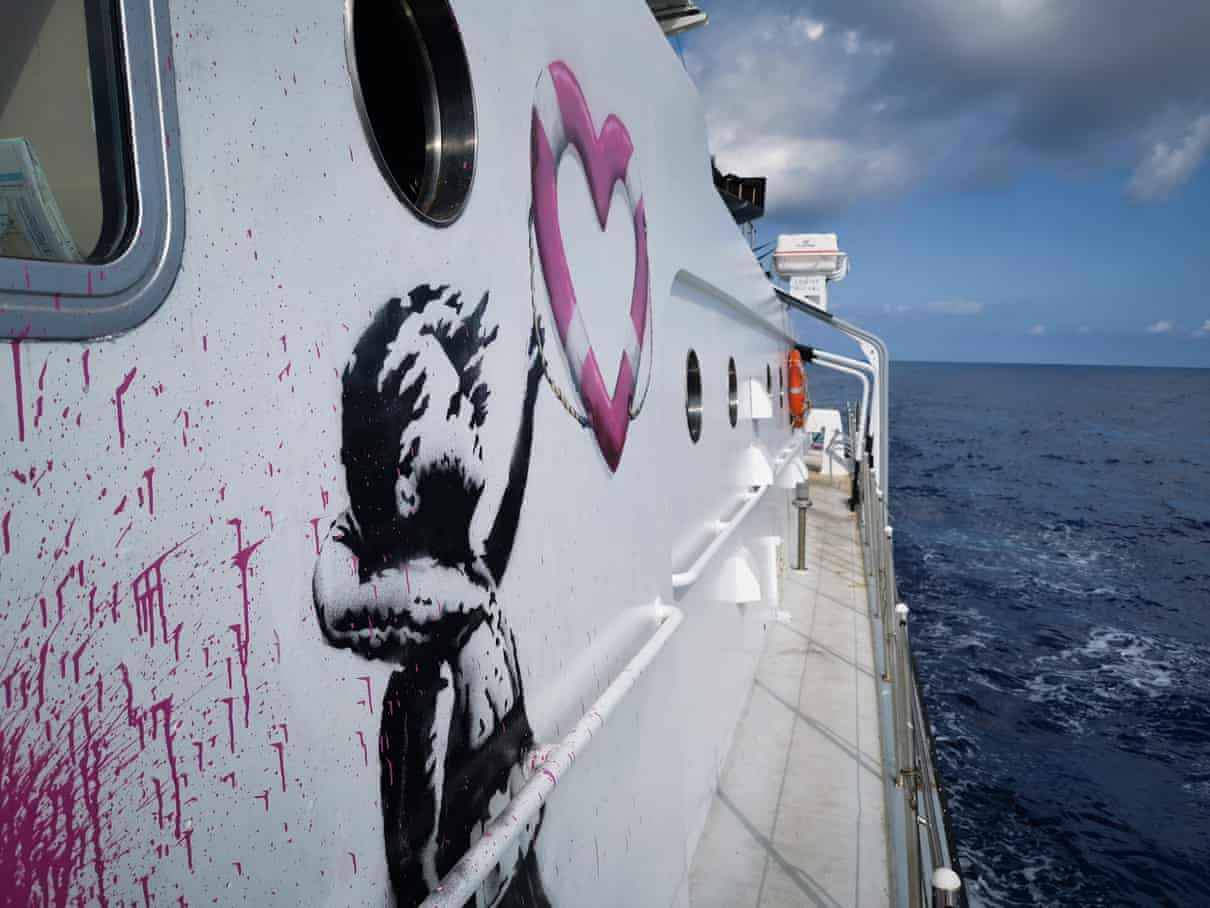
The boat, named Louise Michel, features Banksy artwork depicting a girl in a life vest.
The boat, named Louise Michel, features Banksy artwork depicting a girl in a life vest. Photograph: Ruben Neugebauer
 in Palermo and  in Berlin
The British street artist Banksy has financed a boat to rescue refugees attempting to reach Europe from north Africa, the Guardian can reveal.
The vessel, named Louise Michel after a French feminist anarchist, set off in secrecy on 18 August from the Spanish seaport of Burriana, near Valencia, and is now in the central Mediterranean where on Thursday it rescued 89 people in distress, including 14 women and four children.
It is now looking for a safe seaport to disembark the passengers or to transfer them to a European coastguard vessel.
The crew, made up of European activists with long experience in search and rescue operations, had already assisted in two other rescue operations involving a total of 105 people, who are now onboard the NGO vessel Sea-Watch 4.
Painted in bright pink and featuring Banksy artwork depicting a girl in a life vest holding a heart-shaped safety buoy, the Louise Michel sails under a German flag. The 31-metre motor yacht, formerly owned by French customs authorities, is smaller but considerably faster than other NGO rescue vessels.
Banksy’s involvement in the rescue mission goes back to September 2019 when he sent an email to Pia Klemp, the former captain of several NGO boats that have rescued thousands of people over recent years.
The vessel set off in secrecy last Tuesday from the Spanish seaport of Burriana, near Valencia, and is now in the central Mediterranean where it has already carried out its first mission.
The vessel set off in secrecy from the Spanish port of Burriana, near Valencia. Photograph: Ruben Neugebauer
“Hello Pia, I’ve read about your story in the papers. You sound like a badass,” he wrote. “I am an artist from the UK and I’ve made some work about the migrant crisis, obviously I can’t keep the money. Could you use it to buy a new boat or something? Please let me know. Well done. Banksy.”
Klemp, who initially thought it was a joke, believes she was chosen by Banksy due to her political stance. “I don’t see sea rescue as a humanitarian action, but as part of an anti-fascist fight,” she told the Guardian.
She has made clear that Banksy’s involvement in the operations is limited to providing financial support. “Banksy won’t pretend that he knows better than us how to run a ship, and we won’t pretend to be artists.”
With a top speed of 27 knots, the Louise Michel would be able to “hopefully outrun the so-called Libyan coastguard before they get to boats with refugees and migrants and pull them back to the detention camps in Libya”, said Klemp.
Pia Klemp in October 2017.
Pia Klemp in October 2017. Photograph: Lisa Hoffmann
Non-state sea rescuers have long criticised the mass return of migrants to Libya by the Libyan coastguard in collaboration with EU member states. International organisations have accused the Libyan coastguard of mistreating people at sea or selling them off to militias at Libyan harbours after intercepting them.
According to the International Organization for Migration, more than 7,600 migrants have been intercepted so far this year and returned to Libya, a war-torn country where different political factions continue to struggle for power. Often confined to informal camps, the situation for migrants in Libya is desperate, with acts of systematic torture and rape long documented by human rights organisations.