03/03/2014

From Central African Republic - on Twitter


For more update from Bossangoa and Central African Republic, follow me on Twitter:

https://twitter.com/melissachemam/status/440527457012023297/photo/1


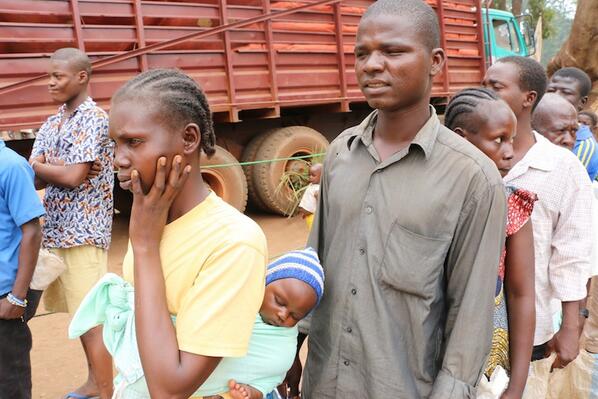
: Ppl queuing for latest food distribution in church. Distributions also ongoing in villages now.


: Abbot Frederic at today food distribution in Bossangao. 20 000 ppl are still staying in church camp

ICG on Central African Republic, monthly update and more


Crisis Group
CrisisWatch 127, 1 March 2014 - on C.A.R.:


The conflict in Central African Republic continued to worsen despite the appointment of a new transition government in January. Muslim civilians increasingly came under attack from anti-balaka groups, and intercommunal violence has continued to spread beyond Bangui as ex-Seleka forces retreated to the north east and the anti-balaka expand their reach. With the transition government unable to stem the violence, the international community has promised additional troops (see our recent blog post and commentary on the international community’s response to the crisis).


Widespread violence continued unabated, including increasing attacks on Muslims, despite Jan political transition and increase of MISCA forces to nearly 6,000. UNSG 20 Feb recommended establishment of UN peacekeeping mission, appealed to international community for additional 3,000 troops to reinforce MISCA in interim. France 25 Feb extended Sangaris mission indefinitely; EU said would send 1,000-strong force, troops expected to deploy in March. Attacks on Muslims by anti-balaka escalated, scores killed throughout month including several killed in repeated attacks on MISCA-escorted convoys of Muslims departing CAR. Transitional Council member assassinated 9 Feb after denouncing anti-Muslim violence. Joint French-MISCA disarmament operation 15 Feb in Bangui led to dozens of anti-balaka arrests including leaders. Seleka retreat to NE continued as anti-balaka expanded territorial control beyond Bangui; spokesman 22 Feb said militia would disarm only after all Seleka laid down weapons. Anti-balaka split between supporters of ex-President Bozizé and supporters of new national authorities. President Samba-Panza expressed concern over risk of sectarian partition of CAR, 17 Feb asked France to remain until elections early 2015. French President Hollande 28 Feb visited Bangui, met president to discuss crisis. ICC prosecutor 7 Feb announced investigation into possible war crimes, crimes against humanity.


Central African Republic - Making the Mission Work

Thierry VircoulonThibaud LesueurAllAfrica  |   25 Feb 2014

By failing to engage when Crisis Group and others warned that the Central African Republic had become a phantom state, the international community has now had to become much more heavily involved, at much greater expense, after horrifying loss of life and massive displacement, with much greater odds of failure.
The new CAR government (the third in one in a year) looks promising and the capital, Bangui, enjoys slightly more security. Yet the international response continues to be riven by divisions, most notoriously between the African Union and the UN.
CAR's new president has called for a UN peacekeeping mission and Chad, an important regional player which initially opposed this option, now agrees. The Security Council has itself approved a European Union mission, soon to be deployed. But peacekeepers (EU and otherwise) must be guided by a stabilisation strategy that is coherent, comprehensive and meets the needs of CAR not just in the short-term but over the long haul.
From the capital to the provinces
Since the end of January, the conflict has spread from the capital, Bangui, to the provinces. In Bangui, the anti-balaka groups have replaced the Seleka fighters - the majority of the victims of violence in the capital are no longer Christians but Muslims. Confessional violence and crime is now the norm and revenge is a dominant impulse in the country. In the provinces, militias are establishing territorial control: most of western CAR has fallen to anti-balaka militia who are pushing away Muslim communities, while Seleka fighters control the northeast. There is an exodus of Muslims to safe areas, including Chad, Cameroon and the eastern part of the country. All this risks a de-facto division of the country along religious lines and between armed groups, with new groups likely to emerge soon.
The arrival of the new president, Catherine Samba-Panza, and her government is a welcome development, particularly given that her ministers are more technocratic than they are tied to militias (whether ex-Seleka or anti-balaka). Her comments recently on the importance of justice to reconciliation are welcome too, particularly given currents elsewhere on the continent.
Some steps toward law and order have been taken in Bangui, including arrests of some anti-balaka by peacekeepers. However, as mob violence increases in Bangui (last Saturday afternoon, three Muslims were lynched there), peacekeepers need more policing and crowd management capacity - something that the French Operation Sangaris (with 1,600 troops deployed in and around Bangui and 400 more on the way) and the 5,000 African-led troops in the International Support Mission in CAR (MISCA) still do not have. Such policing resources need to be deployed urgently, even before questions of ultimate mandate - whether AU or UN-led - are resolved.
French and MISCA forces also need to deploy in key towns outside of Bangui before the rainy season begins in April. This, too, cannot wait for a final decision on whether the mission is AU or UN. International forces need to facilitate the delivery of humanitarian aid into the hinterland, to free provincial capitals from militias and thus to enable the transitional government to establish its authority, and its credibility, throughout CAR. MISCA and French troops have indeed been escorting trucks, including ones bearing humanitarian aid, along the main trade road between Bangui and Cameroon. But for the most part the country outside the capital is lawless. Both anti-balaka and Seleka fighters prey on civilians; they should be disarmed and brought into a far better reintegration program than those in the past (five by our count).
An incoherent international response
In the last few months, there has been considerable focus on troop deployment to end the violence and the humanitarian disaster. But the CAR effort, like others in the continent's conflict zones, is falling victim to bureaucratic wrangles, capacity deficits and struggles over turf between its international partners. MISCA is short of troops and resources; re-hatting some forces to the UN would be difficult given concerns over some of their human rights records, apparent bias and high level of unpopularity. Meanwhile, mobilising the small European mission has been difficult, and the spat between the AU and UN on who should be responsible for peacekeeping in CAR - when both need to work together to define responsibilities - merely distracts attention from securing the country's recovery.
Some anti-Balaka militias are allegedly linked to former president François Bozizé and his entourage in Cameroon and France. Ties between the anti-balaka and Bozizé should be investigated and, if proved, appropriate action should be taken, including consideration of criminal investigation.
It is essential that as CAR security forces are gradually reconstituted, they are vetted fully and monitored - particularly given reports that some former soldiers have joined the anti-balaka ranks and been involved in attacks on Muslims - and that they include in all ranks individuals from all groups and regions. Competent international police monitors should patrol jointly with national police but, given the past record of state security forces, their reconstitution requires significant and long-term training and capacity building by international actors.
Security sector reform must be high on the agenda, but only after careful analysis of previously failed efforts.
Grassroots reconciliation and economic stimulus
Relations between Muslim and Christian communities have deteriorated dramatically, as seen recently when a representative of the National Transitional Council was shot dead in Bangui after he appealed to the population to denounce violence against Muslims. The anti-balaka have been targeting Muslim neighbourhoods with a barely hidden cleansing motive: in the Berberati and Nola neighbourhoods, for example, they destroyed shops owned by Muslims as the latter fled in anticipation of anti-balaka militiamen's arrival.
International troops will need to use all necessary force to halt those attacks, but this has implications for the peacekeepers. Chadians, in particular, are seen as aligned with the Seleka and stand accused of complicity in the group's violence, which would complicate their rehatting under UN command.
Measures to rebuild confidence between communities are essential. The imam, the archbishop and representatives of the other Christian churches in Bangui have been working closely with each other, but this is limited to the capital. An interfaith dialogue and a reconciliation campaign should start at the grassroots level and be expanded to the provinces with the support of the transitional government and CAR's international supporters. At this stage, the absence of prominent politicians in reconciliation efforts is highly disturbing.
Human rights monitoring, with publicly available reporting, and investigations will be essential to reconciliation, as President Samba-Panza has said. Just recently a new mass grave was found in a former Seleka camp in Bangui. Those responsible need to be identified and held accountable.
The economy also needs emergency repair. Economic development is usually a long-term goal, but in CAR it needs to be at the centre of international efforts. The country's collapse is largely the result of decades of neglect and decline, with its socioeconomic indicators the worst on the continent. Job creation, in particular finding something productive for youths in Bangui to do, is vital. Labour-intensive programs should be put in place to fix water and sanitation systems before the rainy season gets under way in April. This would provide an important short-term dividend for the new government and could contribute to stability in Bangui and other cities. Donors should be careful to focus not just on macroeconomic management but on the day-to-day economy of the poor.
Getting the sequence right
Major decisions will be made in the next six weeks. On the 25th France's Assembly will discuss CAR. A few days later UN Secretary-General Ban Ki-moon is expected to deliver to the Security Council his report on CAR, which will focus on the possible transformation of MISCA to a UN-led peacekeeping mission. France is then expected to table a resolution creating such a force. Meanwhile, fact-finding missions are thick on the ground in Bangui. A Turkish team arrives this week and European ministers will arrive in the middle of next month.
Nearly one year has passed since the March coup that led to CAR's current descent into chaos, and the crisis has moved rapidly from Bangui to the provinces. Most worryingly, what was primarily a political conflict - driven by poverty, bad governance, corruption, underdevelopment and inequality - has taken on ugly religious overtones, making conflict resolution and recovery all the more difficult.
This is the third transitional government in a year. The timeline of a year to the next planned elections is unrealistic and dangerous. There are obvious risks in rushing to a vote in a country with as troubled an electoral history as the CAR, particularly now in the light of recent intercommunal divisions, armed groups' territorial control and massive population displacement. Regional and international actors should be prepared to support a longer transition and the transitional government should focus on reconciliation, improving security and making state services effective. These are the foundations for a decent electoral process. As soon as the security situation permits, the new president should travel to the provinces to signal the country's normalisation and to restart state services.

--

More from ICG on CAR here:

Central African Republic: Better Late than Never

Africa Briefing N°96, 2 December 2013

Central African RepublicAs the Central African Republic (CAR) stares into an abyss of potentially appalling proportions, the international community must focus on the quickest, most decisive means of restoring security to its population.


--

01/03/2014

CAR: Two families from Bossangoa


WFP is reaching displaced Central Africans from the northern region of C.A.R, like Nadege and Ashitou:


Nadege and her family finally decided to retun home, though they don't feel perfectly safe. They say some Seleka militia men are still hining in the bush.


Ashitou, her two daughters and her grand-daughter Samzam in the camp at Ecole Liberté in Bossangoa, where most Muslims now live. The rest of their family fled to Chad in December. They hope to join them soon.


28/02/2014

Field visit in Bossangoa


Travelling with WFP in Northern CAR.

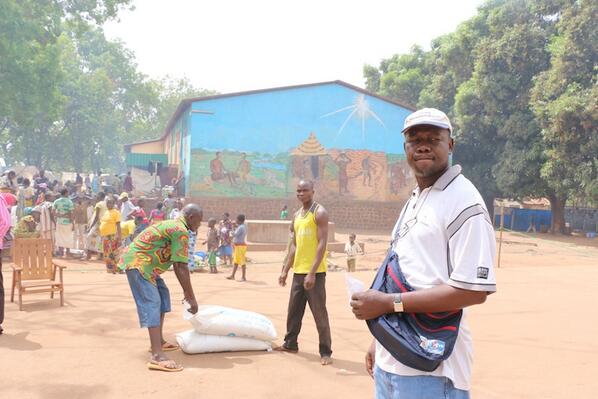
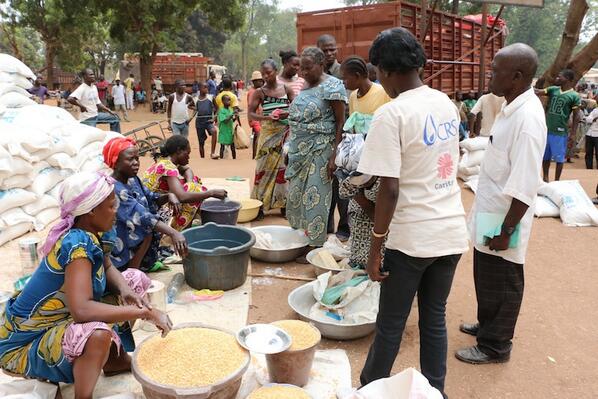
Here are my colleagues at work in Bossangoa where food distribution is ongoing:


WFP'S WORK IN DON BOSCO AREA, BANGUI, C.A.R.


Central African Republic: Fleeing Families Shelter Near Mosques, Churches

Published on 26 February 2014


--

See here: 


Photos

http://www.wfp.org/photos/gallery/central-african-republic-shelter-around-mosques-churches


People living at the Don Bosco camp had not received food aid from WFP since early January because of problems getting supplies into CAR. Thanks to the recent airlift and three convoys arriving by road from Cameroon, WFP has been able to start a new cycle of distributions in several IDP sites in the capital.


3 year old Juanita eating Plumpy Doz from her mother’s spoon. The supplement will help her fight malnutrition and keep away from disease. Since mid-February WFP provides extra children rations (Plumpy Sup, Plumpy Doz, Super Cereals Plus) in general food distributions so kids fight malnutrition and keep smiling.


A woman cooks some maize flour, just one hour after receiving it from a WFP distribution at Don Bosco Camp. Families share the rations of maize meal, split peas, vegetable oil, salt and children nutritional supplement after the distribution.


--


For more photos by Alexis Masciarelli and I for the UN World Food Programme - see WFP's site here: 

Photos

http://www.wfp.org/photos/gallery/central-african-republic-shelter-around-mosques-churches

26/02/2014

From Bangui with visuals


Well and sound in Bangui.

Here are a few glimps on my first field mission with WFP public information officer...
In Don Bosco camp, near the PK-12 and airport areas, for WFP food distribution:


--


RCA : Vers un retour des personnes déplacées à Bangui?


Bonjour de Bangui.

Je partage cet article de l'ONG ACTED sur la situation des déplacés centrafricains :

--

Faciliter le retour des personnes déplacées à Bangui


Près de 800 000 Centrafricains sont toujours déplacés à l’intérieur de leur pays, dont près de 300 000 à Bangui.
Pour faire face à la crise qui touche la capitale depuis le mois de décembre 2013, ACTED avec le soutien duDépartement d’Aide Humanitaire de la Commission Européenne, mène plusieurs activités pour soutenir les habitants vulnérables de Bangui.

Accompagner le retour des personnes déplacées

Une activité de travail contre argent a été mise en place avec pour objectif d’accompagner le retour des personnes déplacées.
Le 5ème et le 3ème arrondissements comptent parmi les zones les plus touchées de Bangui et une grande majorité des habitants a été contrainte de se déplacer dans des sites, en quête de sécurité, tels que l’aéroport de M’poko.
Afin d’aider les personnes déplacées à retourner chez eux, ACTED avec d’autres acteurs tels que les Maires des arrondissements, soutient matériellement et financièrement cinq ONG nationales pour qu’elles puissent effectuées des travaux de désherbage, de nettoyage, d’enlèvement d’ordures, etc.

Recruter des habitants des quartiers pour relancer l’activité économique

Le recrutement des travailleurs s’effectue dans les quartiers touchés par la crise, et directement sur les sites de personnes déplacées. Ainsi, l’argent gagné par les travailleurs permet de relancer l’activité économique dans les quartiers, et encourage la population à revenir dans l’arrondissement. Les jeunes hommes, inactifs et facilement influençables par les milices armées, sont particulièrement ciblés par ces activités.
Aujourd’hui, la situation sécuritaire se stabilise dans la capitale centrafricaine et l’accompagnement au retour des personnes déplacées, à travers la réalisation de travaux communautaires d’assainissement, est une étape importante qui favorise le relèvement économique des zones les plus touchées. ACTED poursuivra ses activités d’appui au retour et de relèvement des communautés au cours de l’année 2014
--

25/02/2014

OCHA BULLETIN FOR CENTRAL AFRICA - FEB. 2014


Central African Republic: Inter-communal Violence, Food Crisis 

Insecurity and warnings of genocide

The situation throughout the Central African Republic (CAR) continues to rapidly deteriorate with myriad humanitarian issues affecting the population amid warnings of genocide.

Security remains extremely precarious both in the capital, Bangui, and throughout the north and northeast of the country, notably in, Bossangoa, Kaga Bandoro, Paoua and Sibut.

Since the escalation of violence on 5 December 2013, the Red Cross reports more than 1,200 people killed in on-going clashes.


NB. The UN Emergency Response Coordinator, Valeria Amos, visited CAR from 18-21 February. She released a second CERF tranche of USD$10 million in February to support the response.

--

IDP figures decrease by 25 per cent 

There are presently 698,500 IDPs in CAR. An additional 280,000 Central Africans
have fled the country as refugees to neighbouring countries. In Bangui alone,
273,500 people remain in 66 IDP sites lacking adequate water, health and
sanitation. The decrease of IDP figures by over 220,000, predominantly in
Bangui, from a mid-January peak of 922,000, is owed to returns, improved
verification of displacement figures, and the flight of Muslim IDPs out of CAR.
Partners underline that this decrease speaks more to Christian communities who
comprise the bulk of site-resident IDPs and now feel more secure to return.

Muslims flee CAR prompting food crisis 

While internal displacement has decreased, refugee and evacuee figures are on
the rise due to the mass exodus of Muslims out of CAR. From mid-January, the
number of refugees fleeing to neighbouring countries has increased by over
35,000, bringing the total to more than 280,000 refugees; evacuees have
ballooned to over 78,000 mostly Muslims. Convoys carrying Muslim communities
fleeing CAR are frequently targeted and attacked by roving mobs. Amnesty
International recently warned of a possible partition of the country, reporting that
some 100,000 Muslims have fled - many heading north towards Chad, where
larger concentrations of the overall 15 per cent Muslim population in CAR reside.
UN Secretary General Ban Ki-moon recognized this month a ‘distinct risk’ for
partition in CAR.

A February Oxfam-ACF report indicated that CAR is facing a large-scale food
crisis. The report noted that as Muslim traders were largely responsible for the
importation and trade of food before December, their departure from CAR has all
but cut off supplies. The result is a rapid increase in food prices – with meat now
double in price and manioc, a staple food, already up 20 per cent since the crisis.
Further compounding food scarcity, the planting season is currently being missed
due to a lack of agricultural inputs and on-going insecurity prohibiting rural
communities from planting. FAO is stressing the critical need to facilitate planting
immediately in order to avoid a larger scale food and nutrition crisis later this
year.

Humanitarian response and gaps 

In February alone, 31,800 people in Bangui, Bossangoa, and Bouar received
food from WFP. Joint efforts from the humanitarian and military communities
have also resulted in the establishment of CAR’s first ‘night shelter’ opened in the
5th arrondissement in Bangui, which will be secured by the international forces in
the event of an attack. Gaps in humanitarian response remain in the area of
protection, notably with regard to SGBV in IDP sites; access to shelter; WASH;
and healthcare.

Chad: More Than 70,000 Evacuees from CAR 

78,750 Muslims flee violent attacks from CAR

The rampant violence against the Muslim community in CAR has resulted in over
78,000 migrants fleeing the country since December 2013. Chad is by far the
largest recipient of the evacuee caseload with 70,353 evacuees registered to
date, most of who have never been to Chad or have very tenuous links to the
country. An IOM profiling of the evacuees indicates that the evacuees are mostly
women and children and that only half are strictly Chadian nationals...


MORE HERE:
 http://reliefweb.int/sites/reliefweb.int/files/resources/HB%20ROWCA%20FEB%20FINAL.pdf

--

NB.

Food Crisis in CAR

Food reserves in the
Central African Republic
are almost exhausted
due to low crop
production in 2013, which
decreased sharply after
civil conflict broke out in
December 2012. Meal
consumption has
dropped from 3 to 1 meal
per day. Some 1.6 million
people, or over a third of
the population, already
require life-saving food
assistance. Farmers
urgently need to start
clearing and preparing
their land now to be able
to plant during the main
staple crop planting
season beginning in a
few weeks. The success
of the main planting
season in March in the
centre and the south,
followed by the main
planting season in May in
the north, underpins food
security in the country,
where around 75 percent
of the population rely on
small-scale agriculture for
their food and income.
Today, 95 percent of
communities report that
they do not have enough
seeds for the next
agricultural season.