07/04/2015

Meanwhile in Somalia...


On The Guardian:


Kenya launches air strikes against al-Shabaab camps in Somalia


Military says jets have bombed two camps in border region in response to massacre of students at Garissa University

 in Nairobi and agencies

Monday 6 April 2015


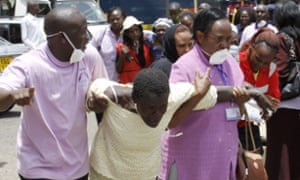
Medical staff console a woman after she  viewed the body of a relative killed in Thursday's attack at Garissa university.
Pinterest
 Medical staff console a woman after she viewed the body of a relative killed in the attack at Garissa University. Photograph: Khalil Senosi/AP
Fighter jets have bombed two al-Shabaab camps in southern Somalia, Kenyan officials said on Monday, as more details emerged of the model-student-turned-jihadi who took part in a massacre that left 148 dead.
In the first major military response to last week’s attack by the militant group on Garissa University, jets hit what were described as al-Shabaab camps in two villages in the Gedo region of southern Somalia, close to the border with Kenya.
A spokesman for the Kenyan military, Colonel David Obonyo, said the al-Shabab camps which were used to store weapons and for logistical support were destroyed, but it was not possible to determine the number of casualties because of poor visibility.


The bombings, which followed President Uhuru Kenyatta’s promise to retaliate in “the severest way possible” to the attack, in which dozens of cowering students were lined up and shot in the head at close range, came as a government source told Reuters that governors, members of parliament and security officials from regions bordering Somalia would compile a list of people suspected to have joined al-Shabaab or been radicalised by Islamists.
“The message is very clear: we have to deal with this problem once and for all,” said the official, adding that regional governors had discussed the idea with Kenyatta on Monday.
Hawa Yusuf, who lives in a village near the town of Beledhawa that is close to the Kenyan-Somali border, said the Kenyan warplanes “were hovering around for a few minutes, then started bombing.” She didn’t know if there were any casualties, she said by phone. Another resident of the village, Ali Hussein, said the airstrikes hit a grassland “where nomads often take their animals for grazing.”
As Kenya began the second of three days of national mourning, meanwhile, people digested the shock identity of one of the gunmen.
Abdirahim Abdullahi – whose name was first revealed by the Kenyan journalist Yassin Juma on his blog and later confirmed by Kenyan authorities – was described by friends as a “brilliant, upcoming lawyer” and an A-grade student who took a mysterious turn to radical Islam at some point between school and university.
Abdullahi was the son of a chief – a Kenyan government official whose job includes identifying criminals to the police and arbitrating in local disputes.
Friends described the gunman, who had secured an internship at a major bank that recruits many Muslim graduates, as a bright student who began to show signs of radicalisation during his college studies, even as he gave motivational lectures to high-school pupils.
“He used to make the students laugh with his words, quoting wise people and motivate them to do the best they can. He was the perfect lawyer. He had his way with people,” a former student said.
One student described a conversation with Abdullahi and another of his former schoolmates Mohamed Atom, who is the only Kenyan known to have joined Islamic State in Syria, after one of its motivational lectures.
He told the Sahan Journal website that the lawyer-turned-jihadi and his friend spoke of the futility of western education and repeatedly brought up the question of dying to advance the cause of religion.
“After the lecture, they kept talking about how secular education was not useful,” said a previous student who engaged him afterwards. “He kept saying: ‘We need to strengthen our connection with Allah. It is the knowledge of Islam that will only be useful to you today and in the hereafter.’”
Alarmed by the prospect of more Kenyans returning from jihadi training camps to take part in terror atrocities, the authorities urged relatives whose children had disappeared to come forward.
“It is indeed very necessary and critical that parents whose children go missing or show tendencies of having been exposed to violent extremism report to authorities to help prevent further escalation of radicalisation”, Mwenda Njoka, an interior ministry spokesman, told the Standard newspaper.
The Garissa attack came amid a debate about Kenya’s involvement in a UN-backed, African Union troop mission to tackle al-Shabaab in Somalia.
Although the Kenyan military has enjoyed considerable success on the battlefield, taking few casualties and pushing the terror group from most populated centres in southern Somalia, the mission has come at the cost of more than 400 Kenyan lives.
Al-Shabaab, which at one point controlled most of Somalia, has lost swaths of territory in recent years but diplomats have repeatedly warned this has not diminished its ability to stage guerrilla-style attacks at home and abroad.
It has threatened to turn Kenyan cities “red with blood” and police have stepped up security at shopping malls and public buildings in the capital, Nairobi, and in the eastern coastal region, which is popular with tourists and has been prone to attacks.

Read here:


France : vers plus de surveillance?


Communiqué de l'ONG Human Rights Watch


France : Un projet de loi ouvrirait la voie vers une société de la surveillance 


Ce texte bafoue des obligations relatives aux droits humains et servirait de modèle préjudiciable pour d’autres pays 


(Paris, le 7 avril 2015) – Un projet de loi conférant de vastes pouvoirs de surveillance électronique contrevient aux engagements internationaux de la France relatifs aux droits humains, a affirmé aujourd'hui Human Rights Watch. Le texte, qui a déjà obtenu l'approbation de la commission des lois de l'Assemblée nationale, risquerait de servir de modèle extrêmement néfaste pour d'autres pays, et devrait être reconsidéré et révisé, au lieu de faire l’objet d’un examen accéléré par le parlement. 

Le projet de loi relatif au renseignement, qui était prévu avant même les attentats contre Charlie Hebdo et un supermarché Hyper Cacher, doit être examiné en séance plénière à l'Assemblée nationale à partir du 13 avril, dans le cadre d'une procédure législative accélérée qui exclut une seconde lecture. Parmi les défauts de ce texte figurent les pouvoirs considérables accordés au Premier ministre pour autoriser la surveillance, sur des motifs qui dépassent largement ceux reconnus par le droit international des droits humains ; le manque de contrôle judiciaire effectif ; l'obligation pour les fournisseurs de services privés de contrôler et d'analyser les données des utilisateurs, et de dénoncer les comportements suspects ; les longues périodes de conservation de certaines des données collectées ; et le manque de transparence vis-à-vis du public.

« Bien que l'objectif du projet de loi soit de raccrocher les pratiques de surveillance de la France au cadre du droit, c'est en réalité une extension massive des pouvoirs en matière de surveillance qui se drape dans le voile de la loi, » selon Dinah PoKempner, directrice juridique chez Human Rights Watch. « La France se doit de faire mieux que ça, surtout si elle veut se distancier des pratiques de surveillance de masse abusives et secrètes des Etats-Unis et du Royaume-Uni, qui suscitent tant de contestations juridiques. »

Le projet de loi consacre en préambule le respect de la vie privée ainsi que le principe selon lequel toute forme d'entrave à ce droit n'est légitime que si elle est nécessaire et proportionnée. Pourtant, ce point de départ positif est rapidement mis à mal par une liste extensive de sept « intérêts publics » qui peuvent justifier la surveillance, parmi lesquelles « les intérêts économiques et scientifiques essentiels » de la France, la « politique étrangère » et l'« exécution des engagements […] internationaux ».

Contrairement à la protection de la sûreté nationale et de la sécurité publique, de tels intérêts ne sont pas reconnus aux termes du droit international des droits humains comme motifs valables pour porter atteinte aux droits fondamentaux, et peuvent de plus être interprétés de façon très large pour justifier toutes sortes de contrôle de données.

« L'exemple du droit américain montre comment des normes vagues peuvent facilement finir par justifier une surveillance de masse », selon Dinah PoKempner. « La très large portée de ce projet de loi contredit radicalement les obligations de la France aux termes du droit international des droits humains, et  pourrait servir à légitimer légalement un État de surveillance. » 

Le texte inclut l'obligation pour les opérateurs d’installer des dispositifs secrets, non spécifiés et fournis par l’État, pour analyser les comportements suspects – par exemple des visites sur des sites web faisant l'apologie du terrorisme, ou des contacts avec des personnes faisant l'objet d'une enquête. Cette obligation pourrait potentiellement s'appliquer à un nombre pratiquement illimité de critères, selon Human Rights Watch.

Cette disposition, dont la Commission de réflexion et de propositions sur le numérique de l’Assemblée nationale avait suggéré la suppression, mais qui a été conservée par la Commission des lois, suscite déjà des inquiétudes. La France pourrait forcer des entreprises privées à opérer comme analystes de sécurité de substitution pour l’État, avec des conséquences qui pourraient être désastreuses sur les fonctionnalités en ligne et la sécurité des informations, ainsi que sur la confiance des consommateurs et les droits fondamentaux tels que l'accès à l'information et la liberté d'expression et d'association.  Les entreprises devront garder confidentielles leurs activités au nom du gouvernement, ce qui réduirait encore davantage la transparence.

Human Rights Watch a rappelé que de nombreux chercheurs, journalistes, universitaires, avocats et acteurs humanitaires visitent des sites web qui font l'apologie du terrorisme, et échangent avec des personnes liées à des crimes, pour mieux comprendre ces exactions et lutter contre elles.

« L'ensemble des activités d'organisations indépendantes devrait-il ainsi faire l'objet d'un contrôle et d'une suspicion généralisée? » a demandé Dinah PoKempner. « Les gouvernements les plus répressifs pourront remercier la France, qui créée un précédent juridique en forçant les plus grandes entreprises de l'Internet à contrôler non seulement les indices de “terrorisme”, mais aussi les indices d'une dissidence tout juste naissante, ou même d'une pensée indépendante. » 

Le projet de loi confère entière discrétion au Premier ministre, pour appliquer ces pouvoirs de surveillance. Il est censé consulter au préalable un nouvel organe consultatif, la Commission nationale de contrôle des techniques de renseignement, mais n'est pas obligé de suivre son avis. Et même cette étape de consultation peut disparaître au profit d'une surveillance en temps réel, quand il existe « un risque très élevé » de ne pouvoir exercer cette surveillance a posteriori.  

Le projet de loi n'impose aucune obligation de contrôle judiciaire sur les mesures de surveillance avant leur mise en application, à moins qu'une majorité de neuf membres nommés à la commission ne soient en désaccord avec la décision du Premier ministre. Dans ces cas, très rares, la question devra être renvoyée pour examen devant le Conseil d’État, la plus haute cour de justice administrative française.  

Au contraire, un seul membre de la commission suffit pour approuver une mesure, et si la commission ne s'exprime pas au cours d'une brève période dédiée à son examen critique, qui dure 24 à 72 heures, la mesure peut prendre effet. Si la commission devra faire des rapports publics, ceux-ci ne présenteront guère que le nombre de fois où elle aura été sollicitée, aura rendu un avis défavorable au recours aux techniques de surveillance, et le nombre de fois où le Premier ministre sera néanmoins passé outre. 

« Au final, la commission n'a pour ainsi dire aucun moyen de remplir sa fonction protectrice », a affirmé Dinah PoKempner.

Le public continuera à ignorer le nombre de gens faisant l'objet d'un contrôle, le type de cibles autorisé et la nature de celles-ci, les motifs justifiant ce contrôle, le moment où la surveillance a lieu et la façon dont elle s'exerce, les types de matériaux collectés et conservés, ou encore le nombre de fois où le gouvernement passe outre la procédure pour raison d'urgence, a déclaré Human Rights Watch.

« Il est difficile de voir comment les personnes visées – que ce soit directement ou en raison d'associations dont elles ne sont pas conscientes, de l'endroit où elles sont, ou d'autres raisons – pourront savoir qu'elles ont fait l'objet d'un contrôle, et contester ces actes devant le Conseil d’État », a souligné Dinah PoKempner.

Deux autres aspects du projet de loi sont inquiétants. Une fois approuvées, les mesures de surveillance – y compris grâce au piratage ou des logiciels malveillants – pourront être prolongées indéfiniment, sans contrôle judiciaire ni signalement à la personne qui en fait l'objet. Les données obtenues grâce à cette surveillance pourront, dans certains cas, être conservées cinq ans, voir même indéfiniment. 

De nombreux amendements ont été proposés, dont certains apporteraient des améliorations, tandis que d'autres pourraient encore exacerber les inadéquations entre le texte et le droit des droits humains, selon Human Rights Watch.

« Peu après les attentats du 11 septembre 2001, l'administration Bush a fait passer en force le Patriot Act, consacrant des pouvoirs que peu avaient compris, sans vrai débat ni examen juridique, » a conclu Dinah PoKempner. « Le Premier ministre Manuel Valls prétend que le projet de loi français n'a rien à voir avec le Patriot Act, mais autoriser une surveillance d'une telle portée nécessite une réflexion approfondie, plutôt qu'un passage précipité au Parlement. »


06/04/2015

Glorious! Live version of "Glory Box" - Massive Attack joins Portishead


The hours after midnight are the most glorious, the hours after 1am the most permissive, the time for things with no time...

Digging sounds. Finding pearls.


Glory Box - Massive Attack y Portishead /

Massive Attack & Portishead - Improvisation & Glory Box


Massive Attack & Portishead 
fund raising concert for the Tsunami Crisis in Asia @ the Bristol Academy
--

"Alleyways and hallways. I love you always"...
--


Lyrics

Yeah I seen ya go down to a cold mirror 

it was never clearer in my era so 
material 
to shine upon your forehead or 
check it by the signs 
the faces in the corridor 
you used to guide me the club maze 
and now we struggle through the dub daze 
you used to guide me the club maze 
and now we struggle through the dub daze 
alleyways and hallways 
you grab me always 
through the alleyways and hallways 
i love ya always 
its how you go down to the men room sink 
its how we talk of how mad men think 
its how you go down to the men room sink 
its how we talk of how mad men think 
i sink myself in hair upon my lover 
i don't know her from another Miss 
I sink myself in hair upon my lover 
I don't know or think that I'd be missed 
From alleyways and hallways 
I love you always 
Yeah, through alleyways and hallways 
I love you always 
I crawl in through 
Alleyways and hallways 
I love you always 
Yeah I crawl in through 
Alleyways and hallways 
I love you always 
I love you all ways! 


05/04/2015

Kenya: Trying to help making more sense out of the recent chaos


 As readers and followers of this blog may know, Kenya is very dear to my heart. First, I started this blog while in Kenya, reporting from Kenya and on the whole of East Africa. As a French-speaker, coming from France, I could only notice while there how much is written and thought through in English and very little in French about this complex and fascinating region of the world.

Then, for all the complex effects of the freelance journalist's hazards, I had to come back to Europe, to be based in Europe to earn a living, and started to go back regularly in the region and then to follow the evolution of its politics from Europe.

The recent developments, especially since the Westgate Attack in Nairobi in September 2013 make me realise how little knowledgeable Europeans remain about East Africa, and also how I was willing to go in Nairobi - and beyond - again.

Before I am able to do this, I want to share here some articles and analysis bringing more comprehension...

Here are a few links and quotes, obviously in English, that can help understand.

--


Why Kenya matters
15 Jan 2015|


Extract:

"2014 was a bad year for all three but Kenya faced the most complex range of challenges. Its political, ethnic and economic fault-lines were exacerbated by attacks by the Somalia-based Islamist extremist group al-Shabaab, a never-ending refugee crisis (the second largest in Africa) and an indictment of its President, Uhuru Kenyatta, by the International Criminal Court for crimes against humanity (the case was finally dropped in December after three years)".

(...)

"For most of its history since independence in 1963, Kenya was Africa for much of the outside world, at least the Africa it wanted to see: of preternatural landscapes and wildlife, of vibrant, liberal-minded people, of social harmony. Then came the disputed 2007 election. The widespread communal violence which erupted in its aftermath eviscerated the Kenya of our popular imagination".

(...)

"Kenya’s not now an oasis of political stability but nor has it ever been. The distribution of land and wealth has always been a source of tension amongst its myriad ethnic groups. Injustices suffered by one or another have been used as political fodder by the country’s powerful elite since independence. That isn’t unique in African politics. People just thought Kenya was different.

Kenya is different. It’s the economic powerhouse of East Africa, boasting the region’s strongest international trade and investment links, and serving as its transport, logistics, tourism, banking and services hub. Though millions of its citizens remain stuck in crushing poverty, Kenya jumped to ‘middle income’ status after the latest rebasing of its GDP. Its private sector, which has evolved under relatively market-friendly policies, is arguably the most dynamic in Africa and its economy is amongst the most diversified".

(...)

"Kenya is trying to deepen global understanding of that security context and the tough choices facing the government. I hope it succeeds. What happens in Kenya matters—and not just to Africa".


--


How to make sense of the #GarissaAttack in Kenya (you may want to switch off television news)

April 4, 2015
http://africasacountry.com/how-to-make-sense-of-the-garissaattack-in-kenya/
To make sense of the attack by Al Shabaab on Garissa University near Kenya’s border with Somalia (official count of fatalities are 148others say closer to 200), you may want to switch off television news. Especially since CNN is moving Nairobi to Nigeria and Tanzania to Uganda. Crucial will be how these attacks will be framed in the next few hours and especially how the Kenyan state will respond (already they’ve blamed the judiciary and in the past they’ve round up Somalis despite little evidence). Equally important is public opinion. So, like we did at the time of the attack by Al Shabaab on the Westgate Mall in Kenya’s capital Nairobi, we’ve compiled a bunch of links, including some twitter accounts, we suggest you read or follow.
Poet Shailja Patel‘s “The Road to Garissa” on The New Inquiry.
Criminologist Mwenda Kailendia in The Guardian, “Kenya attacks: Brute force isn’t enough to beat the terrorists
Karen Rothmeyer in The Nation: “Horrifying blowback in Kenya.”
Novelist Abdi Latif Ega’s “What’s it like to be Somali in Kenya
International Relations scholar Stig Jarle Hansen,”Al-Shabaab is failing in Somalia, but Kenya’s chaotic response could keep it alive” on The Conversation.
Harry Misiko, “How Kenya made itself vulnerable to terror,” on the Washington Post’s WorldViews blog.
Political science graduate student Ken Opalo on his blog about “Five Things About Al-Shabaab and the Somalia Question.”
This documentary made 2 years ago by Al Jazeera reporter Mohammed Adow (you would recognize him his recent reporting on Nigeria’s general election) about Garissa, which also happens to be his hometown. The film, which is very personal, also gives a good history of state violence in Kenya’s North Eastern Province, where Garissa is located. The North Eastern Province is  “the country’s third-largest region, borders Somalia and is exclusively inhabited by ethnic Somalis.”

--

On "The Road to Garissa":

http://thenewinquiry.com/essays/the-road-to-garissa/

1962
"Somali northeast votes to join Somalia: ”Kenyan-Somalis’ sore relations with the government of Kenya have a rich history. Carved out of Somalia by the British, the arid northern region was neglected by both colonial and post-colonial administrations. Born out of this history of marginalization, Kenyan-Somalis identify more with their ethnic group in Somalia than with the rest of Kenyans.

“In a 1962 referendum, residents voted overwhelmingly to join Somalia. But Kenya refused to accept the results, hampering Mogadishu’s plans to form “Greater Somalia” by annexing all Somali-populated areas in the region, including Djibouti and Ethiopia’s Ogaden state.” "

--


THE GARISSA MASSACRE SHOWS US IT IS TIME TO ABANDON THE WAR ON TERROR


http://digitaldjeli.com/2015/the-garissa-massacre-shows-us-all-it-is-time-to-abandon-the-war-on-terror/


"A continuation of the highly discredited, top-down, ‘War-on-Terror’ approach will only exacerbate these problems and needs to be replaced by a more nuanced, locally-based, non-sectarian understanding.
A new approach needs to reconstruct the relations of information production so that citizens are both protected and seen as allies and not the ‘bandits’ of the past.
In this framing of the story through the war-on-terror lens, instant experts, politicised government approaches to radicalisation and foreign and local media all collude to play the role of town crier. The war-on-terror is good for business and it boosts careers too.
The genie is half-way out of the bottle in Africa, a second, potentially marginalised generation is in the wings and only a radical change of approach now stands any chance of putting it back in any constructive form".

--


Feel free to share some more. Thanks for your attention.


Next stop: Clifton / Hotwells - and insight into the work of Abigail McDougall


 I like the sound of the name "Hotwells". It makes me think of a place by the water, and there's nothing I love as much as places by the water...

Discovering this painter based in Bristol, I'd like to show a few of her paintings here, inspired by the Hotwells area and the Harbour:


Hotwells with Cabot Tower 
Copyright: Abigail McDougall


Hotwells in Blue
Copyright: Abigail McDougall


I'll be in Clifton soon, and want to walk along the River Avon in Hotwells, searching for its spirit and its art galleries... 


Abigail's Clinfton in the Winter...
Copyright: Abigail McDougall


I'll See Clifton in the spring :)

And Stokes Croft, Jamaica Street, Bedminster, Broadmeads...
See you soon Bristol.


--

More about Abigail McDougall's painting:
http://www.abigailmcdougall.com/


--

My soundtrack:


PJ Harvey - from Yeovil, Somerset, South West England - "Down By The Water"


Massive Attack - from Bristol (is it even worth mentioning?) - "Future Proof", Live:


04/04/2015

Next shows: Let's meet in Bristol


 There's a theatre near my new place in Clifton... 


Redgrave Theatre


Welcome to the Redgrave Theatre - Bristol's third largest Theatre


Read more at http://www.cliftoncollege.com/upper/redgrave-theatre/#Bx0R8q0srKiTSM0I.99


The Western Opera Players present 
Me And My Girl

Wednesday 22nd – Saturday 25th April
7.30pm
Saturday Matinee at 2.00pm
Tickets 
Wednesday to Friday at 7.30pm £13 
Saturday Matinee at 2.00pm - £12 
Saturday evening at 6.30pm - £13
Me And My Girl


Read more at http://www.cliftoncollege.com/upper/redgrave-theatre/whats-on/#j63e8e5KgAEhdVJH.99


--


And Seun Kuti, Fela's youngest son, is coming to Bristol next 

month: 


Legendary African musician Fela Kuti’s youngest son “has handled his father’s esteemed Afrobeat legacy with aplomb” (The Guardian), heading up his old band, Egypt 80, over the course of three albums. The latest, A Long Way to the Beginning, finds Seun “turning in a high-energy, danceable Afrobeat/jazz/funk fusion” (Pop Matters). “These tracks are for dancing,” says NPR. “If you’re not moving, something may well be wrong.”


This is a standing show

Venue: The Lantern
Time: 20:00
Date: Fri 8 May 2015
Price: £19.50 incl. booking fee


Watch: 


Seun Kuti & Egypt 80 - Black Woman at Glastonbury 2014


https://www.youtube.com/watch?v=EkWwEY-se4o


A Long Way To The Beginning

[EP]


  • Seun Kuti & Egypt 80
  • Audio CD

--

More soon.