11/04/2015

LATEST NEWS FROM KENYA


Just sharing:


Kenya criticised for closure of money transfer firms following Garissa attack

NGOs caution that revoking licences of remittance companies over fears they are linked to al-Shabaab will hit a vital lifeline for ordinary citizens


Friday 10 April 2015 

Garissa
Afraid of Rainbows

Washing the blood off the walls of a place of learning


Statistics released by Kenya’s anti terrorism unit cite an attack every eight days. They’ve counted 133 attacks and 264 people killed since the two-year military operation. Then there were the 274 casualties in the Nineties bombing of the US embassy in Nairobi. And going even further back, there was the bombing of the Norfolk hotel a decade earlier that left 20 dead. The number of Kenyans killed in this ever increasing brutality exceed 1 000. We commissioned one of the nation’s finest investigative journalists to give us insight into what is happening in a land once known for lazy safaris and spectacular sightseeing.

Text:

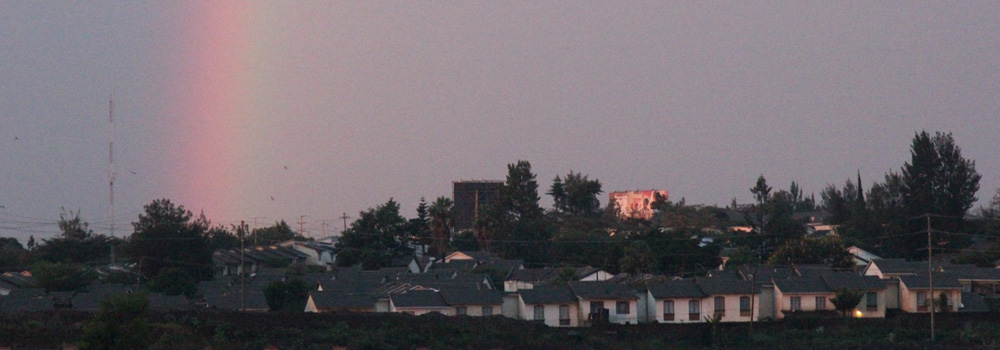
Just in from a reggae DJ gig at a Nairobi club, I chanced upon this view of a rainbow over the Langata bypass. For us fishermen at the lake, it is a woeful sight. It signifies the end of the rains and the onset of a long spell of harsh sun. The dreaded season when fish stock disappears and competition mounts for dwindling supplies with neighbouring countries.
This contrast of beauty and hopelessness occupied my mind for a while. Then as I got closer to home my worries about the rainbow disappeared. From Garissa, a town where the Tana River flows forcefully from the Aberdare Mountains no matter the season, came news that shook me. Shook the world.
Al-Shabab gunmen, the reports said, had cornered 700 learners in a dawn attack on April 2nd. They were killing mostly non-Muslim students at Garissa University, about 200 kilometres away from our border with Somalia the home country of Al-Shabab.
The news flowed in torrents. I glimpsed at the sky again and saw the rainbow had vanished. Perhaps it was mindful that its novel beauty could no longer linger in the face of such ugly, such incomprehensible happenings.

A Wounded Nation

At the end of the day-long ordeal the attackers, four of whom were killed, had left a trail of 148 people murdered. Close to 100 were in a critical condition.
The nation too is deeply wounded.
The gunmen, one of them described as a law graduate and son of a local government security official, demanded that the October 2011 invasion and occupation of parts of Somalia by the Kenya Defence Forces (KDF) must end.
In his immediate reaction to the Garissa killings, our President Uhuru Kenyatta controversially ordered that more than 10 000 recruits, rejected by the Supreme Court due to a corrupt hiring process, had to report to the police training school as soon as possible.
The KDF followed up a couple of days later with an air raid inside Somalia.
“We bombed two Shabab camps in the Gedo region. The two targets were hit and taken out, the two camps are destroyed,” army spokesman David Obonyo announced.
In the aftermath Kenyans struggled to comprehend what had happened. And we began to question. On social media, inside public transport, in local pubs… Wherever I went, the same questions. Why did it take eight hours for anti-terror officers to arrive and eventually engage the killers?
Eight hours is the time it takes to fly from Nairobi to Johannesburg, enjoy an hour-and-a-half in the Rainbow nation and then return to Nairobi.
Many commentators agree that we have not learnt important lessons from the shocking Westgate terror attack in 2013 that left more than 60 people of different nationalities dead.

Security Buffer Zone

Corruption in government and within the forces has been blamed for the string of terrorist attacks that has befallen this country since the KDF trundled into Somalia ostensibly to pin down Al-Shabab far away from Kenyan borders.
Six years ago, security agencies together with the Somali Transitional Government and with the backing of the Intergovernmental Authority on Development (IGAD) embarked on a recruitment and training process of Somali fighters. Their aim was to confront Al-Shabab and create a security buffer zone between the border of Kenya and the Jubaland border region.
A parliamentary committee set up to study the process discovered that local politicians and government security officials had corruptly secured recruitment slots for their kin who were to be paid a handsome sum of up to US $1 000 (R 11 820) a month to join forces with the Transitional Authority Government (TFG) in its bid to crush Al-Shabab, particularly in the Kenyan border region.
According to a report last June in the Daily Nation retired KDF major and security expert, Mr Bashir Abdullaiah, was quoted saying that the plan, though noble, was bound to fail from the start.
“The plan was good. Train Somali youths and not Kenyans to create a buffer zone between Kenya and Somalia. However, it was infiltrated by Kenyans who received this training and later filtered back into the population and back to their families. Kenya should have handled it the way Ethiopia did to the ones they trained. Put them under the command of their military so that you can monitor them long after the war. These people are today roaming and killing people in parts of Kenya,” said retired Major Bashir.
Local chiefs among other members in the security chain were involved in recommending recruits for the training. Most of the recruits hailed from Garissa, notably among them is the mastermind of the Garissa attack, Mohamed Mohamud. A bounty of 20 million Kenyan Shillings (R 2,56-million) has been placed on his head.
Mohamud, a teacher at a madressa in Garissa, worked with the KDF as a commander in the southern Somali Ras Kamboni militia under the warlord Ahmed Madobe, a former Islamist commander-turned-Kenyan ally. 

A Plan Gone Wrong

Due to poor planning and monitoring, most of the 3,000 trainees were left to their own designs and did not remain border patrols as planned. Many of them being Kenyans who returned home.
Revelations that one of the Garissa attackers was a university law graduate and son of a local chief debunked the myth that Al-Shabab terror recruits are wild-eyed, unemployed youth in Somalia. Or that they are Somali refugees found in the Kenyan camps and urban settlements such as the sprawling Eastleigh estate, referred to locally as “Little Mogadishu”.
A commentator on Facebook attracted a lot of applause when he posted:
“While Al shabaab are busy recruiting graduates of law, our security systems recruit tall, D+ materials with 32 teeth as if they are going for a biting contest.”
The order to recruit security forces formerly dismissed by the court has caused division among Kenyans. We are split between those who support a bigger police force and those who believe the president has subverted the law by admitting, “corrupt” offers into the force.

Corruption To Blame?

“He has announced he will ignore a court order on recruitment of 10 000 new police officers, halted because of corruption. By ordering their illegal recruitment, he is undermining his own anti-corruption crusade! And it makes our efforts to combat terrorism harder. For if people pay to become police officers and soldiers, how can they then take the necessary risks to combat terrorism or corruption?” writes commentator and activist Maina Kiai in the Daily Nation.
It is corruption that has allowed terrorism to spread so effectively throughout Kenya. This helps to explain our insecurity despite having one of the most formidable militaries in the region. Kenya, according to the Stockholm International Peace Research Institute (SIPRI), is among the top spenders in military budgets purchasing 19.8 billion Kenyan shillings worth of advanced weapons from 2010 to 2014, up from 919.4 million Kenyan shillings between 2005 and 2009.
“Entrenched corruption in the security system allows Al-Shabaab to move freely in and out of Kenya and carry out such attacks with ease,” said civil rights activist Boniface Mwangi in wire reports.
Arms caches are also abundant in Garissa and other towns along the border that has rightly earned the title of ‘porous’. Cashing in on corruption very effectively, the combatants managed to transport their arms to the capital city, the border towns of Garissa and other areas. Kenya has become an easy market for access to illegal arms.
I am very scared. I fear looking up. I don’t want to see rainbows. I don’t want to look down…. At the newspaper in front of me. I am afraid of even more terrible headlines that could emanate from just about anywhere in this once peaceful country.
I think of the Tana river running red with the mud of the last of the rainy season and I weep for a town that will never ever wash all of the blood from the walls of a place of learning.
Argwings Odera is a Freelance Investigative Journalist based in Nairobi Kenya. In recent times his life was threatened because of his critical coverage of a dam project in western Kenya. A local resident himself, Odera saw many faults in the Sondu Miriu Dam project that the mainstream media had missed.
--
More soon.


Mali : Il n'y aura pas de paraphe d'accord à Alger le 15 avril prochain


Mon dernier papier pour RFI et Rfi.fr :

MALI  ALGÉRIE  MNLA

Nord du Mali: la CMA ne paraphera pas le projet d’accord de paix

mediaLe médiateur algérien Ramtane Lamamra avec le secrétaire général du MNLA, Bilal Ag Acherif, le 1er mars 2015.AFP PHOTO / FAROUK BATICHE
Selon le MNLA, la Coordination des mouvements de l'Azawad (CMA) ne va finalement pas parapher le projet d'accord de paix. L'Algérie invitait pourtant depuis plusieurs jours toutes les parties du dialogue inter-malien à une cérémonie prévue pour parapher l'accord le 15 avril à Alger, affirmant que la CMA « avait notifié sa décision de procéder au paraphe de l'accord ».

Dans une lettre envoyée jeudi à tous les protagonistes du dialogue malien, le médiateur algérien Ramtane Lamamra invitait toutes les parties à être présentes le 15 avril. Il affirmait que la Coordination des mouvements de l’Azawad serait présente pour cette cérémonie symbolique de paraphe de l'accord.
Pourtant, le porte-parole du MNLA, le Mouvement de libération de l'Azawad, affirme désormais que les amendements émis par la CMA n'ont pas été pris en compte et que toutes les parties membres de la Coordination sont d'accord pour ne pas signer : « Nous confirmons que les mouvements réunis au sein de la Coordination des mouvements de l’Azawad, la CMA, ont décidé suite à de larges consultations et des échanges de ne pas parapher les documents dits "Accord pour la paix et la réconciliation au Mali", indique Moussa Ag Attaher.Le point crucial qui constitue l’épine dorsale des aspirations légitimes du pays de l’Azawad, c’est la réalité du statut politique et juridique de l’Azawad, et ce statut est complètement ignoré dans les documents, alors que ce statut politique demeure le nerf de notre lutte et de notre combat depuis toujours. »
Dans son courrier, le ministre algérien indiquait que la cérémonie de paraphe serait l'occasion d'ouvrir de « nouvelles consultations informelles de courte durée pour clarifier et arrêter la méthodologie » en vue de la signature et de la mise en œuvre de l'accord de paix.
Le gouvernement malien ainsi que des groupes proches de Bamako ont déjà paraphé ce texte le 1er mars dernier. Les autres membres de la Coordination ne se sont pour l'instant pas exprimés officiellement. Mais selon le MNLA, celle-ci reste unie et demande la poursuite des discussions.

--

Le communiqué du MNLA diffusé hier soir sur leur site :

La CMA déclare ne pas pouvoir parapher l'accord en son état actuel

 10 Avr 2015


Coordination des Mouvements de l’Azawad
Communiqué de Presse

La Coordination des Mouvements de l’Azawad  / CMA informe l’opinion nationale de l’Azawad et l’opinion internationale qu’en réponse à sa lettre du 04 avril 2015 le chef de file de la Médiation, par lettre officielle en date du 06 Avril 2015,  l’a informée de l’organisation du paraphe, le 15 Avril 2015 à Alger, de  « l’accord pour la paix et la réconciliation au Mali ». 
La CMA, tout en réaffirmant sa disponibilité à donner toutes les chances à l’aboutissement d’un paraphe, réitère, encore une fois, son attachement à la prise en compte des amendements qu’elle a remis à la mission internationale, le 17 mars 2015 à Kidal, amendements qui constituent l’essentiel des revendications de l’AZAWAD.
Par conséquent, la CMA, informe  qu’elle ne pourra pas parapher « l’accord pour la paix et la réconciliation au Mali » dans son état actuel et à la date indiquée.
La CMA  remercie vivement la médiation et particulièrement son chef de file pour les efforts inlassables déployés avec dextérité et dévouement depuis bientôt une année. En même temps elle réaffirme son ferme engagement à poursuivre le dialogue tout en sollicitant la médiation pour davantage d’efforts afin de prendre en compte les préoccupations issues de la volonté du Peuple de l’Azawad.

Fait à Nouakchott, le 10 Avril 2015
Pour  La commission de communication de la CMA
Mossa Ag Attaher


10/04/2015

"Take Me Back To Beautiful England"


PJ Harvey 

"The Last Living Rose"

(Let England Shake)


Goddamn' Europeans!
Take me back to beautiful England
& the grey, damp filthiness of ages,
fog rolling down behind the mountains,
& on the graveyards, and dead sea-captains.

Let me walk through the stinking alleys
to the music of drunken beatings,
past the Thames River, glistening like gold
hastily sold for nothing.

Let me watch night fall on the river,
the moon rise up and turn to silver,
the sky move,
the ocean shimmer,
the hedge shake,
the last living
rose quiver.


Bristols' graffiti - Early days


 Bristol, capital of graffiti.

Here's a reminder with two photographs taken by Beezer on Jamaica Street, near Stoke Croft in Saint Pauls' neighbourhood, Bristol's Caribbean hub then and now.

This is why I keep on coming back, Bristol. You had it all by then. You're still thriving today. Looking forward.


3D painting The Day The Law Died on Jamaica Street around 1984-85:


© Beezer


© Beezer


Arts in Bristol: "Gravitas" at Purifier House


Gravitas

Gravitas explored the continual and complex relationships between human and animal. The exhibition brought together large-scale, monochrome oil on canvas paintings by Abigail Reed and the life-sized fabric sculptures of Dorcas Casey.
Responding to the exhibition space, Antlers Gallery presented two female artists working in a large, bold manner in order to convey the power and weight of the animal form, in relation to human scale. In Abigail’s paintings the animals are bursting out of the canvases whilst Dorcas’ sculptures are awkwardly juxtaposed with seemingly fragile furniture. In both cases the animal subjects have a sense of stature but their relationship to human objects evokes an air of vulnerability.
Dorcas Casey uses a variety of materials including fabric, wire and found objects to create startling portrayals of animal forms.  Her sculptures are inspired by the recurring motifs of animals which appear in her dreams – the familiar and comforting is merged with the menacing and unsettling. Impeccably fabricated portrayals of stags, pigs, and bulls are awkwardly placed in direct opposition to delicate antique furniture; they are suspended between strength and collapse, evoking the ambiguity of dream-like imagery.
Surrounding these sculptures were Abigail Reed’s immense oil paintings of: bulls, stags and horses. Standing strong and powerful within the canvas these works are almost sculptural in themselves and vying for the viewers attention. Her painting style is free and fluid; nothing is fixed as the dripping and cracking of the paint reveals the accidental, volatile and vulnerable nature of the medium and in turn life. Abigail sees her paintings as representations of ‘other’, something non-human which puts us in our place and stills our anxieties.

Gravitas
21 March – 21 April 2014
Everyday 10am – 6pm
Purifier House (waterfront entrance), Lime Kiln Road, Bristol, BS1 5AD
Preview: Thursday 20 March, 6-9pm
Artist Talk: Wednesday 2 April, 6.30pm
Gravitas Feast – 11, 12, 13 April, 7 – 10pm – tickets- http://foodandtheatrecompany.bigcartel.com


--


Tunisie: le projet de loi sur la lutte contre le terrorisme inquiète à Tunis


Résumé de mon entretien diffusé ce matin sur RFI :

TUNISIEDROITS DE L’HOMMETERRORISME

Tunisie: un projet de lutte contre le terrorisme inquiète les ONG

mediaPoliciers tunisiens à l'entrée du musée du Bardo, à Tunis, le 19 mars.REUTERS/Anis Mili

En Tunisie, le nouveau projet de loi de lutte antiterroriste du gouvernement tunisien inquiète les ONG de défense des droits humains. Le projet de loi de 2014 avait été mis de côté au moment des élections générales. Depuis l'attentat contre le musée du Bardo, les parlementaires entendent mener à bien un nouveau projet de loi pour renforcer la lutte antiterroriste.

Pour Human Rights Watch, ce texte autoriserait la garde à vue prolongée et affaiblirait les garanties judiciaires des personnes inculpées d’acte terroriste. Il lèverait également le moratoire sur la peine de mort, comme s’en inquiète Amna Guellali, chercheuse pour l'ONG à Tunis : « En Tunisie, il y a un moratoire sur la peine de mort. Donc les juges peuvent condamner les personnes à une peine de mort, mais cette peine n’est pas exécutée. Ce moratoire existe depuis 1991. Donc ici, la réintroduction de la peine de mort dans le nouveau projet peut donner lieu effectivement à une application de ces peines. Et ça peut représenter un recul par rapport à ce qui existait avant en Tunisie ».
Pour Amna Guellali, il est important que le Parlement garde à l'esprit que le débat sur le projet de loi doit rester rationnel et ne doit pas être influencé par l'émotion engendrée par les attentats : « Il est très important que le Parlement examine sereinement cette nouvelle loi et qu’il ne prenne pas des décisions hâtives, dictées par des questions politiques ou par la réactivité par rapport à l’événement parce que cela, finalement, ne serait que contreproductif et ne ferait qu’affaiblir encore plus la possibilité pour le système de lutter contre le crime terroriste ».

 
  • Tunisie

09/04/2015

Ouganda : suite de l'enquête sur la mort de la procureure Joan Kagezi - Arrestation d'un ancien détenu de Guatanamo ougandais


 En Ouganda, plusieurs suspects ont été arrêtés dans le cadre de l'enquête sur l'assassinat de la procureure chargée du dossier d'attentats islamistes en 2010, le le 30 mars à Kampala. L'un des suspects est un ancien détenu de la prison américaine de Guantanamo. 

Mélissa Chemam

--

OUGANDA TERRORISME SHEBABS JUSTICE GUANTANAMO ETATS-UNIS

Procureure assassinée en Ouganda: plusieurs suspects arrêtés

mediaL'endroit où la procureure Joan Kagezi a été tuée par des hommes à moto, le 31 mars 2015 dans la banlieue de Kampala.AFP PHOTO/ ISAAC KASAMANI

Les Etats-Unis ont participé à l'interpellation de plusieurs des suspects ; l'un est en effet un ancien détenu de Guantanamo.

La porte-parole du département d'Etat, Marie Harf a confirmé "que des membres du gouvernement américain ont apporté leur soutien à une opération de l'Ouganda qui a permis d'appréhender plusieurs individus soupçonnés d'être impliqués dans l'assassinat de la procureure". Elle a également précisé que l'ancien détenu de la prison de Guantanamo "avait été libéré en 2006".
 
Il s'agit de Jamal KIYEMBA, ancien résidant au Royaume-Uni de nationalité ougandaise, arrêté au Pakistan en 2002 pour lien supposé avec Al Qaeda puis transféré à la prison de Guatanamo. Il avait été libéré en 2006 sans être inculpé. Il avait alors été renvoyé en Ouganda.

Au moins six personnes ont été arrêtées ces derniers jours, selon les autorités ougandaises, deux femmes et quatre hommes.

Fin mars, la police ougandaise indiquait n'avoir encore arrêté aucun suspect et ne privilégier aucune piste dans l'assassinat de Joan Kagezi, directrice adjointe du ministère public ougandais.

Elle avait été tué par des hommes armés et à moto  le 30 mars à Kiwatule alors qu'elle faisait des courses.

Cette n°2 du Parquet dirigeait les poursuites dans de nombreuses affaires criminelles d'importance, dont le dossier du double attentat du 11 juillet 2010 à Kampala qui avait fait 76 morts. Une attaque revendiquée par mes islamistes somaliens al shebab.
.
Le procès lié à cet attentat avait commencé le 17 mars dernier à Kampala et impliquait 13 accusés : sept Kényans, cinq Ougandais et un Tanzanien, poursuivis pour de nombreux chefs d'inculpation, dont ceux de terrorisme et de meurtres.

Il devait reprendre le 31 mars mais après le meurtre de la procureure, il a été reporté sine die.


London shows the way for African Art in Europe / America


As I always said! And NYC is following. Paris, wake up. 

Read below:

http://www.okayafrica.com/news/1-54-ny-contemporary-african-art-fair-new-york-frieze-week-2015/


London’s 1:54 Contemporary African Art Fair is crossing the Atlantic next month for its US debut during New York’s Frieze Week. Dubbed 1:54 NY, this satellite edition of the growing art gathering will set up shop at Brooklyn’s Pioneer Works from May 15-17. Yesterday, 1:54’s creator and director Touria El Glaoui revealed the lineup of artists and galleries exhibiting at the New York presentation. “Contemporary African art is continuing its rise to the fore as it is granted the attention it duly deserved,” El Glaoui said about expanding the fair. “In light of this, it seems only right that 1:54 would spread its wings to land in New York, where established and emerging African artists and artists of the African Diaspora are leading a burgeoning contemporary art scene that communicates across international geographies. The New York edition will retain the intimacy and charm that the setting of London’s Somerset House has made possible, and as always, will showcase the highest caliber of art to date, in an unrivaled setting.”
What do you think?

1:54 NY’s participating galleries, which come from Abidjan, Cape Town, Johannesburg, Lagos, London, Marrakech, Milan and Paris, will feature works from 70+ African artists, including Gabonese painter Boris Nzebo, British-Nigerian draftswoman ruby onyinyechi amanzelegendary Malian portrait photographers Malick Sidibé andSeydou Keita, Senegalese fashion and fine arts photographer Omar Victor Diop, Kenyan visual artist Jim ChuchuBeninese mixed-media artist Romuald Hazoumè, iconic Nigerian photographer J.D. Okhai Ojeikere, Mozambican sculptor Gonçalo Mabunda, Belgian-Beninese photographer Fabrice Monteiro, and Tunisian artist and researcher Nidhal Chamekh, among others. For more on the upcoming 1:54 NY fair head to their official websiteTwitterInstagram, and Facebook, and see below for the full list of participating exhibitors and artists.
What do you think?

1:54 NY Selected Exhibitors
What do you think?

A Palazzo Gallery, Brescia / Afronova, Johannesburg / Art Twenty One, Lagos / ARTCO Gallery, Aachen / Axis Gallery, New York / Bennett Contemporary, Cape Town / CIRCA Gallery, Johannesburg / Galerie Cécile Fakhoury, Abidjan / Jack Bell Gallery, London / Magnin-A, Paris / Mariane Ibrahim Gallery, Seattle / NOMAD Gallery, Brussels / Primo Marella Gallery, Milan / SMAC Gallery, Cape Town / VOICE Gallery, Marrakech

1:54 NY Selected Artists
What do you think?

Aboudia
Leonce Raphael Agbodjelou
Leila Alaoui
ruby onyinyechi amanze
Olu Amoda
Joël Andrianomearisoa
Younes Baba-Ali
Sammy Baloji
Steve Bandoma
Wayne Barker
Rim Battal
Daniel Blom
Conrad Botes
Armand Boua
Frédéric Bruly Bouabré
Nathalie Boutté
Edson Chagas
Nidhal Chamekh
Jim Chuchu
Soly Cissé
Bruce Clarke
Peter Clarke
Barend de Wet
Calixte Dakpogan
Omar Victor Diop
Bright Ugochukwu Eke
Theo Eshetu
François-Xavier Gbré
John Goba
Maïmouna Guerresi
Romuald Hazoumè
Ayana V. Jackson
Seydou Keïta
Lebohang Kganye
Abdoulaye Konaté
Lawrence Lemaoana
Toyin Loye
Gonçalo Mabunda
Ibrahim Mahama
Abu Bakarr Mansaray
Megumi Matsubara
Vincent Michéa
Jean-Paul Mika
Bobson Sukhdeo Mohanlall
Shula Monsengo
Fabrice Monteiro
Jean-Claude Moschetti
Richard Mudariki
Lavar Munroe
Vitshois Mwilambwe Bondo Cheikh Ndiaye
Boris Nzebo
J.D.’Okhai Ojeikere
Gérard Quenum
Chéri Samba
Amadou Sanogo
Kura Shomali
Malick Sidibé
Ransome Stanley
Pathy Tshindele
Eric van Hove
Billie Zangewa
Asha Zero

Cultural guide to Nairobi - by The Guardian


The insider's cultural guide to Nairobi: Tusker beer, urban slang and 'writivism'


From Lupita Nyong’o street art to occupied playgrounds and poking fun at socialites, let Josephine Opar guide you round Kenya’s capital

Nairobi culture in five words

Beeps from security wands and metal detector machines are the norm in Nairobi, because of the compulsory security checks at every major building, mall, event locations and some buses in the city. In short, security checks are everywhere. Individuals are required to put their bags and phones in trays while they walk through the metal detector machine and in some places security guards also frisk people.

Everyone’s tuning into …

The Trend, NTV’s hit show, chats with popular and polarising personalities that people in Kenya are talking about on Twitter: from pop stars to skin-bleaching socialites.

The look on the street

Nairobians are all about mixing local and international trends. Local accessories are popular, while clothes are often sourced from markets (mtumba), or from vendors who select pieces from overseas. Designers and tailors are increasingly becoming a popular choice for producing original attire.

Kuona Trust
Pinterest
 Kuona Trust. Photograph: Joel Lukhovi
Kuona Trust is a vibrant and accessible arts space in the Hurlingham district of the city. It’s a great place for discovering local painters, glass artists, visual artists, sculptors and photographers, who showcase their work there at regular exhibitions and installations, events, workshops and community outreach programmes.
Kuona markets many Nairobi-based artists. Recently, director Sylvia Gichia spoke out about the Venice Biennale scandal, which sees Chinese and Italian artists representing Kenya instead of local artists, for the second time.

What’s the big talking point?

Digital migration – three leading private TV stations operating on analogue platforms were switched off for three weeks in February for failing to migrate to digital. The conflict caused Kenyans on social media to swap memes making fun of the situation. Now that all the stations are back on air, Kenyans are required to purchase set-top boxes to watch local channels, unless they already have satellite TV.
Fena is a solo singer-songwriter whose take on the urban-soul genre is swaggy and relatable. She is proudly African, from her dreads to her lyrics she stands out as a positive, “fena-menal” woman. The artist recently shared a stage with the legendary South African singer Yvonne Chaka Chaka.

What Nairobi does better than anyone else …

Tusker beer is made in Nairobi, and is popular with Kenyans and tourists alike. Locals often drink it with nyama choma (barbecued meat). Now that police are on the look-out for drunk drivers, Kenyans are doing their best to enjoy their alcoholic beverages responsibly and avoid failing the “alco-blow” tests.

--

See more here - on The Guardian:

http://www.theguardian.com/cities/2015/apr/07/nairobi-kenya-insider-cultural-guide-urban-slang-lupita-nyongo