Followers of this blog know I lived one year in East Africa, where I was covering the region from Nairobi, Kenya. I travelled to Uganda, Tanzania, Somalia and Ethiopia, but unfortunately not to Eritrea, where, you might know, it is very difficult for journalists to get in.
I only dreamt once I landed in its capital by mistake, the plane I was in having to organise an emergency landing... And as I dreamt once in 2010 I arrived in Niger by mistake and finally went in 2013 for an amazing series of reporting, I can only imagine Eritrea's time will come.
In the meantime, the country remains very closed because of the very harsh dictatorship, but recently reporters have done an amazing job to let it out of silence.
The current migrant crisis has some roots in Eritrea, where people suffer often too much to choose not to leave their homeland.
Here is a wonderful article about the story of two Eritrean men who had to flee.
Now the Guardian is what I call a newspaper. Please read and share.
m
--
Link:
http://www.theguardian.com/world/2015/aug/17/inside-eritrea-glimpse-africas-most-secretive-state-two-men?CMP=edit_2221
--
Tale of two Eritreans offers glimpse inside Africa's most secretive state
As thousands flee every month and reports of repression abound, two men’s diverging paths paint a more complex picture of life in Eritrea
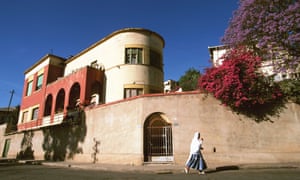
A villa in Eritrea’s capital, Asmara. This year, Eritreans have made up the third largest group of migrants trying to cross the Mediterranean to Europe. Photograph: Stefan Boness
Kemal and Mohammed have never met, but until recently their lives were typical of a peaceful, comfortable existence in middle-class
Eritrea.
Idyllic childhood evenings were spent playing football in the winding, sun-swept streets of the capital, Asmara. As they got older, they passed time sipping coffee or eating pisseti – mini pizzas – in the art deco cafes that dot the city, or at popular cinemas built when Eritrea was an Italian colony. Then came university, and eventually jobs as civil servants, following in the footsteps of their parents.
But a wild diversion in their lives this year provides a glimpse into two sides of life in Eritrea, one the world’s most secretive, closed-off states.
A
500-page United Nations report released in June describes a country where the government wields absolute power through an extensive surveillance network, torture, forced disappearances and indefinite military service. State control is so pervasive that one citizen said: “When I am in Eritrea, I feel that I cannot even think because I am afraid that people can read my thoughts.”
The figures are disputed, but the UN says up to 5,000 Eritreans flee each month. The EU’s border agency says the number of Eritreans reaching its shores
tripled to some 35,000 last year – although some warn numbers may be inflated by migrants who claim to be Eritrean to improve their chances of gaining asylum.
Aged 33 and 26 respectively, Kemal and Mohammed recently joined the exodus, but together their stories paint a complex picture: Kemal left to pursue business opportunities in South Sudan, while Mohammed’s journey to Sudan marked the end of a harrowing few months of imprisonment and torture.
Their stories tell differing but interlinked accounts about conditions in the country today – a topic of fierce debate that divides the growing Eritrean diaspora, with many keen to defend the regime.
Thanks to the 30-year war with Ethiopia for independence, the country’s government is closely tied to the fight for freedom. Both men say the older generation – at home and abroad – are more likely to be staunchly loyal to the government while a newer, younger movement has begun to agitate to for change.
Pint
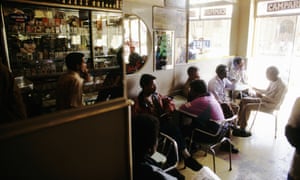
Men in a cafe in Asmara. Much of the city’s architecture was built by Italian colonisers in the 1930s. Photograph: Ed Kashi/Corbis
‘I wish to return’
Kemal’s story differs from that of most Eritrean exiles. He says his time doing compulsory national service was uneventful, working for a few months as a civil servant in the capital, and avoiding the hard labour and indefinite service that others have described.
His only brushes with the authorities came during trips to the countryside when soldiers at the checkpoints surrounding the city would ask to see his identity card.
He says that since leaving his mountain-top home for Juba – South Sudan’s scruffy capital nestled in the Nile Valley – he has missed the daily pleasures of his home city, such as walking to work on palm-lined streets as the cathedral bells rang out.
“Downtown Asmara – it’s full of beautiful things; the cafeterias, the smell of fresh roasted coffee in the mornings,” says Kemal, who is planning a return home later this year.
Rather than political pressure, it was Eritrea’s crumbling economy that forced Kemal out. Crippling UN sanctions
have been in place since 2009 following reports that the government, led by president Isaias Afwerki, was training the Somali Islamist group al-Shabaab, an allegation it strongly denies.
“Every Eritrean isn’t necessarily clamouring for elections,” said Richard Reid, a professor specialising in the country, where he lived for a decade and periodically returns to. “There’s a large percentage who will tolerate the politics as long as the economy is growing.”
A ban on carrying foreign currency has seen a thriving black market spring up, with exchange rates vastly out of kilter with official values. This, in turn, has hit businesses hard in a country that imports almost everything.
“I left Eritrea for business purposes. The system there couldn’t provide us work, so I chose to work somewhere else,” says Kemal, who also runs a small business on the side. “Here in South Sudan it’s much better.”
A large percentage will tolerate the politics as long as the economy is growing
Repression
Mohammed’s decisions were shaped by entirely different motives. Money wasn’t the problem – he had long been used to doing small jobs on the side to boost his 700 nakfa ($66) a month salary as a civil servant.
But in May this year, his life changed. One evening he was standing outside a ministry building after work, using its Wi-Fi network to connect to the internet on his phone. “It was almost getting dark when I noticed two young men passing close to me. Sometime later, they came again from a different direction.” The third time, the men stopped in front of him and confronted him directly: what exactly was he doing?
Panicked, Mohammed told them he lived in the neighbourhood. The men threatened to take him to prison, without telling him why. “I guess someone living in one of the houses close to the office must have seen me and reported me to them,” he said.
Over the next few weeks Mohammed’s apprehension grew as he frequently noticed the same two men when travelling to work, or loitering outside his family home. He feared it was because he had so far avoided being conscripted for compulsory military service.
The programme has been labelled as
modern-day slavery by some rights groups, and a former diplomat said conscripts are often used to carry out back-breaking work for infrastructure programmes.
A government spokesperson did not respond to requests for comment, but Eritrea has repeatedly dismissed claims of rights abuses.
“Although a person may … be at real risk of mistreatment or inhuman and degrading treatment as a result of the conditions of military service, it cannot be said that every single person [is at risk],” the Home Office noted in a March 2015 report.
Still, a telling clue about the fear which conscription provokes in many people comes in the next sentence: “The application of any such harm or mistreatment appears to be arbitrary.”
Mohammed and two friends decided it was time to make the dangerous trek to Sudan rather than risk being conscripted.
But decades of struggle and skirmishes with neighbours have resulted in a tightly guarded border, and they were soon captured by men in uniform. The soldiers stripped them of their money and phones. When they forced them to take off their shoes, Mohammed assumed it was to prevent them from escaping – but worse was to come.
The soldiers said they were taking them to
Hashferay. Later, he says he was glad he did not realise then that they were referring to the notorious prison where thousands of Eritreans are said to be held.
When the shackled prisoners were dragged out of the truck they found themselves in front of a series of rocky mountains dotted with thorny acacia trees. Situated near the town of Haqaz, their cells were underground. By day they carried water and moved rocks for construction projects, or worked on farms in the sweltering heat. Meals were bread and water twice a day. At night, they slept crowded together “like matchsticks”, Mohammed said.
Escape was impossible: without shoes, rocks and thorns pierced their feet, making travel by foot out of the question. Guards would sometimes punish people by forcing them to run around the thorn-strewn ground beneath the trees.
By the time Mohammed was transferred to a military training camp in the north-eastern city of Nakfa three months later, he had seen enough. One night he and another friend escaped under cover of darkness and spent several weeks journeying to Sudan.
“If I had stayed in Eritrea, everything there would have started to seem normal,” said Mohammed, who worries about his family members still back at home.
“I had to do this to be free.”
--
More here:
Guardian Africa series: Inside Eritrea
Follow three days of coverage devoted to getting a deeper look at the country making the headlines for all the wrong reasons. Here are some highlights:
In 1991 Eritrea emerged from a 30-year war with neighbouring Ethiopia. For decades the small east African country had fought for its independence, and when it was finally won its 6 million people were full of hope for a bright, free future.
But 24 years later Eritrea has become known as “
Africa’s North Korea”, and its citizens are fleeing in their thousands to escape a repressive government. Eritreans now make up the
third largest group of people embarking on the perilous Mediterranean crossing to Europe, after Syrians and Afghans, with 5,000 said to leave every month.
Refugees speak of their home as an “open prison” in a paranoid political climate where the government allows no elections, where torture is routine, and all media beyond the state sanctioned newspapers and TV
has been wiped out.
In response to the worsening crisis, in June the
United Nations released its first comprehensive investigation into the country, collecting the testimonies of 550 people. It reported “systematic, widespread and gross human rights violations have been and are being committed”, and found a country “in a permanent state of anxiety”.
With international journalists routinely refused access and little reliable news emerging from the country, the
Guardian Africa network is devoting three days of coverage to better understand what is happening inside Eritrea.
(...)
--
What you need to know about Eritrea – the Guardian briefing
Repression, torture and defections in droves – why thousands of refugees are abandoning the small Horn of Africa state every month
What’s the story?
Hundreds of thousands of Eritreans are voting with their feet and embarking on a perilous journey north through Sudan and Libya or to Egypt and Israel, their goal to eventually reach safer destinations in Europe. An estimated 5,000 people leave the small Horn of
Africa country every month, fleeing the highly repressive regime run by president Isaias Afwerki.
Why do so many Eritreans leave?
Eritreans have been leaving the country for years to escape repression, but recent refugees say they are fleeing an intensified recruitment drive into the mandatory and indefinite national service.
(...)
Just how repressive is the regime?
In its report,
the UN commission found that systematic, widespread and gross human rights violations are being committed by the Eritrean government: rights and freedoms are severely curtailed, without the rule of law. The commission also found violations in the areas of extrajudicial executions, torture (including sexual torture), national service and forced labour may constitute
crimes against humanity.
(...)
Where can I find out more?
Anyone interested in Eritrea should read Michela Wrong’s engrossing book,
I Didn’t Do it For You, which chronicles the country’s turbulent history from its days as an Italian colony, its time as a UN trust territory, and its 30-year struggle for independence from Ethiopia. The
UN commission report also delves into the grim human rights situation in Eritrea in exhaustive detail.
The
Guardian Africa network will also be devoting three days of coverage to the country now being called “Africa’s North Korea”. From reports on migration, political opposition and media, the series will also focus on life inside the country, looking at sport, music and the capital’s architecture, along with diaspora experiences.
You can also follow and contribute to our coverage on Twitter using
#GuardianEritrea.
--
In French, you can also follow the great work from
Leonard Vincent to know more about life of Eritreans outside Eritrea:
https://erythreens.wordpress.com/
Avant et après la publication du récit intitulé "Les Erythréens" en janvier 2012 aux éditions Rivages, son auteur a tenu un journal un peu particulier.
Notes d'écriture, impressions de voyages, confessions et réflexions sur l'investigation et le journalisme ont peu à peu fait place à la chronique incertaine de l'actualité de la petite Erythrée, cette dictature perdue de la Corne de l'Afrique.