22/04/2016

3D printing the Ancient World


Palmyra's Arch of Triumph recreated in Trafalgar Square


Faithful copy of ancient Syrian monument destroyed by Isis will stand in central London for three days

A monumental recreation of the destroyed Arch of Triumph in Palmyra, Syria, has been unveiled in London’s Trafalgar Square.
The 1,800-year-old arch was destroyed by Islamic State militants last October and the 6-metre (20ft) model, made in Italy from Egyptian marble, is intended as an act of defiance: to show that restoration of the ancient site is possible if the will is there.

Italian workers in Carrara build the arch from marble.
FaceboowiterPinterest

 Italian workers in Carrara build the arch from marble. Photograph: Marco Secchi/Getty Images

It was unveiled by the mayor of London, Boris Johnson, who said people were there in solidarity with the people of Syria and “in defiance of the barbarians who destroyed the original”.
He said: “For 2,000 years Palmyra stood in a desert, for 2,000 years warriors, generals, conquerors have come and gone. All of them have brought their languages and cultures and religions and deities and each succeeding generation has found something to admire in the inheritance when they arrived.
“The temples of Mesopotamian divinities became Greek temples then Roman temples then churches and then mosques ... and they admired that arch, no one was so savage, so nihilistic, so pitifully inadequate as to want to destroy it.”

He congratulated Oxford’s Institute for Digital Archaeology (IDA), which is behind the project. “How many digits do Daesh [Isis] deserve? Two digits to Daesh from London!”
Roger Michel, director of the IDA, said: “No one would have seriously considered leaving London in ruins after the blitz.
“Monuments – as embodiments of history, religion, art and science – are significant and complex repositories of cultural narratives. No one should consider for one second giving terrorists the power to delete such objects from our collective cultural record. 
“When history is erased in this fashion, it must be promptly and, of course, thoughtfully restored.”
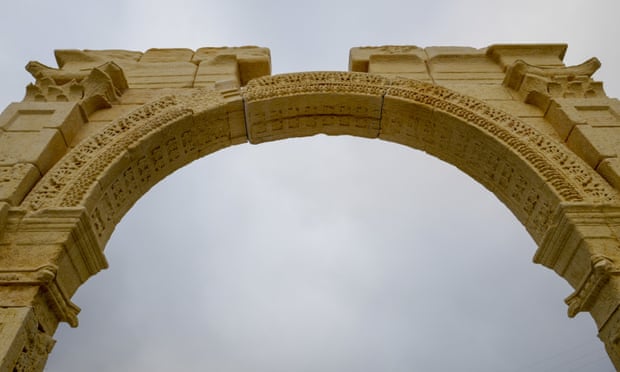
Detailed carvings on the arch.
Pinterest
 Detailed carvings on the arch. Photograph: Marco Secchi/Getty Images
The arch, weighing 11 tonnes, 
was unveiled after a six-hour installation process.


The reconstruction of the arch nears completion in Trafalgar Square.
Pinterest
 The reconstruction of the arch nears completion in Trafalgar Square. Photograph: Stefan Rousseau/PA
Maamoun Abdulkarim, director general of Syria’s antiquities and museums, said the recreated arch served as a model for how Palmyra would be restored in what would be a message of peace.
“The life of the Syrian people rests on their cultural identity, and Palmyra represents one of the most unique and exceptional cultural heritage sites, not just in Syria but the whole world. 
“We know that the plans to restore Palmyra to its former glory are grand, but they can be realised if the task is treated as a global mission.”
An archive picture from 2014 showing the Arch of Triumph.
Pinterest
 An archive picture from 2014 showing the Arch of Triumph. Photograph: Joseph Eid/AFP/Getty Images
The arch is being installed as part of World Heritage Week and will stand in London for three days before being put on public display in Dubai and New York.
The IDA said it had been both an engineering and digital technology challenge.
Alexy Karenowska, who led the IDA team, said it would provide people with a chance to celebrate the rich history of north Africa and the Middle East. 
“Without reconstructions, destroyed sites will, in time, be swallowed by the sands and forgotten, and with them the history for which they provided the last remaining visual cues. 
“The IDA is dedicated to resisting that cycle and helping to preserve the history of a region that defined the artistic, literary, scientific and architectural traditions of the world.”

--

See also the videos and interviews here:

http://www.theguardian.com/culture/2016/apr/19/palmyras-triumphal-arch-recreated-in-trafalgar-square


21/04/2016

Dancing to the Music...


"Il faut avoir une musique en soi pour faire danser

 le monde."

- Friedrich Nietzsche


"You need a music inside of you to make the 

world dance" 


--


“And those who were seen dancing were 

thought to be insane by those who could not 

hear the music.” 

Friedrich Nietzsche


“We should consider every day lost on which 

we have not danced at least once.” 

Friedrich Nietzsche


--


"The solar system watches in wisdom

The children dance as the moonlight 

kissed them"...


- 'Blue Lines'


20/04/2016

Sur la situation des migrants en Grèce

20.Avil

Grèce : WAHA recentre son activité sur la Grèce continentale pour répondre aux besoins des migrants

Depuis la signature d'un accord entre l'Union européenne et la Turquie, fin mars, le nombre d'arrivées d'étrangers fuyant des conflits a diminué en Grèce. Néanmoins, des dizaines de milliers de réfugiés sont encore coincés en Grèce, où ils ont besoin d'aide humanitaire et en particulier médicale.
 

Sur les îles de Lesbos et de Chios, à l'est des îles grecques de la Mer Egée, les bateaux arrivant à l'horizon sont de moins en moins nombreux depuis le début du mois d'avril. Mais les hotspots sont toujours remplis, comme celui de Moria à Lesbos et celui de Souda à Chios. 50 000 migrants, potentiels demandeurs d'asile, sont toujours présents sur le territoire grec, dont plus de 10 000 au nord du pays, près de la frontière macédonienne, désormais fermée.
Les équipes de WAHA sont toujours présentes en Grèce néanmoins, car les besoins médicaux restent importants. Nous sommes désormais présent de Thessalonique aux îles du Dodécanèse, en passant par Athènes. A Lesbos, nous sommes présents dans le port et dans le camp de Kare Tepe ainsi que dans une clinique fixe, car de nombreux migrants vivent encore en dehors des hotspots et ont besoin de soins médicaux.
Au nord du pays, WAHA a développé ses activités à partir du camp de Cherso, près de Thessalonique, depuis fin février, et est également présente dans le camp de Diabata et à Thessalonique même. A Athènes, nous travaillons dans les camps d'Elliniko et d'Elleonas
Nous recrutons d'ailleurs de nouveaux médecins grecs pour certaines de nos missions avec l'Elite Rescue Team et l'Association des Médecins grecs. Nous travaillons bien sûr toujours en accord avec le haut Commissariat de l'ONU pour les réfugiés (HCR).


19/04/2016

'The Banksy Job'


Trailer For Tribeca’s Controversial Documentary, ‘The Banksy Job’


This rather controversial documentary called The Banksy Job follows “art terrorist” AK47 as he plans a heist to steal a piece of Central London artwork by Banksy... says the press.
 Why? Because the enigmatic Banksy didn’t sign a print for AK47. The film follows the heist, which was pulled off in broad daylight and the response to the theft and subsequent ransom, which was for it to be stolen right out from under AK47’s nose.
Deadline dropped the trailer for The Banksy Job on Friday, hyping up the Sunday Tribeca debut of the documentary. 

18/04/2016

about urban art


Street art, urban art, graffiti?
Whatever you call it, urban art is constantly evolving and challenging the meaning and means of contemporary art.

Soon in paris :


The First Ever International Street Art Fair Is Heading to Paris


Vermibus, Ceniza Y Sed, Solvent on Original Advertising Poster, 120 x 170cm, 2015 - © OPEN WALLS Gallery 2015, Courtesy Private Collection – Paris. Presented by OPEN WALLS Gallery, Berlin

PJ is back


“As a creative artist it’s crucial to be open - to feel. You can’t do it with a closed heart. You almost have to hand over your soul to that action.” - PJ Harvey 


--

PJ Harvey - The Community Of Hope


--

Album trailer:


17/04/2016

Between west and east


U.S. Plans to Step Up Military Campaign Against ISIS


People fled their homes during fighting between Iraqi security forces and the Islamic State in Hit, a city in the Anbar Province, on Wednesday. 
(Khalid Mohammed/Associated Press)
Credit


ABU DHABI, United Arab Emirates — The Obama administration is preparing to broaden its military campaign against the Islamic State in Iraq and Syria by increasing the number of Special Operations forces who advise Syrian rebels, and it is also considering the addition of Army attack helicopters to the fight against militants in Iraq.
The goal would be to accelerate what United States officials said on Saturday was momentum behind Iraqi security forces and American-backed rebels in Syria fighting the terrorist organization.
Inside Syria, the administration is prepared to add dozens of Special Operations forces to the 50 who now advise and assist Syrian rebels fighting the Islamic State, say three Defense Department and military officials. The additional trainers, who could total as many as 200, would be able to expand their instruction to Syrian Arab fighters, who are likely to play a pivotal role in capturing Raqqa, the Islamic State’s de facto capital in Syria, the officials said.
The administration’s plans for Iraq are more complicated.
Pentagon officials would like to increase efforts to advise and train Iraqi security forces for the anticipated assault on Mosul, Iraq’s second largest city and the Islamic State’s main stronghold in the country. The plan calls for shifting trainers who are already in the country to positions closer to Mosul, the officials said. They would also like to deploy Apache helicopter gunships — which are already in Iraq, but used only to protect American personnel — and order them to participate in the battle for Mosul.
But the government of Iraq’s prime minister, Haider al-Abadi, has been battling internal political turmoil. His challenges include political opponents, rampant corruption and an economy weakened by low oil prices.
The military options under consideration — which could be announced in the next several days — were described by five Defense Department and military officials who spoke on the condition of anonymity because final decisions are pending in Washington and Baghdad. Administration officials said on Saturday that announcing or even proposing increased American assistance is a delicate diplomatic task that could further imperil Mr. Abadi’s position.
Defense Secretary Ashton B. Carter made clear on Saturday that the administration will increase its military efforts to defeat the Islamic State, also known as ISIS or ISIL, but he did not discuss specifics.
“You should expect us, to see us, doing more,” he said at a news conference at the Al Dhafra air base as he opened travels in the Middle East. “It will be consistent with the same approach, but it’ll be across all the domains, right up to cyber.”
Mr. Carter described the administration’s approach as one that will use members of the American armed services to help accelerate the military campaign against the Islamic State, but will not replace Iraqi security forces or Syrian rebels.
There are roughly 5,000 American service members in Iraq, according to current Pentagon estimates, but the number often varies, sometimes daily, by hundreds.
Mr. Carter’s comments come at a time when Iraqi militias and military forces have been making notable progress on the battlefield against the Islamic State, including seizing parts of Hit, a city in Anbar Province, this month.
Last Wednesday, Col. Steven H. Warren, the military spokesman in Iraq, said that the initial phase of the American-led campaign against the Islamic State, with the intent of degrading or weakening the fighters, was complete, and that allied forces were in the second phase of the operation.
“During this phase, we will enable our partners to dismantle the enemy, fragment his forces, isolate his centers of gravity and liberate the terrain he holds,” he said.
But even as the campaign against the Islamic State is showing gains in Iraq and Syria, the group’s franchises in places like Libya, as well as its external operations in Europe, are increasingly lethal.
On Saturday, Mr. Carter met with American service members, including pilots, who are stationed at the Al Dhafra air base and are part of the air campaign over Iraq and Syria. He said that in the coming days he would be meeting with American commanders leading the efforts to defeat the Islamic State.
“We continue to look for, and identify ways of accelerating that, and as we find those we will do them,” Mr. Carter said, adding that the administration would seek the approval of Iraqi government there.
Mr. Carter said that gaining the support of President Obama to do more in Iraq has not been an obstacle.
“We’ve gotten approval from the White House every time the chairman and I have gone to ask for something that we’ve needed to accelerate going way back to last year,” Mr. Carter said, referring to the chairman of the Joint Chiefs of Staff, Gen. Joseph F. Dunford, Jr., who will also be traveling in the region in the coming days. “So that isn’t really the issue for us, the issue for us is yet identifying more ways to accelerate the campaign.”

In Bristol soon


SALT.

Selina Thompson

12-13 & 18-19 May


“… where our real home might be is tricky to say. In a way that is the point. Some people say that is the body, but I think the body is more a channel that leads us home. Ultimate reality is our home. It is here and now, and it is not a special piece of what is happening. We imagine that we are on a journey, that life is a journey, but we are home from the beginning. This is not an easy thing to accept.”

In February, two artists got on a cargo ship, and retraced one of the routes of the Transatlantic Slave Triangle – from the UK to Ghana to Jamaica, and back.
Their memories, their questions and their grief took them along the bottom of the Atlantic and through the figurative realm of an imaginary past.
It was a long journey backwards, in order to go forwards.
This show is what they brought back.
Commissioned by Yorkshire Festival, Theatre Bristol and MAYK. Supported by Arts Council England, and 200 kind and generous supporters who donated towards our voyage across the Atlantic.

Iraq - these days


 "Even by our most conservative estimates, this could be the largest population movement anywhere in the world this year".  
Lise Grande, UN's humanitarian coordinator for Iraq

MIDDLE EAST

Iraq's humanitarian workers brace for Mosul influx

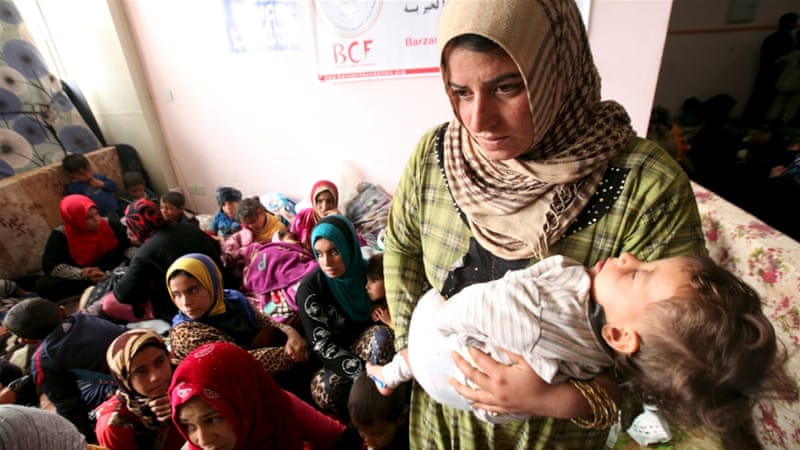
The battle for Mosul is expected to drive hundreds of thousands more people towards Iraq's Kurdish region.

Campbell MacDiarmid |  | Middle EastIraqISIS

More than one million of the 3.4 million displaced people across Iraq have sought refuge in Kurdish areas [Azad Lashkari/Reuters]
--
More soon

Iraq: The endless war...


Analysis from The Economist:

http://www.economist.com/news/middle-east-and-africa/21696951-long-fight-retake-iraqs-second-biggest-city-mosul-has-begun-last


Islamic State in Iraq

The last battle

The long fight to retake Iraq’s second-biggest city, Mosul, has begun


--


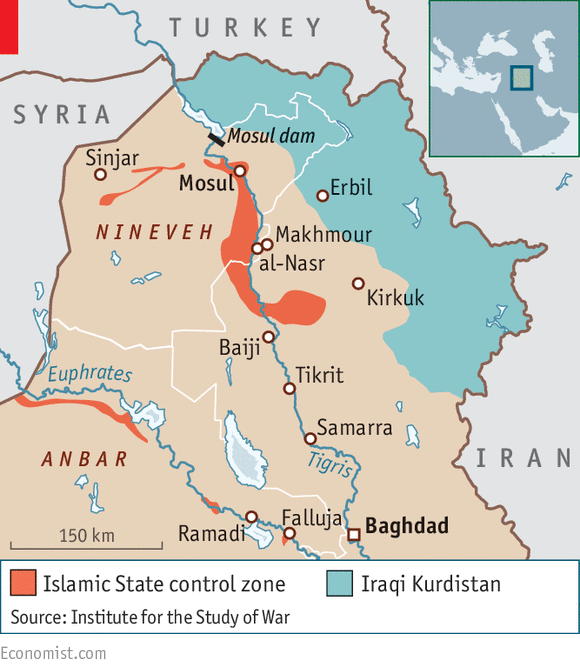
IT WAS not an auspicious start. On March 24th the government in Baghdad announced the beginning of operations to retake the city of Mosul, Iraq’s second largest, from Islamic State (IS). The first phase went well. An Iraqi force of about 5,000 quickly overran several villages. But within a few days progress stalled, when a counter-attack by no more than 200 IS fighters resulted in the loss of the village of al-Nasr and the high ground it sits on. Some 20 Iraqi soldiers were killed. An American marine also died from a rocket attack on a small American “fire base”, established to provide artillery support, an indication of America’s expanding role in the conflict.
Iraqi officials still talk positively about pushing IS out of Mosul before the end of the year. It is a big prize: the mainly Sunni Arab city had a population of 2m when it fell to IS in June 2014, and is the key to regaining control of the northern province of Nineveh. But the setback at al-Nasr has been a reality check. Just to take and hold al-Nasr, the local operations command says it needs to bring in more tribal fighters and police.
Military analysts reckon there is, in fact, little prospect of a concerted attempt to regain Mosul before 2017. Michael Pregent, a former Intelligence Officer who served as an adviser to Kurdish peshmerga fighters in 2005-06 and worked with Sons of Iraq during the 2007 surge (and is now at the Hudson Institute, a think-tank), says no force large enough to do the job has been built. One under-strength Iraqi division with some American military advisers will not cut it. Pentagon sources reckon that a force of at least 40,000 will be needed.
The problems do indeed appear immense. Iraqi intelligence puts IS’s fighting strength in Mosul at around 10,000, although the Americans think that the number is dwindling as IS comes under pressure elsewhere. Whatever the precise figure, IS has had the best part of two years to build multilayered defences. Mr Pregent says that although there are reasonably capable peshmerga forces to the east of Mosul that can help, these units have little interest in trying to take a city that will never be a part of Kurdistan and in which their presence would provoke ethnic tensions.

The Shia question

The same concerns, only more so, apply to the Shia-dominated Hashd al-Shaabi, or Popular Mobilisation Units. Their leaders claim that it will be impossible to regain control of Mosul unless they are involved. However, when Iraqi security forces (ISF) drove IS out of Ramadi, the capital of largely Sunni Anbar province, earlier this year, the Baghdad government, under pressure from the Americans, ordered the Hashd, some of which are trained by Iran, to stay away. They did not want a repeat of the sectarian reprisals that marred the retaking of another Sunni city, Tikrit, last year.
There are other risks in deploying the Hashd for the assault on Mosul. In a survey carried out in February by an Iraqi polling firm that included 120 respondents in Mosul, 74% said they did not want to be liberated by the mainly Shia Iraqi army on its own, while 100% said they did not want to be liberated by Shia militias or Kurds. That does not mean Mosul’s inhabitants support IS—according to a nationwide survey in January, 95% of Iraqi Sunnis oppose it—but it does suggest that they are at least as fearful of their potential liberators as they are of their oppressors. One solution would be to bring more Sunnis into the Hashd, but it will be hard to rebalance a force that consists of some 120,000 Shias and only about 16,000 Sunnis.
Mr Pregent says that the force that eventually goes to Mosul must be mostly Sunni. He argues that it should be recruited from among the American-trained soldiers and officers who were purged from the army by the former prime minister, Nouri al-Maliki. He reckons that there are as many as 50,000 such men, some of them sitting in camps for internally displaced people, who, with an offer of some back pay, would be keen to join up.
Another factor in the battle for Mosul will be the size and role of American forces. Air strikes are a given, but the Pentagon has said that it wants to set up more fire bases of the kind that came under attack last month. Both Ashton Carter, the defence secretary, and General Joe Dunford, the chairman of the joint chiefs of staff, have put forward plans that are believed to include, among other things, the deployment of more special forces and Apache helicopter gunships. These could operate from a new airbase at Erbil, 20 minutes’ flying time from Mosul, if allowed to do so by the Iraqi Kurdistan authorities.
However, the White House has yet to agree. Barack Obama’s pledge of no “boots on the ground” has worn thin, but there is little indication that he is ready to sanction military support on the scale needed to regain Mosul. That may have to wait until the election of a new president—another reason to suppose that Mosul will be in IS hands until next year.
The enemy also gets a vote, at least on the battlefield. Patrick Martin of the Institute for the Study of War, a think-tank in Washington, DC, notes that a recent spate of spectacular suicide-attacks by IS in the south suggests that its strategy is now to destabilise Iraq’s southern provinces, thus putting pressure on the Iraqi army and the Hashd to restrict their operations in the north and west. IS knows that the fall of Mosul will signal, in effect, its defeat in Iraq; so it is determined to delay that moment for as long as it can. It may one day lose its bloody grip on the city. But when, how and at what cost it will be liberated, remains to be seen.
--