Journalist at RFI (ex-DW, BBC, CBC, F24...), writer (on art, music, culture...), I work in radio, podcasting, online, on films.
As a writer, I also contributed to the New Arab, Art UK, Byline Times, the i Paper...
Born in Paris, I was based in Prague, Miami, London, Nairobi (covering East Africa), Bangui, and in Bristol, UK. I also reported from Italy, Germany, Haiti, Tunisia, Liberia, Senegal, India, Mexico, Iraq, South Africa...
This blog is to share my work, news and cultural discoveries.
Since the attacks launched by the Islamic State / Daesh in Northern Iraq, thousands of Iraqi, mainly Arabs, had to flee and seek refuge in the northern province of Kurdistan.
Here about 6.000 Iraqi are living in the Debaga camp set up for Internally Displaced People (IDPs).
Most of them are children.
The United Nations is worried that displacement will increase massively in the coming week as Iraqi forces and the international coalition plan to chase ISIS out of the stronghold in Iraq, Mosul. Mosul in the second largest city in Iraq and a few kilometers away from Erbil, Iraq Kurdistan's provincial capital.
Secretary of State John Kerry’s visit to Iraq last week underlined the folly of continued U.S. involvement there, 13 years after America’s second invasion.
The United States still has 4,000 troops in Iraq, nearly five years after President George W. Bush agreed with the then-Iraqi government that all U.S. troops would be withdrawn by the end of 2011. President Obama pledged to end the war in Iraq as part of his 2008 election campaign, a promise he has not fulfilled, bending to pressure from the Pentagon and Washington’s other advocates of a continued U.S. military presence.
In principle, U.S. troops are in Iraq in the context of advising and supplying Iraqi armed forces, not in a combat role. However, it emerged last month that Marines maintain an independent fire base in northern Iraq and are expected to play a critical role in carrying out the plan of Iraqi forces to free Mosul, the country’s second-largest city, from Islamic State in Iraq and Syria control. ISIS has held Mosul since June, 2014.
The Iraqi government of Prime Minister Haider al-Abadi has its own problems, considered largely to be a result of the actions of its Shiite Muslim leadership in monopolizing authority in Baghdad, excluding the 35-percent Sunni Muslims who ruled the country from 1932 to the U.S. invasion in 2003. That piece of unwise religious discrimination is bad enough in itself, but it is joined by serious pushing and shoving among the Shiites themselves.
Muqtada al-Sadr, a figure from the period of U.S. occupation who caused a lot of trouble back then, has now invaded the fortified Green Zone, which includes the American Embassy as well as significant parts of the Iraqi government, in pursuit of his goals. He wants more political influence than he has already and has set up a tent inside the Green Zone, which the predominantly Shiite Iraqi armed forces did not prevent him from doing.
The Abadi government that the United States supports now faces Mr. Sadr’s Shiite Mahdi Army, the forces of ISIS, and the remnants of al-Qaeda in Iraq, as well as the increasingly independent, heavily U.S.-armed secessionist Kurds in the north. The hard question to answer is why America is still there, holding the bag. Maybe Mr. Kerry has figured it out.
Operations began last month to retake Nineveh province, including Mosul, from the Islamic State of Iraq and the Levant (ISIL, also known as ISIS) group.
ISIL took control of Mosul, Iraq's second-largest city, in June 2014. The town of Makhmour, around 75km southeast of Mosul, is among the frontlines of the operation to reclaim it. Here, the Iraqi army and Kurdish Peshmerga forces have been holding the line as battle preparations continue.
Since the operation began, an increasing number of displaced people have been streaming into Iraq's Kurdish region, seeking refuge. The influx is expected to continue in the months ahead.
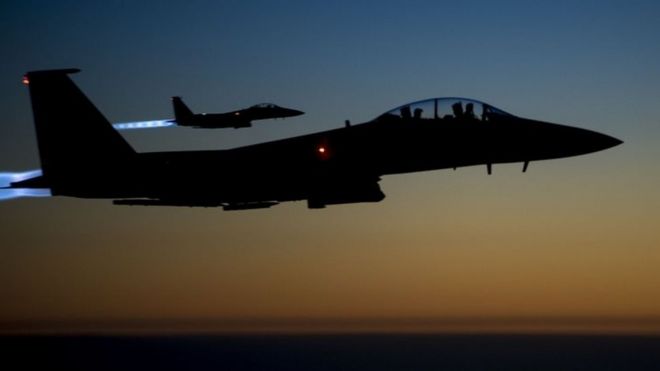
Image copyrightUS Air ForceImage captionThe US military has carried out nearly 12,000 air strikes in Iraq and Syria since 2014
US air strikes aimed at Islamic State militants killed 20 civilians between September and February in Iraq and Syria, the US military has admitted.
US Central Command identified nine separate strikes - six in Iraq and three in Syria.
It said it deeply regretted the unintentional loss of life.
It said a total of 41 civilians had been killed since the air strikes began in 2014. Some human rights groups say the figure is much higher.
Announcing the results of several investigations, US Central Command said "the preponderance of evidence" indicated that 20 civilians were killed and 11 other wounded in the strikes between 10 September 2015 and 2 February 2016.
The heaviest casualties were in October, when eight civilians died in an attack in Atshanah in northern Iraq. The US military did not provide further details of that strike.
It also said that five civilians were killed in a strike on a suspected IS target in Ramadi last December.
The civilians "unexpectedly moved into the target locations after weapons were already in flight," the military said.
Central Command spokesman Col Patrick Ryder said the US deeply regretted the casualties.
He added that the US operation was "the most precise air campaign in the history of warfare".
Washington says it has carried out nearly 12,000 air strikes since it launched its operation in Iraq in August 2014 and a month later in Syria.
Faithful copy of ancient Syrian monument destroyed by Isis will stand in central London for three days
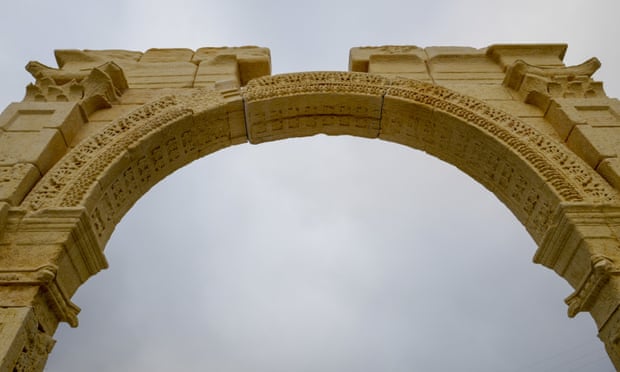
A monumental recreation of the destroyed Arch of Triumph in Palmyra, Syria, has been unveiled in London’s Trafalgar Square.
The 1,800-year-old arch was destroyed by Islamic State militants last October and the 6-metre (20ft) model, made in Italy from Egyptian marble, is intended as an act of defiance: to show that restoration of the ancient site is possible if the will is there.
Italian workers in Carrara build the arch from marble. Photograph: Marco Secchi/Getty Images
It was unveiled by the mayor of London, Boris Johnson, who said people were there in solidarity with the people of Syria and “in defiance of the barbarians who destroyed the original”.
He said: “For 2,000 years Palmyra stood in a desert, for 2,000 years warriors, generals, conquerors have come and gone. All of them have brought their languages and cultures and religions and deities and each succeeding generation has found something to admire in the inheritance when they arrived.
“The temples of Mesopotamian divinities became Greek temples then Roman temples then churches and then mosques ... and they admired that arch, no one was so savage, so nihilistic, so pitifully inadequate as to want to destroy it.”
Roger Michel, director of the IDA, said: “No one would have seriously considered leaving London in ruins after the blitz.
“Monuments – as embodiments of history, religion, art and science – are significant and complex repositories of cultural narratives. No one should consider for one second giving terrorists the power to delete such objects from our collective cultural record.
“When history is erased in this fashion, it must be promptly and, of course, thoughtfully restored.”
The reconstruction of the arch nears completion in Trafalgar Square. Photograph: Stefan Rousseau/PA
Maamoun Abdulkarim, director general of Syria’s antiquities and museums, said the recreated arch served as a model for how Palmyra would be restored in what would be a message of peace.
“The life of the Syrian people rests on their cultural identity, and Palmyra represents one of the most unique and exceptional cultural heritage sites, not just in Syria but the whole world.
“We know that the plans to restore Palmyra to its former glory are grand, but they can be realised if the task is treated as a global mission.”
An archive picture from 2014 showing the Arch of Triumph. Photograph: Joseph Eid/AFP/Getty Images
The arch is being installed as part of World Heritage Week and will stand in London for three days before being put on public display in Dubai and New York.
The IDA said it had been both an engineering and digital technology challenge.
Alexy Karenowska, who led the IDA team, said it would provide people with a chance to celebrate the rich history of north Africa and the Middle East.
“Without reconstructions, destroyed sites will, in time, be swallowed by the sands and forgotten, and with them the history for which they provided the last remaining visual cues.
“The IDA is dedicated to resisting that cycle and helping to preserve the history of a region that defined the artistic, literary, scientific and architectural traditions of the world.”
Grèce : WAHA recentre son activité sur la Grèce continentale pour répondre aux besoins des migrants
Depuis la signature d'un accord entre l'Union européenne et la Turquie, fin mars, le nombre d'arrivées d'étrangers fuyant des conflits a diminué en Grèce. Néanmoins, des dizaines de milliers de réfugiés sont encore coincés en Grèce, où ils ont besoin d'aide humanitaire et en particulier médicale.
Sur les îles de Lesbos et de Chios, à l'est des îles grecques de la Mer Egée, les bateaux arrivant à l'horizon sont de moins en moins nombreux depuis le début du mois d'avril. Mais les hotspots sont toujours remplis, comme celui de Moria à Lesbos et celui de Souda à Chios. 50 000 migrants, potentiels demandeurs d'asile, sont toujours présents sur le territoire grec, dont plus de 10 000 au nord du pays, près de la frontière macédonienne, désormais fermée.
Les équipes de WAHA sont toujours présentes en Grèce néanmoins, car les besoins médicaux restent importants. Nous sommes désormais présent de Thessalonique aux îles du Dodécanèse, en passant par Athènes. A Lesbos, nous sommes présents dans le port et dans le camp de Kare Tepe ainsi que dans une clinique fixe, car de nombreux migrants vivent encore en dehors des hotspots et ont besoin de soins médicaux.
Au nord du pays, WAHA a développé ses activités à partir du camp de Cherso, près de Thessalonique, depuis fin février, et est également présente dans le camp de Diabata et à Thessalonique même. A Athènes, nous travaillons dans les camps d'Elliniko et d'Elleonas
Nous recrutons d'ailleurs de nouveaux médecins grecs pour certaines de nos missions avec l'Elite Rescue Team et l'Association des Médecins grecs. Nous travaillons bien sûr toujours en accord avec le haut Commissariat de l'ONU pour les réfugiés (HCR).


 `
`


 US Air Force