06/05/2016

Radiohead's Daydreaming


After 'Silent Spring' in December, 'Daydreaming'?!
Radiohead, we have some friends in common...


Radiohead - 'Daydreaming'


Taken from the new album released digitally on 8th May 2016 at 7pm BST.

Director: Paul Thomas Anderson
Producers: Sara Murphy, Albert Chi, Erica Frauman
Editor: Andy Jurgensen
Production Companies: Ghoulardi Film Company, m ss ng p eces

Assistant Directors: Adam Somner, Trevor Tavares
Gaffer: Michael Bauman
Key Grip: Jim Kwiatkowski
Steadicam Operator: Ari Robbins
Production Designer: Carmen Ruiz de Huidobro
Camera: Josh Friz, Aaron Tichenor, Ryan Creasy, Drey Singer, Eric Anderson
UPM: Deanna Barillari
Telecine Colorist: Gregg Garvin

CREW:
Anthony Bradshaw, Ben Brady, Bart Dion, Eric Fahy, Clark Gapen, Sean Gossen, Chad Hladki, Se Hoh, Grace Illingworth, Jessica Jazayeri, Jacob Kubabojsza, Micah Minor, Mike Misslin, Adam Morgan, Rene Parras, Jr., Peter Rybchenkov, Charlotte Townsend, Kasia Trojak, Cymbre Walk, David Yoon

http://www.radiohead.com
http://www.instagram.com/radiohead
http://www.twitter.com/radiohead
http://www.facebook.com/radiohead

Refugee Response Training: New Dates Announced


NEWS STORIES

Refugee Response Training: New Dates Announced for Summer 2016

05 May 2016
Looking out to sea, Lesbos © Amy Murrell

We are delighted to announce that RedR UK has received funding from the Stanley Thomas Johnson Foundation to support our response to the European refugee crisis. With this support, we will be running a series of two-day workshops for volunteers and grassroots organisations operating in northern France, in Serbia and in Greece, and for UK-based volunteers travelling to locations across Europe. 
In addition, we are pleased to be continuing our partnership with the Humanitarian Leadership Academy. Drawing on humanitarian professionals from INGOs working in the response, we will be delivering the two-day volunteer orientation workshop in an additional eight locations over the coming months.
The workshops will provide a crucial introduction to key considerations to ensure volunteers are able to understand the context in which they are working, and to operate more effectively while keeping themselves and those they are working with safe and secure. Read more about the project here.
Details of the workshops can be found on our course finder, which will be updated as and when dates and locations are confirmed. Currently, the following courses have been confirmed:

London, UK
Manchester, UK
Calais, France
Dunkerque, France 
Skopje, Macedonia 
Lesbos, Greece 
Belgrade, Serbia
Photo © Amy Murrell for RedR UK

05/05/2016

Kafka, writers, cities and islands


Reading back some comments about Franz Kafka for a new project, I'm reminded that one of his first trips outside of Prague was in Heligoland, the then British island, now off Germany in the Northern Sea.


Franz Kafka 

1883Am 3. Juli 1883 wird Franz Kafka in Prag geboren. Er ist das älteste Kind des Kaufmanns Hermann Kafka. Zwei nach ihm geborene Brüder sterben schon im Säuglingsalter. Seine drei Schwestern werden später von den Nazis verschleppt. Ihre Spuren haben sich verloren.  
1889-1901Nach der "Deutschen Knabenschule" besucht Franz Kafka das humanistische Staatsgymnasium. Bereits als Schüler schreibt er, vernichtet jedoch die Frühwerke allesamt. 
1901Nach dem bestandenen Abitur macht Franz Kafka Ferien auf den Inseln Norderney und Helgoland. Im Herbst nimmt er ein Studium an der Universität zu Prag auf. Er belegt Chemie, anschließend Jura. Zusätzlich besucht er Vorlesungen in Kunstgeschichte.


Here is an interesting academic article about how the island inspired writers around that time:

http://blog.wellcomelibrary.org/2013/03/the-red-white-and-green-of-germany/


The Red, White and Green of ….Germany?


04/03/2013

When we talk about our archives and manuscripts, our focus is usually on their content.  People order archive items in order to read them, by and large, and our catalogues tend to focus upon the words on the page, and their meaning, rather the detailed nature of that page.  Scholars of medieval manuscripts will also look at the physical makeup of a volume – it may, for instance, form only a part of a larger whole whose other parts are elsewhere, or have been assembled from disparate pieces years after these were written – and accordingly catalogue records for medieval manuscripts do go into more detail about this aspect of a manuscript.  In general, however, catalogue records for post-medieval material are silent about the medium on which the words are written and focus purely on their meaning.
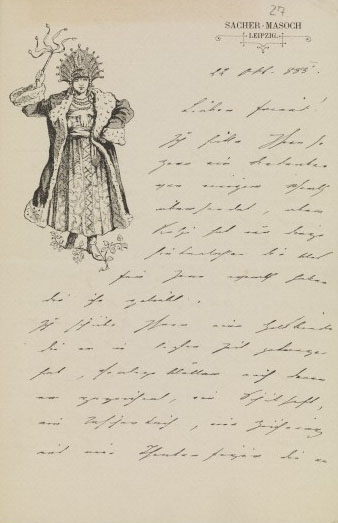
Letter from L. von Sacher- Masoch. Wellcome Images No.L0072452.
And yet, one of the abiding fascinations of archive material is its physicality: the sensation of touching the past, of contact across the centuries.  Periodically something about an archive item will wake this interest in the physical object.  It may be something as simple as the autograph of a famous person, such as Darwin or Dickens, or a doodle that catches the moment at which a thought takes shape.  Sometimes, however, it is something about the sheet of paper itself, something unrelated to the content of the words: the thick black border that marks the point that someone goes into mourning, for instance, or the letterhead that sits, often ignored, above the writing.
One such letterhead opens a window into a little-known corner of Europe, and its history.  The Library holds a collection of 98 pieces of correspondence relating to the Austrian writer Leopold von Sacher-Masoch, whose novel “Venus in Furs”, recounting a sexual relationship based on punishment and humiliation doled out by a dominant woman, is the origin of the word “masochism”. (For more detail on our Sacher-Masoch holdings see the archives catalogue here or an earlier blog posting on a twentieth-century reimagining of his fiction.)   
Sacher-Masoch’s personal letterhead is well worth a glance, showing a woman in furs brandishing a whip in a scene recalling his fiction.  In 1890, however, he writes to a friend on a printed card that was presumably readily available in the shops.  He is writing from Helgoland (or, as it is known in English, Heligoland), that chip of sandstone thirty miles off the north German coast.  The card shows a drawing of the island and below it a poem that describes the colours of the island’s flag, relating them to features of its landscape, each line in the appropriate colour.
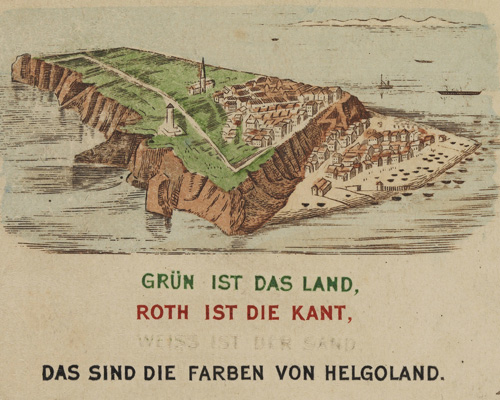
Postcard from L. von Sacher-Masoch, MS. 6909 - Item 55
Postcard from L. von Sacher-Masoch, MS. 6909 – Item 55
In translation (and losing its rhymes) it reads:
The land is green,
The cliff is red,
The sand is white:
Those are the colours of Helgoland.
The poem is in German, as is Sacher-Masoch’s letter.  Helgoland is now a German-speaking island, part of the German state of Schleswig-Holstein.  So German is it, that it was on Helgoland that the poet Heinrich Hoffmann von Fallersleben wrote the song “Deutschland Über Alles”.  However, Helgoland’s status is more complicated than it seems.  Von Fallersleben was on Helgoland when he wrote the song in 1841 because he was in political exile from Prussia, having involved himself in liberal and nationalist agitation in the turbulent, divided Germany of the time. He had come here precisely because it did not belong to Prussia or to any of the other German states of the time: it belonged to the United Kingdom.
For much of its history Helgoland was left largely alone; notionally it was part of the duchy of Schleswig-Holstein which brought it eventually under Danish rule, but it was largely ignored.  In 1807, however, it found itself in the way of global politics and was seized by the United Kingdom as a base that would enable it to maintain its blockade of Napoleonic Europe all the year round.  Like Gibraltar one hundred years before, it remained a British possession after the immediate circumstances of its acquisition had passed and in 1814 the Treaty of Kiel formally ceded it to Britain.
The British royal family, of course, had strong links to Germany at this time which may well have made possession of Helgoland seem natural.  (When I began researching this issue I was surprised to learn that the island was acquired so late and by force: I had assumed that it must have been part of the Kingdom of Hanover, which was linked to the British Crown from 1713.) This did not mean, however, that the latest colonial masters put any more resource into the island than Denmark had; it remained a footnote, without a proper harbour and with only a tiny garrison.  The strongest link to Britain was the Union Jack now inset at one corner of the island’s red, white and green tricolour flag.  By contrast, in Germany it was a subject of some interest: an enchanted island whose towering red sandstone cliffs contrasted with the low-lying, muddy Friesian coast to the south.  Visitors included the future Kaiser Wilhelm II, who fell under its spell in the 1870s; other German-speaking  intellectuals to visit included the composers Brückner and Mahler, and the writers Kafka, Kleist and – as we see – Sacher-Masoch.  And as the nineteenth-century progressed, and Germany moved toward unification, pressure grew to bring Helgoland “back” within the German ambit, Prussia’s war with Denmark in the 1860s having brought Schleswig-Holstein (and thus the “original” title to ownership of the island) under Prussian rule, although the island itself had never been part of a German state and the islanders themselves spoke Frisian, the Germanic dialect close to English that is spoken along the coast and islands of northern Germany and the Netherlands.
White sands and breaking waves on a Helgoland beach.
White sand beach at the north end of Helgoland, from Geograph.de
For much of the nineteenth-century matters remained in this state: Britain, the owner of many far-flung island colonies, largely forgetful in administrative terms of this little close-up corner of the empire; Germany, increasingly assertive of its claims to represent all German-speakers. Queen Victoria, on the British throne, opposed any proposal to hand over British subjects to another power and may well have felt a kinship with them, as someone who had strong personal links to Germany through her own family and her marriage. To the Colonial Office, Helgoland was a useless anomaly, its garrison likely only to be a burden in time of war.  As so often, Helgoland’s fate was decided by geopolitical events way beyond its control: in this case the Scramble for Africa.  Germany and the United Kingdom were both engaged in colonial activity in East Africa, in Tanganyika (German East Africa) and Kenya respectively.  British ambitions for continental dominion (and the Cape-to-Cairo railway) depended on curtailing German expansion inland, and the island of Zanzibar, off the coast of Tanganyika, was seen as a key to the area.  In the late 1880s the Prime Minister, Lord Salisbury, hatched a scheme to exchange Helgoland for Zanzibar, at that time a German protectorate, thereby, as he saw it, parting with a useless possession that happened to be craved by a colonial rival to gain something of far greater value.  Despite fierce opposition from Queen Victoria, the measure eventually passed in July 1890 and the island was handed over almost immediately, on August 10th.
Sacher-Masoch’s card thus dates from the final months of British rule over the island, a time at which German interest in the island was at its height and behind the scenes, in the corridors of power, the British government was trying to get rid of it on the most advantageous terms.   Immediately after the 1890 handover, imperial Germany set about trying to prove Britain wrong about the island’s military use by fortifying it.  A generation later, as Britain and Germany went to war, who knows what use a British fortified base not far off the German shore might have been – a red sandstone Gibraltar or Malta, a thorn in the side of the German war effort, or an indefensible outpost overrun as quickly as the Channel Islands were in 1940.  There is a counter-factual novel to be written, perhaps, set in British Heligoland in the interwar years, an enclave of holiday-makers and duty-free shoppers through which slip spies of various nations.  Perhaps the Helgolanders themselves would say nothing has changed: in this alternative history, just as in the real one, their fate is decided far away by forces beyond their control.
Images of Helgoland are by joergens_mi and Oxfordian Kissuth

-

Dr Christopher Hilton is a Senior Archivist at the Wellcome Library.


To The Sirens...


This Mortal Coil - 'Song To The Siren' (Official Video)


This Mortal Coil - 'Song To The Siren' 


On the floating, ship less oceans
I did all my best to smile
Till your singing eyes and fingers
Drew me loving to your isle

And you sang, "Sail to me
Sail to me, let me enfold you"

Here I am, here I am
Waiting to hold you


Did I dream you dreamed about me?
Were you here when I was full sail?
Now my foolish boat is leaning
Broken lovelorn on your rocks


For you sang, "Touch me not
Touch me not, come back tomorrow"

Ohh my heart, ohh my heart
Shies from the sorrow


Well, I'm as puzzled as a newborn child
I'm as riddled as the tide
Should I stand amid the breakers?
Or shall I lie with death my bride?


Songwriters
TIM BUCKLEY, LARRY BECKETT


04/05/2016

They are back


This sounds absolutely not new. Actually, I find that very few come-back songs have sounded so much like Radiohead :)

But it's definitely great.

Strings and soft rock. Lyrical voice. Text about broken society and fear taking over.... I hear some influence there.

Have a listen:


Radiohead - 'Burn The Witch'


--

“Stay in the shadows / Cheer the gallows / This is a round-up” . 

(...)

“Loose talk around tables / Abandon all reason / Avoid all eye contact / Do not react / Shoot the messenger / This is a low-flying panic attack.”


03/05/2016

West versus East


Important reminder ahead of the Sykes-Picot agreement's 100 years anniversary.
Best ever example of the damages inherited with "divide and rule" strategies.

In the New Yorker:
http://www.newyorker.com/news/news-desk/how-the-curse-of-sykes-picot-still-haunts-the-middle-east?mbid=nl_050216_Daily_Analytics&CNDID=36185179&spMailingID=8864576&spUserID=MTA5MjQwODYxMjQ2S0&spJobID=920152134&spReportId=OTIwMTUyMTM0S0


How the Curse of Sykes-Picot Still Haunts the Middle East

BY 


Anti-government demonstrators breaching the heavily fortified Green Zone, in Baghdad, on Saturday.CREDITPHOTOGRAPH BY HAYDAR HADI / ANADOLU AGENCY / GETTY

In the Middle East, few men are pilloried these days as much as Sir Mark Sykes and François Georges-Picot. Sykes, a British diplomat, travelled the same turf as T. E. Lawrence (of Arabia), served in the Boer War, inherited a baronetcy, and won a Conservative seat in Parliament. He died young, at thirty-nine, during the 1919 flu epidemic. Picot was a French lawyer and diplomat who led a long but obscure life, mainly in backwater posts, until his death, in 1950. But the two men live on in the secret agreement they were assigned to draft, during the First World War, to divide the Ottoman Empire’s vast land mass into British and French spheres of influence. The Sykes-Picot Agreement launched a nine-year process—and other deals, declarations, and treaties—that created the modern Middle East states out of the Ottoman carcass. The new borders ultimately bore little resemblance to the original Sykes-Picot map, but their map is still viewed as the root cause of much that has happened ever since.

“Hundreds of thousands have been killed because of Sykes-Picot and all the problems it created,” Nawzad Hadi Mawlood, the governor of Iraq’s Erbil Province, told me when I saw him this spring. “It changed the course of history—and nature.”

May 16th will mark the agreement’s hundredth anniversary, amid questions over whether its borders can survive the region’s current furies. “The system in place for the past one hundred years has collapsed,” Barham Salih, a former deputy prime minister of Iraq, declared at the Sulaimani Forum, in Iraqi Kurdistan, in March. “It’s not clear what new system will take its place.”

The colonial carve-up was always vulnerable. Its map ignored local identities and political preferences. Borders were determined with a ruler—arbitrarily. At a briefing for Britain’s Prime Minister H. H. Asquith, in 1915, Sykes famously explained, “I should like to draw a line from the ‘E’ in Acre to the last ‘K’ in Kirkuk.” He slid his finger across a map, spread out on a table at No. 10 Downing Street, from what is today a city on Israel’s Mediterranean coast to the northern mountains of Iraq.

“Sykes-Picot was a mistake, for sure,” Zikri Mosa, an adviser to Kurdistan’s President Masoud Barzani, told me. “It was like a forced marriage. It was doomed from the start. It was immoral, because it decided people’s future without asking them.”

For a century, the bitter reaction to the Sykes-Picot process has been reflected in the most politically powerful ideologies to emerge—Nasserism, in Egypt, and Baathism, in Iraq and Syria—based on a single nationalism covering the entire Arab world. For three years, Egypt and Syria, despite being on different continents, actually tried it, by merging into the United Arab Republic; the experiment disintegrated after a 1961 coup in Damascus.

Even the Islamic State seeks to undo the old borders. After sweeping across Syria and Iraq in 2014, Caliph Abu Bakr al-Baghdadi announced, “This blessed advance will not stop until we hit the last nail in the coffin of the Sykes-Picot conspiracy.”

Yet the premise of American policy (and of every other outside power) today—in stabilizing fractious Iraq, ending Syria’s gruesome civil war, and confronting the Islamic State—is to preserve the borders associated with Sykes-Picot. Since August, 2014, the United States has invested more than eleven million dollars a day in military operations, including almost nine thousand airstrikes on Iraq and more than five thousand on Syria. For the world’s worst humanitarian refugee crisis, which is now spilling out of Syria across countries and continents, Washington has pledged seven hundred million dollars in 2016, with more promised. The rest of the world—from Europe to the Gulf sheikhdoms, Russia to Iran—has poured billions into perpetuating the borders, even as they vie for different political outcomes.

In its final months in office, the Obama Administration is intensifying that strategy. Since April 8th, senior officials—Vice-President Joe Biden, Secretary of State John Kerry, and Defense Secretary Ash Carter—have made surprise visits to Baghdad to prop up Iraq’s increasingly fragile government. Baghdad’s political crisis predates its war with ISIS. Recent debates in parliament have disintegrated into brawls and water-bottle fights; dozens of lawmakers held a sit-in this month to demand the resignation of their Speaker. Tens of thousands have demonstrated in several provinces for months to demand political and economic reforms, as well as an end to rampant corruption. On Saturday, protesters breached fortified blast walls around the Green Zone—bringing down a section as if it were the Berlin Wall—and stormed Parliament. Reuters reported that the demonstrators waved flags, danced in the aisles, and chanted, “The cowards ran away!” of fleeing lawmakers, who had once again failed to reach a quorum for a vote on a new Cabinet of technocrats to replace the current top officials, who were chosen according to quotas based on sect and ethnicity. Iraq declared a state of emergency and closed all roads into the capital. The U.S. Embassy, the U.N. mission, and other embassies inside the Green Zone were on lockdown.

“Now is not the time for government gridlock or bickering,” President Obama said earlier this month. Biden’s visit “focussed on encouraging Iraqi national unity,” the White House said. But Prime Minister Haider al-Abadi increasingly risks becoming Iraq’s Humpty Dumpty.

The United States is upping its military footprint, too. On April 18th, President Obama announced the deployment of Apache helicopters, sophisticated mobile rockets, and another two hundred troops to Iraq. The total is now around five thousand American forces. Airstrikes are up sixty per cent this year over the same period last year.

The situation is even worse in Syria, as the United States ratchets up its role there, too. The peace talks launched in January are precarious, at best, after three unsuccessful rounds. The ceasefire collapsed in an explosion of fighting this week, especially around Aleppo, Syria’s largest city and its former commercial capital. On Monday, Obama called for another two hundred and fifty U.S. Special Forces to be sent to Syria to boost the fifty already there and “keep up the momentum.” It’s the largest expansion in the U.S. role since the civil war erupted, in 2011.

The United States claims progress in the military campaign against the Islamic State. Since November, ISIS’s pseudo-caliphate has lost forty per cent of its territory in Iraq and ten per cent in Syria, as well as tens of thousands of fighters, tons of arms, and hundreds of millions of dollars stored in warehouses that have been bombed by the U.S.-led coalition. Pentagon officials said last week that the number of new ISIS recruits in Iraq and Syria has plunged—from fifteen hundred a month last year to two hundred a month now. ISIS fighters are dying faster than they can be replaced. For the first time, ISIS no longer seems invincible.

The region is now beginning to peer nervously beyond both the political chaos and the challenge from ISIS. There’s a well-rooted fear that both Iraq and Syria—an area stretching from the Mediterranean to the Gulf—have become so frail that they may not be sustainable, regardless of whether ISIS is defeated. It’s the subject of political debate, media commentary, teahouse chatter, and academic conferences.

“Can Iraq remain the same as it was the day before ISIS attacked? No, I believe not,” Jan Kubis, the U.N. representative for Iraq, said at the Sulaimani Forum. “People must understand that something was wrong when ISIS was able to sweep through the country. And something is wrong when part of its territory has been liberated, but people know that things are not yet right to return.”

The debate about Iraq’s future has shifted since Senator Joe Biden wrote a controversial Times Op-Ed, in 2006, proposing three autonomous regions, for Shiites, Sunnis, and Kurds to have their own political space. After thirteen years of war, the fabric of the young nation is threadbare. Iraq, in in current form, is less than a century old; Saddam Hussein ruled it for a quarter of its existence. Since his ouster, Baghdad has not devised a political formula to insure that its disparate constituencies feel invested in saving the country as is. The economy—of a major oil producer—has also been hit by a crippling mix: grossly wasteful mismanagement, a bureaucracy bloated by unqualified personnel, escalating greed, a five-hundred-per-cent budget increase since 2004, and plummeting oil prices. Nationalism has unravelled. Iraqis take great pride in their land’s ancient civilization; it’s the connection with their present state that is the existential challenge.

In Syria, the sheer physical and human devastation undermines the prospects of a viable state for years to come. The stats are almost incomprehensible: more than half the population depends on humanitarian aid to make it through the day. Some three million kids are not attending school—in a population of twenty-two million. Besides a staggering death toll, one and a half million people have been injured or permanently disabled. Life expectancy is down fifteen years from when the civil war started, in 2011. Almost one out of five citizens has fled the country altogether. They may have little incentive to return. Physical destruction totals at least two hundred and fifty billion dollars, in a state the size of Washington. And it increases every day.

A century after Sykes-Picot, the dual crises have stripped away the veneer of statehood imposed by the Europeans and have exposed the emptiness underneath. Iraq was managed by Britain and Syria by France, with limited nation-nurturing, before both were granted independence. They flew new flags, built opulent palaces for their leaders, encouraged commercial élites, and trained plenty of men in uniform. But both had weak public institutions, teeny civil societies, shady and iniquitous economies, and meaningless laws. Both countries were wracked by coups and instability. Syria went through twenty coups, some failed but many successful, between 1949 and 1970, an average of one a year, until the Assad dynasty assumed power—in another coup. Increasingly, the glue that held both countries together was repressive rule and fear.

The outside world, led by the United States, has reëngaged to help salvage both countries. After its eight-year intervention, however, Washington is not eager to again assume responsibility for the political aftermath. “We have to have real humility about our ability to affect the course of events,” Brett McGurk, Obama’s point man for the anti-ISIS coalition, told me in Washington last month. “We have to be really careful before we get overinvested. We have to define our interests very narrowly and focus very aggressively on achieving those interests.”

At the Sulaimani Forum, McGurk foreshadowed other dangers undermining prospects of reconstituting the Iraqi state. He recounted an anecdote about an Iraqi leader urging a Yazidi not to focus on revenge after the ISIS slaughter of his people on the mountains of Sinjar, in 2014. The massacre, along with the enslavement of hundreds of Yazidi women, was the flashpoint that led to the original U.S. airstrikes. McGurk said the Yazidi replied, “They took my wife, my daughter, and my sister. All I have left is my revenge.” McGurk warned, “This is something that Iraq will be dealing with for decades.”

In Syria, the death toll is many times higher, the sectarian and ethnic divide at least as deep as in Iraq. The test in both countries is not just finding a way to re-create states more viable than the various formulations attempted since the Sykes-Picot process was launched. It’s also rallying public will in the current environment.

“You can liberate. You can hold. And you can build,” Salman al Jumaili, Iraq’s Minister of Planning, said at the Sulaimani Forum last month. “But you may not be able to sustain.”

Some of the political alternatives may be just as problematic. The reconfiguration of either Iraq or Syria into new entities could be as complicated, and potentially as bloody, as the current wars. The breakups of India, Yugoslavia, and Sudan spawned huge migrations, cycles of ethnic cleansing, and rival claims to resources and territory, which in turn sparked whole new conflicts, some still unresolved years later.

Civilization started here in the sixth century B.C.,” Iraqi Foreign Minister Ibrahim Jafari said at the Forum. “We don’t want Iraq without sects or nationalities. But we want Iraq without radicalism. We would like Iraq to be like a bouquet of flowers.” As the chaos mounts by the day in Baghdad, that is surely an illusion.

We don’t know the fate of the people in this region,” Salih, the former Iraqi deputy prime minister, told me this week. “But, for sure, this time—unlike a hundred years ago, when Mr. Sykes and M. Picot drew the lines in the sand—the people of the region will have much to do with shaping the new order.” The problem, for them and the outside world, is that they only know what they don’t want. They have yet to figure out which political systems—and which borders—will work.


--


02/05/2016

'Blue Lines' 25 years on: Just One (Big) Love


Couldn't agree more :)


"The benefits of nostalgia also mean that Blue Lines is undeniably a classic. It was made with heart and soul and was a piece of pure artistic collaboration. No one has made anything like it since. RATED".

Read here:

http://standardissuemagazine.com/arts/rated-dated-blue-lines/?utm_content=bufferf56b9&utm_medium=social&utm_source=twitter.com&utm_campaign=buffer

Rated or Dated: Blue Lines

Twenty-five years after its release, Justine Brooks asks if Massive Attack’s debut album has stood the test of time.


Blue Lines album coverWhat and why: Pioneering spirit and Bristolian vibe are the key ingredients to this iconic album. It was the soundtrack to the three years I spent as a student in Bristol, where down at the Thekla we’d see 3-D, Mushroom, Daddy G and Tricky Kid walk in like royalty. Perhaps we’d even get to talk gibberish with Tricky in the bar after a gig.
I first remember hearing their sound in the Moon Club (later Lakota), in its pre-refurb days down in St Paul’s. What Massive Attack created was a new and laid-back club groove that expressed a particularly Bristolian personality. They were more than a band: they were the whole city and their sound was part of an emerging scene that also featured Neneh Cherry, Massive Attack’s fairy godmother who bankrolled them while they got Blue Lines off the ground.
Rated or dated: In this album, Massive Attack created something that defied definition. It wasn’t soul or reggae or dub or funk or hip hop, it was the boundary blurring lot of them and it wasn’t until later that people started calling it trip-hop.
It was this new trip-hop sound that took the whizzy, ecstasy-fuelled rave scene down a peg or two and was just as much at home on the dancefloor as in a beanbag-strewn chill-out zone. Music was never the same again after this genre-defying debut and in those nine tracks Massive Attack arguably created their finest work.
Each track flows effortlessly and deliciously into the next – from the splendour of Unfinished Sympathy into the witty and streetwise Daydreaming to the smoulderingly sexy Lately and the album’s hauntingly soulful finale, Hymn of the Big Wheel, a collaboration between Neneh Cherry and Massive Attack and written to feature the vocals of Horace Andy.
Massive_Attack_Daddy G By Festival Eurockéennes CC BY 2.0
Daddy G. Photo by Festival Eurockéennes, via Wikimedia Commons (CC BY 2.0).
Unfinished Sympathy, with its sweeping orchestrations and Shara Nelson’s soaring vocals, is the swooningly beautiful, anthemic superstar of Blue Lines and still incites spine-tingling elation in me to this day. But this album was about so much more: it was the voice of a generation.
Maggie this, Maggie that, Maggie means inflation” rapped Tricky in the 1990 single Daydreaming. Earlier that year we had filled the streets and protested against the poll tax. We were a country about to go to war in the Middle East and the fear was palpable, so much so that Massive Attack changed their name to Massive around the time of the Gulf War, for risk of sounding too belligerent.
Blue Lines is about a point in time and that is very much 25 years ago. And yet, listening now, the variety of vocals on this album, the laid-back yet epic vibe, the devastating basslines on every track, mean that despite it being of a particular time and place, it’s still amazing and it still sounds fresh.
The benefits of nostalgia also mean that Blue Lines is undeniably a classic. It was made with heart and soul and was a piece of pure artistic collaboration. No one has made anything like it since. RATED.