20/05/2016

Bristol for Massive


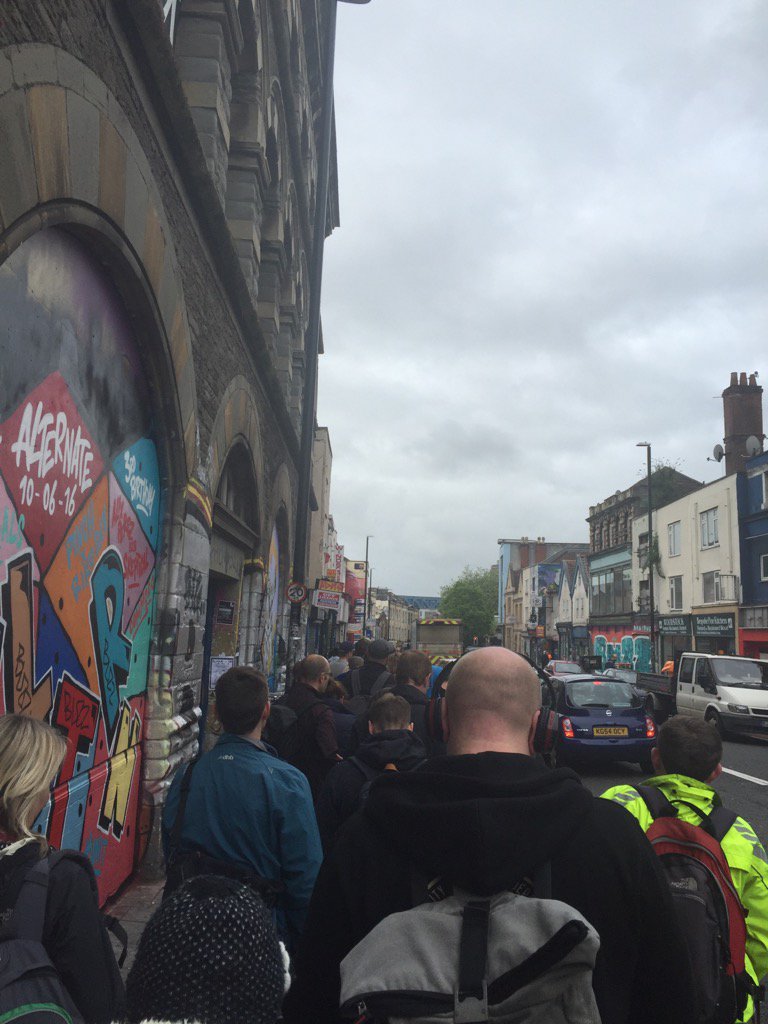
A certainly unusual morning in Bristol!!


Fans queue from 4.30am for Massive Attack tickets

Read more: http://www.bristolpost.co.uk/LIVE-Fans-queue-4-30am-Massive-Attack-tickets/story-29297322-detail/story.html#ixzz49BeTADNi 


Unlike Glasto or Radiohead, and in stupidly long actual physical queue for gig tickets.  
The ticket queue at Bristol Ticket Shop is still going strong too!


Ben is first in the queue at Idle Hands in Stokes Croft! He says "Massive Attack just represent Bristol don't they?"


https://twitter.com/bbcrb/status/733550481142775809

--


  1. ITV REPORT
  2.  

Massive Attack tickets generating massive queues after going on sale

Massive Attack queues
Hundreds of people have been queuing for tickets to Massive Attack's homecoming concert in Bristol. Credit: Dani Andres

Tickets for Massive Attack's home-coming concert in Bristol have gone on sale with hundreds of people queuing in the city to get their hands on them.
The concert in September will take place on the Downs - the first time an outdoor music event has been held there for 15 years.
Tickets have also gone on sale online but many fans decided to queue up outside the Stokes Croft shop Idle Hands from as early as 4am to be in line for tickets as they went on sale at 8am.
Around 20,000 people are expected to attend the show on September 3.

---

19/05/2016

"Jamaican Pulse" in Bristol this summer


Bristol's Royal West of England Academy (RWA) will host an exhibition of Jamaican art this summer. One more reason to pass by.


Jamaican Pulse: Art and Politics from Jamaica and the Diaspora

B.I.B. Kimani Beckford, oil on canvas, 2014
At a time when Jamaican art is receiving growing international acclaim, Jamaican Pulse showcases the extraordinary diversity of Jamaican art, presenting contemporary artwork alongside key works from Jamaican art history.
While exploring the roots of modern Jamaican art and suggesting new links between past and present, the exhibition also explores the artwork through a political lens and considers how global attitudes to body, gender, religion, class and sexuality have impacted this small island nation. By creating a conversation between the Jamaican Diaspora population across the UK and internationally, Jamaican Pulse looks back at early artistic and political awakening, whilst also creating a platform for contemporary artists.
Many of the contemporary artists in the exhibition also featured in the recent, critically- acclaimed Jamaica Biennale. Their work spans multiple disciplines including painting, sculpture, photography, textiles and moving image, and will be supported by twentieth century artwork from a number of public and private collections, including the Jamaican High Commission, London, and The National Gallery of Jamaica, Kingston.
Jamaican Pulse will be accompanied by an exciting learning and participation programme, with activities taking place on and off-site, including a satellite programme at The Bluecoat, Liverpool.
Jamaican Pulse is delivered in partnership with the Jamaican High Commission and is supported by Arts Council England and the Art Fund. It is co-curated by Kat Anderson and Graeme Mortimer Evelyn on behalf of the RWA.


Jamaican Pulse media partner 


Ras Dizzy, The Bird is a Shefield Prospect it Cald the Gospel Bird, 1998, Tempera and oil on matboard,27.9 x 38.1 cm, Courtesy of Cavin-Morris Gallery, Photograph © Cavin-Morris Gallery


--

Details:

25 June – 11 September


Admission Prices
Adults: £6.95
(includes a 70p donation)
Concessions: £4.95
(includes a 50p donation)
Under 16s/SGS, UoB & UWE students: FREE
Art Fund card holders: £4.50 (includes a 50p donation)
PLEASE GIFT AID YOUR TICKET and help us to claim up to 25% more
(Please ask for details)
Become a Friend (yearly membership): from £15, enjoy unlimited repeat visits, private view invitations, and other benefits.
For more details on admissions go to: www.rwa.org.uk/visit-us/admission/

Opening times

Galleries and café
Tuesday – Saturday: 10am – 6pm
Sunday: 11am – 5pm
Closed Mondays
Last admission 30 minutes before closing.

My article from Iraq: Dr Juman's work for displaced women in Nineweh, Kurdistan


19.May

IRAQ: WAHA’S ACTION IN KURDISTAN AND


 NINEVEH


In Iraq, WAHA International is committed to helping displaced people, chased away from their home by the 2014 violence linked to the rise of the Islamic State in Iraq and Syria. In different locations, WAHA has helped to reopen hospitals, to secure maternal and reproductive care, and to send high-quality medical personnel in IDP camps.


Dr Juman is a busy woman. Only a few years ago, this elegant gynaecologist was living with her husband in Arizona, in the U.S., but she decided to come back to her home country. The urge to feel helpful and to contribute to the needs of her fellow citizens, plagued again by the attacks from the Islamic State, was stronger than her crave for freedom and peace. For a while at least.
Born in Zakho, in the extreme north of the country, in Kurdistan, Juman is the oldest of a Chaldaean family of seven children. From 1915, Christian families like hers were pushed away from an area to another by the different political rulers that followed the end of the Ottoman Empire. Hers temporarily found peace in Zakho.
Though her parents were teachers and most of her siblings followed their path, Juman studied medicine at the University of Mosul, started working as a gynaecologist in 1997 and got married in Iraq. Since 2000, she has been practicing her specialty in remote villages, trying to help women with no access to hospitals. For two years, she was the only doctor responsible for Obstetrics & Gynaecology (OBGY) in Amedia.
But with the war starting in 2003 and the consequences on the society, at some point in 2007 she had to leave the country. “I lived five years in Jordan, I was working with NGOs there to help refugees, receiving up to 50 patients a day, but my husband could not find work. Then we managed to get a visa for the United States where we arrived in 2012”, says Dr Juman. “But I came back to Iraq to do my job, to help my people here. In the U.S., I could work as a general practitioner but they have so many there. I wanted to serve my country”.
After Fear, A New Beginning
Dr Juman met the WAHA International’s team in February this year. WAHA was starting a new programme in northern Iraq to help displaced families and children still in need of better healthcare facilities. WAHA opened its mission in the country after a first exploratory mission. The current situation is still pushing people to flee their home, mainly because of on going fighting between the government forces and the Islamic State (ISIS or Daesh).
WAHA’s activities in Iraq are based in Kurdistan. A team of two doctors is based in Erbil and has recently been completed by a logistical administrator and by a local field coordinator based in Duhok. The staff is working in the main clinic in the IDP camp of Qadiya to help displaced people, mainly from minorities and oppressed communities, including Yazidis.
The camp in Qadiya, which hosts more than 15.000 IDPs in 3.000 residential units, is run by the RWANGA organisation. A Primary Healthcare Unit has been open by the German NGO Malteser, with the help of the German Aid Agency (GiZ). WAHA has a reproductive healthcare unit, including a maternity in their compound. The team of doctors led by Dr Juman is bringing support to local health authorities in the form of healthcare material and personnel.
WAHA also contributed to the reopening of the Snuny Hospital, one of the main health centres in the region, with the help of the U.N. Development Programme (UNDP) and with the help of ta local charity. They later opened a fixed clinic in the Sinjar Mountains region, in Sardehsti. Most of the displaced people in this region are also Yazidis.
Dr Juman visits the patients and the younger doctors in Qadiya, Snuny and Sardehsti almost daily. In Qadiya, she is helped by another gynaecologist, Dr Drakhshan, and by a radiologist, Dr Mosaab. The medical team gives between 40 to 50 consultations per day, mainly to pregnant Yazidi women. In Snuny, Dr Reem is in charge of obstetrical care, gynaecology and deliveries four days a week. Another team is in charge from Friday to Sunday, with Dr Suzan from Dohuk and Dr Najah from Syria.
In Sardehsti, they are working with Dr Heshkal, from Zakho. The situation in the Sinjar Mountains is the most difficult one. Here, displaced people are forgotten by the state. There are very few infrastructures, and the locations are abandoned by the authorities. Sinjar City has been completely destroyed by ISIS fighters. Even teachers in the camps don’t receive any salary. “There are almost no international organisation here”, says a member of the a local charity, “it’s a precious help that WAHA brought by opening the small clinic”.
People in the region know that more fighting is to come as the international coalition promised to liberate Mosul from ISIS fighters before the end of the year. But in the meantime, displaced people and impoverished families only ask for daily survival.
--

--

En français :


25.Mai

IRAK : L'ACTION DE WAHA AU KURDISTAN ET AU NINIVE

En Irak, WAHA International est déterminée à aider les personnes déplacées, chassées de leur domicile par la violence liée à l'augmentation de l'Etat islamique en Irak et en Syrie depuis 2014. Sur différents sites, WAHA a contribué à rouvrir les hôpitaux, pour garantir des soins maternels et de la reproduction, et d'envoyer du personnel médical de haute qualité dans les camps de déplacés.
Dr Juman est une femme occupée. Il y a quelques années, cette élégante gynécologue vivait avec son mari dans l'Arizona, aux États-Unis, mais elle a décidé de revenir dans son pays d'origine. L'envie de se sentir utile et de contribuer aux besoins de ses concitoyens, en proie aux attaques de l'Etat islamique, a été plus forte que sa soif de liberté et de paix. Pendant un certain temps au moins.
Né à Zakho, dans l'extrême nord du pays, au Kurdistan, Juman est issue d'une famille chaldéenne de sept enfants. Depuis 1915, les familles chrétiennes comme la sienne ont été poussées d'une région à l'autre par les différents dirigeants politiques qui ont suivi la fin de l'Empire ottoman. La sienne trouvé temporairement la paix à Zakho.
Bien que ses parents fussent des enseignants et la plupart de ses frères et sÅ“urs aient suivi leur chemin, Juman a étudié la médecine à l'Université de Mossoul. Elle a commencé à travailler comme un gynécologue en 1997 et s’est mariée en Irak. Depuis 2000, elle pratique sa spécialité dans des villages reculés, en essayant d'aider les femmes sans accès aux hôpitaux. Pendant deux ans, elle a été le seul médecin responsable de l'obstétrique et de gynécologie (OBGY) dans la région de Amenia.
Mais avec la guerre entamée en 2003 et les conséquences des violences sur la société, en 2007, elle a dû quitter le pays. « J'ai vécu cinq ans en Jordanie, je travaillais avec des ONG là-bas pour aider les réfugiés. Nous recevions jusqu'à 50 patients par jour. Mais mon mari ne pouvait pas trouver de travail. Ensuite, nous avons réussi à obtenir un visa pour les États-Unis, où nous sommes arrivés en 2012 », explique le Dr Juman. « Mais je suis revenue en Irak pour faire mon travail, pour aider mon peuple ici. Aux États-Unis, je pourrais travailler comme médecin généraliste, mais ils ont tant de là. Je voulais servir mon pays ».
Après la peur, l’espoir du renouveau
Dr Juman a rencontré l'équipe du WAHA International en février 2016. WAHA commençait un nouveau programme dans le nord de l'Irak pour aider les familles et les enfants déplacés ayant besoin de meilleures installations de soins de santé. WAHA a ouvert sa mission dans le pays après une première mission exploratoire. La situation actuelle pousse encore les gens à fuir leur maison, principalement en raison des combats en cours entre les forces gouvernementales, kurdes et internationales contre l'État islamique (ISIS ou Daech).
Les activités de WAHA en Irak sont basées au Kurdistan. Une équipe de deux médecins est basé à Erbil et a été récemment complétée par un administrateur logistique et par un coordinateur local de terrain basé à Duhok. Le personnel travaille dans la clinique principale du camp de Qadiya pour aider les personnes déplacées, principalement des minorités et des communautés opprimées, dont de nombreux Yézidis.
Le camp de Qadiya, qui accueille plus de 15 000 personnes déplacées dans 3 000 unités résidentielles, est géré par l'organisation RWANGA. Une unité de soins de santé primaires a été ouverte par l'ONG allemande Malteser, avec l'aide de l'Agence de coopération allemande (GIZ). WAHA dispose à côté de ce bâtiment d'une unité de soins de santé en matière de reproduction, comprenant une maternité. L'équipe de médecins dirigée par le Dr Juman apporte un soutien aux autorités sanitaires locales sous la forme de matériel et de personnel de santé.
WAHA a également contribué à la réouverture de l'hôpital Snuny, l'un des principaux centres de santé de la région, avec l'aide du Programme de développement des Nations Unies (le PNUD) et avec l'aide d'une fondation locale. WAHA a ensuite ouvert une clinique fixe dans la région des Monts Sinjar, à Sardehsti. La plupart des personnes déplacées dans cette région sont également yézidis.
Dr Juman rend visite aux patients et aux médecins de Qadiya, Snuny et Sardehsti presque tous les jours. A Qadiya, elle est aidée par une autre gynécologue, le Dr Drakhshan, et par un radiologue, Dr Mosaab. L'équipe médicale donne entre 40 à 50 consultations par jour, principalement à des femmes enceintes yézidis. A Snuny, le Dr Reem est en charge des soins obstétricaux, de la gynécologie et des accouchements, quatre jours par semaine. Une autre équipe est en charge du vendredi au dimanche.
La situation dans les montagnes de Sinjar est la plus difficile. Ici, les personnes déplacées sont oubliées par l'État. Il y a très peu d'infrastructures, et les emplacements sont abandonnés par les autorités. La ville de Sinjar a été complètement détruite par les combattants d’ISIS. Même les enseignants dans les camps ne reçoivent plus leurs salaires. « Il n'y a presque pas d'organisation internationale ici », commente un membre de la Fondation Barzani, « c’est une aide précieuse que WAHA apporte depuis l'ouverture de la petite clinique ».
Les gens de la région savent que de nouveaux combats se préparent car la coalition internationale a promis de libérer Mossoul des combattants d’ISIS avant la fin de l'année. Mais en attendant, les personnes déplacées et les familles pauvres ne demandent que la survie au quotidien.

-

By Melissa Chemam
18/05/2016

"The New Odyssey": stories of the refugee crisis


Just out:

The New Odyssey


The New Odyssey

Patrick Kingsley
Paperback 

Book of the Moment


The New Odyssey is a work of original, bold reporting written with a perfect mix of compassion and authority by the journalist who knows the subject better than any other.

Europe is facing a wave of migration unmatched since the end of World War II - and no one has reported on this crisis in more depth or breadth than the Guardian's migration correspondent, Patrick Kingsley.

‘Tremendously impressive… Vivid, sometimes shocking, always telling… The story of what lies behind the news from the Mediterranean has rarely been told so strongly.’   Philip Pullman


DESCRIPTION

'A brilliant, humane, sweeping account of the European refugee crisis. Kingsley has produced the great piece of reporting this issue so badly needs.'   Alan Rusbridger.

Europe is facing a wave of migration unmatched since the end of World War II - and no one has reported on this crisis in more depth or breadth than the Guardian's migration correspondent, Patrick Kingsley.

Throughout 2015, Kingsley travelled to 17 countries along the migrant trail, meeting hundreds of refugees making epic odysseys across deserts, seas and mountains to reach the holy grail of Europe.

This is Kingsley's unparalleled account of who these voyagers are. It's about why they keep coming, and how they do it. It's about the smugglers who help them on their way, and the coastguards who rescue them at the other end. The volunteers that feed them, the hoteliers that house them, and the border guards trying to keep them out. And the politicians looking the other way.

The New Odyssey is a work of original, bold reporting written with a perfect mix of compassion and authority by the journalist who knows the subject better than any other.


'A must read for our times'   Yanis Varoufakis

This is a unique achievement speeding urgent insight, understanding, and wake up calls for the rest of us who sleep easy in our beds at night.'  Jon Snow

'Kingsley is doing the world an invaluable service by showing that migrants are particular and human, not collective and a group, and that each of them – just like us - has a story of their own.'  David Hare

'A really moving and important publication. It provides a basis of fact and analysis that is truly important at a time of great challenge for humanity. I have no hesitation in recommending it.' Peter Sutherland United Nations Special Representative of the Secretary General for International Migration

'Deeply moving and hugely timely...The New Odyssey reminds us that behind the statistics and headlines lie real lives, driven by desperation and simply wanting a safer future. It should be compulsory reading.'  Caroline Lucas MP


--


Bristol and the EU


Anyone could go for me and record?? Wish I could stay longer...


link: http://www.obv.org.uk/news-blogs/bristol-debates-eu-referendum

Bristol debates EU Referendum


The newly elected Mayor Marvin Rees has agreed to give a few opening remarks at the EU, in-out debate, in Bristol next week. Three racial equality organisations are teaming up to put on a European Referendum debate in Bristol on the 26th of May.
Voice4Change England, Operation Black Vote and the Black South West Network are holding this crucial debate from 6:00 -8:30 in the evening at M Shed in Bristol, to encourage and promote voter registration ahead of next month’s referendum.
The issues that are to be discussed around ‘Brexit’ will affect every person in Bristol that’s why we are encouraging a lively debate for the remain or leave arguments around the EU.
Our organisations are also very keen for young people and all Black and minority ethnic groups to register to vote. Young people and those BME communities are often less likely to be registered to vote than other groups.
In this critical debate all our differing opinions are valid in a healthy democracy, and events like these encourage more engagement from the diverse back grounds in Bristol.
The debate is also supported by Up Our Street, BabassaInc, Hope Not Hate and the Somali Forum.

You can book your ticket here: http://blacksouthwestnetwork.eventwax.com
And to register to vote: https://goo.gl/2UN5Su
Time: 6pm -8.30pm
Date: Thursday 26th May 2016
Venue: M Shed, Prince Wharf, Wapping Road, Bristol BS1 4RN


Reporting on the 'Brexit' referendum


I'll be in the UK the coming days and mid-June to report on the Brexit's campaign and its effects on voters and citizens.

Today, as a starter, I've been following this debate in Paris:


Melissa Chemam checked in to Sciences Po.
3 hrsParis
« The UK Referendum and the Future of the European Union »
Une discussion avec :

Hugo Dixon, rédacteur en chef de InFacts et auteur de The In/Out Question
Toby Young, rédacteur adjoint de The Spectator et chroniqueur pour The Telegraph
Ana Palacio, ancienne Ministre des Affaires Etrangères d’Espagne
Hubert Védrine, ancien Ministre des Affaires Etrangères de France

More details here:


Full room to hear ,,Toby Young, +Hubert Vedrine speak on


--

Apart from Mr Toby Young, all guest were in favour of the UK remaining in the EU for political and economic reasons.

--

Britons, I want to hear your views! On the EU, on politics, on our future. Express yourself.

I'll be editing a radio package first, then probably writing.

--

Let's start with  a point of view:


EU is far from being a superstate

WHY BRITAIN SHOULD STAY IN

THE EU


EU is far from being a superstate

by David Hannay | 17.05.2016


The Leave campaign’s standard operating procedure is to exaggerate the EU’s actual powers, to allege creep in their exercise and to cast doubt on the British government’s ability to block any extension of those powers. Hence, frequent references to the “Brussels octopus”. Hence, too, the reiterated citing of non-legislative documents (their current favourite being the Five Presidents’ report ) whose recommendations have not been accepted by the member states and are unlikely ever to be so.
Let us look first at those policy areas where decisions can only be taken if the British government agrees to them. These are all highly significant matters – treaty change, enlargement negotiations (which would give Britain a veto on Turkey joining the EU), common foreign and security policy, European defence policy, and any lifting of the EU’s revenue ceiling or changes in the UK’s budget rebate
Moreover any proposal to shift the boundaries between provisions requiring unanimity and those that can be decided by Qualified Majority voting would need treaty change and would, in all likelihood, trigger the requirement for a new referendum in the UK, as provided for in the 2011 European Referendum Act – the “double lock” to which the government often refers. How likely is it that any British government in the years ahead would set out down that course; or that any group of EU member states would try to persuade them to do so?
This argument over how much of our legislation is actually based on EU decisions is muddied by a dispute over figures – the House of Commons Library says 13%, the Leave campaign somewhere north of 60%. Quite a big gap. How can that be explained? Well the Leavers throw in a large number of EU decisions which have no practical application in this country at all, such as provisions relating to the production of olive oil, or tobacco, or cotton or competition policy decisions relating to state aid in another member state.
But in any case what matters is not just quantity but quality. And so, when you look at policy areas that British people really mind about a lot – the NHS, our military deployments, our social security system, the education system, the future of the BBC, our use of intelligence material, our controls over immigration from third countries outside the EU, the devolution of powers to Scotland, Wales and Northern Ireland – you find that the key decisions remain in our own hands and under the control of parliament.
Our role as a Permanent Member of the UN Security Council is explicitly protected in the treaty and we are only constrained by EU policy there when we ourselves have given our prior agreement to that policy. On the exchange of intelligence, we often cooperate with other member states because it is in our national interest to do so; but we cannot be compelled to do so against our will.
We also have opted out of the EU’s two problem areas – the single currency and the border-free Schengen Area. The only policy area which voters really care about that parliament doesn’t control is free movement of people from the rest of the EU. Not only is this the quid pro quo for access to the single market, which is responsible for half our trade; it is also economically beneficial.
The failure to say any of this constitutes part of the Leave campaign’s own Project Fear.

17/05/2016

Massive Attack meets Bristol again


What a fantastic news! Perfect start of the day. Music and politics, in Bristol, with the greatest artists and musicians of the UK... Who could dream of a better idea?

Massive's message this morning:


"We are curating what we hope will become an annual event something made in Bristol with a truly colonial reach. We will also use the project to engage with the important social and political issues of the day".

Tickets available from 9am Friday 20th May at tickets.massiveattackbristol.co.uk


In the news:


Massive Attack To Perform On The Downs

Tuesday, May 17th, 2016 7:00am
TheBreeze.com


The Bristol band are putting on an outdoor concert on 3rd September on The Downs, with Primal Scream and Skepta also on the bill.

This will be the first time The Downs has been used for a major music event for over 15 years. It will be an all-day event with more acts to be added to the line up.

Massive Attack band member 3D said: "We are curating what we hope will become an annual event something made in Bristol with an international reach.  We will also use the project to engage with the important social and political issues of the day".

The show has been curated in partnership with Team Love (promoters of Love Saves the Day) and Crosstown Concerts.

Tom Paine, Co-founder of Team Love explains; "We've been talking with the band now for many years now about trying to put a show of this scale on together - and it finally feels like the moment is right."

Tickets, priced at £37.50 plus booking fee will go on sale on Friday 20th May at 9am via http://tickets.massiveattackbristol.co.uk, Songkick.com, Seetickets.com, Gigantic.com and Bristolticketshop.co.uk. 

Tickets will go on sale at 8am Friday 20th May from Idle Hands record shop on Cheltenham Road and Bristol Ticket Shop, to personal callers only.

There will be a limited number of reduced price tickets at £25 available to anyone unemployed or on income support. These tickets are only available in person from Bristol Ticket Shop, and supporting documentation and ID will be required. Children under 5 are free (though must be wearing adequate hearing protection) and a limited number of tickets for children aged 5- 12 years will be available at all outlets for £10 per ticket. All under 16's need accompanying by an adult.

Tickets are restricted to six tickets per person/per billing address. Please note that in order to protect our audience from ticket touts we are putting in measures to help eliminate them. The lead booker will need to attend the event (or nominate a 3rd party at the point of purchase) with their guests and will need to show photo ID in order to enter the concert arena.


--

On BBC Bristol:


It's Tuesday, it's sort of sunny and this is BBC Local Live.
And to kick off, we have some good news this morning. Good news for music fans anyway.
Massive Attack has announced an outdoor concert in September on the Downs in Bristol.
It'll apparently be the first time the Downs has been used for a major music event for more than 15 years.

--
Well, obviously organiser Tom Paine's very enthusiastic about the planned outdoor concert on the Downs, but it would seem that others are less keen.

In fact, some living in the area "feel as though it's a massive attack on the Downs", according to Conservative councillor Peter Abraham, who is on the Downs Committee.
He said there would be objections to the licence which have to be heard before a final decision is made on whether the event can go ahead.
"Let's challenge the council - have they totally agreed to this?" he said.
"If they have, they've ignored any proper consultation and that is quite disgraceful. Whatever your views of the concert, surely we've got to go through the democratic system."

Tom Paine, who's organising the outdoor Massive Attack concert on the Downs in Bristol - announced this morning - has been on BBC Radio Bristol talking about it.
He said: "We've been speaking to the council and the Downs committees for quite a few years now, and talking with the band for quite a few years about trying to put on a concert of this size for them in Bristol, and it seems like it's finally all come together this year."

link: http://www.bbc.com/news/live/uk-england-bristol-36305284?ns_mchannel=social&ns_source=twitter&ns_campaign=bbc_live&ns_linkname=573ad7f7e4b02b8f874b3603%26A%20'massive%20attack'%20on%20the%20Downs%3F%26&ns_fee=0#post_573ad7f7e4b02b8f874b3603