Journalist at RFI (ex-DW, BBC, CBC, F24...), writer (on art, music, culture...), I work in radio, podcasting, online, on films.
As a writer, I also contributed to the New Arab, Art UK, Byline Times, the i Paper...
Born in Paris, I was based in Prague, Miami, London, Nairobi (covering East Africa), Bangui, and in Bristol, UK. I also reported from Italy, Germany, Haiti, Tunisia, Liberia, Senegal, India, Mexico, Iraq, South Africa...
This blog is to share my work, news and cultural discoveries.
Lots of souvenirs on this song.
My last year of high school.
Any progress? For women, I mean. Somehow, we're moving forward.
Thanks for some men who really help.
Neneh Cherry - 'Woman' (1996)
Lyrics:
"Woman"
You gotta be fortunate
You gotta be lucky now
I was just sitting here
Thinking good and bad
But I'm the kinda woman
That was built to last
They tried erasing me
But they couldn't wipe out my past
To save my child
I'd rather go hungry
I got all of Ethiopia
Inside of me
And my blood flows
Through every man
In this godless land
That delivered me
I've cried so many tears even the blind can see
This is a woman's world.
This is my world.
This is a woman's world
For this man's girl.
There ain't a woman in this world,
Not a woman or a little girl,
That can't deliver love
In a man's world.
I've born and I've bread.
I've cleaned and I've fed.
And for my healing wits
I've been called a witch.
I've crackled in the fire
And been called a liar.
I've died so many times
I'm only just coming to life.
This is a woman's world.
This is my world.
This is a woman's world
For this man's girl.
There ain't a woman in this world,
Not a woman or a little girl,
That can't deliver love
In a man's world.
My blood flows
Through every man and every child
In this godless land
That delivered me
I cried so many tears even the blind can see
This is a woman's world.
This is my world.
This is a woman's world
For this man's girl.
There ain't a woman in this world,
Not a woman or a little girl,
That can't deliver love
In a man's world.
Writer(s): Cameron Mcvey, Neneh Cherry, Jonathan Sharp
Prof Karma Nablusi & Bella Freud organise an urgent benefit event for their charity "Hoping" which works with Palestinian child refugees growing up in vast refugee camps.
With the help of filmmaker and activist Mark Donne.
We're doing an urgent benefit on 4th June at the Roundhouse with Patti Smith, The Libertines and Loyle Carner, Eric Cantona (I know!) and other special guests."
EVERYTHING IS RECORDED WITH SPECIAL GUESTS + PATTI SMITH + LOYLE CARNER
Doors 7pm
Patti Smith, The Libertines, Loyle Carner, illuminations from Eric Cantona, and with DJing throughout the night by Jamie xx and a special guest – this is some of the incredible talent performing at ‘Hoping for Palestine’, a concert in aid of the HOPING Foundation’s work.
Limited edition posters designed as a gesture of support for the children of Palestine by artists Tracey Emin and Robert Del Naja from Massive Attack, will also be available at the event.
HOPING stands for Hope and Optimism for Palestinians in the Next Generation. It is a charitable foundation that provides grants to organisations working with Palestinian refugee children living in refugee camps in Lebanon, Syria, Jordan, the West Bank and Gaza.
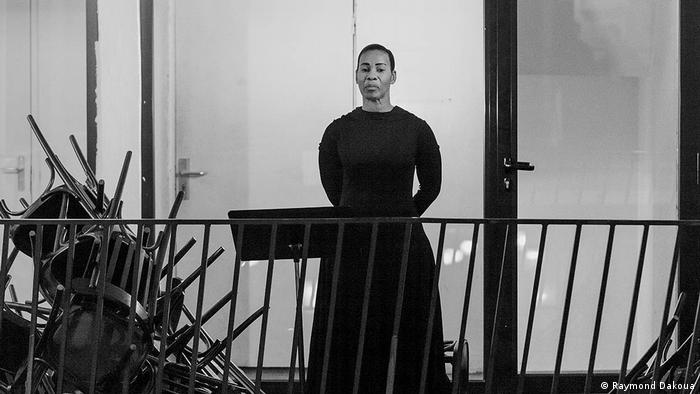
Dans l'émission "Vu d'Allemagne" de la Deutsche Welle, mon reportage sur les commémorations de la mémoire de l'esclavage en France, avec un focus sur le spectacle de Danielle Gabou adaptant le roman de Maryse Condé, "Moi, Tituba, Sorcière noire de Salem" :
"Tituba" ou le parcours d'une femme noire vers la liberté
Danielle Gabou interprète tous les personnages du roman de Maryse Condé, accompagnée au piano par Lise Diou
La France commémore, chaque 10 mai, l’abolition de l’esclavage. Une "journée nationale des mémoires de la traite, de l'esclavage et de leur abolition" qui a mis du temps à s'imposer : elle a été fixée cinq ans après l'adoption de la loi Taubira. La loi, adoptée par le parlement le 10 mai 2001, reconnaît la traite et l'esclavage en tant que crimes contre l'humanité.
C’est sur proposition de l’écrivain Maryse Condé, présidente du Comité pour la mémoire de l’esclavage, que l'ancien président Jacques Chirac a fixé cette date en 2006.
Cette année, le président Macron a annoncé la création d’une Fondation pour la mémoire de l’esclavage, qui sera présidée par l’ancien maire de Nantes et ancien Premier ministre, Jean-Marc Ayrault.
À cette occasion, notre correspondante à Paris, Mélissa Chemam, a rencontré la Compagnie Sans sommeil, qui a monté un spectacle adaptant le roman "Moi, Tituba sorcière... noire de Salem" de Maryse Condé, parrainé par la politologue de renom Françoise Vergès et l’ancienne ministre Christiane Taubira.
-
Le spectacle "Moi, Tituba sorcière... noire de Salem" de la compagnie Sommeil, en partenariat avec le projet "La Route de l’esclave : Résistance, Liberté et Héritage" et la Coalition internationale des artistes pour l’Histoire générale de l’Afrique de l’UNESCO.
Rendez-vous le 23 mai - de 19h à 22h à la Maison de l’UNESCO Salle I, 7 place de Fontenoy, Paris 7ème. Ce sera en présence de l’auteur.
A new chapter in the relations between Bristol and Paris!!
Dan Everett's new video:
'Rivers & Canyons'
A few words from Dan:
"I have always been drawn to dilapidated buildings, forgotten urban spaces and the stories they tell. Some of more neglected Paris Arcades that I first encountered in my early twenties have remained something that my mind returns to time and time again, quiet haunted spaces nestled within a busy city. I wanted to explore this further through my album, finding ways to give voice to the emotions I felt, and tying it to post graduate academic research that I undertook into cultural memory.
We filmed the music video in a dozen of the Paris Arcades over one bitterly cold December weekend. Just a small crew: my friend Jethro on camera and myself, dodging security guards and the odd irate maître d. Post-production, Jethro and Julien did a beautiful job of weaving it all together."
For those interested, more information on the history of the Paris Arcades can be found in my blog here: http://danieleverett.co.uk/the-arcade...
Directed by: Jethro Massey
www.jethromassey.com
Edited by: Julien Chardon
Produced by: Film Fabric
www.filmfabric.tv -
The Arcades of Paris
So where am I stood on the front cover of Fragments?
The image is a photo-montage of various shopping arcades in Paris. These narrow, glass-roofed passageways are lined with boutiques and bistros and date as far back as the 18th Century. At one time, there were over 120 dotted all over the city, but urban planning schemes cleared many and only 17 remain in the districts around Montmartre and Boulevard de Strasbourg.
They were built to entice middle-class city goers off the filthy streets of early 19th Century Paris and into its covered passageways containing boutiques fronted with large glass windows, each displaying their wares in displays designed to closely mimic home interiors of the bourgeoisie. The intention was to recreate warm and dry grown-up ‘playgrounds’, in which shopping shopping and eating became a hobby and no longer a necessity. It was in these arcades that the concept of ‘window dressing’ emerged and where a shop proprietor could transform a padded chair from something merely to sit on into a symbol of a better way of living.
When the first department stores appears in the 1850s, the Paris Arcades began their slow decline. Glass ceilings darkened with grime and haute-couture boutiques gave way to second-hand bookshops, gaudy side shows and cut-price dentists.
History is a story constantly rewritten and the Paris authority will constantly debate with its citizens and with itself about what best to preserve, renovate and memorialize in accordance with the politics of the present. In a city famed for its carefully preserved architecture, some of the arcades continue to gently decay, in part because many remain in private ownership and have escaped various local government urban regeneration projects.
I discovered the Paris arcades 10 years ago and would often return to the more down-at-heal Passage Brady on rue de Faubourg Saint-Denis, where I would sit outside one of the Indian Thali restaurants and observe the vivid sounds, smells and sights. I could see layers of history behind the cracked paintwork, soot marks from decades of gas lighting, defunct signs and bleached advertising boards. On the tiled floor worn by thousands of footsteps lay dusty stacks of discarded newspapers, pamphlets and business cards and with all of this in mind, I would think about Walter Benjamin’s comment that history is more truthfully revealed once we pay more attention to the forgotten scraps and detritus of the past.
"The Young Karl Marx" by Raoul Peck is release on British and Irish screens today!
This overwhelms me with joy.
I'm so proud to have work on this film and very proud to be part of Raoul's team at Velvet Film.
Go and see the film... It's a story of deep thinking, writing, it's about our truth, friendship, love and believing we can change our world, no matter how hard it seems, but constantly changing ourselves, bettering our self and remain authentic.
Much love to the lovers of the world...
-
The Independent's review:
Raoul Peck: I Am Not Your Negro director on his new film The Young Karl Marx and why The Communist Manifesto is 'more relevant than ever'
The 5 May marks 200 years since the birth of Karl Marx. To coincide with the anniversary a new film by Raoul Peck, The Young Karl Marx, looks at how the philosopher and his collaborator on The Communist Manifesto, Friedrich Engels, came to meet and form such a strong bond in Germany in 1844.
The Young Karl Marx is a kindred spirit to Walter Salles’ The Motorcycle Diaries, about another Communist icon, Ernesto ‘Che’ Guevara. Both films are more interested in the youthful antics of the protagonists than their later work and exploits.
Director Peck claimed the Best Documentary Film Bafta this year for his incredible I Am Not Your Negro, a look at the battles that black people have had to fight for equality in America told entirely through the words of the novelist James Baldwin.
Born in Haiti in 1953, Peck fled the country, aged just 8, with his parents and two younger brothers. They escaped the Duvalier dictatorship and Peck grew up in the Democratic Republic of the Congo.
Peck later attended schools in New York, where his mother worked at the UN, and in France, earning a baccalaureate before studying engineering and economics at Berlin’s Humboldt University, where he became enamoured with the work of Marx.
“All I am today is because of the structure that I got when I was young studying the work of Marx,” says the director. “At that time, in the 1970s and 1980s, you needed to confront yourself with those books, because it’s your past, it’s your present, it’s part of your general knowledge to understand the society that you are living in and in which you are an actor.”
Peck is an impressively built man, who looks much younger than his 64 years, and vernacular of an academic. He talks like he’s delivering a lecture, which he often is. Peck is the President of La Fémis, the prestigious Paris film school. He speaks with that mastery of his subject matter that can at times be intimidating but is always enthralling.
He argues that to understand society “Marx is the key”. He’s a man who backs up his analysis with numbers, with history, and with philosophy.
The film starts in 1843 at a time when Europe was dominated by absolute monarchies. It credits the Industrial Revolution in England as transforming the world’s order, in which a new proletariat class are creating workers’ organisations founded on the Communist notion that all men are brothers.
The film posits that two young Germans, Marx and Engels, will disrupt this notion and transform the struggle and future of the world.
“Marx never wrote any utopia,” says Peck, disparaging the commonly held perception. “In the film you see the people who wrote this utopia were [Pierre-Joseph] Proudhon and [Wilhelm] Weitling. Marx told them, both of them: ‘Let’s stick to reality, let’s develop something from reality.’ Marx never prophesied anything, except sometimes just as a joke or as a conversation.”
Peck argues that today, Marx’s writings are more relevant than ever: “You sum up the articles and it is exactly the description of the 2008 crisis. It’s like the children’s book of the history of capitalism and you can trace it until today. So what other proof do you need?”
Peck’s driving ambition was to make a film that would explain the socio-political context of the friendship between Marx (played by August Diehl) and Engels (Stefan Konarske). It starts with Engels witnessing revolts at his dad’s factory in Manchester, the Ermens and Engel Mill. At the same time, Marx is undertaking a more philosophical interpretation of the changes in society, whilst struggling with his journalistic deadlines.
Their spouses are also key characters. Marx’s wife Jenny (played by Phantom Thread star Vicky Krieps) and Engel’s spouse Mary Burns (Hannah Steele) are both as rebellious as their beaus.
He argues that this is not a period film, despite the era and the costumes. “I didn’t make a film about the past. I’m not interested in the past in that way.”
“I wanted to go back to that moment of creation in the film… to go back to the fundamentals, because the book he left is the most important thing,” states Peck. “How do we utilise this instrument to analyse society at a precise moment?”
And it’s this desire to connect to the present that has led to him make a movie that at times seems like an overly theoretical political analysis, and in other moments like a fun bromance, capturing the hijinks of ordinary young men.
“I hope that young people will recognise themselves in the film,” he says. “For me that would be the best thing. Because that’s what it’s about: How do I see or find a way to fight back against whatever is happening right now?”
What does need to be fought against right now? His response, unsurprisingly, includes President Trump and the widening gap between rich and poor.
I ask Peck how Marx ties in with the arguments that we see Baldwin making in I Am Not Your Negro. “When Baldwin says in my film ‘White is a metaphor for power,’ it’s another way of saying ‘Chase Manhattan Bank’. That’s Marx’s analysis. So there are some similar perspectives in the way to see society.
“Race is just one emanation of capitalism – like the whole thing about the refugees today. It’s not about the colour of the refugees – it’s about capitalism doing its job, separating people, dividing, and maintaining the status quo of those who want to protect their privilege.”
Peck believes that people can do more to change society, especially in the West where a kind of lethargy has crept in.
His childhood experiences have taught him that human rights and democracy are something that must constantly be fought for: “Democracy is not something that is fixed once and for all. I came from a country that had a dictatorship and I fought a lot for the restoration of democracy. I know the price of being able to vote.
“In the West, people use voting as a consumer good,” he adds, “you can sit down on your couch and watch a reality show. This is not democracy. Democracy is to be an active citizen, to question every day what you do in your job.”
From African Space Craft, an album by Keziah Jones, released in 1995.
-
AllMusic Review by Don Snowden
African Space Craft finds Keziah Jones continuing on his idiosyncratic way, this time out discovering guitar solos and an incredibly rasty wah-wah tone in what may well be his under-the-influence-of-grunge album. It starts characteristically enough with the rhythmic, acoustic thrash strum of "Million Miles From Home," but even though the sound is a little less frenetic and bit more power trio-ish, the band is still an evenly balanced unit. Once again, you're never quite sure exactly where the arrangements are going or exactly what Jones is getting at in the highly personal, sometimes surreal lyrics.
Race issues pop up more than once and "Colorful World" deals with them with frank street talk that might offend some sensitive ears -- but then so might the first surfacing of that biting wah-wah guitar. "Splash" is just one monster of a killer riff celebrating carnal pleasure -- it's frank, sexy, and not far away from something PJ Harvey would come up with. "Dear Mr. Cooper" and the title track are strong, too -- the rasty riffing very strong on the latter -- while "Speech" mellows things out and "Cubic Space Division" goes from hyper-rhythm to dreamily loping bridge and back again.
Jones gets his dynamics by playing with contrasts that way, be it that searingly raw wah-wah against high voices on "Never Gonna Let You Go" or the acoustic/electric call-and-response games of "If You Know." African Space Craft is a consistently strong record that's just a little more one-dimensional than Blufunk Is a Fact!, but not by much and it might be a better pick for anyone who would prefer a more electric, rock-oriented sound to check out a very unique and singular artist.