04/01/2020

'What is postcolonial literature?' by Professor Ato Quayson


A wonderful follow-up to my post on postcolonial studies!!

Synchronistically, I've just seen online this British response to French denial: https://www.thebritishacademy.ac.uk/blog/what-is-postcolonial-literature

Gratitude.


What is postcolonial literature?

Blog • Literature •  • Professor Ato Quayson FBA


A good way to start any definition of postcolonial literature is to think about the origins of the term postcolonialism and how it has been used in literary criticism, from roughly the late 1980s to present times. The term is sometimes written with a hyphen, sometimes left unhyphenated, with the two forms used to designate the same areas of interest by different critics. The hyphenated version was first used by political scientists and economists to denote the period after colonialism, but from about the late seventies it was turned into a more wide-ranging culturalist analysis in the hands of literary critics and others. The unhyphenated version is conventionally used to distinguish it from the earlier iteration that referred only to specific time period and to indicate a tendency toward literary criticism and the analysis of various discourses at the intersection of race, gender and diaspora, among others.
“Postcolonialism... involves a studied engagement with the experience of colonialism and its past and present effects”
A possible working definition for postcolonialism is that it involves a studied engagement with the experience of colonialism and its past and present effects, both at the local level of ex-colonial societies and at the level of more general global developments thought to be the after-effects of empire. Postcolonialism often also involves the discussion of experiences such as slavery, migration, suppression and resistance, difference, race, gender and place as well as responses to the discourses of imperial Europe such as history, philosophy, anthropology and linguistics. The term is as much about conditions under imperialism and colonialism proper, as about conditions coming after the historical end of colonialism. A growing concern among postcolonial critics has also been with racial minorities in the west, embracing Native and African Americans in the US, British Asians and African Caribbeans in the UK and Aborigines in Australia and Canada, among others. Because of these features, postcolonialism allows for a wide range of applications, designating a constant interplay and slippage between the sense of a historical transition, a socio-cultural location and an epochal configuration. Edward Said’s Orientalism(1978) is considered as pivotal in the shaping of postcolonial studies. In Orientalism, Said argued for seeing a direct correlation between the knowledges that oriental scholars produced and how these were redeployed in the constitution of colonial rule.
shakespeare-tempestFisayo Akinade as Caliban in William Shakespeare's ‘The Tempest’, at the Sam Wanamaker Playhouse in London. Photo by Robbie Jack / Corbis via Getty Images.
It should be acknowledged, however, that whatever the developments were that led to the formation of the field of postcolonial studies, it has to be seen more in terms of a long process rather than a series of events, with the central impulses of this process coming from a variety of sources, sometimes outside any concern with colonialism. These may be traced in a variety of directions, such as in the changing face of global politics with the emergence of newly independent states; in the wide-ranging re-evaluation begun in the 1980s of the exclusionary forms of western reason and in the perception of their complicity with imperial expansion and colonialist rule; in the debates that raged about empiricism and culturalism in the social sciences from the 1960s; and in the challenges to dominant discourses of representation from feminist, gay, lesbian and ethnic studies in the 1970s and 1980s.
Postcolonial literature represents all these conditions and comes from various sources and inspiration. It includes works such as Samuel Beckett’s Murphy, Gabriel Garcia Marquez’s One Hundred Years of Solitude, Salman Rushdie’s Midnight’s Children, Chinua Achebe’s Things Fall Apart, Tayeb Salih’s Season of Migration to the North, Toni Morrison’s Beloved, J.M. Coetzee’s Waiting for the Barbarians, Michael Ondaatje’s The English Patient, Arundhati Roy’s The God of Small Things, NoViolet Bulawayo’s We Need New Names, Zadie Smith’s White Teeth, and Ingolo Mbue’s Behold the Dreamers, among many others. Shakespeare’s Othello, Antony and Cleopatra and The Tempest have been taken as key texts for the application of postcolonial modes of analysis. This suggests that postcolonial literature is a broad term that encompasses literatures by people from the erstwhile colonial world, as well as from the various minority diasporas that live in the west. Postcolonialism has also been a term used to reinterpret western canonical literature from a variety of fresh and diverse perspectives.

Ato Quayson is Professor of English at Stanford University. He was elected a Fellow of the British Academy in 2019. 

#Meanwhile


On the Middle Eastern front of World War III, the dangers haven't been higher. And on the Western calendar, it's only the third day of the year. 

Yesterday, in Baghdad, Iraq, a US military strike killed Iranian general Qasem Soleimani, a much respected and loved leader in high Iranian circles. It is not difficult to imagine how this move will escalate. Iran has already declared it would replicate.

Iran's Supreme Leader Ayatollah Ali Khamenei said harsh revenge awaits the "criminals" who killed the commander of its elite Quds Force, Qassem Soleimani, and called for three days of mourning. Iran's National Security Council spokesman Kiwan Khosravi promised there will be an emergency meeting to discuss what she called a "criminal attack" that killed Soleimani. 

Mohammad Marandi, the head of the American Studies Department at the University of Tehran, told Al Jazeera that the United States had thus "declared war" against Iran and Iraq, and "it's best for Westerners to evacuate countries like UAE and Iraq immediately".

This can no longer be justified or tolerated. Trump’s US policy is illegal and murderous.

-

As a journalist, I feel terribly frustrated to follow this and share the news.

The current American president Donald Trump today defended the killing of Suleimani this: 'We did not take action to start a war'... Yet he took the stage at an ‘Evangelicals for Trump’ event at a Florida church and doubled down on the claim that the military action interrupted an attack Suleimani had planned: He was preparing for an attack, Trump said of Iran’s general, “and we got him,” he added, while his critics pointed the "unverified nature of that claim"!

Mike Pence, the Vice President of the United States, justified the drone strike by calling the Iranian general “an evil man who was responsible for killing thousands of Americans” -  claiming - without evidence! - that Iran supported the September 11 attackers...  

Most foreign-policy called the vice-president’s assertion inaccurate and dangerous.

U.S. Senator from Connecticut Chris Murphy wrote on Twitter that: "Soleimani was an enemy of the United States. That’s not a question. The question is this - as reports suggest, did America just assassinate, without any congressional authorization, the second most powerful person in Iran, knowingly setting off a potential massive regional war?"

Yet, here we are, with a murderous administration, bluntly lying to cover war-going actions.

-

As a journalist, again, posting Trump's words is part of the job; at this stage, as a human being it feels like reporting his propaganda.

 In 2003, when the second in Iraq was about to be launched, I was in Chicago as a young journalist-to-be discussing why France refused to support that war. Now no one resists this policy anymore. 

So women and children are paying the high price.

-

My work with the Arnolfini enabled me to recall how women’s contributions to the arts and activism is what we need more than ever in this violent, destructive era based on patriarchy...

The situation in Iraq, Syria, Libya and Iran has been turned into utter hell by the decade-old US-led war-going policy, that culminates this morning. We can’t ignore it anymore here in Europe without endorsing it!

#Meanwhile, w
omen work to protect their communities and still strive for life. 
I’ve travelled to Iraq, Turkey, and many other countries ravaged by war, meeting countless women in NGOs and community work trying to rebuild their cities and hold on to hope... 
We need to wake up and choose a different path!!

I'm using this hashtag for now, #MeanwhileI've been for a few months, to reclaim the news that don't make the headline, to share this stories, to detail the point of view of the ones behind the curtains, mainly women and this called as "minorities", even if their reality is much more complicated...

There will be a few more on them in the coming month... Watch this space.

And thank you.

"The Empire strikes back": on how deeply France lives in denial of its past


A text in French for a change.

One of the reasons I'm happier in the UK is that France is deeply in denial of its colonial past, and most of my research and journalism led me to write about issues that have a link with the consequence of 4 to 5 centuries of imperialism.

These sorts of attacks against the very few researchers, historians, artists, journalists and thinkers trying to rebalance the general blind eye turned on postcolonial studies, blamed as some sort of Anglo-Saxon disease, shows that the long is long until we can have a global, national discussion on the issues, but that it will for sure come some day.

As a researcher, I've spent most of 2017 and 2018 reading Frantz Fanon's texts, his biographies, and all sorts of writing about his groundbreaking anticolonial work in French Algeria in the late 1950s and his research in and on West Africa.

I did so in a specific context: as the main researcher and content manager for Velvet Film, a cinema production company founded by the Haitian filmmaker Raoul Peck, author of films like 'Sometimes in April' on the Rwanda genocide and 'I Am Not Your Negro'.

Before then, I lived in East and Central Africa as a foreign reporter and travelled regularly to North Africa. I was also based in Miami and London, where the knowledge and understanding of Fanon's writing are completely different and deeply appreciated.

The film should be out in 2021, for the 60th anniversary of Fanon's passing.

We hope that until then, France will be ready for it.


Frantz Fanon in Tunisia in the late 1950s

-


Recherche postcoloniale: "l’Empire contre-attaque" - 

L’Express aux côtés de duo Bouvet-Taguieff se lance dans une croisade contre les chercheurs postcoloniaux. Tribune au vitriol. Il y aurait urgence, l’université et la recherche seraient en péril. Il faut selon eux dénoncer ce danger, stigmatiser les livres et colloques de ces chercheurs. Pascal Blanchard, Nicolas Bancel et Gilles Boëtsch, directement mis en cause, leur répondent.

Que se passe-t-il dans le monde de la recherche pour que L’Express titre sur son site « Les obsédés de la race noyautent le CNRS », le 24 décembre 2019, dans un article au vitriol signé par Amandine Hirou ?
Il semble qu’il y a urgence pour certains à empêcher des chercheurs en sciences humaines, issus d’universités et laboratoires de recherche en France ou à l’étranger, de travailler sur l’histoire coloniale et les héritages postcoloniaux. Un ouvrage précis est la preuve de ce danger immédiat, il vient d’être publié aux CNRS Éditions Sexualités, identités & corps colonisés (avec une postface de Leïla Slimani), regroupant une cinquantaine de spécialistes, tous reconnus. Bien entendu, Amandine Hirou n’en cite aucun, puisqu’elle n’a semble-t-il pas lu le livre et ne connaît pas ce domaine de recherche. Il faut avant tout (et surtout) dénoncer ceux qui osent faire des recherches et des colloques sur ces objets de recherche et s’attachent à comprendre le passé colonial, comme celui organisé au CNAM le 3 décembre 2019 sous le titre Images, colonisation, domination sur les corps. 
Il existe pourtant dans le monde entier des chercheurs travaillant sur ces questions depuis des dizaines d’années, mais l’impératif serait d’empêcher les « Ã©tudes postcoloniales » (postcolonial studies) de pénétrer les universités françaises, dans les laboratoires de recherche. L’invasion serait proche…
Quelle conséquence ? Elles menaceraient rien de moins que de détruire l’« Ã©difice républicain » et les « valeurs universalistes ». Le diable serait dans la place. Face à un tel danger, il faut que les chercheurs que nous sommes soient brûlés sur le bûcher de l’histoire. Nous serions des traîtres à la cause, nous aurions trahi la recherche, nous serions des « obsédés de la race », des colonies et, pour faire bonne mesure, des « bonimenteurs » selon les auteurs d'une tribune qui arrive deux jours après l'article.
En fait, tout l’article d’Amandine Hirou est un prétexte (bien entendu la journaliste n’en avait pas parlé aux personnes qui ont été interviewées), un pare-feu, une stratégie. Il vise à préparer une tribune « Ã©vénement » que L’Express a publié deux jours plus tard. Le suspense commence, et le duo Bouvet-Taguieff est à la rédaction du texte, sacrifiant les fêtes de Noël pour rédiger leur pamphlet, cherchant à droite et à gauche des « preuves » de seconde main uniquement sur le web — car bien entendu, aucun des signataires n’a lu aucun des livres cités, ni participé aux colloques mentionnés, ni rencontré les chercheurs flétris par leur prose haineuse. Pour des « scientifiques » qui se targuent de déontologie, on a déjà vu plus convaincant. Chacun jugera, mais on retrouve là la bonne vieille méthode du Printemps républicain ou des radicaux indigénistes : polémiquer, énoncer des fake news, détruire des réputations… il en restera toujours quelque chose dans l’esprit du public.
Les derniers croisés des sciences morales
Ce qui est rassurant, en fin de compte, c’est justement de se dire que ces deux extrêmes — d’un côté le Printemps républicain et de l’autre les Indigènes de la République — nous désignent comme l’ennemi à abattre. L’idée est, pour eux, en fin de compte de se retrouver enfin face à face, comme au temps des colonies. Il y aurait alors le « bien » et le « mal », pas de juste milieu. C’est bien le souhait de ceux qui, se prenant pour les derniers croisés des sciences morales en nous mettant au pilori dans cette tribune publiée le 26 décembre 2019 par L’Express « Les bonimenteurs du postcolonial business en quête de respectabilité académique », que de nous faire taire et de nous faire passer pour des « chasseurs de postes académiques ».
Première réaction : ils n’ont vraiment rien à faire pendant les fêtes de Noël… Deuxième réaction : que d’amalgames, de manipulations des informations — jusqu’à utiliser un texte d’un faux chercheur, un certain Camille Trabendi, inventé pour dénigrer il y a déjà dix ans… ou d’une militante du parti des Indigènes de la République… cela ne s’invente pas. Troisième réaction : de quoi ont-ils peur ?
Pour eux, il y a « danger » car désormais le CNRS, l’université, le CNAM s’intéressent à ces questions : outrage ultime, certains imaginent pour le futur, lors du colloque du 3 décembre, « des chaires de postcolonial studies qui manquent beaucoup à notre pays ». Rien de surprenant de se pencher sur ces questions, alors que, quelques semaines plus tard, le président de la République s’interrogera lors d’un voyage en Côte d’Ivoire sur les relations entre République et colonisation... Tout cela est, pour eux, la fin de leur magistère et le risque ultime de voir des chercheurs penser de manière différente. De penser le passé colonial. De regarder autrement nos sociétés actuelles.
En fin de compte, l’alliance de ces signataires nous laisse songeurs. Autour d’un Laurent Bouvet « penseur du Printemps républicain » qui cherche à abattre tous ceux qui ne pensent pas comme lui, et de Pierre-André Taguieff, le maître d’Å“uvre de ce texte — L’Express Ã©crit sous sa photographie, où il prend la pose en tenant une branche de ses lunettes sourire aux lèvres, que c’est « l’instigateur de cette tribune » —, on découvre quatre signataires : une activiste ultra-laïque comme la doctorante Isabelle de Mecquenem, mais aussi la chercheuse à l’EHESS Dominique Schnapper, l’enseignante Véronique Taquin ou la sociologue et militante anti-PACS Nathalie Heinich. Avec une volonté pour la bande des six : nous faire passer pour des anti-laïcité. Échec sur ce point, car en trente ans de projets, pas une ligne contre la laïcité, bien au contraire, comme le montre notre tribune du 19 mai 2017 sur le site de Solidarité laïque qui s’oppose à tous les fondamentalistes. Mais peu importe, il faut condamner tous nos travaux, passés et présents. Ils seraient tous médiocres et des travaux sans valeurs. Près d’une centaine de livres à mettre au pilori ! Quel joyeux feu de Noël en perspective…
En premier lieu, il y a les livres sur les zoos humains. Les signataires de la tribune s’appuient sur une critique ancienne qui ne concernait que l’introduction du livre (mais encore une fois à quoi bon lire les livres ?) pour affirmer que les « zoos humains » n’existent pas. Ce qui est amusant, c’est que l’auteur de cette critique d’alors, Claude Blanckaert, dans un livre publié en 2013, fera appel à Pascal Blanchard — un des directeurs d’édition de l’ouvrage — pour une contribution sur les mêmes zoos humains (ouvrage La Vénus hottentote : Entre Barnum et Muséum, Paris, Publications scientifiques du Muséum, 2013).
À l’époque, même si plus de soixante chercheurs et universitaires reconnus et spécialistes de ces enjeux montrent dans ce livre-référence — publié en quatre langues — l’ampleur d’un phénomène qui a touché tout l’Occident et au-delà pendant plus d’un siècle, mobilisant des centaines de millions de visiteurs, indiquant clairement que ces spectacles ethniques ont contribué à construire le racisme, il faut mettre au purgatoire ce travail issu de plusieurs années de recherche. Pourquoi ? Mais parce qu’il est un sujet novateur, qui a rencontré le succès et qu’il va à l’encontre du travail de Pierre-André Taguieff qui n’a jamais intégré ce passé — et plus largement la question coloniale — dans ses travaux (voir son dernier ouvrage « Race », un mot de trop ? ou Le racisme qui date de 1997). Au-delà des livres, il faut proscrire les expositions qui en sont le fruit — comme celle au Musée du quai Branly en 2011-2012 ou au Mémorial Acte en 2018 : Exhibitions. L’invention du sauvage —, où les films documentaires, comme celui diffusé en 2018 sur Arte, Sauvages, au cÅ“ur des zoos humains.
Le travail de dizaines de chercheurs, pendant plus de quinze ans, ne compte pas… Il faut asséner à tout prix que ce travail n’a aucune valeur. Que la plupart des chercheurs de ce projet et ouvrages ne sont pas spécifiquement dans la dynamique des études postcoloniales n’a aucune importance pour eux. Il faut éradiquer.
Seconde attaque, sur notre travail collectif portant sur l’exploitation sexuelle des esclaves et des colonisés, et la prolongation de cette exploitation dans le temps postcolonial. Objet inintéressant pour eux, l’ouvrage Sexe, race & colonies (La Découverte, avec une préface d’Achille Mbembe), qui a mobilisé une centaine de chercheurs pendant cinq ans au plan international étant à leurs yeux seulement de la « pornographie ». Mettre autant d’énergie à nier ces questions historiques a quelque chose d’effarant. Mais c’est ainsi, il faut « prouver » que tout ce que produisent les chercheurs postcoloniaux n’a aucune valeur scientifique. Des « bonimenteurs », vous dis-je !
En fait, de manière volontaire, ils mélangent chercheurs postcoloniaux et militants décoloniaux. L’idée est de brouiller les cartes et de convaincre les lecteurs (et les autorités) qu’il y a danger. Si les mouvements décoloniaux radicaux ramènent tout à la période coloniale, les auteurs de la tribune font le contraire : ils nient en bloc toute influence de l’histoire coloniale, comme si celle-ci n’avait strictement aucune influence sur la période postcoloniale et les crispations identitaires de la société française aujourd’hui. Sorte de point aveugle…
En vérité, cette vision réactionnaire n’a rien à envier aux radicaux décoloniaux racisés proches des Indigènes de la République qui, il y a un an, voulaient eux aussi nous interdire ces champs de recherche — à l’occasion précisément de l’ouvrage Sexe, race & colonies (La Découverte) —, au nom du fait que ce territoire de recherche devait leur être réservé — nous n’étions pas assez « racisés » à leurs yeux — et qu’il ne fallait pas montrer les images de la domination sexuelle aux colonies (voir notamment la tribune d’un collectif afro-féministe Cases rebelles proche des Indigènes de la République).
Tribunes, textes polémiques, insultes se sont succédé durant plusieurs mois pour asséner que cet ouvrage était illégitime (notamment parce que les directeurs de l’ouvrage étaient blancs) ou inacceptable dans sa démarche (Laurent Fourchard). Voici maintenant le tour des ultra-républicains de nous attaquer, avec les mêmes méthodes. Lorsque vous vous trouvez au centre d’une échiquier dont les extrêmes sont occupés par de tels idéologues – décoloniaux et ultra-républicains –, vous êtes en droit de penser que vous êtes proche de la « vérité ».
Notre réponse, aux uns comme aux autres, est identique : laissez-nous travailler. Nous l’avons formulée en direction des décoloniaux radicaux et aux donneurs de leçons moralistes, notamment dans plusieurs textes et réponses (AOC, L’Obs, The Conversation, Libération, Le Monde...), ou sous la plume de Christiane Taubira qui indiquait dans Le Monde du 14 février 2019, que « Le livre “Sexe, race & colonies” restera une référence ». Et, nous vous le confirmons, nous allons poursuivre nos recherches, publier des livres — dans 15 jours le prochain sur les décolonisations —, insister pour que de jeunes chercheurs soient recrutés, pour que des expositions et des films soient faits… et dans le même temps nous allons prendre le temps de vous répondre car nous croyons en la pédagogie des mots, plus qu’à la violence des anathèmes.
Une tribune bricolée, aux sources discutables 
Enfin, nous donnons un conseil : avant de publier une tribune, ayez un minimum de déontologie scientifique : lisez les livres que vous critiquez ; venez aux colloques dont vous parlez ; échangez avec les chercheurs de manière normale sur ces questions. Gardez les tribunes pour de véritables combats pour défendre les valeurs de la République. N’inventez pas des guerres qui n’existent pas et des urgences qui n’en sont pas. Les chercheurs en sciences humaines ont autre chose à faire que de telles tribunes.
Avec de tels oukases, qu’ils viennent des militants racisés et de leurs alliés ou des ultra-républicains, de deux pôles de radicalité en fait, on prépare une belle société de guerre identitaire. Car avec ces ultra-républicains, la République est vraiment en danger. Et surtout, on veut empêcher que des chercheurs puissent trouver une voie médiane entre l’aveuglement sur le passé et la systématisation – évidemment caricaturale – de ses effets contemporains. Qu’ils soient rassurés, nous avons tous des postes, des carrières, des projets individuels et collectifs. Nous n’attendons aucun poste. D’ailleurs, ce que nous mettons en perspective, c’est pour la génération qui vient.
Dans le même temps, nous ne sommes pas aveugles. Certains ultras-radicalisés ont déformé les recherches postcoloniales pour en faire une machine de guerre contre la République et ses valeurs, nous le savons. On les retrouve bien souvent autour des Indigènes de la République (mais pas seulement), un collectif que nous avons critiqué immédiatement et dès sa création — bien avant que Pierre-André Taguieff ou Laurent Bouvet ne s’y intéressent — et dont nous étions les premiers le 16 mars 2005 dans Le Monde Ã  dénoncer les raccourcis et les excès de leur démarche dans une tribune (« Comment en finir avec la fracture coloniale »). À l’époque, nos détracteurs n’avaient même pas compris ce qui était en train de se produire. Et nous sommes d’ailleurs devenus pour les Indigènes de la République leurs « meilleurs ennemis » (opposition verbalisée depuis une tribune de Houria Bouteldja « Au-delà de la frontière BBF (Benbassa-Blanchard-Fassin(s)) » publiée sur le site du PIR le 30 juin 2011.       
Ces croisés de la « bonne pensée » — la journaliste de L’Express les désigne comme des « vigies du sérail scientifique » — ne font pas de détail. Comme ils ne peuvent lutter avec les idées, pratiquement aucun d’entre eux n’a la moindre connaissance ni compétence sur l’histoire coloniale et postcoloniale (Pierre-André Taghuieff n’a jamais intégré la problématique coloniale, pas plus que Laurent Bouvet, Nathalie Heinich est sociologue de l’art, Isabelle de Mecquenem est agrégée et doctorante en philosophie, Véronique Taquin est enseignante et romancière ; seule Dominique Schnapper a travaillé sur les migrations et diasporas, en partie (post)coloniales — et on s’étonne d’ailleurs de sa signature au bas d’un texte aussi caricatural —). Ils sont bien en mal d’évoquer un ouvrage qu’ils n’ont pas lu, ou un colloque auquel ils n’ont pas assisté, au-delà des informations transmises par la journaliste de l’hebdomadaire.
Puisque leur « manque de curiosité » les condamne à n’utiliser que des sources secondaires éparses (non vérifiées) et des ouï-dire, ils ne peuvent évidemment débattre dans les amphis, argumenter par les livres, leur seule option est l’outrance, l’amalgame et la dénonciation de chercheurs postcoloniaux présentés comme de simples manipulateurs. Pour l’un des chefs de file de ce brillant combat des temps modernes, Pierre-André Taguieff, dans son interview qui annonce sa tribune, si ces recherches se développent en France ce sera la « catastrophe ». Pour Dominique Schnapper, « Le monde de l'universalisme intellectuel qu'est le monde de l'université est menacé dans son essence par ce projet ! ». Est-ce à dire que dans tous les pays où se sont développés les Postcolonial Studies, la recherche s’est effondrée ? C’est évidemment grotesque.
Après, que l’on critique toute une partie des Postcolonial Studies, où le jargon le dispute à une utilisation problématique de la terminologie raciale ou à un systématisme qui voit du colonial partout, que l’on s’interroge sur les limites de ce courant, nous en sommes bien d’accord, puisque nous formulons aussi cette critique, comme en témoigne le récent ouvrage publié par Nicolas Bancel (Le postcolonialisme, PUF, Que sais-je ?). Mais là encore, pourquoi s’embarrasser de lire les livres ? Il suffit de prononcer des oukases sans fondement.
Face à une telle volonté d’empêcher ces recherches, l'introduction du colloque du 3 décembre précisait que nous n’avions « pas à nous interdire d'aborder des sujets qui impactent notre société aujourd'hui. Mettre la poussière sous le tapis n'est pas la solution ». La meilleure manière de répondre aux radicalités indigénistes, aux délires communautaristes et aux réactionnaires de la pensée, c’est justement de continuer sur la voie de ces recherches.
Avec une lecture critique, nous insistons, de ce que les Postcolonial Studies ont pu produire dans les sociétés anglo-saxonnes, mais en acceptant de regarder en face ce que nos histoires impériales ont produit et leurs héritages. Il faut poursuivre ce travail critique, ne négliger aucune science humaine ni approches croisées, ni bien évidemment les enjeux politiques, la question sociale ou la place de la « race » dans l’histoire (et notamment celle des empires coloniaux), pour structurer des recherches sérieuses et innovantes sur ces passés complexes.
C’est cela que propose le Groupe de recherche Achac depuis 30 ans, en fédérant des projets, en coordonnant des équipes, en engageant des programmes en multi-partenariat. C’est dans cette perspective que nos ouvrages et colloques, comme nos expositions et films sont proposés. Il faut faire attention à ne pas mélanger ceux qui font de la recherche en utilisant certains des questionnements des Postcolonial Studies et ceux qui prônent un combat décolonial racisé, et ce clairement à des fins politiques, c’est une évidence. Et c’est justement ce que nous faisons et c’est, d’ailleurs, ce que nous reprochent les décoloniaux les plus radicalisés.
Depuis quelques temps, il y a un risque de mélange des genres, et on le voit dans plusieurs dossiers comme dans Marianne avec « Les décoloniaux à l’assaut des universités » ou L’Obs « Le décolonialisme, une stratégie hégémonique », mais aussi dans Le Point, CauseurValeurs actuelles ou Le FigaroVox. Il est nécessaire de bien distinguer ces deux approches, car l’amalgame est justement ce que souhaitent les décoloniaux radicaux. L’équilibre est complexe, nous le reconnaissons, mais nous ne pensons pas comme Gérard Noiriel que les études postcoloniales seraient responsables des « polémiques identitaires » qui ont conduit à « l’extrême-droitisation des esprits ». Bien au contraire, ces recherches peuvent offrir des clés pour comprendre autrement les radicalités identitaires du temps ; les chercheurs postcoloniaux ne sont pas les seuls, mais ils contribuent à penser le monde autrement. Comme le suggère Souleymane Bachir Diagne, il faut chercher le juste équilibre et le juste milieu, entre le radicalisme des décoloniaux et le fondamentalisme des ultra-républicains, et questionner, sur la base de recherches scientifiques, les temps coloniaux durant lesquels les valeurs de la République ont basculé dans un rapport de domination alors « légitime ».
Il faut donc poursuivre ces travaux avec tous les garde-fous nécessaires, sinon il ne restera plus, face à face, que deux radicalités pour nous expliquer le monde dans lequel nous vivons. Et nous serons alors absolument dans les ténèbres. Au cÅ“ur des ténèbres. 

31/12/2019

"Still, We’ll Rise Once Again…" - My text for Lucy Writers Platform


 Dear readers,

this last week of the year, I wrote this text for the brilliant website Lucy Writers Platform, named after Lucy Cavendish, the Cambridge College for women, looking to make a positive impact for women.

It's about 'Still I Rise', the exhibition that just ended at the #Arnolfini gallery, about feminist art and resistance in the 21st century.  

Very grateful for this space!

"Still, We’ll Rise Once Again…"

Link here:


Still, We’ll Rise Once Again…

Journalist, writer and lecturer Melissa Chemam reflects on the Arnolfini’s recent exhibition Still, I Rise, the cultural history of Bristol and her experience as the gallery’s writer in residence.

When I first entered the rooms of the Still I Rise: Feminisms, Gender and Resistance – Act 3 exhibition at the Arnolfini gallery in September, I felt incredibly empowered by the selection of artwork, and deeply hopeful. The themes of feminisms and resistance were mirroring the very essence of my life as a freelance journalist, a reporter and writer, and an activist and commentator of the political realities in Western Europe, North America, North, East and Central Africa. 
Being chosen as the Arnolfini’s writer-in-residence at this particular moment felt like a major achievement and step forward. I had first come to Bristol in February 2015 to write a book about its art and music scene. I wanted to shine a spotlight on the city’s politically aware artists, like The Pop GroupBanksyBlack RootsTrickySmith & MightyPortishedThe Wild Bunch and, of course, Massive Attack. The book, Massive Attack: Out of the Comfort Zone, finally came out in English in March 2019.
Working on this book was, for me, a way to rewrite part of British and European culture and address it with a different focus, a focus on art, music, creativity, engagement; a multicultural angle. Since Bristol had a special history as one of the key ports that lined England to North America, and therefore to colonisation, the Atlantic slave trade and mass migrations in the 20th century, it was important to underline how this history was later mirrored and expressed in its music scene; when reggae and punk exploded there in the 1970s, and much later when bands like Massive Attack came about. Massive Attack took that history as part of their discourse and changed Bristol for the better by bringing it to the forefront.
Having the opportunity to write more about contemporary art – particularly art with a feminist agenda – has allowed me to journey further into new territories, new routes of migration; it has allowed me to consider the rights both of women and diverse communities, and, most importantly, to highlight the power of art to express and instigate acts of resistance.

Still I Rise was thought of as an itinerant exhibition, in 2016, long before the #MeToo movement went viral. It was a visionary idea and its title was inspired by the famous poem of the same name by Maya Angelou. Angelou wrote ‘Still, I Rise’ in 1978 as an ode to the “indomitable spirit of Black people”, who she felt were capable of endless resistance and resilience. The contemporary exhibition first opened in Nottingham in 2018, and travelled to Sussex before finally reaching Bristol this autumn. The main body of ideas and work remained the same but each iteration has a special flavour and includes pieces which reflect the history of each city.
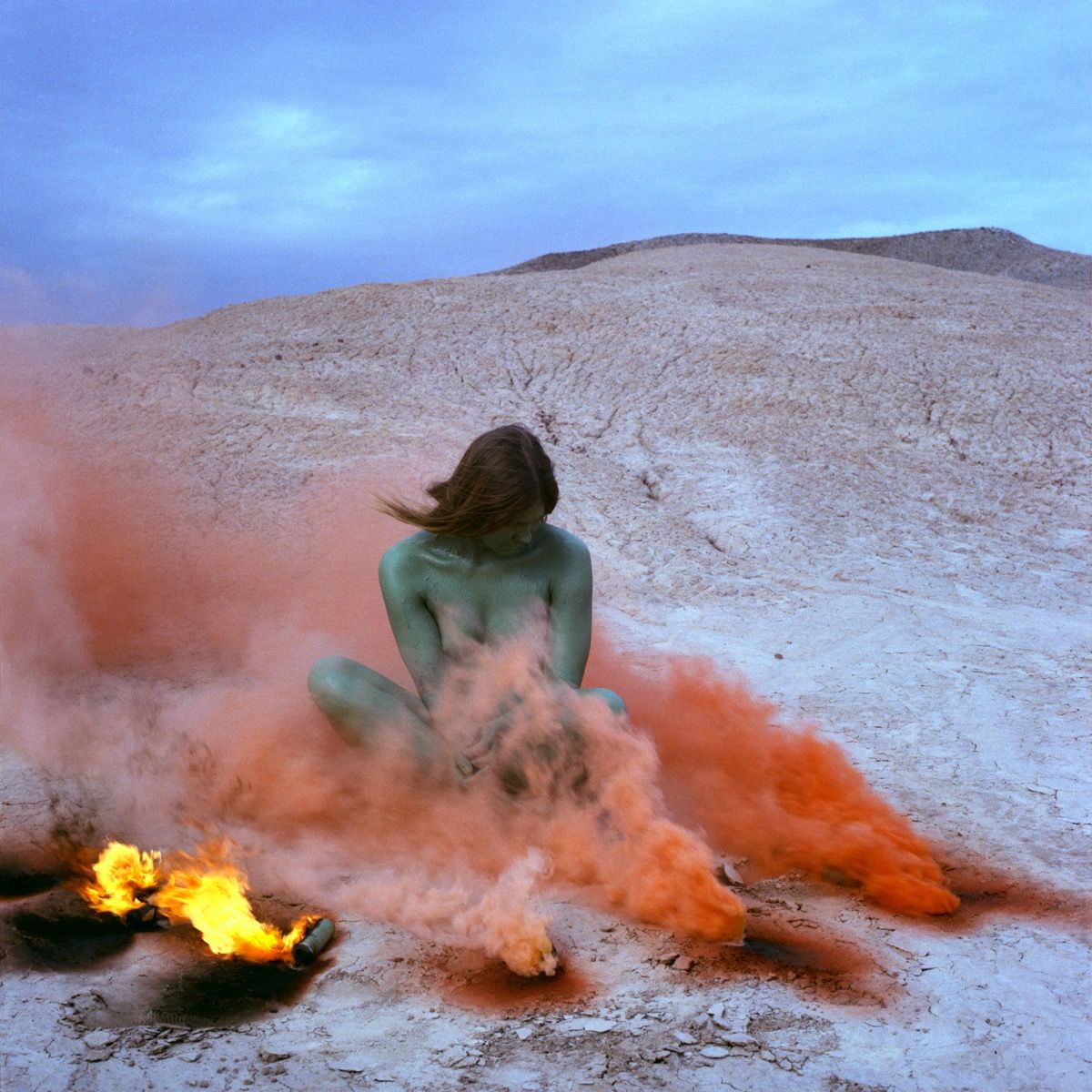
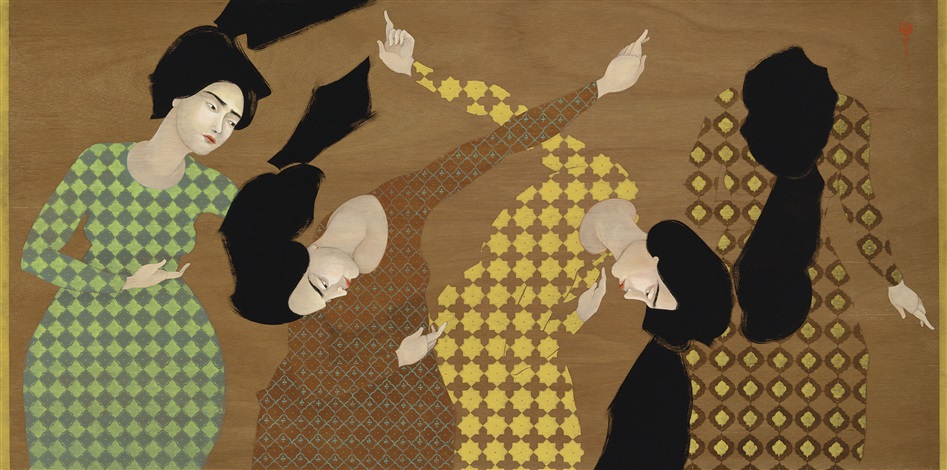
Several international artists were the highlight of the show: photographers like Judy Chicago, one of the first American self-declared feminist artists, and the African-American artist-cum-designer Xenobia Bailey; the Iraqi painter and sculptor, Hayv Kahraman, who is now based in California; and British multi-disciplinary artist Rachael House, to name a few. Aside from Hayv, whose art includes her experiences as a refugee, all these artists use their work to explore issues of gender, identity, freedom and power.
Rachael House’s To Be Normal Is Not a Healthy Aspiration, 2019, 
Ink on Hahnemühle Museum Etching paper.
Hayv’s painting, in particular, was deeply touching for me. The Kawliya Dancerepresents women from a Roma heritage in Iraq who are swept away in a dance ritual. The ritualistic dancing is supposed to wash away the pain and discrimination that their community has been fighting for decades, if not centuries. The beauty of the painting on wood, the liveliness of the movements, the symbolic power of female hair, are all so evocative, expressive and liberating for both the depicted women and the beholder. 
Hayv Kahraman’s The Kawliya Dance, 2013, oil on panel.
In the same room, Xenobia Bailey’s magical and spiritual tent, weaved to reconnect abducted African ancestors with their heirs in America, carries the same sense of bitter-sweetness; but it also offers hope and redemption. 
Zenobia Bailey’s Sistah Paradise’s Great Wall of Fire Revival Tent, 1993. Image courtesy of Flickr.
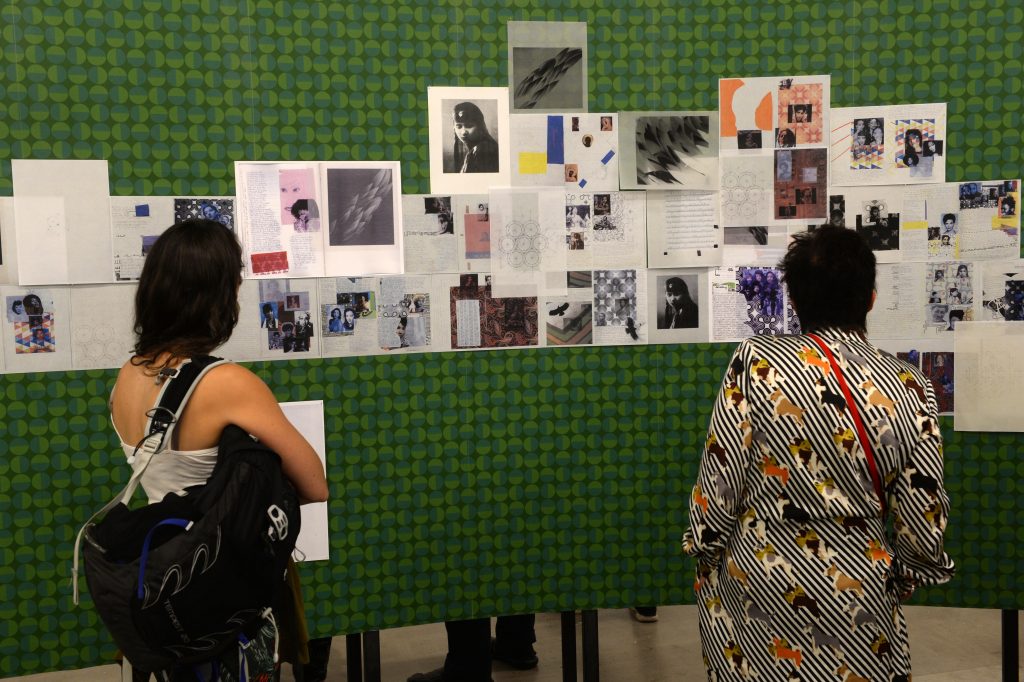
In the basement, historical and documentary photography was heavily represented, with work coming from Argentina (including photos by Eduardo Gil), India (with Pamela Singh), Iran, Botswana, South Africa, the United Kingdom, and more.
Issues of domestic violence, domestic work and marital inequality were also addressed through a series of posters from different countries and decades. They represent acts of resistance against the marginalisation of women in politics and wider society. Activists and protesters who defended the rights of individuals from the queer community, as well as disabled people, could be seen in archival material and photographs. These photographs also captured the numerous marches for peace, equality and environmental protection. All the work in this section confronted a world dominated by patriarchal systems and values, capitalistic greed and materialism, and the general, arbitrary lust for power.
Still I Rise: Feminisms, Gender and Resistance – Act 3. Image courtesy of the Arnolfini.
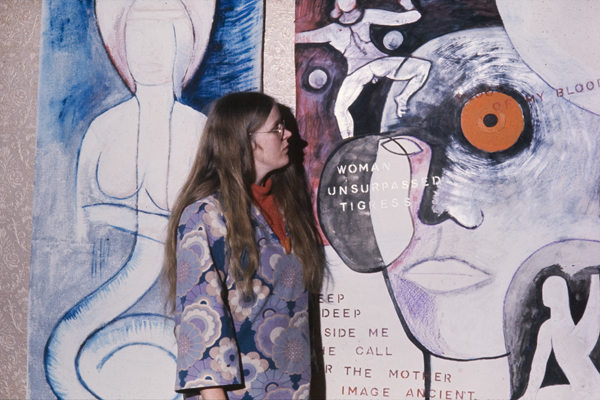
Bristol’s feminist history also came through with the work of the bisexual Swedish artist, Monica Sjöö, a painter, writer and radical ecological feminist who moved to Bristol in 1950s, where she lived until her death in 2005. She was an early exponent of the “Goddess movement” and became known for her painting ‘God Giving Birth’ (1968), which depicts a non-white woman in labour. It was censored multiple times for obscenity, with Sjöö being reported to the police for blasphemy in a later show. Her paintings and protest posters, which were once created for feminist marches in Bristol, show huge iconic female pagan figures dancing and bolstering another iconic stage of resistance.
Monica Sjöö with her work in 1973-4, courtesy of the Feminist Archive South.

During the past three months, I spent a lot of time in the gallery. I thought and wrote about the many women I had met over the years who endured terribly bleak environments: women from Kenya, Iraq, Somalia, Uganda, Haiti, Algeria, India, Mexico, on the Italian/French boarder, in Calais, or, closer to us, in Northern Ireland. I though about their lives, what they saw and lived through, and the kinds of acts of resistance, however large or small, they made.
Walking around the gallery and working as a writer in residence also brought me into contact with some insightful visitors, of all genders, who were interested in many of the issues around gender equality and socio-political resistance. One of them was the poet and activist Lawrence Hoo, whose recently published book Cargo has opened a new level of conversation in Bristol about the city’s past role in the slave trade. Another was Dawn, a radio producer of English, Afghan and Indian decent, who discussed the prejudices she has been subject to her whole life, so often has she been treated like a foreigner, a newcomer, while born and bred in England. I had the chance to meet and talk with the artist Angelica Mesiti, who represented Australia at the 2019 Venice Biennale and is known for her large-scale video works. We talked about the misogyny of the Parisian art scene (she is currently lecturing at the Ecole des Beaux-Arts), among other issues. 
I also had a powerful discussion with Tricky, one of Bristol’s most famous rappers and music producers, who I’d had the privilege of talking to years ago. Tricky has just released his autobiography, Hell is Round The Corner, in which he ponders the influence of his mother on his life, a mother who committed suicide when he was only four years old but who he clearly inherited a love of words from.

As the exhibition closed on 14th December, the fight for our rights to be equal – to be safe, protected, free and ourselves – only seemed more relevant than ever. 
In the UK, the Conservative Party won the election on 12th December. As soon as Parliament resumed, most MPs voted for a bill that would enable them to “get Brexit done” as quickly as possible, thus effectively endangering the rights of migrants and scrapping laws to protect the environment, freedom of movement and much more.
In light of the election result and as a French citizen whose parents came to Europe from North Africa; as a grandchild of freedom fighters, and as a journalist and lecturer, I fear for this country. I fear for my future in it, and for the future of children here and worldwide. 
Yet, my faith in the power of creativity and rebellion to awaken more of us to the urgency of these issues undeniably remains intact. Indeed, the rest of the world is boiling with revolt. And women are, once more, often leading the protest forward, urging us to believe and fight for a better future, as seen in the Black Lives Matter and #MeToo movements, Extinction Rebellion and many others.

Throughout my life, with everything I wanted to do, I was told I couldn’t do it. Whether it was by a neighbour, a teacher, a boss or even my friends: each time I was told I couldn’t do it. And when I did achieve what I set out to do, it was always met with scepticism or ignored altogether. And as a daughter of foreigners, as a foreigner living and working in the UK now, I was told countless times I wasn’t good enough; that I couldn’t study at the best universities or fulfil my professional ambitions. Yet I did. I kept on dreaming and continuing to work. I studied literature, then international politics. I became a journalist. I travelled five continents. I worked for international broadcasters. I used my journalistic writing to support refugee and foreigners’ rights. And I published my first book in two languages. I rose, to use Maya Angelou’s famous words. Like many of the women artists mentioned above, I kept dreaming; I kept fighting to do what I cared for most.
But while I did, how many other young women were deprived of these rights and denied their dreams? This is what pushed me on and what still encourages me to continue reporting and writing. My duty, like many of the artists in the Arnolfini exhibition, is to use my creative voice to enable others to grow and liberate themselves from whatever forms of oppression and socio-political restrictions they encounter. Witnessing the work of Judy Chicago, Xenobia Bailey, Hayv Kahraman and many more has fuelled my desire to continue to fight and resist, as well as encourage and empower those around me. The Arnolfini gallery continues in this mission too by exhibiting two exceptional artists next year: Paris-based Australian video artist Angelica Mesiti, and the Bristol-based Iranian photographer Amak Mahmoodian. The discussion on feminisms, genders and resistance through art will continue, and I will be there to see and write about it all. Still, we will rise once again.
To read more about Melissa Chemam’s experience of being an Arnolfini writer in residence, click here and the following links for her Instagram and Twitter. For more information on the Arnolfini’s upcoming events and exhibitions, including the work of Angelica Mesiti and Amak Mahmoodian, see here.
Feature image credit: Immolation IV by Judy Chicago. Courtesy of the artist, Salon 94, New York, and Jessica Silverman Gallery, San Francisco.

23/12/2019

Ms Lauryn Hill


Melancholic mood...
Universe, I just want to say, thank you for music...

New track featuring the mighty Lauryn Hill, sublime:
'Guarding The Gates' (From "Queen & Slim: The Soundtrack")


Lyrics:


Everybody, everybody wants to know
Where you going to
What you running from
What you going through
Where you coming from
What you going through
Where you coming from
Everybody, everybody wants to know
What you gonna do
Where you going to
'Cause they wanna come
Where I'm showing you
Yes, they wanna come
Where I'm showing you
All that you could be is a spectacle
Following after every single miracle
Watch them marvel at
All the joy you have
But they're too important to have all the joy you have
What a tragedy, you can laugh at me, you can laugh at me
But I'm in love
Yes, I'm in love
Don't you wish you had real love
Yes, I'm in love
Tryna fix myself for society
Tryna mix myself for society
But can you tell me where is love in anxiety?
Can you tell me where is love in anxiety?
What you say to me
I don't mind at all
What you say to me
I don't really care at all
'Cause I'm in love
Don't you wish you had real love?
I know you do
Yes, I'm in love
Watch them speculate
All the life you live
Watch them try to hate
All the love you give
Everybody, everybody wants to know
Where you going to
'Cause they wanna come
Or so they think, until they find the cost of it
'Till they found out, found out what you lost for it
And I'll do it all again
'Cause I found love
'Cause I found love
Don't you wish you had real love?
I know you do
Yes, I'm in love
Everybody, everybody wants to know
Where you going to
What you running from
What you going through
Where you coming from
What you going through
Where you're coming from
Everybody, everybody wants to know
What you gonna do
Where you going to
'Cause they wanna come
Where I'm showing you
Yes, they wanna come
Where I'm showing you
All that you could be is a spectacle
Following after every single miracle
Watch them marvel at
All the joy you have
But they're too important to have all the joy you have
What a tragedy, you can laugh at me, you can laugh at me
But I'm in love
Yes, I'm in love
Don't you wish you had real love?
I know you do
Yes, I'm in love
So what you say to me, I don't even mind at all
What you say to me, I don't even care at all
'Cause I'm in love
Don't you wish you had real love?
I know you do
Don't you wish you had real love?
These broken thoughts in my mind
Can't let them get down in there
These broken thoughts in my mind
Can't let them get down in there
'Cause I need real love
I need real love
I'm guarding, guarding the gates
Oh, I'm guarding my gates

Songwriters: Lauryn Hill


Guarding The Gates (From "Queen & Slim: The Soundtrack") · Ms. Lauryn Hill Guarding The Gates ℗ 2019 Sony Music Entertainment Released on: 2019-11-15

Barbès Baby


I just love this song, so much in there... Beat poetry, books, Lou Reed, etc.


Lana Del Rey - 'Brooklyn Baby' (Official Audio, 2014) 


I also wish I could write a personal version to respond to it, it with a Bristol/Paris twist, instead of New York :)  

Including the likes of Marguerite Duras, la Nouvelle Vague, Camus and Char... and a band covering the Velvet Underground...