11/06/2015

Jupiter Bokondji et son Okwess International band bientôt à Paris - Portrait pour Toute La Culture


Mon dernier article pour Toute la culture : Kinshasa - Berlin - Bristol - Paris - Londres smile emoticon 

Lien vers le site: http://toutelaculture.com/musique/world-music/jupiter-des-faubourgs-de-kinshasa-aux-sommets-de-hyde-park-allers-retours/


[PORTRAIT] JUPITER, DES FAUBOURGS DE KINSHASA AUX SOMMETS DE HYDE PARK, ALLERS-RETOURS


11 juin 2015 Par Melissa Chemam


A 50 ans, Jupiter est un musicien comblé. Le 15 juin 2015, il partagera la scène du Zénith avec le groupe le plus célèbre du Royaume-Uni, Blur, et cette consécration internationale arrive après un parcours exemplaire mais non sans embûche pour le musicien congolais, né à Kinshasa, et élevé en partie à Berlin où son père était diplomate dans les années 1980. Depuis son retour en République Démocratique du Congo, ce percussionniste et chanteur s’est donné pour mission de faire revivre les centaines de traditions musicales ancestrales des quatre coins du pays, tout en leur apportant des influences glanées au cours de ses voyages plus récents.

Pour en savoir plus sur Jupiter, rendez-vous sur le blog Melissa on the Road.
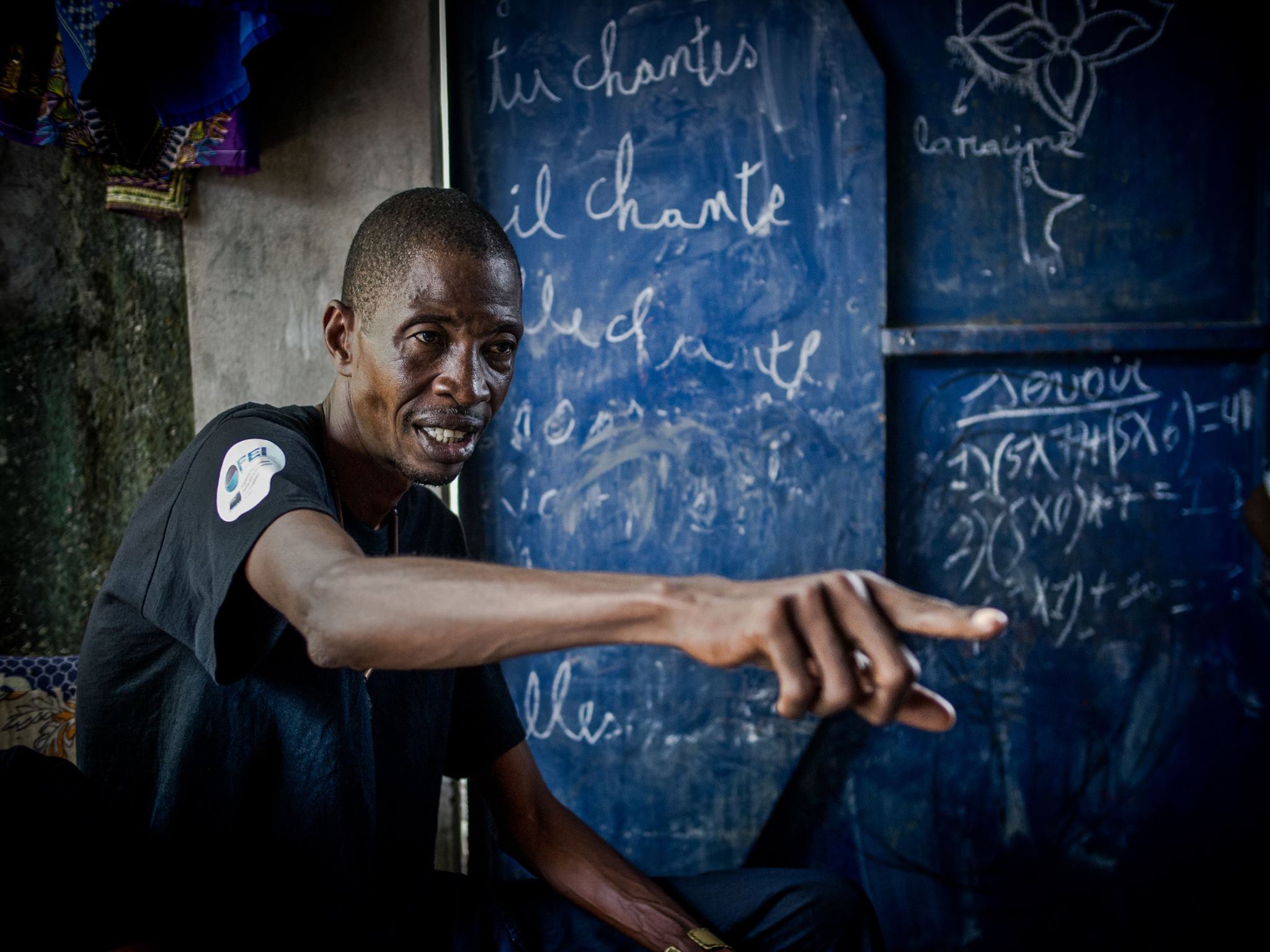


Jupiter Bokondji voyage à présent avec son Okwess International Band, un groupe comprenant six musiciens, et est en tournée en France et en Europe. Après le 15 juin au Zénith, il sera à Hyde Park à Londres avec Blur dont le chanteur et leader charismatique, Damon Albarn, est devenu son ami à la suite de l’aventure Africa Express que Damon a mise sur pied à partir de 2005. Le projet a pour ambition de réunir sur une même scène des musiciens européens et africains, Damon se passionnant notamment pour les musiques malienne et congolaise. C’est ainsi qu’il a produit les disques d’Amadou et Mariam à Bamako et de Jupiter à Kinshasa.

Des rives du fleuve Congo au Berlin Est de la Guerre froide

Mais si Jupiter doit son succès international au musicien britannique, sa longue carrière a été forgée au prix de ses seuls efforts. Nous nous sommes rencontrés à Paris, à la frontière entre les 18ème et 19ème arrondissement, quelques jours avant le début de sa tournée française. Fin, grand et mystérieux, Jupiter est aussi chaleureux et esthète. Il parle d’une voix profonde, grave, imposante et inoubliable « Ma grand-mère était guérisseuse et je le voyais faire ses cérémonies en musique, elle utilisait les rythme pour guérir les malades ; je pense que j’ai en partie hérité de son don », explique Jupiter pour justifier son talent.
Son père, diplomate, lui a transmis la passion des affaires étrangères, des beaux costumes, de la mission politique, et si les rythmes du Congo ne l’avaient pas rattrapé il serait sûrement devenu bureaucrate. A Berlin, il a découvert la musique moderne occidentale, le rock, le jazz, la musique classique, venus des Etats-Unis et de Grande-Bretagne notamment. Et en rentrant à Kinshasa, il redécouvre les musiques traditionnelles de son pays. Au Zaïre – l’ancien nom de la RD Congo – dans les années 1960, 70 et 80, c’est la rumba congolaise qui règne sur les scènes, mais pour Jupiter, cette musique a fait son temps, et elle a été imposée par les colonisateurs. Lancé dans la musique avec un premier groupe à partir de 1983, à à peine 18 ans, Jean-Pierre, que tout le monde surnomme Jupiter depuis l’enfance du fait de son tempérament de feu, fonde Okwess en 1995 et sa version Internationale en 2003. Entre temps, il doit lutter pour faire exister le groupe, les financements sont inexistants à Kinshasa, les salles de concerts peu nombreuses, les possibilités d’enregistrer extrêmement limitées.

Au Congo, c’est l’Europe qui revient le chercher de nouveau 

Son quotidien change lorsque deux Français, Renaud Barret and Florent de la Tullaye, viennent en 2004 tourner un film à Kin et réalise au final un documentaire sur sa musique : La Danse de Jupiter, sortie en 2006. A partir de 2010, le groupe, désormais plus connu, commence à enregistrer, a recours à des guitares électriques et pas seulement des instruments acoustiques et commence à partir en tournée : au Gabon, d’abord, puis en Europe : Belgique, Portugal, et le festival Back to Black à Londres. Jupiter est invité à rejoindre Africa Express en 2012, après avoir rencontrer Damon Albarn venu à Kinshasa pour enregistrer l’album Kinshasa One Two pour l’ONG Oxfam avec des musiciens anglais et locaux, sous le nom du super groupe DRC Music , sorti en novembre 2011. « Damon, c’est mon pote, on ne s’est pas rencontré par hasard. Lui comme moi aimons apprendre toujours plus de choses, les uns des autres, découvrir, c’est un génie ! ».
Coup sur coup, les mois qui suivent transforment la vie de Jupiter et son groupe : invités au festival WOMAD dans l’ouest de l’Angleterre, ils produisent un premier album qui sort au Royaume-Uni en 2013, Hotel Univers. L’été suivant, ils se produisent sur la scène de Glastonbury, dans la même région, l’un des festivals de musique les plus grands et prestigieux du monde.
Ce qui fait sa force et son succès, Jupiter Bokondji le sait, c’est son message : très politisé, il défend à la fois la culture de son pays, des pays africains, le besoin de démocratisation, un retour aux traditions et le droit à la modernité, tout en osant des textes forts et sans demi-mesure. Son superbe morceau intitulé sobrement ‘Congo’ a été ainsi choisi par le fondateur de Massive Attack, 3D, lui-même très engagé, pour son ‘’side project’’ intitulé Battlebox, en octobre 2013. Il y chante notamment « nos ancêtres étaient des esclaves, on les fouettait trois fois par jour mais ils bouffaient trois par jour (…) Cinquante ans plus tard, les Congolais bouffent une fois par jour (…) Est-ce qu’on est indépendant ou dépendant ? Ca dépend, l’histoire nous jugera ».
Depuis Jupiter et Okwess International ont produit un deuxième album, sur lequel Damon Albarn va enregistrer une partie de l’instrumentation au clavier. Il devrait sortir l’an prochain.
-
Jupiter et Okwess International seront au Zénith le 15 juin prochain et le 20 juin à Hyde Park à Londres en première partie de Blur, le 26 juin au Point Ephémère, puis en tournée en Europe dont une date au Festival Roskilde au Danemark le 4 juillet avec Africa Express.


Presenting from Bristol: The Pop Group's come back


Le groupe britannique est légendaire à Bristol. Formé en 1977 dans la capitale du West Country, où je passe tout mon temps depuis février dernier, The Pop Group s'est reformé en 2010 et cette année a sorti un nouvel album en février, Citizen Zombie

Il est également en tournée et passe par Paris le 20 juin prochain, au Social Club. A ne pas manquer!!


J'interview aujourd'hui le leader et chanteur Mark Stewart et notre entretien sera publié bientôt sur le site Toute la culture:
http://toutelaculture.com/

--

Plus de détails:

Leur dernier clip vidéo réalisé par l'actrice et réalisatrice italienne Asia Argento:


The Pop Group - Mad Truth (Official Video)


THE POP GROUP: PERSONNEL

Mark Stewart (vocals, lyrics)
Gareth Sager (guitar, saxophone, clarinet, piano, organ)
Bruce Smith (drums, percussion)
John Waddington (guitar, bass guitar)
Simon Underwood (bass guitar)

Dan Catsis (bass guitar)

--

More in English: 

The Pop Group was born in Bristol in 1977 out of a disenchantment with punk failing to bust out of its rock origins.


Comments:


“It’s one of those moments when the cogs of your mind shift and your life is going to irreversibly change forever”
Nick Cave on hearing The Pop Group for the first time.

“The Pop Group’s life was brief and fierce. Begun in 1978, collapsing in 1980, the Bristol teenagers' insertion of black funk, free jazz, dub and political protest into post-punk seemed, like much of the era's music, to be a doomed experiment. And yet, with each passing year, the influence of The Pop Group and its leader Mark Stewart grows.”
The Independent 1998

“Cited as a key influence by Nick Cave and Primal Scream these wilfully discordant Bristolians unleash an exhilarating mash up of polemical lyrics, funk rhythms, free jazz and dub reggae with a tightness and ferocity that would challenge bands half their age.”
**** The Times 2014

“They paved the way for Fugazi's politicized dissonance, Massive Attack and Nine Inch Nails' larger-than-life soundscapes, and the dancefloor-friendly art-rock moves of contemporary bands like Yeah Yeah Yeahs and Liars.”
Rollingstone.com 2014

“The defiant and inventive British band meets the modern era head-on, tempering its dystopias with the rhythms required to move bodies and open minds”
NPR 2015

The energy is still there, the idea is still there, it [The Pop Group] still fizzes with a life that most young bands today just don’t have.”
Paul Epworth


--

Details on the video:

Post punk provocateurs The Pop Group have collaborated with acclaimed Italian director and actress Asia Argento on the video of their first single Mad Truth from album Citizen Zombie, their first in 35 years.

"Collaborating with The Pop Group is a dream come true. The track blew my mind: all the set-ups and symbols in the video are inspired on a subconscious level by the music and the lyrics. I imagined a world ruled by the colourful souls of eternal children, expressing their crazy love through art, a spiritual warfare against a world populated by the living dead. The kids that appear in the video have worked also in the last movie I directed, including my daughter Anna-Lou. Between us there is a deep bond of trust and freedom.
The same freedom I was given by the band when they chose me to direct their first single in 35 years. I am deeply grateful to have my vision entwined with MAD TRUTH for eternity." Asia Argento, 2015

“The priestess of provocation, Asia Argento is a kindred spirit in this crazy zombie world we live in, we were born to collaborate, she’s the bomb!” Mark Stewart, 2015

Released in February of 2015 the album has since gained widespread praise, including album of the week slots in both the Independent and Scotsman, as well as ‘album of the day’ at BBC 6Music.

Produced by the much-acclaimed Paul Epworth, a long-time fan of The Pop Group, the 11-track album features original members Mark Stewart (lyrics / vocals), Gareth Sager (guitar) Dan Catsis (bass), and Bruce Smith (drums).

Digital:
iTunes: http://geni.us/ThePopGroupCZombie
Amazon: http://geni.us/PopGroupCZombieAMZ
Bleep: https://bleep.com/release/56598-the-p...

Physical:
Amazon: http://geni.us/PopGroupCZombieAMZ
Rough Trade: http://www.roughtrade.com/albums/90108

March 1st Tokyo JP – Liquid Rooms
March 5th Adelaide AUS – Adelaide Festival
March 6th Sydney AUS – The Factory Theatre
March 7th Melbourne AUS – The Corner Hotel
March 10th Los Angeles CA – Echoplex
March 11th San Francisco CA – Great American Music Hall
March 12th Seattle WA – Neumos Crystal Ball Reading Room
March 13th Chicago IL – Levitation Festival, Thalia Hall
March 14th Toronto ON – Lee’s Palace
March 16th Brooklyn NY – Rough Trade
March 17th New York NY – Bowery Ballroom
March 19th – 22nd Austin TX – SXSW

May 5th – Brighton UK – The Haunt
May 6th – Norwich UK – Arts Centre
May 8th – London UK – The Dome, Tufnell Park
May 9th – Sheffield UK – Plug
May 10th – Glasgow UK – CCA Arts Centre
May 11th – Liverpool UK – The Kazimier
May 16th – Aaurhus DK – Pop Revo Festival
May 29th – Aalst BEL – Netwerk Centre
May 30th – Porto PRT – Serralves Festival
June 12th – Birmingham UK - Supersonic Festival
June 19th – Hilvarenbeek NL - Best Kept Secret Festival
June 20th – Paris, FR – Social Club
June 21st – Ramsgate UK – Ramsgate Music Hall
June 26th – Bristol UK – Exchange
June 27-29 – Glastonbury UK – Glastonbury Festival


http://www.thepopgroup.net

--


10/06/2015

About BANKSY ON PALESTINE’S BROKEN WALLS - and why it matters


The Daily Review published this article yesterday about Banksy, the West Bank, politics and art.
Read and think about it please:

http://dailyreview.crikey.com.au/banksy-on-palestines-broken-walls-the-medium-really-is-the-message/25137


BanksyWEB
• JUN 9, 2015

A bank? Why would I want to see a bank? I came here to see the birthplace of Christ!
No, a Banksy. Do you want to go and see a Bansky?

What in God’s name is a Banksy?  - Bethlehem, May 2015.
So it was that two American pilgrims — retirees, sotherners judging by their drawl —  came to learn about the world’s most famous street artist. They were bemused. They didn’t quite understand the connection between Jesus and this Banksy fellow. Here they were in the Holy Land, on a trip they’d probably been planning for years, and they were being confronted by a man — an Arab no less, which, for many white conservative American Christians is a synonym for terrorist — offering to take them to some sight they’d not only not planned to visit, but had never even heard of.
They declined his offer and, thus, passed up a unique touristic pleasure: The sight of the virgin birth in the morning and, in the afternoon, ‘a Bansky’.
The politics and cultural value of street art have long been divisive topics because it pushes back against what has, for centuries, been considered ‘art.’ The idea that street art is at once both valuable — culturally and artistically — and a canvas for others to paint over, challenges long accepted notions of how art should be consumed and preserved. Artists have always re-used canvases, but they never painted over their masterpieces. Street artists, at least in the early days, didn’t discriminate.
Looking at the Banksy stencils in Bethlehem and in other cities in the West Bank, one is struck by the fact that the location adds a further layer of complexity to an art form that is still often misunderstood or, depending on your take, increasingly corrupted by the ‘art world’ (whatever that is).
It’s self-evident to say that Bethlehem isn’t Bristol or Berlin and Ramallah’s not Rio, but it’s not until you stand in front of one of Banksy’s works in the occupied territories that one fully understands what that means. I’ve seen his work in Melbourne, London and Berlin and, while his anti-authoritarian, anti-capitalist and anti-surveillance messages resonate, it’s in Palestine that his work is imbued with a unique sense of injustice that is, quite literally, painted on the very walls that carry it.
The walls that his work is painted on imprison the Palestinians and ‘liberate’ Israelis —  never has Marshall McLuhan’s idea that ‘the medium is the message’ seemed more relevant or more compelling. Of course, street art — an art form that takes its name from its medium — has always been an illustrative example of McLuhan’s thesis, but in Palestine the ‘street’ is an exponentially more political place because it is a contested sight of  war and occupation.
Street art challenges the convention that art is something that hangs in galleries and is consumed by the educated upper-classes. The politicisation of art didn’t start with street art, but it has democraticised art in a radical and new way.
It merged ideas of high art with vandalism and criminality: It turned what was once considered an act of destruction into something not just socially acceptable, but widely lauded. So, born out of illegality, it’s inevitable that street art is inherently political in a way that other art forms are not (though they might have been in the past).
Similarly, it attracts those with a radical bent who see laws as social constructs that, when morally permissible, should be broken.
The fortress through Palestine is covered in street art, graffiti and messages of resistance or struggle and Banksy’s work fits comfortably alongside these. Their financial or cultural value is far less important than their political value. That the Israeli authorities have removed or painted over some of Banksy’s work matters little because it only reaffirms the repression many Palestinians experience on a daily basis.
Above all, his work is an expression of solidarity with a persecuted and occupied people. It’s not insignificant that the world’s best-known street artist has contributed to the Palestinian struggle in a tangible and real way — even if it’s only to force a few pilgrims to see that there’s more to Bethlehem than being the place the Bible says Jesus was born.
And Banksy’s commitment to the Palestinian’s cause has continued. Following the most recent war in Gaza, he travelled to the ‘world’s largest open-air prison’ where he adorned the ruins of Israel’s assault with his work. It should be noted that getting into Gaza is no mean feat: it is blockaded by Israel and, for those without permission, can only be accessed illegally via tunnels, presumably from Egypt’s north Sinai since Israel claims to have destroyed all tunnels into her territory during the last bombardment.
As street art has become more widely recognised as having its own value one of its stranger developments is that people have sought to ‘protect’ works by famous artists like Banksy. It’s strange because it is counter to the very ethos on which street art was founded and represents a shift towards more traditionally accepted notions of what constitutes art.
Nevertheless, it’s a shift easily explained. Our modern Western societies are built on the foundations of capitalism and, since the Reagan-Thatcher era, this has become the raison d’ětre by which every aspect of society relies on in order to function ‘effectively.’ Culture has been subsumed by the market — ‘value’ is not some sort of abstraction anymore, it’s something that can be priced. The idea that culture can operate independently of the market now seems naïve or fantastic —  to suggest such a thing to a ‘serious person’ is to be accused of being divorced from reality.
And so, when a Gazan familiar with Banksy’s work cheated his neighbour into selling him a spray-painted Rodinesque figure painted on a bombed-out iron and brick doorway for 700 shekels (about $A230), one could hardly be surprised.
This has, in one form or another, been going on for as long as people have thought they can make money from street art. How many Banksy’s have been chiselled out of walls around the world?
As a society we’re dismissive of these acts of vandalism and robbery. This is the spirit, after all, that we’re taught to believe in. These are the people —  emboldened by Ayn Rand’s call to act selfishly and take what you want to make your life better — that prosper in our neoliberal age.
But do these same forces of corruption — of unrestrained, immoral capitalism — infect Gaza too? Well of course, if one speaks about capitalism as being all-pervasive, it only makes sense that it reaches the places that suffer the most under the system.
But the Left has a tendency to romanticise resistance struggles in far away lands and to see the people living there not as fellow humans, but as abstract players in a political action – a kind of undefined part that makes up an ideological whole. There is an obvious disconnect with reality here, but it does raise interesting questions about how street art — and, more specifically, Banksy’s work in Palestine — can be co-opted and used in a way that is counter to his original message.
Would, for example, the artist approve of the shop set-up in Bethlehem selling postcards and posters of his work? His work is being used (exploited, if you will) in the pursuit of personal wealth but, on the other hand, if it provides a Palestinian family with a livelihood is that such a bad thing?
Banksy is certainly not the first artist whose work has been misinterpreted for personal gain. (Who could forget Dan Brown’s bestselling novel born out of some crazed esoteric interpretation of Da Vinci’s Last Supper?) Nor should it be reason enough to stop producing art and, in the case of street art, engaging in political struggles.
There is much to be celebrated about Banksy’s work in Palestine. To walk through Israeli settlements and see the homes of Palestinians destroyed, their shops welded shut and the old market places deserted is to get a glimpse of the despair those under occupation have to live with. It can feel, at times, a place devoid of hope.
For Palestinians, largely abandoned by the international community, it must feel as though they are fighting apartheid alone. Walking along and photographing the seemingly endless wall in Bethlehem, a young boy approached me selling some tissues. I handed over one shekel and said shokran (thank you).
And with that simple gesture — one Arabic word — his entire demeanour changed. With a smile across his face he took me by the hand and, pointing into the distance, excitedly repeated, ‘Banksy! Banksy! Banksy!’ as he led me to the stencil I’d just come from. I saw that he understood that there were people on his side –that, as futile as it may seem, his people haven’t been entirely abandoned — and, in that moment, with the innocence only children possess, that’s all that mattered.

09/06/2015

"It's No Great Crime" - Bristol's iconic graffiti by 3D from 1983 reinvented in 2011


"Its No Great Crime" by Paris1974, inspired by 3D's from 1983 in , St Pauls:
http://paris1974.com/profile/its-no-great-crimehttp://paris1974.com/profile/its-no-great-crime
http://paris1974.com/profile/its-no-great-crime


Its No Great Crime

Painted in honour of an original piece by 3D from 1983. St Pauls, Bristol 2011.


Paris, 3D, Bristol, Massive Attack, Its No Great Crime.


Paris is a British visual artist known for his trademark abstract graffiti effects.
Specialising in bespoke art, avant garde logos, large scale decor , customisation & installation.


Thinking of bees and butterflies


 Because my name means "bee" in greek, I cannot help but caring for this part of nature being endangered... Then I, metaphorically, feel I'm on a search for butterflies. All representations of happiness, nature and spontaneous beauty...

Just a few articles and links on the issue on a busy spring Tuesday in Bristol.


BBC World Service on : Saving the bees

President Obama has announced a new plan to help restore bee and butterfly populations by giving pollinators their own protected corridor in the American Midwest. So how will it work?

#US #Obama #Bees

President Obama has announced a new plan to help restore bee and butterfly populations across North America. The plan’s centrepiece is a proposed bee habitat corridor along the I-35 freeway— a major north-south interstate highway in the Central US that runs from Texas to the Minnesota city of Duluth. Catherine Winter, who lives in Duluth and keeps bees herself, tracked down some other bee enthusiasts to talk about the president's plan and their own efforts to protect the pollinators that help feed us all.
Image: A honeybee hovers over a flower. Credit: Getty/Prakash Mathema
Release date: 05 Jun 2015

--
Girls in Hawaii sing:


--
More here:
Beyond Honeybees: Now Wild Bees and Butterflies May Be
 in Trouble

08/06/2015

Insights into The Other Art Fair, Bristol, June 2015


   Local and national artists were gathered this weekend in the Arnolfini Gallery for the affordable art fair baptised The Other Art Fair in Bristol.


The Arnolfini Gallery is right in the heart of Bristol, along the Harbourside.


--

Among my favourite artists was graffiti legend Inkie, see some of his pieces:


Dia de Los Muertos, inspired by Mexican popular arts:


"Love is The Message", funky style:


"Wizard":


Again, Love:

Green or blue:


Red features:


French inspirations in "Sacre Bleu" and Ooh la la", with Tati shops' features in the background, Barbès, my hood (!):


--

Three other art crushes:


Hugh Dunford Wood


Hugh's website:
http://www.dunfordwood.co.uk/


Abigail McDougall


Waterlilies


Abigail's website:
http://www.abigailmcdougall.com/


Emma Davis

Watercolours


More on Emma's Website:
http://www.emmadavisartist.com/


--

Latest news from WOMAD 2015


WOMAD UK Charlton Park 2014

The WOMAD (the World of Music Arts and Dance) Festival is poised to celebrate its 33rd year in July – and its ninth within Lord Suffolk’s spacious backyard at Charlton Park, near Malmesbury.
Already a raft of big hitters from the world music scene have been announced for the four-day event from July 23-26, including De La Soul, Tinariwen, Ghostpoet, Bellowhead and Laura Mvula.
--
Now announced last week: Daddy G of Bristol’s Massive Attack has teamed up with dancehall MC Deemas J for a special collaboration in The Red Tent – one of several stages dotted around the meadows, woods and chill-out zones of Charlton Park.
--
More on the programmation - selection:

Cheikh Lô at WOMAD UK 2015

Cheikh Lô (Senegal)

Cheikh Lô first came to international attention in 1996. He brings something different to the vibrant dance music of Senegal -  acoustic sounds and Sufi lyrics.


Ezza WOMAD UK 2015

Ezza (Niger)

North African guitar rockers Ezza, take blues and rock and deepen it with desert Tuareg sounds. What they create is a rhythmic and relentless groove that is both modern and unique in its power.


Olcay Bayir at WOMAD UK 2015

lcay Bayir

lcay Bayir is an impressive newcomer to the vibrant global music scene. Born in the Kurdish region of southern Turkey, she studied opera and classical singing in the UK before bring her rich textured voice and stories to bear on Asian and Mediterranean musical traditions.

Kasse Mady Diabate WOMAD UK 2015

Kassé Mady Diabaté (Mali)

This venerable, velvet-voiced elder of Mali brings WOMAD more traditional sounds from Africa. He has taken on the mantle of stately ambassador for his country's music for a good 40 years now.


 Nazim Ziryab at WOMAD UK 2015

Nazim Ziryab (Algeria/UK)

He has been compared the legendary Carlos Santana, but his music is a rich fusion of Algerian Chaabi, Sub Saharan rhythms blended with Pop and Reggae

--

And also:
The Mahotella Queens (South Africa)  Daddy G and MC Deemas (UK)  Mbongwana Star (Congo)  Maarja Nuut and Alhousseini Anivolla (Estonia and Niger)  Criolo (Brazil)  Sinkane (USA)  Nightmares on Wax (UK)  Tal National (Niger)  Pascuala Ilabaca (Chile)  The Soil (South Africa)  Violons Barbares (Bulgaria, France and Mongolia)  Winston McAnuff & Fixi (Jamaica/France)  Shy FX and Stamina MC (UK)  Wrongtom Meets Ragga Twins (UK)  Chassol (France) The Cambodian Space Project (Cambodia) Sheelanagig (UK)