Journalist at RFI (ex-DW, BBC, CBC, F24...), writer (on art, music, culture...), I work in radio, podcasting, online, on films.
As a writer, I also contributed to the New Arab, Art UK, Byline Times, the i Paper...
Born in Paris, I was based in Prague, Miami, London, Nairobi (covering East Africa), Bangui, and in Bristol, UK. I also reported from Italy, Germany, Haiti, Tunisia, Liberia, Senegal, India, Mexico, Iraq, South Africa...
This blog is to share my work, news and cultural discoveries.
WAHA s'est déployé dans les Balkans pour répondre à l'afflux de réfugiés
Face à l'afflux de réfugiés venant du Moyen-Orient vers l'Union Européenne, WAHA International a déployé ses activités médicales et sanitaires dans les Balkans, en particulier en Serbie et en Croatie, mais aussi en Macédoine.
La situation des réfugiés arrivant dans les Balkans présente de nombreux défis.
WAHA International contribue à répondre au surcroît de besoins suscité par cette crise en Europe, en partenariat avec l’association française la Chaîne de l’espoir.
La Serbie se trouve notamment dans une position stratégique, sur la route de migrations vers l’Union européenne. Après la fermeture par la Hongrie de sa frontière avec la Serbie, la Croatie est ensuite devenue la principale destination des réfugiés en quête d’un chemin vers l’Allemagne.
La Serbie s’est révélée le pays le plus accueillant dans cette traversée des Balkans mais est dépassée par le nombre d’arrivées.
Les opérations de WAHA en Serbie ont commencé le 14 septembre, en Croatie le 17.
En octobre, elles se sont étendues en Macédoine. En novembre, nous prévoyons d’intervenir également en Slovénie.
Nous avons pu apporter une aide médicale à plus de 1000 patients en Croatie, où nous sommes présents dans 4 localités différentes, et plus de 9000 en Serbie, sur 5 localités.
Les actions de WAHA ont été particulièrement réactives dans le centre d'accueil de Miksaliste, en Serbie, ainsi qu'à Hogros à la frontière hongroise.
Le but principal de nos actions reste de se coordonner avec les autorités locales et non de mettre en place un système de gestion sanitaire parallèle. WAHA est ainsi membre du réseau de santé organisé conjointement par le Ministère de la Santé serbe et le HCR, ainsi que Médecins sans Frontière (MSF) et le Danish Refugee Council (DRC).
--
Plus de détails sur les actions de WAHA en Europe :
Alors que de plus en plus de réfugiés tentent de rejoindre l'Union européenne, WAHA International travaille en partenariat avec l’association française La Chaîne de l’espoir, via un financement fourni par ECHO, le service d’aide humanitaire de l’Union européenne.
WAHA International a depuis septrembre 2015 mis en place son action la plus importante en Europe, notamment en Grèce et dans les Balkans. Elle offre des soins médicaux aux réfugiés et notamment aux femmes et enfants, le long de la longue route que doivent traverser la plupart d'entre eux.
Depuis le début de l'année 2015, plus de 700 000 personnes ont traversé la mer Méditerranée, sur des embarcations peu sûres, poussées par le caractère désespéré de leur situation dans leur pays, en guerre ou en proie à de grandes violences et à la misère. Certains fuient également des persécutions.
D'Izmir en Turquie, d'où partent un grand nombre de réfugiés, aux îles grecques de Lesbos, Samos et Chios, en passant par les pays des Balkans (Macédoine, Serbie et Croatie, principalement), WAHA s'assure que tous les réfugiés reçoivent les soins médicaux essentiels et un soutien en matière de d'hygiène et nourriture.
WAHA International dispose d'un réseau des cliniques mobiles et travaillent en collaboration avec des organisations locales et nationales, ainsi qu'avec les autorités des pays traversés et le Haut-Commissariat aux Réfugiés de l'ONU (HCR).
Depuis septembre, nous avons fourni de l’aide médicale à plus de 10 000 réfugiés, pour la plupart des hommes et des enfants.
A partir de novembre, WAHA renforcera également sa présence en Turquie, en Macédoine et en Slovénie.
--
WAHA International se félicite d’avoir été très réactif dans cette crise d’arrivée des réfugiés en Europe. Nous avons travaillé de près avec le HCR, les autorités locales et les sociétés civiles des pays concernés. Avec l’arrivée de l’hiver et la baisse à venir des températures, de nouveaux défis apparaissent. Une campagne de vaccination des enfants va être mise en place.
Il sera nécessaire d’améliorer et renforcer les équipes de santé et les structures sanitaires mobiles. WAHA International va notamment distribuer des vêtements chauds et des couvertures thermiques.
Face à l'arrivée d'un nombre croissant de réfugiés en Europe, depuis octobre 2015 WAHA International a mis en place son action la plus importante sur le continent, notamment en Grèce. L'île de Lesbos a enregistré plus de 70 000 arrivées en septembre dernier.
Photo : Livia Saavedra
WAHA International contribue à répondre au surcroît de besoins suscité par cette crise en Europe, en partenariat avec l’association française la Chaîne de l’espoir, et via un financement fourni par ECHO, les services d’aide humanitaire de l’Union européenne.
WAHA offre des soins médicaux aux réfugiés et notamment aux femmes et enfants, le long de la longue route que doivent traverser la plupart d'entre eux.
WAHA International dispose d'un réseau des cliniques mobiles et travaillent en collaboration avec des organisations locales et nationales, ainsi qu'avec les autorités des pays traversés et le Haut-Commissariat aux Réfugiés de l'ONU (HCR).
Depuis le début de l'année 2015, 700 000 personnes ont traversé la mer Méditerranée, sur des embarcations peu sûres, poussées par le caractère désespéré de leur situation dans leur pays, en guerre ou en proie à de grandes violences et à la misère. Certains fuient également des persécutions.
D'Izmir en Turquie, d'où partent un grand nombre de réfugiés, aux îles grecques de Lesbos, Samos et Chios, en passant par les pays des Balkans, WAHA s'assure que tous les réfugiés reçoivent les soins médicaux essentiels et un soutien en matière de d'hygiène et nourriture.
Depuis septembre, nous avons fourni de l’aide médicale à plus de 10 000 réfugiés.
En Grèce : L'île de Lesbos au coeur du dispositif d'accueil
Depuis le début 2015, les îles grecques de Lesbos, Samos et Chios ont vu arriver un afflux de réfugiés en nombre croissant, plus de 580 000 jusque fin octobre. Le nombre moyen d’arrivée par jour est passé de 1600 en juillet à 8800 mi-octobre.
Dans ce contexte, le but de WAHA International est de soutenir réfugiés les plus vulnérables, notamment les femmes et les enfants, sur les points les plus chargés de cette route de migration.
Selon le HCR, 70 000 sont arrivés par exemple à Lesbos en septembre dernier, pour la plupart par bateau, depuis la Turquie, dans le nord de l’île. La capitale de l’île, Mytiline, au sud, a ouvert deux camps, dont un pour les Syriens spécifiquement.
WAHA International est arrivée sur place début septembre, alors que les services d’aide étaient concentrés dans le sud de l’île. La plupart des réfugiés ont ainsi dû marcher pendant deux jours pour rejoindre les bureaux d’enregistrement et les camps, sans recevoir d’aide depuis leur arrivée.
Nous avons donc décidé de mettre en place des cliniques mobiles pour accompagner ces déplacements et fournir aux réfugiés l’aide nécessaire le plus tôt possible. Nous avons obtenu le soutien des autorités locales et du HCR, ainsi que l’aide de bénévoles sur place.
Nos activités ont commencé le 13 septembre. Nous avons pu traiter 7800 patients.
Depuis fin septembre, la coordination de l’aide s’est ainsi améliorée et deux camps de transit ont pu être créés au nord de l’île.
‘The noise and chaos is deafening; humanity is laid bare on the shores of Europe’
Photographer Giles Duley is on the Greek island of Lesbos where every day thousands of refugees are landing, to be told there is nowhere they can stay. He introduces a new series of images documenting the plight of the world’s displaced people
Photographer Giles Duley is currently on the Greek island of Lesbos documenting the terrible human impact of the vast European refugee crisis
THEGUARDIAN.COM|BY GILES DULEY
mid-October I arrive in Skala Sikamineas on the north coast of the Greek island of Lesbos. I am here as part of a long-term project for the UN High Commissioner for Refugees (UNHCR), documenting the refugee crisis across Europe and the Middle East. For more than a decade I have documented the effects of conflict and humanitarian disaster across the world, and much of that work has been in the countries from which these people now flee. From Afghanistan to South Sudan, in the past years I have seen growing instability across the globe.
I understand the fear that is driving people to leave their homes. I thought I had seen it all, but I have never been so overwhelmed as by the human drama unfolding on the beaches of Lesbos. In its sheer scale, it is hard to comprehend; the lack of response impossible to explain or excuse.
The events of the past few years are unprecedented in size and scope. Not since the second world war have so many people been on the move. The UNHCR estimates there are more than 60 million forcibly displaced people worldwide, with over 4 million Syrians alone leaving their war-torn country to seek safety in neighbouring countries and Europe.
On Lesbos, I have watched thousands land, fleeing wars in Afghanistan, Syria and Iraq. Again and again they say to me: “We thought we would die on that boat, but at least there was some chance; what we left behind was certain death.”
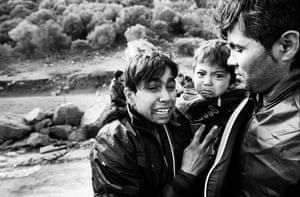
On landing, men break down into tears, women stand lost in visible shock, children cry hysterically. The noise and chaos is deafening; humanity is laid bare on the shores of Europe and the response from politicians is a shambles. It is volunteers who hold this frontline; often taking unpaid leave from work, bringing their own equipment and living in whatever accommodation they can find; a nurse from Palestine, a doctor from Israel, lifeguards from Barcelona; from Bolton to Oslo, everyday people are making a difference.
When survivors, upon landing, shake your hand and say “thank you”, I turn ashamed, for they have nothing to thank us for. If this were ever to be my family seeking safety, I hope the world would treat them better. We can argue about the root causes and possible solutions; we can discuss the difference between refugees, asylum seekers and migrants; we can blame traffickers and smugglers. But the simple truth is that men, women and children are suffering terribly and dying on the coasts of Europe, and for the sake of humanity alone we must help them, not turn our backs.
An Afghan family arrives in Lesbos – 19% of those arriving are from Afghanistan. Photograph: Giles Duley/UNHCR
I still work on film, so it’s some time before the first rolls are developed and contact sheets delivered. Working this way gives me the time to consider what I’m doing, especially for a project like this, which is focused on documenting the breadth and depth of this crisis. In the relative calm of Goji, a harbour-side cafe, I start looking through the images, seeing with clarity the fear and emotion now frozen on the faces of the refugees. It’s almost too heartbreaking to look. As I sit there, the mayor of Skala Sikamineas, Giorgos Saroglou, joins me for a coffee. He talks of how the local population is struggling with the impact of this crisis too; he’s trying to hold together a community battered by tragedy. “How can anything be normal when each day you see a drowned child?” he says, dropping his head. “This coast has become a cemetery of souls.”
It’s nearly 11pm here in Lesbos. Today, 3 November, has been one of the busiest on record for refugees arriving, and despite the dark, boats are still landing. Estimates put the figure at more than 7,000. Two men and two children drowned. The camps are full, the volunteers and agencies overwhelmed. Families are sleeping wherever they can. An Afghan father with a baby in his arms asks for somewhere to sleep. He offers to pay three times the price in a hotel, even just for his wife and baby. When it’s explained there is nowhere left and no blankets, he says: “Touch me, am I not human too?”
This is Europe, this is today.
Donations towards UNHCR’s relief work can be made here
Cameroun : le président Paul Biya fêtait ce vendredi ses 33 ans au pouvoir
Un anniversaire sans faste pour l'un des règnes les plus long d'Afrique. Du côté des militants de son parti, on se félicite du bilan . Autre son de cloche évidemment du côté des opposants qui espèrent vivement son départ.
Calais, une politique absurde, inutile et dégradante
L’opération de grande envergure menée par le gouvernement depuis le 21 octobre pour disperser des centaines de migrants de Calais se poursuit. À ce jour, près de 600 personnes ont été déplacées puis enfermées dans sept centres de rétention administrative (CRA), à Marseille, au Mesnil-Amelot, à Metz, Nîmes, Paris-Vincennes, Rouen et Toulouse.
Après le jet privé pour 5 exilés, le gouvernement accélère la cadence et loue un avion de la sécurité civile pour 25. Il a déjà effectué douze rotations pour enfermer les exilés de Calais à Marseille, Nîmes et Toulouse. Quatorze transferts en bus se sont chargés de remplir des CRA du Mesnil-Amelot, de Metz, Paris-Vincennes et Rouen. La machine à disperser tourne à plein régime : elle enferme, elle humilie. Elle ajoute de la violence à la violence, du traumatisme au traumatisme, déjà subis entre le parcours de l’exil et les campements de Calais.
99 % des personnes enfermées sont libérées dans les 5 premiers jours de leur enfermement en CRA. La plupart sont déjà de retour à Calais. Comble de cette obstination absurde, coûteuse et dégradante : un Syrien enfermé au CRA de Metz 5 jours fin octobre a été une nouvelle fois privé de liberté au CRA du Mesnil-Amelot du 2 au 3 novembre, après deux nuits dans les campements de Calais. Ce cas n’est pas isolé : un Afghan de Calais a déjà été enfermé à deux reprises au CRA d’Hendaye en août. Un sort qui guette les 600 autres.
Des familles sont séparées : un enfant afghan de 12 ans est resté seul dans la jungle pendant que son père et le reste de sa famille étaient embarqués pour le CRA de Toulouse.
Les personnes concernées par ces rafles : 23 % de Syriens, 17 % d’Afghans, 13 % d’Iraniens, 11 % d’Irakiens, 10 % d’Érythréens. Tous sont à la recherche d’une protection au titre de l’asile, mais le gouvernement leur impose les barbelés et le traumatisme de l’enfermement avec la perspective d’une expulsion.
La Cimade appelle le gouvernement à changer radicalement de politique et à appliquer les valeurs d’humanité dont il se réclame.
It is modern art's most powerful antiwar statement... created by the twentieth century's most well-known and least understood artist.
But the mural called Guernica is not at all what Pablo Picasso has in mind when he agrees to paint the centerpiece for the Spanish Pavilion of the 1937 World's Fair.
For three months, Picasso has been searching for inspiration for the mural, but the artist is in a sullen mood, frustrated by a decade of turmoil in his personal life and dissatisfaction with his work.
The politics of his native homeland are also troubling him, as a brutal civil war ravages Spain. Republican forces, loyal to the newly elected government, are under attack from a fascist coup led by Generalissimo Francisco Franco. Franco promises prosperity and stability to the people of Spain. Yet he delivers only death and destruction.
The Kenyan government says it is working with the United Nations High Commission for Refugees (UNHCR) to ensure a smooth and voluntary repatriation of over 500,000 Somalia refugees living in Dadaab, Garissa County.
So far, only 45,000 refugees have left the country voluntarily according to Interior Cabinet Secretary Joseph Nkaiserry.
Records from the Interior Ministry show that at least 45,000 refugees have been repatriated in the last two years from the Dadaab refugee camp and more could soon be going back home under a new program that looks to repatriate at least 500,000 Somali refugees.
“We have spoken to the leaders and we are going to follow the law,” said Nkaissery.
Speaking during a tour of the five Dadaab Camps, Nkaissery said that the long term plan include stabilizing the war torn country by the Kenyan troops under UNISOM and ensuring all the necessary infrastructure such as health services, education, water among other basic amenities are in place before the refugees can go back home.
In August, UNHCR Antonio Guterres said Kenya had agreed to repatriate refugees in the Dadaab Refugee Camp voluntarily rather than forcibly as earlier declared.
Guterres said that the Kenyan and Somali governments have reached a political solution to address the refugee relocation challenge.
Before visiting the camp, Guterres held talks with President Uhuru Kenyatta, the Prime Minister of Somalia and leaders of the Jubaland regional administration.
“In our common understanding there are three very important pillars, the first and I want to thank President Kenyatta to confirm that the return for the return of the refugees will be done as voluntary repatriation as in line with the tripartite agreement,” said Guterres.
This means no one will be forced out of the camp as earlier feared. Many in the camp were not prepared to make the move.
Over the years, Somali refugees trickled into the country due to war and famine. Their population here has grown to an estimated 350,000 people, more than half the population of the entire refugee community in Kenya.
UNHCR says it has identified 8 areas in Somalia, where most of the refugees came from, and where they will be hosted.
Although there are concerted efforts to make the repatriation process possible, new timelines have not been laid out.
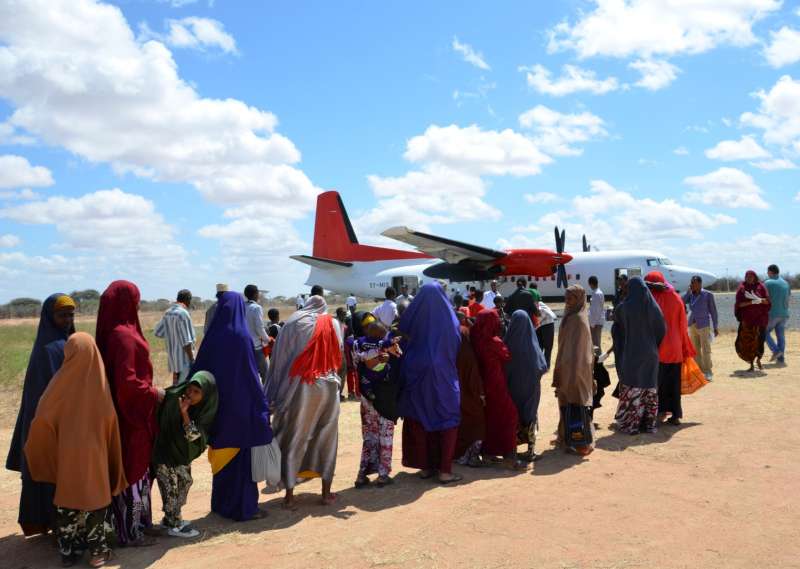
Somali refugees board a plane that will take them home to Mogadishu from Dadaab camp in Kenya.
Nearly 5,000 Somali refugees from Kenya's Dadaab camps have returned home since December 2014 and a further 4,500 have signed up to go back, the UN refugee agency announced today.
UNHCR has helped the returning refugees with transport to their places of origin. Mostly these have been the southern port of Kismayo, the capital Mogadishu, the towns of Baidoa and Luuq in south and central Somalia.
"They also receive a cash grant, food and basic domestic items such as sleeping mats, mosquito nets, a solar lantern, hygiene supplies and kitchen utensils to help them start a new life," UNHCR spokesperson Adrian Edwards told a press briefing in Geneva.
Meanwhile, UNHCR says that more than 26,000 Somali refugees have fled violence in Yemen and returned to Somalia, mostly to Mogadishu.
UNHCR says that although security and socio-economic conditions in many parts of Somalia are not right for large-scale returns and that many refugees remain doubtful about returning, some are eager to leave life in exile behind and help rebuild their country.
"To end one of the world's most complex refugee situations it is vital to make sure that the small number of returns can be successful and contribute to a more peaceful and stable Somalia," Edwards added.
He added that more support and investment in the country's social and economic infrastructure was urgently needed.
"While security remains a concern, the lack of equipped public schools and of job opportunities is cited by many as stopping them from going back," he added.
To rally international support for Somalia, UNHCR and the European Union are organizing a pledging conference on Wednesday 21 October, in Brussels.
UN High Commissioner António Guterres, the EU High Representative for Foreign Affairs and Security Policy Federica Mogherini and the European Commissioner for International Cooperation and Development Neven Mimica will welcome the Somalia's Prime Minister Omar Abdirashid Ali Sharmarke and the Kenyan Cabinet Secretary for Foreign Affairs, Amina Mohammed, together with the high-level delegations from Djibouti, Ethiopia, Kenya, Uganda and Yemen.
They will present a plan of action to prepare for the sustainable returns of Somali refugees from the region to Somalia and to rebuild the areas of return.
The main focus will be on rebuilding the infrastructure, reinforcing law enforcement, education, water and sanitation, health care provision, shelter, agriculture and the creation of job opportunities to representatives of more than 30 donor countries and organizations. The plan requires a total of US$500 million and will run for two years until the end of 2017.
More than 2 million Somalis remain displaced in the region, including over 1.1 million in their own country and 967,000 as refugees in the neighbouring countries. The majority (420,000) are living in Kenya, mostly in the five refugee camps in Dadaab in the north-east of the country. Nearly 250,000 Somali refugees are living in Ethiopia and an estimated 200,000 in Yemen.
Kenya to 'Repatriate' Half a Million Somali Refugees

A Somali girl accompanies women bringing firewood to the Ifo refugee camp in Dadaab near the Kenya-Somali border on Aug. 31, 2011 | Photo: Reuters
Previous
Next
Published 4 November 2015 (9 hours 9 minutes ago)
0
Comments
111
We Recommend

Somali refugees have long been subjected to state racism, including ethnic profiling and abuse by Kenyan police.
Kenya plans to “voluntarily” repatriate half a million Somali refugees after it stepped back from doing so earlier this year due to mass international condemnation.

The mass removal of 500,000 people living at the Dadaab refugee complex, the world’s oldest and largest refugee site, will be carried out together with the U.N. refugee agency, Interior Cabinet Secretary Joseph Nkaisery said Tuesday.

The plan will allegedly involve maintaining Kenyan military presence in Somalia and establish the necessary infrastructure to cover basic necessities like health services and water supply for returning-refugees, Xinhua news agency reported.

"We have to ensure that the refugees go back to a safe place. That is why we still have our troops inside Somalia to stabilize the country," Nkaissery said.

RELATED: How the World Bank, Ethiopian Elite Destroy Native Communities

The news comes after in May, Kenyan President Uhuru Kenyatta took back his threat to close down the Dadaab refugee complex, allegedly a breeding ground for militancy after it was erected in 1991 when a civil war rocked Somalia forcing hundreds of thousands to flee.

Kenyatta’s threat at the time was in reaction to a mass shooting that left nearly 150 dead at a university in Garissa at the hands of the militant group Al-Shabab in April.

Somali refugees have since been subjected to what they see is “collective punishment,” including systemic ethnic profiling, abuse, extortion and harassment by Kenyan police.

“Police intimidation is part of our daily life. When they see Somali person, they assume that you are illegal. I have paid a lot of money in bribes. They don’t accept that I am legal, even though I have a refugee card. They say it’s fake and demand money,” Said Hassan Anteno, told the New Statesman back in May.

Some 45,000 Somali refugees have already repatriated in the last two years from the Dadaab refugee camp according to Kenyan officials.


Xinhua News Agency

This content was originally published by teleSUR at the following address:
 "http://www.telesurtv.net/english/news/Kenya-to-Repatriate-Half-a-Million-Somali-Refugees-20151103-0029.html". If you intend to use it, please cite the source and provide a link to the original article. www.teleSURtv.net/english
Somali refugees have long been subjected to state racism, including ethnic profiling and abuse by Kenyan police.
Kenya plans to “voluntarily” repatriate half a million Somali refugees after it stepped back from doing so earlier this year due to mass international condemnation.

The mass removal of 500,000 people living at the Dadaab refugee complex, the world’s oldest and largest refugee site, will be carried out together with the U.N. refugee agency, Interior Cabinet Secretary Joseph Nkaisery said Tuesday.

The plan will allegedly involve maintaining Kenyan military presence in Somalia and establish the necessary infrastructure to cover basic necessities like health services and water supply for returning-refugees, Xinhua news agency reported.

"We have to ensure that the refugees go back to a safe place. That is why we still have our troops inside Somalia to stabilize the country," Nkaissery said.

RELATED: How the World Bank, Ethiopian Elite Destroy Native Communities

The news comes after in May, Kenyan President Uhuru Kenyatta took back his threat to close down the Dadaab refugee complex, allegedly a breeding ground for militancy after it was erected in 1991 when a civil war rocked Somalia forcing hundreds of thousands to flee.

Kenyatta’s threat at the time was in reaction to a mass shooting that left nearly 150 dead at a university in Garissa at the hands of the militant group Al-Shabab in April.

Somali refugees have since been subjected to what they see is “collective punishment,” including systemic ethnic profiling, abuse, extortion and harassment by Kenyan police.

“Police intimidation is part of our daily life. When they see Somali person, they assume that you are illegal. I have paid a lot of money in bribes. They don’t accept that I am legal, even though I have a refugee card. They say it’s fake and demand money,” Said Hassan Anteno, told the New Statesman back in May.

Some 45,000 Somali refugees have already repatriated in the last two years from the Dadaab refugee camp according to Kenyan officials.

This content was originally published by teleSUR at the following address:
 "http://www.telesurtv.net/english/news/Kenya-to-Repatriate-Half-a-Million-Somali-Refugees-20151103-0029.html". If you intend to use it, please cite the source and provide a link to the original article. www.teleSURtv.net/english
Somali refugees have long been subjected to state racism, including ethnic profiling and abuse by Kenyan police.
Kenya plans to “voluntarily” repatriate half a million Somali refugees after it stepped back from doing so earlier this year due to mass international condemnation.

The mass removal of 500,000 people living at the Dadaab refugee complex, the world’s oldest and largest refugee site, will be carried out together with the U.N. refugee agency, Interior Cabinet Secretary Joseph Nkaisery said Tuesday.

The plan will allegedly involve maintaining Kenyan military presence in Somalia and establish the necessary infrastructure to cover basic necessities like health services and water supply for returning-refugees, Xinhua news agency reported.

"We have to ensure that the refugees go back to a safe place. That is why we still have our troops inside Somalia to stabilize the country," Nkaissery said.

RELATED: How the World Bank, Ethiopian Elite Destroy Native Communities

The news comes after in May, Kenyan President Uhuru Kenyatta took back his threat to close down the Dadaab refugee complex, allegedly a breeding ground for militancy after it was erected in 1991 when a civil war rocked Somalia forcing hundreds of thousands to flee.

Kenyatta’s threat at the time was in reaction to a mass shooting that left nearly 150 dead at a university in Garissa at the hands of the militant group Al-Shabab in April.

Somali refugees have since been subjected to what they see is “collective punishment,” including systemic ethnic profiling, abuse, extortion and harassment by Kenyan police.

“Police intimidation is part of our daily life. When they see Somali person, they assume that you are illegal. I have paid a lot of money in bribes. They don’t accept that I am legal, even though I have a refugee card. They say it’s fake and demand money,” Said Hassan Anteno, told the New Statesman back in May.

Some 45,000 Somali refugees have already repatriated in the last two years from the Dadaab refugee camp according to Kenyan officials.

This content was originally published by teleSUR at the following address:
 "http://www.telesurtv.net/english/news/Kenya-to-Repatriate-Half-a-Million-Somali-Refugees-20151103-0029.html". If you intend to use it, please cite the source and provide a link to the original article. www.teleSURtv.net/english
--
Kenya to 'Repatriate' Half a Million Somali Refugees

A Somali girl accompanies women bringing firewood to the Ifo refugee camp in Dadaab near the Kenya-Somali border on Aug. 31, 2011 | Photo: Reuters
Previous
Next
Published 4 November 2015 (9 hours 9 minutes ago)
0
Comments
111
We Recommend

Somali refugees have long been subjected to state racism, including ethnic profiling and abuse by Kenyan police.
Kenya plans to “voluntarily” repatriate half a million Somali refugees after it stepped back from doing so earlier this year due to mass international condemnation.

The mass removal of 500,000 people living at the Dadaab refugee complex, the world’s oldest and largest refugee site, will be carried out together with the U.N. refugee agency, Interior Cabinet Secretary Joseph Nkaisery said Tuesday.

The plan will allegedly involve maintaining Kenyan military presence in Somalia and establish the necessary infrastructure to cover basic necessities like health services and water supply for returning-refugees, Xinhua news agency reported.

"We have to ensure that the refugees go back to a safe place. That is why we still have our troops inside Somalia to stabilize the country," Nkaissery said.

RELATED: How the World Bank, Ethiopian Elite Destroy Native Communities

The news comes after in May, Kenyan President Uhuru Kenyatta took back his threat to close down the Dadaab refugee complex, allegedly a breeding ground for militancy after it was erected in 1991 when a civil war rocked Somalia forcing hundreds of thousands to flee.

Kenyatta’s threat at the time was in reaction to a mass shooting that left nearly 150 dead at a university in Garissa at the hands of the militant group Al-Shabab in April.

Somali refugees have since been subjected to what they see is “collective punishment,” including systemic ethnic profiling, abuse, extortion and harassment by Kenyan police.

“Police intimidation is part of our daily life. When they see Somali person, they assume that you are illegal. I have paid a lot of money in bribes. They don’t accept that I am legal, even though I have a refugee card. They say it’s fake and demand money,” Said Hassan Anteno, told the New Statesman back in May.

Some 45,000 Somali refugees have already repatriated in the last two years from the Dadaab refugee camp according to Kenyan officials.


Xinhua News Agency

This content was originally published by teleSUR at the following address:
 "http://www.telesurtv.net/english/news/Kenya-to-Repatriate-Half-a-Million-Somali-Refugees-20151103-0029.html". If you intend to use it, please cite the source and provide a link to the original article. www.teleSURtv.net/english
De plus en plus de Britanniques s'intéressent aux idées d'extrême-gauche et achètent des livres à tendance socialiste.
Selon les libraires, les électeurs affichent un regain d'intérêt pour les ouvrages comme Le Capital de Karl Marx et le Manifeste du parti communiste depuis l'élection de Jeremy Corbyn, chef du parti travailliste d'opposition.
Jusque là, ces livres intéressaient essentiellement les étudiants en politologie et les activistes nostalgiques. Aujourd'hui, les ventes de littérature sur les idées d'extrême-gauche augmentent rapidement en Grande-Bretagne.
Andrea Butcher, propriétaire du plus grand magasin de littérature socialiste du pays, pense que la hausse des ventes est liée à la popularité de Jeremy Corbyn, chef du parti travailliste connu pour ses opinions bien ancrées à gauche.
"La victoire de Jeremy Corbyn a redonné confiance au gens, en a vraiment stimulé certains. Ils cherchent dans ces livres de l'aide sur les questions de logement ou les problèmes de la politique d'austérité… Et nous avons de tels livres", explique-t-elle.
Andrea Butcher espère que cette demande en littérature socialiste témoigne également de changements dans les préférences socio-politiques de la population.
"Regardez ce qui se passe dans le monde, notamment en Grèce, en Espagne, au Portugal. C'est une époque très intéressante pour les socialistes", dit-elle.
Les établissements spécialisés ne sont pas les seuls à constater cette embellie des ventes. La gérante d'une librairie généraliste, Vivian Archer, explique que ses clients s'intéressent également à la littérature de gauche.
"Ce sont les livres de base comme le Manifeste du parti communiste qui se vendent le mieux. Les gens essaient d'en apprendre davantage sur l'histoire du mouvement travailliste et syndical. Beaucoup de nouveaux livres ont été publiés sur le Service national de la santé. C'est un sujet très populaire, de même que l'économie d'austérité", déclare-t-elle.
Tout cela pourrait présager une nouvelle évolution de la vie politique britannique.