19/08/2015

About Black Britain


Currently reading:


There Ain't No Black in the Union Jack


by Paul Gilroy


Presentation:

Reissue
280 pages | 6 halftones | 5-1/2 x 8-1/2 | © 1987, 1991

Gilroy demonstrates the enormous complexity of racial politics in England today. Exploring the relationships among race, class, and nation as they have evolved over the past twenty years, he highlights racist attitudes that transcend the left-right political divide. He challenges current sociological approaches to racism as wel
l as the ethnocentric bias of British cultural studies. 

"Gilroy demonstrates effectively that cultural traditions are not static, but develop, grow and indeed mutate, as they influence and are influenced by the other changing traditions around them."—David Edgar, Listener Review of Books

"A fascinating analysis of the discourses that have accompanied black settlement in Britain. . . . An important addition to the stock of critical works on race and culture."—David Okuefuna, Chicago Tribune


--


Text witten by Ulrich Gdhler on Amazon.co.uk:


Paul Gilroy is the author of the seminal work “Black Atlantic” (1993) and the leading exponent of black diaspora studies. Paul Gilroy was born as East Londoner with Caribbean and English parents. He is currently a Professor at Kings College London and taught Sociology at the London School of Economics and Yale before. He studied at the Birmingham Centre of Contemporary Cultural Studies. “There Ain’t No Black in the Union Jack” appeared 1987 and reflects Gilroy’s PhD at Birmingham. Gilroy had worked on the famous CCCS “The Empire Strikes Back” project before. Gilroy wants to link the homely cultural studies of Richard Hoggart and E.P. Thompson with the thoughts of radical black thinkers.

Gilroy’s position on race is anti-essentialist

Simone de Beauvoir wrote “One is not born a woman, but becomes one”. Gilroy defends a similar position towards race. “Race” is a political category that can accommodate different meanings which are determined by struggle. In the hierarchy of dimension of inequality “race” should be accorded an equivalent place to class and gender. Gilroy believes structural transformations have reduced the homogeneity and political weight of the working class and the Left should move away from blaming modern social movements of not corresponding to the models written in the 19th century. Gilroy criticizes the idea of an English patriotism of the Left fostered by Tony Benn, Eric Hobsbawm and E.P. Thompson. “There Ain’t No Black in the Union Jack” is implicitly also a contribution to the debate about the peculiarities of the development and the weakness of Marxist tradition in England.

The book starts with an overview of theories about the relationship between “race” and “class”. Gilroy justifies his search for the distinctive, particular characteristics of race and racism in Britain with a critique of the different Marxist approaches of Ambalavener Silvanandan, Robert Miles and Ernesto Laclau.

“Race” and “Racism” is historically particular. The new racism sees race as a cultural issue and not primarily as a biological category. British racists such as Enough Powell understand race with the metaphor of a foreign invasion of Britain. Black criminality is an essential aspect of the race discussions. Gilroy introduces the findings of the CCCS study on “Mugging” and Social Panics. There is an identification of the law with national interests and of criminality with non-English qualities. In 1976 mugging is conceived as a racial crime and legality is the pre-eminent symbol of national culture. “Race” is not an essential biological category. There is a process of “race” formation. The antagonisms between the blacks and the police shaped black settlers in Britain into a political community.

The second part of the voluminous book examines variants of anti-Racism. Gilroy portrays the “Rock against Racism” movement of the late 1970s and the anti-racism campaign of the Greater London Council under Livingston in the 1980s. The GLC’s municipal Anti-Racism appears to endorse the idea that racial groups are real in the sense of being fixed and exclusive. But races are political collectives, not ahistorical essences. The essentialism of the GLC leads to a campaign which detaches issues of “race” and “prejudice” from the concrete social and political conflicts.

After this critique of essentialism Gilroy introduces the concept of the “Black Diaspora”. In the last part of the book Gilroy analyses the relationship between blacks and whites in the leisure institutions of urban Britain. 

Because of the influence of black styles, music, dress, dance, fashion and language, youth cultures became repositories of anti-racist feelings. The extensive chapter on black music in Jamaica, the US and Britain, provides elements of a history of black Soul and Rock music and is worth reading for those interested in understanding the relationship between Rock music and youth rebellion.

Gilroy manages to portray the dialectics of a particular modern British version of “race” and Racism. Unfortunately Gilroy does not show how the defeat of the English labour movement in the late 1970s and early 1980s shaped the relationship between “class” and “race”.

'Tattoo'


What would we become without music?

My own life owes a lot to my music discoveries, mainly in popular music, from the Motown artists to Radiohead, Jeff Buckley, PJ Harvey and Massive Attack, alongside Chopin and Debussy.

These days, I'm going backwards from the 90s to the 80s and 60s, which inspired them.

(An example 'Tattoo', writen by Siouxsie and the Banshees and majestically sampled by Tricky on 1996 on his second album).


'Tattoo' is a song written by Siouxsie and the Banshees that was first released as the B-side of the 'Dear Prudence' single in 1983.

 In 2004, it was included on the Downside Up compilation. 'Tattoo' was composed and performed as a three-piece by singer Siouxsie Sioux, bassist Steven Severin and drummer Budgie.

 During this era, the band experimented other ways of recording and orchestration when they were in the studio to record extra-tracks for their singles.

 For "Tattoo", producer Mike Hedges made them use the mixing desk as an instrument.

 With his assistance, they recorded a track with whispered voices, droning basslines and slow drum beats. The result was spooky and atmospheric.

'Tattoo' is considered to be a proto trip hop track which helped Tricky when he shaped his style.

 'Tattoo' would be later covered by Tricky in 1996 as the opening number of his second album, Nearly God.


Bansky's "Dismaland Ltd" exhibition: one more step into the rumour


Now the BBC is printing the rumour...


Bristol

Seaside exhibition 'bears Banksy hallmarks' says author


  • 18 August 2015
  •  
  • From the sectionBristol
The Tropicana site at Weston-Super-Mare
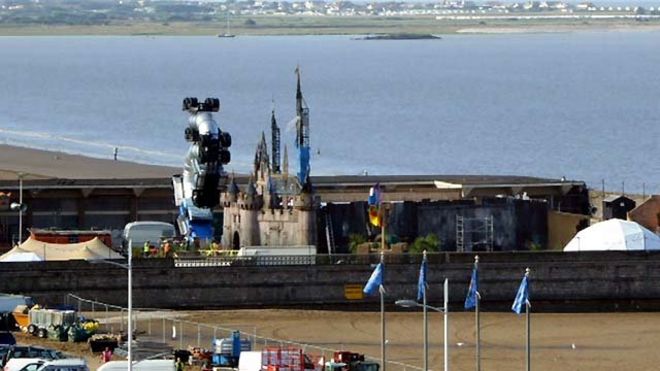
The tanker sculpture and castle at the former Tropicana site
Huge structures set up on a derelict site in North Somerset have "all the hallmarks" of Banksy, said the man who edited a book on the street artist.
Richard Jones said it had been rumoured a Banksy show would take place in the area in August.
Unconfirmed reports suggest Banksy has been creating a new "pop-up" exhibition on the former Tropicana lido site in the seaside resort, Weston-super-Mare.
A castle and sculpture made from tanker trucks can be seen above the walls.
Locals had been told that a Hollywood company was filming there.


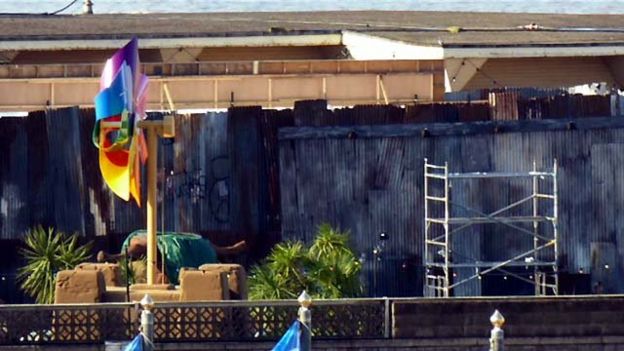
A large version of a child's windmill
This colourful windmill can be seen on the site
--

The Beeb does not have anymore details that the Daily Mail revealed two days ago but they interviewed local author, Richard Jones, founder of Tangent Books, which published a lot of very pleasant books about Bristol's street art.

--

The Daily Mail reported that Holly Cushing - one of the executive producers of Banksy film Exit Through the Gift Shop - had been spotted at the Tropicana site.
In May, along with Simon Durban, a fellow director at Pest Control Ltd, which authenticates Banksy's works, she set up another company called "Dismaland Ltd".
Mr Jones, the editor of Banksy's Bristol: Home Sweet Home, told BBC Radio Bristol it looked like a "major Banksy show" would take place at the Tropicana.
He said: "There have been rumours for some time, but nobody knew when it was going to happen or when."
"I think we can be fairly confident there's going to be a show at the Tropicana. It has all the hallmarks of a Banksy ploy, if you like."
"It's going to be called Dismaland apparently, a take on Disneyland. It's one of Bansky's themes about consumerism and the great American dream."
He predicted, if the exhibition was confirmed, Weston-super-Mare would "benefit hugely" from it.
His Banksy versus Bristol Museum show in 2009 attracted more than 300,000 visitors over 12 weeks and was estimated to have boosted the local economy by £10m.
The elusive Bristol-born artist has an international fan-base and his works sell for hundreds of thousands of pounds at auction.

18/08/2015

Napoli chiamante


Just a few tips to put who needs to be in the mood...


Naples overviewGuglia di San Domenico, Centro Storico - © Karl Blackwell/Time Out
Most exciting of all, perhaps, is the city’s dynamic contemporary art scene, with a wealth of private galleries and two ambitious public museums. Naples’ rich opera, Baroque music and theatre traditions stretch back for centuries, although the language barrier can be tricky to negotiate. Nightlife of all kinds is mostly ad lib, and for most recreational activities – aside from a run in the park – you have to get out of town.
--
Arts

Blindarte


Founded in 1999 as the first auction house in southern Italy, Blindarte opened a storefront contemporary art gallery above its subterranean offices five years later, soon to be expanded with a series of upper-level exhibition spaces. The young director, Memmo Grilli, is dedicated to exposing international emerging artists who work in a wide array of media, such as Brazilian conceptual artists Angela Detanico and Rafael Lain, American painter Adam Cvijanovic, and Italian artist Davide Cantoni, who burns his pictures on to paper. 

Address
Via Caio Duilio 10/4d,
Fuorigrotta
Area Naples
Transport Metro Campi Flegrei/Cumana rail to Fuorigrotta


Museo d'Arte Contemporanea Donna Regina Napoli (MADRe)


For years, Naples lacked a proper contemporary art gallery - but 2005 saw the opening of two large-scale, publicly funded galleries, PAN and MADRe. The palazzo that houses this pleasant, well-appointed museum was completely overhauled by Portuguese architect Alvaro Siza, who created a main display space on the ground floor and three upper floors of smaller connecting rooms.
Granted, it's not Guggenheim Bilbao or Tate Modern, but it is a highly functional space. The first floor hosts site-specific installations by international artists such as Jeff Koons and Richard Serra; highlights include a couple of Joseph Kosuth's cryptic neon signs, Anish Kapoor's marvellously illusory blue space and Rebecca Horn's mirrored skulls. Neapolitan in exile Francesco Clemente also returned to fresco two rooms in their entirety. The subject is Naples itself, and the superstitions that make the city tick. Staff are numerous and knowledgeable, though not all speak English.
The upper floors are given over to temporary exhibitions; artists have included Jannis Kounellis (featuring his notorious dozen live horses), Rachel Whiteread and Robert Rauschenberg. There's also a bar and restaurant, where a visit can be combined with a lively aperitif. 
Address
Via Settembrini 79
Area Naples
Transport Metro Piazza Cavour or Museo/bus 47, CS, E1


Open 10am-9pm Mon, Wed-Fri; 10am-midnight Sat, Sun (last entry 1hr before closing).


Foto © Amedeo Benestante.

In the historical heart of Naples, the three floors of the 19th-century Palazzo Donnaregina host the Madre — Museo d’Arte Contemporanea Donnaregina: 7,200 m2 of exhibition space, with site-specific installations, as well as works from the permanent collection and temporary exhibitions
--


Palazzo delle Arti Napoli (PAN)


Palazzo art delle i Napoli (PAN) is an art gallery and a museum that is housed in a pink 16th-century palace located in Via dei Mille in the heart of Naples.
PAN has 6000 square meters to fill with art. It describes itself as a “centre for arts and documentation”. PAN has no permanent collection of art, but it has amazing venue of exhibitions of contemporary art.
Three storeyed building with white small floors are filled with paintings, photographies and sculptures. There are works by many Italian artists displayed there such as William Kentridge and Dennis Oppenheim.
Contemporary art exhibition also involve multimedia, design, architecture as well as film screenings, book presentations, lectures, workshops, discussions and theatre events. There are also an experimental art lab, multimedia library, archive and a cafe-bookshop In PAN.
I am sure you would enjoy PAN when you visit Naples!


--

PAN has no permanent collection, but instead describes itself as a 'centre for arts and documentation'. A fourth-floor archive has catalogues and pictures of contemporary art activity in Naples stretching back over the last few decades. There are regular exhibitions (often drawn from the collections of other Neapolitan galleries), as well as film screenings, book presentations, lectures, discussions and theatre events. More off-the-wall shows have included a selection of Lou Reed's snapshots of his home town (the opening of the event was priceless, with the singer of 'Heroin' and 'Venus in Furs' politely greeting the somewhat traditional mayor). As a slightly labyrinthine collection of small rooms, it's not a great exhibition space - and with its mixture of activities, there's a sense that PAN is still trying to discover its true calling. It's worth keeping an eye on, though, as interesting shows often crop up.


Centro per le Arti Contemporanee, Palazzo Rocella, Via dei Mille 60
Area Naples
Transport Funicular Chiaia to Piazza Amedeo/bus C24, C25, C28, E6


--

Hermann Nitsch Museum


Set in a former electricity plant, with magnificent views that stretch as far as Mount Vesuvius and Capri, this museum and archive was opened in 2008 by the Fondazione Morra. It's dedicated to Viennese 'actionist' artist Hermann Nitsch's splatter paintings, and the relics of his orgiastic, bloody, theatrical mock crucifixions (by now more than 100). His work is strangely in keeping with the religious rites and iconography of the teeming Neapolitan streets, such as the 'miraculous' flowing of San Gennaro's blood in the Duomo three times a year. Collector Peppe Morra has sponsored Nitsch's performances since the 1970s; one, Lehraktion, took place in 1996 within view of the museum, at a hilltop vineyard owned by Morra. 


Il Museo resterà chiuso per pausa estiva dal 2 al 30 agosto!


--

Attanasio Sfogliate Calde


Hidden in the backstreets near the station, Attanasio is worth hunting out if you have a sweet tooth. The reason: sfogliatelle. They are the finest in the city, thus the best in the world. Fluffy, sweet and spicy ricotta cheese wrapped in flaky pastry, hot out of the oven - heaven. The only dilemma is which type: triangular, millefeuille-style riccia or oval, pie-like frolla


Address
Vico Ferrovia 2/4
Area Naples
Transport Metro Piazza Garibaldi/bus R2


--


Around Midnight


Local jazz musicians, along with combos from across Italy, play the standards here on most nights. The premises are small, and can become uncomfortably crowded, but the atmosphere is unpretentious and friendly. 

Address
Via Bonito 32A
Area Naples
Transport Metro Vanvitelli/funicular Montesanto to San Martino/bus V1
Open 10pm-2am Wed-Sun. Closed July, Aug.


--

Feel free to add more and share your favourite sites.
Thx 


Painting: Discovering Bruce Clarke


"L'identité n'est pas une donnée rigide et immuable, elle est fluide, c'est un processus toujours en devenir, par lequel on s'éloigne continuellement de ses origines, comme le fils quitte la maison de ses parents et on y retourne par la pensée et le sentiment ; c'est quelque chose qui se perd et qui se renouvelle, dans un mouvement incessant de dépaysement et de retour. Une patrie et une identité ne peuvent pas se posséder comme on possède une propriété."


Claudio Magris, Utopie et désenchantement, 2002, p. 92


"Identity is not a fixed unmoving fact; it is fluid, a processes always in process by which one is continually making a distance between oneself and ones beginnings, in the same ay as the son leaves home and only returns through thoughts and feelings; it is something that gets lost and then is renewed in an incessant movement of change and return. A home-country or and identity cannot be owned in the way one owns property."
--
Important statement found on Bruce Clarke's website:

Living (detail)

Born 1959, in London, his parents having recently emigrated from South Africa, Bruce Clarke Studied Fine Arts, Leeds University, Great Britain. Visual artist and photographer, based in Paris, he has exhibited in France and abroad since 1989.

See his work here:

'Daily Violence':

'Working Time':


--

And more here: http://www.bruce-clarke.com/page/gallery


17/08/2015

About 'Watching You'


 Beautiful praise from Jean-Michel Jarre about the sound of Bristol and 3D's work in Massive Attack, as he explains how the two of them have worked together on the recent track, 'Watching You'.


Here is the link:
https://www.youtube.com/watch?v=apAMKmZkhXE


Jean-Michel Jarre with 3D (Massive Attack) Track Story

Jean-Michel Jarre and 3D talk about their collaboration on Jean-Michel Jarre's upcoming album.

Quotes:

"It's a fact that some cities have played an important role in electronic music: it's true for New York, for Los Angeles, Detroit, Chicago, for Berlin, Paris, London and Bristol. Bristol as such a specific sound and gave us so many important bands such as Portishead and of obviously Massive Attack".

"Robert Del Naja being the heart of Massive Attack has that very special quality to approach sound as a very sensual organic dark soundscape, where sounds are quite separated from each other, it's very unique. For me, it was something very important that Massive Attack and 3D especially could be involved in my project".

--

By the way, I love Jean-Michel's accent in English ;).

--


And: I still wonder whose voice is featured... If anyone knows.

--


You can listen to the different versions of the song here: 


Jean-Michel Jarre, 3D (Massive Attack) - Watching You 


Jean-Michel Jarre, 3D (Massive Attack) - Watching You (Extended 3D Mix)


Jean-Michel Jarre, 3D (Massive Attack) - 'Watching You' (Jarre Reworked Version)


Weston-Super-Mare (and Bansky) calling


 I've spent weeks telling friends in Bristol I wanted to visit Weston-Super-Mare, provoking onlye giggles and I can understand why. The seaside resort isn't exactly Venice, but I felt I needed to go, you know, for research...

Now I understand. It's called good instinct.

Here is today's indication:


--

More details in the media out today:


Is Banksy About To Reveal Secret Pop-Up Street Art Show In Weston-Super-Mare?

It’s claimed that the elusive guerilla artist is getting set to open an exhibition called ‘Dismaland’ at a disused outdoor swimming pool in the Somerset resort


Is Banksy about to host a secret pop-up street art show in Weston-super-Mare?
That’s the rumours doing the rounds - as it’s claimed that the elusive guerilla artist is getting set to open an exhibition called ‘Dismaland’ at a disused outdoor swimming pool in the Somerset resort.
His latest show - which appears to be a sinister twist on Disneyland - is expected to be made public later this week.
Work on the rumoured stunt is taking place at the Tropicana, a former lido.
Banksy, who’s been previously named as former public schoolboy Robin Gunningham, has reportedly kept it under wraps by pretending the site was being used as a film location.
The area was reportedly closed off because Hollywood film producers Atlas Entertainment were filming a crime thriller called Grey Fox there.
Signs reading 'Crew Notice Grey Fox Productions’ were put up to ward off curious passersby.
Information about the blockbuster states that it will be directed by Declan Whitebloom and is due to be released in September next year.
But no cameramen or runners have been spotted on the site in recent days. 
Financial records also reportedly show that she also set up a limited company called Dismaland Ltd with Simon Durban, who is thought to be Banksy’s accountant, on May 1.
Sculptures on the site appear to include a petrol tanker bent into an ’S’ shape and a metal sculpture of a horse.
The exhibition is believed to be opening to the public on Friday, a source alleged North Somerset Council said as far as it knew Grey Fox was being filmed there.
If true, it would mean Banksy is trying to copy his 2009 tactic of when he hosted his ‘Banksy v Bristol Museum’ show. 
No-one, including the majority of staff, knew that the exhibition was being held until the doors were thrown open.

--

Has Banksy used a film set to disguise his most ambitious project yet? Underground artist 'is preparing new show' including a fairy castle and massive sculptures on site of old lido in Weston-super-Mare

Read more: http://www.dailymail.co.uk/news/article-3200805/Is-Banksy-s-latest-stunt-Underground-artist-preparing-new-including-fairy-castle-massive-sculptures-site-old-lido-Weston-super-Mare.html#ixzz3j5g8FYTl 

  • Renowned street artist's 'Dismaland' exhibition expected to open this week
  • Photographs show artwork and metal sculptures being erected on the site
  • Officials claim a production company is filming new thriller Grey Fox there

  • Banksy is preparing a secret pop-up exhibition and using a Hollywood film set as a cover-up, it has been claimed.
    The renowned street artist's 'Dismaland' show is expected to open later this week in Weston-super-Mare, a source alleged.
    Previous reports suggested the seaside town was being transformed because Atlas Entertainment was filming a crime thriller called Grey Fox there.

    (...)

    Rumours went into overdrive after Holly Cushing, who is widely thought to be Banksy's manager, was believed to have been spotted at the site earlier this month.
    --

    More soon :).


    About Don Juanism


    When I grabbed Camus' book yesterday, I was just looking for a glimpse into his writing, a good inspiration regarding style coming from a timeless essay.

    But you know what it is, you open a book randomly on a page, and there you get a message...

    Albert Camus in Le Mythe de Sisyphe:


    I found this paragraph on Don Juanism. This is a theme that has been following me since I've started studying literature at La Sorbonne in 1999.

    I wrote my dissertation in 2001/2 about Franz Kafka and Milan Kundera.
     If dear Kafka was the unluckiest man in the matter of love affairs, fearing his own happiness as one ambitious can sometime dread success or a lonely child or orphan never sustain living within the family he has so longed for, Milan Kundera's writing is full of consideration about men's love.

    Maybe that is my quest, to understand why men and women seem to love so differently... And don't seem to manage to bring each other the happiness they feel they deserve...

    Recently, the theme has been everywhere around me, both in my personal life and in the work issues I'm writing about.

    So let's go deeper in the exploration. As there is no other way in life than understanding and learning and growing... or is there?


    --


    "Pourquoi faudrait-il aimer rarement pour aimer beaucoup?"
    This is how Camus' paragraph ends...
    "Why should we love rarely to love deeply?", Camus asks.

    It is indeed a good question.

    As women, we tend to believe a love that can last is a deeper, more precious, truer love. It is cultural, I mean. I am very aware of the writing of Simone de Beauvoir, so don't believe I think women HAVE to feel that way, or all do feel that way. I'm talking about the female figure as edicted in our societies.

    But this feeling obviously cannot be fulfilled if A. Men are Don Juan looking for more love in many more partners, B. Our society has made commitment repellent. Families don't last anymore. Why even try?

    Let's have a deeper look into what modern current Don Juanism can tell us about ourselves.


    --

    First, humbly, here is the Wikipedia definition of the notion of Don Juanism:

    Don Juanism or Don Juan syndrome is a non-clinical term for the desire, in a man, to have sex with many different female partners. The name derives from the Don Juan of opera and fiction. The term satyriasis is sometimes used as a synonym for Don Juanism. The term has also been referred to as the male equivalent of nymphomania in women. Historian Carol Groneman has demonstrated that these terms no longer apply with any accuracy as psychological or legal categories of psychological disorder.

    Now a inch of psychology:

     Psychiatrist Carl Jung believed that Don Juanism was an unconscious desire of a man to seek his mother in every woman he encountered. However, he didn't see the trait as entirely negative; Jung felt that positive aspects of Don Juanism included heroism, perseverance and strength of will.

     Jung argues that related to the mother-complex "are homosexuality and Don Juanism, and sometimes also impotence. In homosexuality, the son's entire heterosexuality is tied to the mother in an unconscious form; in Don Juanism, he unconsciously seeks his mother in every woman he meets... Because of the difference in sex, a son's mother-complex does not appear in pure form. This is the reason why in every masculine mother-complex, side by side with the mother archetype, a significant role is played by the image of the man's sexual counterpart, the anima."

     One of Theodore Millon's five narcissist variations is the amorous narcissist which includes histrionic features. According to Millon, the Don Juan or Casanova of our times is erotic and exhibitionistic.

     Sigmund Freud explored the connections between mother-fixation and a long series of love-attachments in the first of his articles on the 'Psychology of Love', while Otto Rank published an article on the Don Juan gestalt in 1922.

     Otto Fenichel saw Don Juanism as linked to the quest for narcissistic supply, and for proof of achievement (as seen in the number of conquests). He also described what he called the 'Don Juans of Achievement' – people compelled to flee from one achievement to another in an unconscious but never ending quest to overcome an unconscious sense of guilt.

     Sándor Ferenczi stressed the fear of punishment (Hell) in the syndrome, linking it to the Oedipus complex.

     Contemporary psychoanalysis stresses the denial of psychic reality and the avoidance of change implicit in Don Juan's (identificatory) pursuit of multiple females.


    --


    Kundera's model of Don Juan in The Unbearable Lightness of Being, Tomas, remains the most interesting one to me, as he both desires the pursue of women's conquest, almost as battles to be won, and the need for a unique, unearthly, making-you-grow kind of love.


    One example in a few quotes:

    “Making love with a woman and sleeping with a woman are two separate passions, not merely different but opposite. Love does not make itself felt in the desire for copulation (a desire that extends to an infinite number of women) but in the desire for shared sleep (a desire limited to one woman).” 
    ― Milan KunderaThe Unbearable Lightness of Being


    This quote from Kundera's novel explains the feeling I had as a teenager:

    “He suddenly recalled from Plato's Symposium: People were hermaphrodites until God split then in two, and now all the halves wander the world over seeking one another. Love is the longing for the half of ourselves we have lost.” 
    ― Milan KunderaThe Unbearable Lightness Of Being


    --

    But of course, there is much more to understand in this book - and therefore in the mystery of Don Juanism: is it a key to a thrilled life or curse of endless dissatisfaction? Shall we, as women, enter the race of conquest and fulfill our desire to exist as vividly as possible by giving up on the instinct that love has to last?

    Here is the core dilemma of the novel:

    “The heaviest of burdens crushes us, we sink beneath it, it pins us to the ground. But in love poetry of every age, the woman longs to be weighed down by the man's body.The heaviest of burdens is therefore simultaneously an image of life's most intense fulfillment. The heavier the burden, the closer our lives come to the earth, the more real and truthful they become. Conversely, the absolute absence of burden causes man to be lighter than air, to soar into heights, take leave of the earth and his earthly being, and become only half real, his movements as free as they are insignificant. What then shall we choose? Weight or lightness?” 
    ― Milan KunderaThe Unbearable Lightness of Being


    Maybe Tomas has the answer?

    As for the female model, Kundera has created two deep and very beautiful characters, Sabina, who can never be tied down and can never stay in one place, and Tereza, fragile and beautiful person who longs for Tomas to be the strength she fears she lacks... In the novelist's world, it seems no woman can, as Tomas, stand in the middle of the two trends...

    I'd say it is exactly where I'm trying to stand.

    Here is a last quote, though the debate is not closed, I guess we can move forward with food for thoughts...


    “The brain appears to possess a special area which we might call poetic memory and which records everything that charms or touches us, that makes our lives beautiful ... Love begins with a metaphor. Which is to say, love begins at the point when a woman enters her first word into our poetic memory.” 
    ― Milan KunderaThe Unbearable Lightness of Being


    --

    Please, share your thoughts if you do have any on this topic.

    Cheers,
    m