31/08/2017

"Help Bristol's Homeless" and Jasper Thompson


This is the kind of things Bristolians can do :)


Help Bristol's Homeless is a social enterprise created by Jasper Thompson, providing temporary housing for Bristol's homeless community. 
The project recycles shipping containers, transforming them into temporary secure self contained homes. 
The project hopes to attract business and members of the community to sponsor the containers and become involved with the project. 
This social enterprise not only provides temporary homes for vulnerable people, but also offers them the opportunity to work on the project itself, providing a fixed address and the chance to learn new skills and integration back into the community. 
For more information on this project please visit: helpbristolshomeless.co.uk

Here is a video:

Building A Way Out Of Homelessness - Help Bristol's Homeless


Published on 1 Jul 2017
Read the full story at https://helpbristolshomeless.co.uk

-


And a more recent one on Vimeo, posted today by 3D / Massive Attack, with this message:


Bristol entrepreneur Jasper Thompson has created a social enterprise that provides emergency shelter and job opportunities by turning shipping containers into temporary houses for the homeless. Here is a film by Anthony Tombling Jnr and 3D about the project. The container being converted in the film will be on site at the Downs festival this weekend.
Jasper and the team will also be present with more information about the project and it’s objectives.
This container is sponsored by 3D.


-

More on how to help:


HELP US

Make A Difference

It's nobody's fault, but every day in Bristol there is someone who becomes homeless. There are many contributing factors; bills, rent, unemployment and relationship breakdowns are just some of them. We aim to help, and to make a positive difference for these people. Please support us today, and together we can Help Bristol's Homeless.


30/08/2017

Tricky feat. Mina Rose - 'Running Wild'


 Haven't loved a song by Tricky that much in a while :)

I also love Mina Rose's voice (and this first name...).


Tricky feat. Mina Rose - 'Running Wild'


Published on 28 Aug 2017

Available now: https://falseidols.lnk.to/RunningWild

Tricky releases new single ‘Running Wild (feat. Mina Rose)’. A song about the confusing uncertainty of youth, 'Running Wild' features South London-based newcomer Mina Rosa who writes that the lyrics “came from the lost child within me."

ununiform, Tricky's 13th album, is out 22nd September on False Idols / !K7. 
A delicate, storming, intricate album, it sees Tricky take perhaps his most radical step yet - a journey into happiness and contentment. It's a record that shows the legendary British producer confront his legacy, history, family - even death itself.

Follow Tricky on Spotify: https://open.spotify.com/artist/6hhA8...
Follow Tricky on Apple Music: https://itun.es/gb/6h-

Follow Tricky online:
Facebook: http://po.st/trickyfb
Twitter: http://po.st/trickytwitter
Website: http://www.trickysite.com
Instagram: https://www.instagram.com/trickyofficial


Le Jeune Karl Marx - J - un mois


So, so, so, so proud to have contributed to this!!! I was only a young researcher back then but this taught me so much and gave me the amazing opportunity to continuously work with one of the greatest filmmakers of our time! Certainly the most distinctive and rare voice of our days, mixing political reflection, cultural studies, intelligence and emotion.

I'll be watching the definitive version tomorrow.

Avant-premiere mid-September...

And the film will be out in France on September 27th.

La naissance d'un mythe.

#LejeuneKarlMarx, le 27 septembre au cinéma !


-

And I add the trailer in English :) - I'm in love with these two gentlemen!
Strength, intelligence, drive for change and sense of justice.


'Joy In Repetition' @ Fondation Louis Vuitton - Art meets Music


 This musician is my new hero.

"Africa contains the seeds of the future".

Our world is changing, whether European and American leaders want to acknowledge it or not and, as I tried to show in my first book, artists, musicians, writers, thinkers are among the ones making things move...

Here is a beautiful example! From "a proud Nigerian" in one of the most interesting art exhibitions displayed in Paris this year.


Keziah Jones - 'Joy In Repetition' (Prince Cover) 

@Fondation Louis Vuitton


Published on 30 Aug 2017

Keziah Jones "Joy In Repetition" (Prince Cover) @Fondation Louis Vuitton
Single available now : http://smarturl.it/KeziahJonesJIR


Opinion: "The west’s wealth is based on slavery", by Kehinde Andrews


 Just the simple truth... Facts. But never acknowledged by those in power: 


The west’s wealth is based on slavery. Reparations should be paid | Kehinde Andrews


If the countries and companies that became rich by exploiting human flesh paid their debts, the world would be a radically different and fairer place

Monday 28 August 2017 - The Guardian 


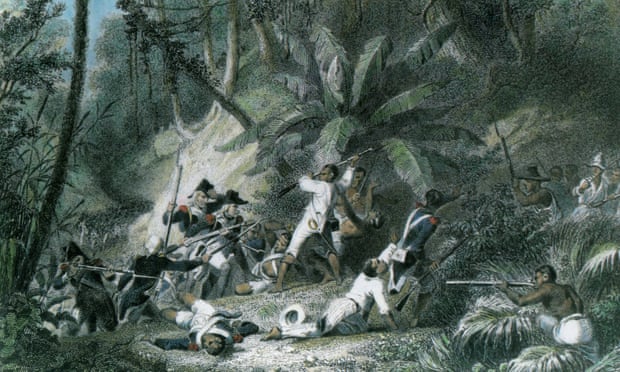
Print showing the Haitian slave revolt ‘Haitians had the audacity to carry out the only ever successful slave rebellion and declared independence from France.’ Photograph: Alamy Stock Photo

The west is built on racism; and not in some abstract or merely historical way. Genocide of over 80% of the natives of the Americas in the 15th and 16th centuries paved the way for the enslavement of millions of African people and the conquest of the world by European powers. At one point Britain’s empire was so vast that it covered two-thirds of the globe, so large that the sun never set on the dominion. The scientific, political and industrial revolutions the British school system is so proud to proclaim, were only possible because of the blood, toil and bounty exploited from the “darker nations” from across the globe. 

Colonialism left Africa, Asia and the Caribbean underdeveloped, as the regions were used to develop the west while holding back progress in what we now call the global south.

Any discussion of progress in racial equality in Britain or the rest of the world has to acknowledge the damage that the west has inflicted on the former colonies and their descendants. Malcolm X explained that “if you stick a knife in my back nine inches and pull it out six inches, that’s not progress. If you pull it all the way out, that’s not progress. The progress comes from healing the wound that the blow made”. Instead of attempting to fix the damage, we are completely unable to progress on issues of equality because countries such as Britain “won’t even admit the knife is there”.

It is the height of delusion to think that the impact of slavery ended with emancipation, or that empire was absolved by the charade of independence being bestowed on the former colonies. Descendants of enslaved Africans in the west find themselves subject to steep racial inequalities in every area of social life and are more likely to be killed by the state, as evidenced by the eruption of Black Lives Matter movements across the globe. This year marks 70 years since the partition of India and the region is still dealing with the consequences of British rule. The underdevelopment of the African continent continues with corrupt trade policies and the domination of the economy from the outside. One in 12 children dies in sub-Saharan Africa before their fifth birthday, in large part because the continent continues to be crippled by western “development”.

Make no mistake, the knife is still planted firmly in our backs and it is time we not only removed it, but healed the wound. The only way to do this is for reparations to be paid to wipe out the unmistakable debt the west owes.

Reparations have been routinely dismissed by British leaders, including David Cameron who told Jamaica that it was best to “move on” rather than expect so much as an apology. But as dismissive as Cameron was, there are plenty of precedents for the repayment of historical and economic debts.

Reparations were paid out by the British government after the abolition of slavery – albeit to the slave owners. So great was the loss of wealth from the exploitation of human flesh that the equivalent of £2bn was paid, which has now been tracked by researchers at UCL. In 1804, Haitians had the audacity to carry out the only ever successful slave rebellion and declared independence from France. One of their rewards was being forced to pay 90m French francs, from 1825, with the final payment only being made in 1947. Slavery was clearly a lucrative endeavour and one for which those who produced the wealth have never received any compensation.

It is not just governments that owe a debt; some of the biggest institutions and corporations built their wealth on slavery. Lloyds of London is one of Britain’s most successful companies and its roots lie in insuring the merchant trade in the 17th century. The fact that this was the slave trade has already led to civil action being taken by African Americans in New York. The church, many of the biggest banks, much of the ironworks industry and port cities gorged themselves on the profits from human flesh.
It is clear that it would be just to pay reparations, and it is also possible to calculate the amount that Britain and other nations owe. A lot of work has been done in the United States to determine the damages owed to African Americans. The figure owed comes to far more than the “forty acres and a mule” that were promised to some African Americans who fought in the civil war. The latest calculations from researchers estimates that for unpaid labour, taking into account interest and inflation, African Americans are owed anywhere between $5.9tn and $14.2tn.
It would not be prohibitively complicated to work out the debts owed by the western powers, or the companies that enriched themselves off exploitation. The obviousness of the issue is such that a federation of Caribbean countries (Caricom) is now demanding reparations, as is the Movement for Black Lives in America and Pan-Afrikan Reparations Coalition in Europe.

In many ways the calls for reparatory justice do not take go far enough. Caricom includes a demand to cancel third world debt, and the Movement for Black Lives for free tuition for African Americans. Both of these are examples of removing the knife from our backs, rather than healing the wound. Third world debt was an unjust mechanism for maintaining colonial economic control and; allowing free access to a deeply problematic school system will not eradicate the impacts of centuries of oppression. In order to have racial justice we need to hit the reset button and have the west account for the wealth stolen and devastation caused. Nothing short of a massive transfer of wealth from the developed to the underdeveloped world, and to the descendants of slavery and colonialism in the west, can heal the deep wounds inflicted.

"Real reparatory justice would allow the developing world to build strong economies that could eradicate global poverty"

We would need to perfect the mechanism for delivering this wealth transfer. Many governments in the developing world have as little interest in their native populations as the colonial administrations did, and sharing the money between individuals is the surest way to ensure that none of the issues are solved. But real reparatory justice would allow the developing world to build strong, sustainable economies that could eradicate global poverty. No one would need to live on less than a dollar a day and children would not die by the second. Racial equality at home would heal divisions between communities and absolve politicians from more handwringing.

There’s even something in it for the “little Englanders”. People are not risking their family’s lives crossing deserts and the Mediterranean on makeshift boats because they crave the British way of life. Migration to this bleary island would turn to a trickle if people could make a decent life in their homelands.

Of course there would be stark economic consequences for repaying this mountain of debt and no longer exploiting the developing world. But it is time we admitted that society currently works to benefit the few, and a rethink of how wealth is distributed more generally is long overdue. A factory reset of the political and economic consensus, in the form of reparations, would lead to a radically different and potentially fairer world for all.


• Kehinde Andrews is associate professor in sociology at Birmingham City University. His research specialism is race and racism and is author of ‘Resisting Racism: Race, Inequality and the Black Supplementary School Movement’ (2013) and co-editor of ‘Blackness in Britain’ (2016)

-

29/08/2017

Les Transversales en vidéo


Le meilleur moment d'août 2017...
Le sud, du soleil, des sourires, discussions et partages, voyages en trains, collines, livres et lectures :)

Grâce à Franck-Olivier Laferrère et son festival littéraire baptisé Les Transversales, nous avons parlé de Bristol et surtout de Massive Attack à Faugères, dans l'Hérault, près de Béziers et Montpellier, une région très prisée... par les Anglais! 

Un public franco- et anglo-phone, donc, pour nous écouter retracer le parcours contre-culturel de ces petits génies.

Résumé en vidéo :


Entretien avec Mélissa Chemam, autour de Massive Attack, Banksy, et la ville de Bristol...


Published on 29 Aug 2017

Entretien avec Mélissa Chemam autour de son essai "En dehors de la zone de confort", paru chez Anne Carrière: Massive Attack, Banksy, et l'histoire de la ville de Bristol !

-


Sur le livre :


Qu’ont en commun le Pont suspendu d’Isambart Brunel, l’acteur Cary Grant, le groupe Massive Attack et l’artiste de rue Banksy ? Ils sont tous originaires de Bristol, une ville moyenne de l’ouest de l’Angleterre. Une ville marquée par une histoire riche et complexe, mais encore jamais racontée ! 

Marquée par une fortune précoce liée à l’ouverture de l’Angleterre vers l’Amérique, elle devient aussi un des points névralgiques du commerce triangulaire. C’est justement cette histoire qui va nourrir, de manière inédite et radicale, la génération d’artistes éclose à Bristol à partir de la fin des années 1970.
Tout prend forme lorsque qu’un jeune graffeur anglo-italien du nom de Robert Del Naja signe du pseudonyme « 3D » sa première œuvre de rue sur un mur de la ville en 1983. Avant de fonder le groupe Massive Attack en 1988 avec les DJs noirs Grantley Marshall et Andrew Vowles, il rencontrera les pionniers du post-punk de Londres et Bristol, les passionnées de reggae antillais du quartier de Saint Pauls, puis la chanteuse Neneh Cherry et le rappeur Tricky. Creuset inattendu mêlant hip-pop, reggae, soul et guitares rebelles, le premier album de Massive Attack, Blue Lines, sort en 1991 et provoque une révolution dans la culture populaire britannique. Massive Attack devient l’incarnation du succès d’un métissage à la britannique, et parviendra à toujours se renouveler, tenter de nouvelles révolutions et durer au-delà de nombreux mouvements musicaux des années 1990 et 2000, telles la Brit Pop, l’electronica et le drum and bass.

Dans le sillage de cette créativité débridée mêlant musique, art et implication sociale profonde, naissent aussi les groupes Portishead et Roni Size, les mouvements nommés trip-hop et dubstep, et le génial Banksy, inspiré dès son plus jeune âge par les graffitis de Robert Del Naja. Depuis, la profondeur artistique de ces artistes et leur engagement n’ont fait que se renforcer, tout comme leur lien avec leur ville. Ce lien va devenir le tremplin qui les porte jusqu’à l’autre bout du monde, de l’Amérique à Gaza. Il pousse aussi très tôt Robert Del Naja à se mobiliser – contre la guerre d’Irak, pour les droits des Palestiniens ou, plus récemment, pour l’accueil des réfugiés jetés sur les routes européennes. 

Rébellion, art, musique, engagement, Bristol synthétise ainsi une autre histoire du Royaume-Uni. Une histoire qui amène au sommet des charts et sur le devant de la scène de parfaits autodidactes, et la part plurielle et afro-antillaise de la culture britannique.


-


Pour commander le livre, quelques références de libraires :

Nordest, Paris 10e, rue de Dunkerque


Libre ère, Ménilmontant 


'Day I Die' or 'Possibly Maybe'


 Hey August, sorry to say that, but I'm so ready for September... Let's get out of this surviving mode.

Busy. Lots of work. Newsroom, the weekly magazine, that news agency. But that's not enough to change anything. So much in the pipeline and still no way out just yet. Started writing again, finished proofreading my book's second version, have this film to make come to reality after months trying, and these new jobs lining in. But it is not enough. Never enough to make things turn around.

For now, just music.

--

New song:


The National - 'Day I Die'


--

Sound of the moment, dwelling in nostalgia... and realising I'm not free here...


'Possibly Maybe' - Björk


"Possibly Maybe"

Lyrics

your flirt finds me out
teases the crack in me
smittens me with hope

possibly maybe probably love

as much as i definitely enjoy solitude
i wouldn't mind perhaps 
spending little time with you
sometimes
sometimes

possibly maybe probably love

uncertainly excites me
baby
who knows what's going to happen?
lottery or car crash
or you'll join a cult

possibly maybe probably love

mon petit vulcan
you're eruptions and disasters
i keep calm
admiring your lava
i keep calm

possibly maybe probably love

since we broke up
i'm using lipstick again
i'll suck my tongue
as a remembrance of you

-


27/08/2017

Björk - 'Isobel'


The singer once explained to the BBC this song is about a young woman being from the forest and arriving in a big city, unable to adapt completely. So she feels so isolated, hence the name "Isobel", Björk said...

So she hides back in nature and trains these moths to send emotional spirits towards urban people...

The video is an illustration of that feeling:


Björk - 'Isobel'


One of the songs of the moment...

-


'Isobel'
Directed by Michel Gondry.
Written by Björk/Nellee Hooper/ Marius De Vries/
Sigurjón Birgir Sigurdsson (aka Sjón).

Published by Universal Music Publishing Ltd/Warner
Chappell Music Ltd/19 Music/BMG Music Publishing Ltd.
® 1995 BjörkOverseas Ltd/One Little Indian Records Ltd.


Brexit's disasters - One more chapter...


 So much to reflect on this Sunday...

Just posted this on social media, with this article from The Independent:


'I don't feel welcome anymore': EU citizens explain why they are leaving the UK in their thousands

Statistics show 122,000 Europeans left UK in a year in what campaigners are calling a 'Brexodus'


-


My post in response: 


Someone in the UK tells me they can read this and not feel ashamed. 

If I read that in France, I'll be so alarmed. Here we have to courage, no plan to host refugees, it is an every day heartbreak to witness. I've been to Calais, to the Italian border, I live near La Chapelle but now there are people, entire families, sleeping in my street and the two streets around. Giving food, money, clothes, as a single person is hardly helping. Promoting organisations helping isn't even enough... 

But there, on the other side of the Channel, when there is no high unemployment rate and jobs in services are at such a high level taken care of by European workers, they want to get rid of legal, educated workers because they are not "ethnically" British...? 

Can someone tell me this is worth "taking back control"? 

This referendum has exposed hatred and selfishness that have beeb there, of course, for years, but in a brutal, disastrous and dangerous way. 

I hope some voices will make themselves heard soon enough to publicly denounce this trend in this country I used to love so much...


-

Read the whole article here:

http://www.independent.co.uk/news/uk/home-news/eu-migration-uk-brexit-referendum-latest-net-fall-figures-why-racism-hate-crime-brexodus-government-a7911196.html


“I don’t feel welcome here anymore,” says Lukasz, a Polish man who has lived in the UK since he was eight years old.
“It’s like staying at someone’s house and you definitely outstayed your welcome – that’s how I feel.”
The 28-year-old is one of thousands of European citizens considering leaving Britain because of last year’s vote for Brexit.
Figures released by the Office for National Statistics (ONS) showed that 122,000 Europeans left the UK in the year to March, with the unprecedented exodus driving a drop in net migration.
Business groups have raised mounting concerns over “brain drain” from vital industries, while organisations representing EU migrants have urged the Government to offer solid guarantees over their status following Brexit.
Lukasz, who did not want his second name published, moved to London as a young child when his mother was offered a better job in the capital.
Educated in Acton and Greenwich, he now drives London buses and said he sees the UK as “home” and feels like more of a “tourist” in Poland.
“I enjoy the diversity of people and culture here – nothing and no one is the same, I have made many friends from all over the world,” Lukasz told The Independent. “I love the UK.”
In the period following the EU referendum, which saw a spike in hate crime including a student being stabbed in the neck “for speaking Polish”, he started feeling unwelcome.
“Someone sprayed ‘GO HOME’ on a Polish shop near me,” Lukasz said.
“Racism has shot up, I started noticing at work … I had few passengers arguing between each other.
“My mum had an incident where she was on a bus with my two-year-old sister, where a guy said ‘f**k off, go back to your country you b****, if not I will stab you’. 
“Maybe this guy was not mentally stable, and it was reported to the police, but in 20 years of living in the UK I never heard anyone be racist to me or my family. Since the referendum it has all come out. “
Lukasz now feels his 20 years of effort to fit into Britain’s way of life is “wasted” and is saving up to leave the country shortly before the deadline for Brexit.
He said he will miss his life-long friends, the food and the diversity of London, but fears that the UK is “isolating itself”, adding: “It’s like the world is going backwards now and everyone wants to shut its doors.”
Matteo Mencarelli, a 30-year-old Italian man, has moved from the UK to Bulgaria in the wake of Brexit.
He arrived in London for a master’s degree at the School of Oriental and African Studies (SOAS) in 2010 and has since been working at the UK office of the European Council on Foreign Relations.
Mr Mencarelli described his years in the British capital as “priceless” and a “completely different world” from his previous homes in Rome and Toronto.
Like many Europeans living in largely Remain-voting London, he was shocked by the referendum result.
“Perhaps my friends, colleagues and I were too naive and didn’t think it would actually happen but once it did, it had a huge impact on us,” he said. “For the first time we felt unwelcome here.”
Mr Mencarelli said the vote to leave the EU acted as a “catalyst” for him to pursue a career working for international organisations in the Middle East and is planning his future while living with his partner in Sofia.
“I miss living in London and I am extremely concerned for its future,” he added.
“I am hopeful that once the dust settles and a reasonable deal is struck with the EU, freedom of movement will be preserved and us Europeans will still be able to freely work and live in the United Kingdom. I do hope to be able to move back in a few years.”
Eva Scheffer, a Dutch aid worker, has already left the UK because of the potential impact of Brexit and now fears for her friends.
“I was offered a job in my field in the Middle East, and the uncertainty of whether or not I would be able to build a life in the UK after Brexit was definitely part of the decision to accept,” the 29-year-old said.
“I am very worried for my friends who are still there, both EU citizens and UK citizens. 
“The EU citizens are in a very insecure position at the moment, as most of them haven’t been there for five years, so might be told to leave after Brexit – the same situation I faced when I was there. 
“For UK citizens, especially many very international oriented ones, Brexit will cost them opportunities to work and study abroad.”
ONS figures show the vote to leave the EU is having a dramatic effect on migration even before any new laws are introduced.
Net migration has fallen by a quarter to 246,000, while EU net migration was down 51,000.
The ONS said the change was mostly caused by plummeting arrivals from the EU, as the number of European citizens leaving Britain rose by 33,000.
“These results indicate that the EU referendum result may be influencing people’s decision to migrate into and out of the UK, particularly EU and EU8 citizens,” said Nicola White, the head of international migration statistics. 
“It is too early to tell if this is an indication of a long-term trend.”
Seamus Nevin, the head of employment and skills policy at the Institute of Directors, said the exodus could cause an “acute labour shortage” in vital industries. 
But the Government is continuing plans to cut net migration to a target of 100,000 a year and said it was “encouraged” by Thursday’s figures.
“There is still more work to do to bring net migration down further to sustainable levels,” said immigration minister Brandon Lewis. 
“People who come to our country to work bring significant benefits to the UK, but there is no consent for uncontrolled immigration.”
Ian Murray, the Labour MP for Edinburgh South, said the UK was facing a “Brexodus” that would damage the economy, universities and public services.
“When EU nationals with every right to be here are being sent letters telling them they will be deported, it is small wonder that increasing numbers of them are choosing to move away from Britain,” he added, referring to a Home Office blunder that saw 100 Europeans sent deportation notices “in error”.
Campaign group the3million, which represents EU citizens in the UK, said it was “little wonder” that so many were fleeing Britain.
“All we want is the assurance that we can continue our lives here as normal after Brexit,” added co-chair Nicolas Hatton.
“The UK Government must strike a deal with the EU which guarantees EU citizens’ current rights in full, permanently under the ECJ, and independently of the main Brexit agreement.
“Only then can we have the certainty we need that our future is in the UK, a country we love and which we want to continue to call home.”
-
Are you considering leaving the UK because of Brexit? Contact us by emailing lizzie.dearden@independent.co.uk


"The essay is powerful again. We’re in a golden age"


 I cannot say I'm not overwhelmed with joy to read this after a very saddening year for my experiencing of the publishing world...


Rebecca Solnit: ‘The essay is powerful again. We’re in a golden age’

The US writer on her new collection of essays on ‘further feminisms’, the Trump ‘horrorshow’, and the joy of being an aunt

Sunday 27 August 2017


By her own account, the writer Rebecca Solnit has never been an optimist. But this is not to say that she isn’t hopeful. “An optimist thinks everything will be fine no matter what, and that justifies doing nothing,” she tells me, just back from her early morning row in San Francisco bay. “But hopefulness as I define it means that we don’t know what is going to happen, and in that uncertainty there is room to act.
Action, moreover, may take many forms in this, the age of Trump, some of them very subtle. “How the American public responds to this unprecedented crisis has everything to do with what happens [next], which is why I feel like my job is trying to remind people we do have [some] power,” she says. “I see the well-justified fear among immigrants, trans people, Muslims. But I also think this will end badly for the administration, which is in free fall. He’s freaked out. He’s thrashing in panic.”
Her voice, which sounds almost merry, drops a little. “To use a Clockwork Orangeword, this is a horrorshow.”
Such hopefulness is not only a matter of temperament. How could Solnit fail to be encouraged by the fact that, seemingly against the odds, the essay has made a surprise return to the near-centre of intellectual life, particularly as it is lived online? However much she dislikes the narrative that has her toiling away in obscurity “knitting socks for wild geese in my lean-to on the prairie” until 2008, when her piece Men Explain Things to Me suddenly went viral – “I was plenty visible before,” she writes to me in an email the day after we speak via Skype – it is an undeniable truth that she is now more in demand than ever. “When I started [Solnit is 56], the essay was belles-lettres, decorative. Essays by women, particularly, tended to be treated as memoir even when they were not. Now they’re seen as powerful and compelling again. We’re in a golden age.”
Her work has an impact she could once have only dreamed of. Last May a piece she wrote about Trump for Harper’s – “once upon a time, a child was born into wealth and wanted for nothing” – had a million hits online in just three days.
Solnit’s latest collection of essays, The Mother of All Questions, works as a companion to Men Explain Things To Me, the slim volume that preceded it in 2014 (Solnit did not invent the term mansplaining, but having been coined shortly after this book’s title essay appeared, it will now forever be associated with her name). Mostly, the new book, subtitled Further Feminisms, is about violence against women, and the various forms this takes, including the many ways in which they are silenced. But there are two essays involving books, among them 80 Books No Woman Should Read, Solnit’s response to a notorious (and notoriously male) reading list put together by Esquire magazine; a piece about the 1956 movie Giant, starring Elizabeth Taylor; and, finest of all, the title essay, a deft and quietly furious polemic that chips away once again at the idea of motherhood as the sole key to feminine identity (Solnit, who has never married, is childless).
Advertisement
“Yes, the having-children dilemma,” she says, giving the finger to an imaginary interlocutor. “It’s about what makes a worthwhile life. The person who asks you that question – why don’t you have children? – doesn’t want to know you more deeply. In fact, it’s not a question. It’s an accusation. What they’re saying is: I’ve judged you, and found you wrong, weird, insufficiently feminine. What’s so maddening is this assumption that children fulfil a woman – as though we’ve never seen an unhappy mother. It’s the same with marriage. Guess what? There are unhappy marriages: I even saw a movie about one, once. These people see love as a commodity that is there to be gathered. It’s a very aspirational, even capitalist, view of love.”
She likes to tell her friends with children that she’s here to “de-nuclearise” the family, the idea being that in the 21st century, just as in centuries past, aunts and uncles, cousins and friends matter just as much (she loves being an aunt).
Isn’t it wearying still to be dealing with this stuff? Mightn’t we have expected more progress by now in the matter of equality? “I do come up against that frustration,” she says. “And yes, it would have been wonderful if as soon as we introduced the radical idea that women are people and have inalienable rights, everyone had just agreed and we could have moved on.
“But the patriarchy is rooted in the Old Testament: the fact that it didn’t get dismantled in a few decades doesn’t dismay me. When I look at how much things have changed since my birth and today, it’s pretty amazing.”
A new generation of women is, she believes, simply not going to take it any more when it comes to rape and gender violence. Sure, Silicon Valley was “built by white men in their own image”; it dismays her that these same men talk in terms of what women can do to avoid threats online rather than dealing with the attacks themselves, as if the victims were responsible (a state of affairs that harks back to the way rape used widely to be regarded). Nevertheless, she thinks of social media as “a Greek chorus of a million women reinforcing the message that we are not going to let this [violence] be erased or excused”.
Bewitched by stories, Solnit wanted to be a writer almost from the moment she learned to read. The third of four siblings – she is the only girl – she grew up in San Francisco. Her parents were leftists who marched against the Vietnam war, but her father, a town planner, was violent – she has written that he once woke her in the night by throwing chocolate milk in her face – and her parents eventually divorced, an event that cast a prolonged shadow over her teenage years.
When she left school she enrolled at the American University in Paris, after which she studied English at Berkeley, California, where she also enrolled as a graduate journalism student: “Journalism was the only model for nonfiction then, and I still feel lucky that I didn’t end up in some MFA [master of fine arts] programme with a bunch of white kids writing memoirs about their suffering.” Afterwards she worked as an art critic until, under the influence of her brother, David, with whom she first visited the Nevada nuclear test site, she gradually became more interested in green issues.
Her frame of reference grew ever wider, and her writing more singular. Among her books are River of Shadows, an award-winning study of the pioneering photographer Eadweard Muybridge; Wanderlust: A History of Walking; and The Faraway Nearby, which partly tells the story of her mother’s decline into Alzheimer’s and Solnit’s efforts to reconcile with her (their relationship was difficult, the mother having been envious of the daughter), but whose broader themes, as explored in essays on such subjects as Iceland and Mary Shelley’s Frankenstein, have to do with questions of empathy and human solidarity.
“Lots of people want to be me now,” she says. “But they didn’t 15 years ago, when I was paying my dues. I lived like a graduate student for a long time after I was one, and I still have fairly frugal habits.” Still, even in the leaner times, she never thought of giving up. “I’m an introvert who loves staying home alone, and it wasn’t as if I was yearning to be super-famous. I didn’t want to be the Stephen King of feminist prose style, or something.”
Grateful as she is to those who read her, she now worries about burnout: “So many people want so many things from me, and that makes it hard to clear the space to be deeply thoughtful, to have the unbroken time in which the best writing takes place.”
Carefully, she lifts a hank of her long hair and pushes it over her shoulder. “It’s not that I feel sorry for myself. These are Cadillac problems. But I’m not sure what great rebellion will give me the time in which I might do pretty good work.” She sounds almost wistful. “In a way, my golden age was 20 years ago, a young woman with a pick-up truck, travelling across the American west, participating in land right struggles. There was no internet, which gave me a certain quality of time. The writing was going somewhere, and I was making a modest living. It was a great adventure.”
-
 The Mother of All Questions by Rebecca Solnit is published by Granta (12.99) on 7 September. To order a copy for £21.25 go to guardianbookshop.com or call 0330 333 6846. Free UK p&p over £10, online orders only. Phone orders min p&p of £1.99

-

Link: https://www.theguardian.com/books/2017/aug/27/rebecca-solnit-interview-essays-feminism-trump-the-mother-of-all-questions